
2004-My brother was taken from me. I will do everything in my power to bring the cowards to justice.
Month: March 2013
There’s A Hangin’ Comin’
In Nevada, where highwaymen were active, Egan, Hamilton, Treasure City and other towns organized protective associations with written rules. Aurora formed one in 1864 after about thirty citizens had lost their lives by violence in three years. The vigilantes caught four of the outlaws, built a scaffold in front of the armory and placed four nooses. When the governor heard what was going on and wired an inquiry, the United States marshal replied, “Everything quiet in Aurora. Four men to be hanged in fifteen minutes.” Then, as a crowd watched, the four stretched rope. At Dayton, Carson, Virginia City, and elsewhere, vigilance committees, remained at worked for a decade or longer. In Colorado, outlaws often were sent to the next world in economy-sized packages. Near Sheridan a committee strung four desperadoes from a railroad bridge. On the Denver and Cheyenne road to the north, seven bandits were dropped from another trestle. Denver miners formed a people’s court in 1859 and hanged from a cottonwood a prospector who had killed another for his gold. The next year the same court strung up four killers. The most remembered was James Gordon, who had killed a man for refusing to drink with him at a bar. His hanging was witnessed by several thousand, whom the mounted Jefferson Rangers kept in order. Most of the Colorado mining camps organized people’s courts in the 1860’s. One historian noted that such courts “were about the only ones thoroughly respected and obeyed.” Their proceedings were open and orderly, he said. “They approached the dignity of a regularly constituted tribunal. The prisoner had counsel and could call witnesses if the latter were within reach. 
This Day…
Singing Cowboys
Once in San Antonio, recalls Colonel Jack Potter in Floyd Streeter’s The Kaw, he applied to Ab Blocker for a job. The famous trail boss asked him: “Can you ride a pitching bronc? Can you rope a horse out of the remuda without throwing the loop around your own head? Are you good natured? In case of a stampeded at night, would you drift along in front or circle the cattle to a mills? …Just one more question: can you sing?” As Jack Potter learned to his dismay, the cattle couldn’t stand his singing. Every time he went on guard and san, the cattle would get up and mill around the bed ground. But as soon as Ab Blocker began singing, the cattle commenced to lie down. Potter was fired. Another old-timer , Edward Charles Abbott was more successful. He could not only sing but also make up verses – “anything that came into your head.” He had a hand in composing the Ogallaly Song”, as he tells in We Pointed Them North. This was “just made up as the trail went north by men singing on night guards, with a verse for every river on the trail,” starting form the Nueces in Texas and ending with the Yellowstone in Montana. “When I first heard it it only went as far as Ogallaly on the South Platte, which is why I called it the Ogallaly song.” Considering that so few cowboys could sing and that it wasn’t the quality of the singing that counted – just the reassuring sound of a familiar voice or even a humming or whistling or yodeling – it is a wonder that cowboy songs are as good as they are. As a matter of fact, most cowboy songs, especially cowboy ballads, were written by known cowboy poets, to older tunes. Everyone sing along with me “As I was walking one morning for pleasure, I spied a young cow puncher riding alone, his hat was thrown back and his spurs was a jingling as he approached me a singing this song. Whoop-ee ti-yi-yo, git along little dogies, it’s your misfortune and none of my own. Whoop-ee ti-yi-yo, git along little dogies, for you know Wyoming will be your new home.” 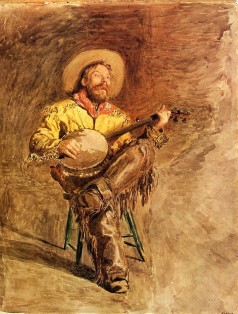
This Day…
Necktie Parties
In many a mining camp and cattle range, vigilantes did more to drive out desperadoes than did elected officials. The committees of vigilance were formed because there was no other effective action against crime. The vigilance committees of the West differed from the lynchers of the South in that, instead of circumventing the law, they enforced it. They had a large hand in making the frontier communities from anarchy and bridged the gap between lawlessness and the formal administration of justice that came later. Frontiersmen who found a horse thief or two dangling from the limb of a tree did not automatically conclude that justice had been violated. Action by the vigilance committee not only was swifter and surer than that of some of the feeble courts but often was fairer. Proceedings of these committees were informal-more so in some instances than in others. But the committees were organized only after conditions had become desperate, and the men they punished were usually those whose guilt was clear beyond doubt. If this were the Old West I know exactly who I’d like to invite to a necktie party
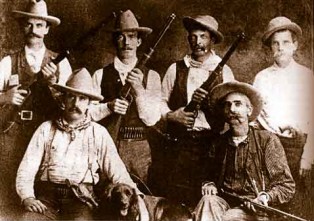
The Rosebud Vigilantes were one of the most notorious vigilante groups of the Old West.
Bedside Book of Bad Girls
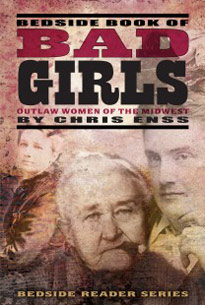
Award-winning author Chris Enss goes behind the lipstick and petticoats to reveal the real women who outran the law and upended gender stereotypes across America’s Heartland in her latest book Bedside Book of Bad Girls: Outlaw Women of the Midwest.
Readers will meet Flora Mundis, expert horse thief and jail breaker; murderess Elizabeth Reed, the first and only woman hanged in Illinois; Belle Black and Jennie Freeman, who shot their way through hold ups and alongside the men of the Wyatt-Black Gang; and Anne Cook, bootlegger and madam, who killed her own daughter in cold blood.
Illustrated with historical photographs, Bedside Book of Bad Girls: Outlaw Women of the Midwest uncovers the true lives long veiled by the glamour of dime novels and sensational tabloid accounts. Cozy up (if you dare) with these women, both sensuous and sinister, as they rampage across the Midwest.
This Day…
The American Gold Rush & Seeing the Elephant
This bit of information about the California Gold Rush is for all the students studying this historical event and email me to find out about its significance. From all parts of the United States, from Latin America, and from China, they all flocked to California. Those who made the 18,000-mile sea voyage around South America were called Argonauts. The steamer Californian brought the first 265 into San Francisco Bay on January 28, 1849. Others took a ship to Panama, braved their way across isthmus jungles packed with snakes and mosquitoes, and boarded another boat for San Francisco. Whoever made it to California had “seen the elephant.” Everybody who was hunting for gold, and that was most able-bodied men and a few women, were called 49ers. Instant riches lying everywhere was the definitive image of the gold rush. A “new Eldorado” was waiting a continent away. Just walking by a stream, a person could net $24 worth of gold in a few minutes. The average miner might sock away $1,000 a day. One man found $9,000 in gold after lunch one afternoon. A rainy season greeted the 30,000 gold seekers who came overland in the spring in 1849. An outbreak of cholera claimed 5,000 of the prospectors who worked the fields that year. The town of Marysville recorded 17 murders in one week. One out of every five who came to hunt for gold was dead within six months of his or her arrival. Still, they came in droves. Five hundred shiploads arrived in 1849, filled with dreamers chasing visions of golden nuggets.
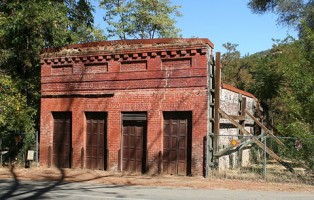
A building in Coloma, California, the site where gold was discovered.