
Many popular dime novels of the Old West were written about soiled doves. Author Metta Victor was one of the most famous dime novelist of her day. Readers couldn’t wait to find out what happened to Gold Rush harlots like Eleanora Dumont and Stagedoor Angie. Metta kept thousands of pioneers entertained with her work. At the end of a long and difficult day traveling from Independence, Missouri to points West, invading a wild land and homesteading an uncertain territory, women of all ages escaped their hard pioneer life reading Dime Novels. The mustard colored, paperback books provided the tough female stock of the 1860s with romantic, spellbinding tales of courageous women who braved the elements to find true love. Author Metta Victoria Fuller Victor was one of the most successful Dime Novel writers in the 1860s. Over her forty year career she penned more than 100 stories for the publishing house Beadle & Adams. She entertained hundreds of thousands of fans. Among her most loyal readers included political activists, inventors and the 16th President of the United States. She was born on March 2, 1831 near the town of Erie, Pennsylvania. Her parents Adonijah and Lucy Fuller, moved Metta and their four other children to Ohio in 1839. It was there that eight year-old Metta began writing. While attending a female seminary she crafted her first story entitled The Silver Lute. The well written story appeared in the Wooster Gazette in 1844. Metta was 13 years-old. Two years later a Boston printing company published her romantic novel, The Last Days of Tul; A Romance of the Lost City of Yucatan. The successful book centered around a pair of missionaries who fall in love while working in Mexico’s Yucatan Peninsula. The charm and maturity in which Metta wrote captured the attention of many well respected editors who gave her the chance to write additional material. N.P. Willis and George Morris, editors of the New York Evening Mirror and the New York Home Journal, published her next two stories and a serial entitled The Tempter. The serial appeared in the New York Home Journal and was circulated throughout the United States and Great Britain. British readers thought the story was a continuation of a popular book written by Reverend George Croly entitled Salathiel. The books main character, Salathiel, led the mob which promoted the death of Jesus, in return for which he was condemned to the misery of the undead state. Metta’s The Tempter was a best seller in England and was hailed as “a fitting conclusion to the life of an evil betrayer.” In addition to being prolific, Metta was versatile. After tackling romance and Biblically themed stories, she ventured into poetry. In 1850, Metta and her sister, Frances coauthored a book called Poems of Sentiment and Imagination. The work was inspired by Metta’s feelings for the man she had just married, a Doctor Morse from Ypsilanti, Michigan. From 1851 to 1856, Metta wrote four more books and contributed to the Saturday Evening Post and Saturday Evening Bulletin. Her work always contained characters wrestling with a moral dilemma and she was criticized for what some readers called “heavy handed sermonizing.” In time she learned to present her ideals in a less forceful manner and was then praised as a “writer with significant influence.” Her most important book during this five year period was a temperance novel entitled The Senator’s Son. The work was extremely popular and was reprinted ten times. Personal information on Metta is slim. What exactly happened to her first husband, whether he died or they divorced, is not known. But by the summer of 1856, Dr. Morse was no longer a part of her life. In July of that year she married a fellow writer named Orville J. Victor. Orville was the editor of the Sandusky, Ohio Daily Register and the Cosmopolitan Art Journal. In 1858, the pair moved to New York to further their writing careers. Both contributed to various periodicals including the New York Weekly. The editors of the paper were so taken with the Metta’s style they offered her a five year contract worth $25 thousand dollars. Metta managed to fulfill her obligation to the paper while raising a family of nine children and maintaining a home and marriage. Metta’s association with the publishing house of Beadle & Adams began in 1859. Already familiar with her background, editors Irwin and Erastus Beadle made her the editor of a weekly magazine entitled The Home. Metta contribute numerous articles for the periodical and proved her range by providing the publication with a series of books containing recipes and cooking tips. She continued to add to her repertoire, but chose to use a number of pseudonyms on each of the books she completed. Among the nom de plumes was Louis Le Grande, M.D. and Mrs. Mark Peabody. On August 1, 1860, Beadle & Adams released Metta Victor’s first romance novel. Alice Wilde: The Raftsman’s Daughter, the heart wrenching exploits of a rugged woman starting a new life out west, was read by thousands. Fans of the genre and Metta’s writing style eagerly anticipated her next book. The Backwood’s Bride was quickly rushed to the printers and released three months after The Raftsman’s Daughter was made available. Metta’s follow up to the Backwood’s Bride entitled Myrtle, the Child of the Prairie, came out in December that same year. Young women responded favorably to all the romantic novels offered by Beadle & Adams, but had a particular fondness for Metta Victor’s work. She was cleaver and skillful and frequently sprinkled her stories with a dash of humor. Whether her books listed her given name or one of the many pseudonyms she used specifically for her romantic novels, her work was easily identified. In 1861, Metta’s husband joined the editorial staff at Beadle & Adams. Orville encouraged his wife to continue working for the company, considering himself to be her most devoted reader. Shortly after he took the job with the profitable publishing house, Metta’s antislavery novel Maum Guinea was released. Orville felt the book was her best work yet. Maum Guinea was as popular as Uncle Tom’s Cabin and praised by President Abraham Lincoln and Congressional Clergyman, Henry Ward Beecher. Metta followed the successful Maum Guinea with a similarly themed piece entitled The Unionist’s Daughter; A Tale of Rebellion in Tennessee. In 1863, she penned another Dime Novel romance entitled Jo Davies’s Client; or Courting in Kentucky. Not unlike The Raftsman’s Daughter, Jo Davies’s Client was a best seller. By the age of 33, Metta Victor had achieve notoriety as an author of romance, social injustice, poetry and humor. All that was left was mystery. When Beadle & Adams published her work The Dead Letter in 1865, she secured her place in American literary history. The Dead Letter is credited as the first full-length detective novel written by a woman. Metta’s combination of gothic horror elements and suspense made The Dead Letter an original and unique read. In early 1865, Metta took a short departure from mystery and romance to write a book on housekeeping. The Housewife’s Manual included chapters on cleaning and renovation, sewing, cultivating plants and flowers, caring for birds and household pets. By the end of the year however, she returned to the subject of love and penned The Two Hunters; or The Canon Campus, A Romance of the Sante Fe Trail. Metta Victor authored more than 150 books and articles and before her death in 1885 she was working on yet another novel. Cancer claimed her life when she was 54 years-old. She passed away at the family home in Hohokus, New Jersey.
Month: August 2012
This Day…
Read Em’ Cowgirl
Joyce Carol Oates once wrote, “Reading is the sole means by which we slip, involuntarily, often helplessly, into another’s skin, another’s voice, another’s soul.” I hoped to be able to encourage young people to want to read at this latest book event in Missouri. I was pleased when a mother approached me after the talk to let me know how excited her daughter was to read the western books I’ve been fortunate to pen. Her daughter won a library of my books and a set of saddlebags at the Saddlebags and Stories signing in Norborne, Missouri. I’m happy that the soon-to-be sixth grader has an interest in pouring over tales of the accomplishment of the brave women heading west in the mid-1800s. It makes being a writer a rewarding venture. On the other hand being at the location where my brother Rick once lived was heartbreaking. I still miss him. I guess that pain will always be.
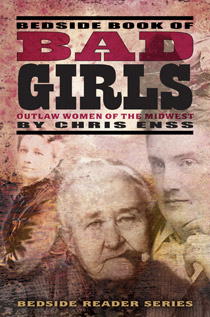
Bedside Book of Bad Girls
This Day…
Unsavory Old West Profession
The Victorian posture was one of stern resistance to human weakness, in particular to carnal pleasures. But the business of vice was extensive enough in Old West cities of the 1880’s to suggest the devil was not in limbo. Respectable standards prescribed laws against prostitution in varying degrees in stringency, but these were not largely enforced as the more urgent demands of lust and money proved irresistible. In the larger cities such as Denver, Colorado and San Francisco, California, prostitution entrepreneurs offered services for all classes and pocketbooks, from palatial bagnios and brownstones to dives in the slum areas. It was a commercial trade, practiced with remarkable openness. The stock solicitation “Hello, dear, won’t you come home with me?” astounded visitors in San Francisco where the girls were particular brazen. Sex had become a commodity; as America’s first woman doctor, Elizabeth Blackwell, observed; “Shrewdness and large capital are enlisted in the lawless stimulation of the mighty instinct of sex.” Police protection cost the bordello operator an initiation fee of $300 to $500 and $30 to $50 monthly thereafter, traditionally collected by the precinct captain. The enormous number of girls involved in interesting counterpoint to the proclaimed rectitude of Victorian life. In 1870, when it’s population was more than 192,000, San Francisco had an estimated 7,500 prostitutes. Prostitution’s unsavory side effects were often more damaging than the vice itself, as the bordellos attracted and encouraged all manner of criminals who found in them a harvest of easy victims. For more stories about the soiled doves of the Old West visit www.chrisenss.com.
This Day…
The Last Book
The forecast for paperback and hardcover books isn’t good. According to business analysts and stock market speculators, along with cues from the current economic temperature, books will soon be going by the way of vinyl. Ebooks, APPs, Kindles, IPADs, all manner of electronic gadgetry will be taking the place of a book you can hold in your hand, a book you can smell, touch, tuck under your arm or tuck away on a book shelf. Books will become dinosaurs and publishing houses will be no more. It is with all that in mind that I have come to the conclusion that once I live up to all the contracts for the books I want to write I will be retiring from this particular field. The last book I will pen will be about my brother Rick. The Plea will contain the story of what happens to a man and his siblings when he is falsely accused of a crime. It will include letters of confessions from the so-called victim, photographs, interviews with lawyers, politicians, journal entries, live film footage and much more. I will be stepping aside from the work I have been doing in the fall of 2016. I’ll write more about what lies ahead for me later, but for now I will continue with the subject for this month, prostitution in the Old West. This story and many others just like them are found in the book Pistol Packin Madames. “Kate Horony removed the crystal stopper from a glass container filled with brandy and poured herself a drink. The svelte, well-dressed nineteen-year-old took a big gulp, and then poured another. She slammed the brandy back and trained the derringer in her right hand on a man’s body that was stretched out before her. Jonas Stonebreak was lying in a pool of blood, with a bullet in his upper torso. He stirred a bit, struggling to lift his head off the floor. He glanced around the bedroom at the Tribolet parlor house until his blurry eyes came to rest on Kate. She stared down at him, her eyes filled with contempt. The lifeless frame of Madam Blanc Tribolet was slumped in a chair next to Jonas. Kate motioned to the dead woman with her empty glass. “You had no cause to kill Blance,” she told him. “You’re a miserable cur.” She blinked away a tear and poured another drink, while Jonas tried to sit up. “She was asking for it,” he offered, spitting blood. “No she wasn’t,” Kate responded, pointing the gun at his head, “But you sure as hell have.” She squeezed the trigger, firing off a shot that lodged a bullet in Jonas’s forehead. He collapsed in a heap. Kate drank down another brandy before pocketing her gun and leaving the room. Blance Tribolet was the first madam Kate Horony, better known as Big Nose Kate, ever worked for. She was more than an employer to the young woman; she was a friend and surrogate mother as well. The revenge Kate sought for the murder of her benefactress was one of many defining moments in the life of one of the West’s most notorious prostitutes.” God to www.chrisenss.com to read more.
Shane
This is by no means a conventional giddyap-oater feature, being a western in the truer sense of the ranking with some of the select few that have become classics in the outdoor field. Director George Stevens handles the story and players with tremendous integrity. Alan Ladd’s performance takes on dimensions not heretofore noticeable in his screen work. Van Heflin commands attention with a sensitive perfpormance, as real and earnest as the pioneer spirit he plays. The story takes place in Wyoming, where a group of farmer-settlers have taken land formerly held by a cattle baron. The latter resents this intrusion on the free land and the fences that come with the setting down of home roots. His fight is against Heflin cliefly, who is the driving force that keeps the frightened farmers together. Just when it seems the cattle man may eventually have his way, a stranger, known only as Shane, (a name that is repeated one too many times during the film in my estimation), rides on to Heflin’s homestead, is taken in and becomes one of the settlers, as he tries to forget his previous life. Jean Arthur plays the role of Heflin’s wife, who is attracted to the stranger. A standout is the young stage actor Brandon deWilde, who worships Shane. Jack Palance plays a hired killer in the film and he is exceptional.
This Day…
1895-Zip Wyatt was caught sleeping in a cornfield near Skeleton Creek, Oklahoma by a posse member who gut shot him and shattered his pelvis before he was disarmed and taken into custody. (Look for the story of Zip Wyatt’s female associates in the book The Bedside Book of Bad Girls coming to book stores everywhere in October).