
1783-A Congressional committee issues a report on the status of the Indians, and urges a meeting between the Indians and the new government; this does not happen.
Month: October 2012
The Celebrated Spoiled One
Pocahontas, a nickname meaning “little spoiled one,” was born Amonute, daughter of Chief Powhatan in 1595. She was an extrovert from a young age, inquisitive and naturally good-natured. At eleven years old she played a minor role in securing John Smith’s survival. Later she was the go-between for trade among the settlers and Indians bartering at Jamestown. The fictionalized version of her love affair with Smith may, in fact, bear some truth, but in a much more disturbing way for our modern sensibility. Today, a thirty-year-old having sex with a preteen in pedophilia and a crime. But, in that era, intercourse with non-Christian pagans of any age was not considered wrong. Pocahontas was known to have “long, private conversations” with Smith during her frequent visits to the Jamestown complex, yet the true dimensions of these encounters are a matter of conjecture. A few years later she was betrothed to the older Englishman John Rolfe, only after she agreed to be baptized in 1614. Two years later Rolfe took her to London, where she was received as a celebrity, billed as a real live Indian princess by high society, and held an audience with King James. In 1617 she believed the smoky air of London was the cause of her coughs and bouts of weakness and wished to return to the forests she had known. Along with Rolfe she boarded a ship to return to Virginia, but the vessel only made it to the end of the Thames River before it turned back. Pocahontas died in London at age twenty-two of disease called the king’s evil, a form of tuberculosis characterized by swelling of the lymph glands.
This Day…
Being First
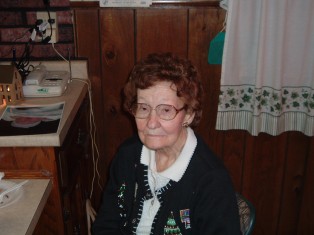
Mary Ragsdale
Chris Enss Quoted in the Dodge City Globe “Dodge City set to figure prominently in new movies”
Chris Enss Quoted in the Dodge City Globe “Dodge City set to figure prominently in new movies”

Chris Enss was interviewed by the Dodge City Globe about the soon to be developed movie “Thunder Over the Plains” based on “Thunder Over the Prairie” by Chris Enss and Howard Kazanjian.
Download Dodge City Globe PDF
Jesse James
Jesse James, notorious train and bank bandit of the late 19th century, and an important figure in the history of the midwest frontier, gets a drastic bleaching in this film made in 1939. Script by Nunnally Johnson is an excellent chore, nicely mixing human interest, dramatic suspense, romance and fine characterizations for great entertainmet. Tyrone Power capably carries the title spot, but is pressed by Henry Fonda as his brother. The story follows historical fact close enough with allownace for dramatic license, hitting sidelights of James in his brushes with the law. The initial train holdup is vividly presented, with all other robberies left to imagination. The picture starts with a foreword on the ruthless manner in which railroads acquired farms for right-of-way through the midwest.
This Day…
A Pioneer with Vision
Helen Keller was a pioneer for rights of the disabled. In 1891 when she was nineteen months old, she fell ill from scarlet fever, which left her not only blind but deaf as well. At seven years old she was taken to Alexander Graham Bell, an expert on hearing and speech, who encouraged her parents to enroll Helen in the Institute for the Blind in Boston. There, in her frustration to communicate, she would seem wild, thrashing about and was at first considered to have no mind capable of understanding – in short, an imbecile. Helen’s father found a live-in private tutor, twenty-year old Anne Sullivan, who taught Helen how to finger-spell, as Braille was then called. She learned the code for W-A-T-E-R, but never knowing light or sounds, Helen couldn’t correlate the words to the liquid these letters spelled. Anne thrust Helen’s hand under water flowing from a pump, followed by the letters for water tapped into her hand. Suddenly Helen realized that the cool substance coming from the pump had a name and quickly learned how to read, write, and eventually speak. With Anne Sullivan’s continued friendship, Helen became the first blind and deaf person to graduate from college in 1901. In 1915 the two women founded Helen Keller International, a nonprofit organization that worked to prevent blindness. Not only did Helen become an international speaker, writing twelve books, she also starred in a silent movie and tried her hand at a vaudeville tour. She died of Ondine syndrome during a nap in 1968 at the age of eighty-seven. Anne Sullivan also had a visual impairment, caused when doctors rubbed cocaine on her eyes before performing a procedure to treat pink eye when she was a child. By 1935, a year before her death, she was totally blind. She died at age seventy of coronary artery disease.
This Day…
1871-The gambler and saloonman, Phil Coe, got to whooping it up with about fifty texas cowboys in Abilene, Kansas when he confronted Coe fired on Wild Bill Hickok but missed twice and Hickok gutshot him. Just then Deputy Mike Williams rushed onto the scene to assist Hickok but Hickok mistook him for an adversary and killed him with two headshots. Williams was the last man that Hickok ever fired a gun at. Coe died in agony three days later.
Women of Invention
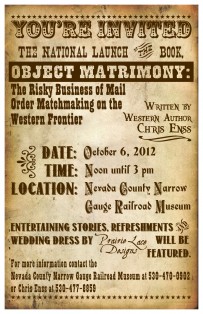 The first woman to be awarded a Nobel Prize was Marie Curie in 1903 for Physics. She became the only woman to receive two Nobel Prizes, when she was awarded the prize for Chemistry in 1911. Her work with radiation and the discovery of the elements radium and the polonium opened the doors for many advances in science and medicine. Soon after Madame Curie won the 1911 prize, she was hospitalized for depression and kidney problems and suffered from ill health the remainder of her life. The dangers of radiation were not understood and she often worked unprotected with radioactive substances. She died in 1934 at age sixty-six of aplastic anemia, a bone marrow condition caused by radiation. In 1938 Marie’s daughter, Irene Joliot-Curie, won a Nobel Prize for Chemistry for her work with neutrons, setting the stage for nuclear fission. She died of leukemia at age fifty-eight in 1956 as a result of being exposed to radiation while assisting her mother years before. Tomorrow is the big launch for the book Object: Matrimony. Everyone is invited to attend the festivities held at the Railroad Museum in Nevada City from noon to 3 p.m.. Register to win a beautiful wedding gown by fashion designer Christian Michael Goodwin. The gown was inspired by the dresses the mail-order brides of the Old West wore, but has a contemporary flair.