
1865-Norrato Ponce killed a man named Joy in a dispute over cards at the Governor’s Saloon in Hayward, California. Later in the month he escaped into the night near Livermore after being surprised by a posse and hit with a shotgun blast and three pistol slugs. He was finally run down and killed by Sheriff Harry Morese in Pinole Canyon.
Month: October 2012
Freedom Fighter
 Mary Ann Shadd Cary (1823-1893) was an educator and abolitionist. She was the first black woman to graduate from Howard University Law School and the first black woman to vote in a federal election. She helped President Lincoln enlist black men to fight in the Union and her house was frequently a safe haven in the Underground Railroad for slaves fleeing the South. After the war she became a school principal, and then a lawyer in Washington, D.C., at the age of sixty. She died in 1893 at age seventy from heart failure, with an estate valued at $150.
This Day…
1876-A patrol led by Texas Ranger Sergeant John Armstrong closed in on an outlaw camp at Espinoza Lake near Carrizo, Texas when the smoke cleared the rangers had killed three of the four outlaws in that camp and the fourth was hit four times. In seperate shootouts that night Armstrong’s detachement killed to other outlaws.
That Pioneering Spirit
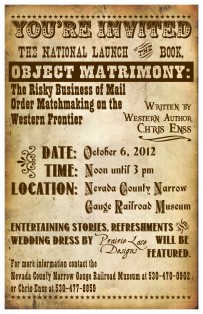
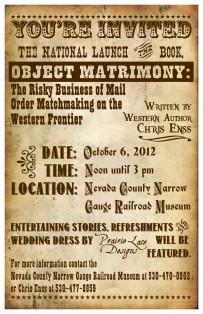 This month I’ll be focusing on tales of the brave frontier women of every profession and walks of life. Women who took on the rugged frontier to make a better life for herself and for the many thousands of women that came after her. Elizabeth Blackwell was a woman who defined the pioneer spirited. American’s first woman doctor was admitted to New York’s Geneva College in 1847 as a joke, and was expected to flunk out within months. Nevertheless, Blackwell prevailed and triumphed over taunts and bias while at medical school to earn her degree two years later. While in her last year of medical training, she was cleaning the infected eye of an infant when she accidentally splattered a drop of water into her own eye. Six months later she had the eyed taken out an had it replaced with a glass eye. Afterward, American hospitals refused to hire her. She then borrowed a few thousand dollars to open a clinic in New York City, which she called the New York Infirmary for Indigent Women and Children. She charged patients only four dollars a week, if they had it, for full treatment that might cost at least two thousand dollars a day at the going rate. During the Civil War she set up an organization to train nurses, Women’s Central Association of Relief, which later became the United States Sanitary Commission. In 1910 age eighty-nine she died after a fall from which she never fully recovered. I’m off this morning to participant in a radio program called Insight on Capital Public Radio. The place to tune to on the dial between 10 a.m. and 11 a.m. is 90.9 FM KXJZ Sacramento; 90.5 FM KKTO Tahoe City/Reno; 91.3 FM KUOP Stockton/Modesto; 88.1 FM KQNC Quincy. The is the first radio interview leading up to the launch of the new book Object: Matrimony. Hope to see everyone at the launch event on Saturday, October 6 from noon to 3 p.m.. I’ll be giving away a wedding dress designed by Christian Michael Goodwin of Prairie Lace Designs. The dress was inspired by the gowns contained in the book Object: Matrimony and is a stunning garment!