
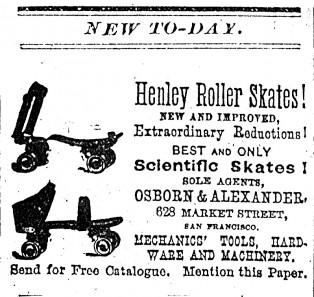
 The invention of roller skates is attributed to an unknonw Dutchman of the early 18th century, who conceived the idea of adopting ice skating for dry ground by affixing wooden spools to a supporting plate. The first skates with metal wheels were fashioned in 1763 by the Belgian mechanic and musical instrument maker Joseph Merlin. The first modern, so called rocking skates, enabling a person to move easily through alternative shifting of his weight, were patented in 1863 by the American inventor James Leonard Plimpton. Roller skates sales soared in 1865 after people witnessed the invention at work in traveling circuses. By the 1880s, nearly every city and large town had a roller skating rink. The sport was enjoyed by both men and women. I’ve been having fun with the selection of Old West ads, but want to call journal reader’s attention to the next chapter in the book The Plea. Chapter one is now available on this site. Soon the story will be transformed into a documentary.
Month: February 2013
Sacbee Gallery – At home with Chris Enss
Appropriately, the road to writer Chris Enss’ home on the outskirts of Grass Valley takes a visitor along the Overland Emigrant Trail, past Ponderosa Pines Way and Lone Star Road, and on two streets named after rattlesnakes.
Parked in the three-car garage of the 3,000-square-foot-plus house is her ride – a Ford pickup truck. Enss is a screenwriter and author of 27 nonfiction Westerns about the unheralded folks who lived, loved and died in the Old West – mail-order brides, prospectors, nurses, entertainers, soldiers. She writes mostly about pioneering women, both the innocent (“Frontier Teachers,” “The Doctor Wore Petticoats”) and the not-so-much (“Bedside Book of Bad Girls,” “Pistol Packin’ Madams”).
She also has written books about some of the Old West’s folk heroes – William “Buffalo Bill” Cody, Annie Oakley, Gen. George Custer – and less genuine but more recent Western-centric icons – Roy Rogers, Dale Evans, John Wayne. “I’m an observer of history who retells what is there,” she said modestly.
This Day…
Cooking Made Easy
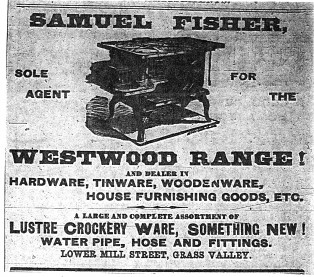 I’ve been out of the office for a few days. Glad to return to work. I have a few more Old West ads I’d like to share before I begin a series on great cowboy duos. Chapter one of the book The Plea is now available at www.chrisenss.com. I’ll be adding more to the chapter as the month goes on. And now a word from our sponsor. This ad features a monster stove I can’t imagine would even fit in a pioneer home. Pioneer women endured a lot to take care of her family. She hauled water in to the home from a nearby stream, chopped wood for heat, cleaned clothes on a washboard, and cooked meals over an open fire using heavy kettles and awkward fireplace appliances. An invention introduced in 1820 made things easier for wives and mothers and made the cast-iron cook-stove a much sought after household item. The cast-iron cook-stove simplified cooking because their stovetops were at waist level, which saved housewives from constantly stooping. It also burned one-third less wood. In the 1830s cook-stoves were reduced in price, giving every family more of a chance to own one. By the 1850s only rural families and poor Southerners continued with the old ways.