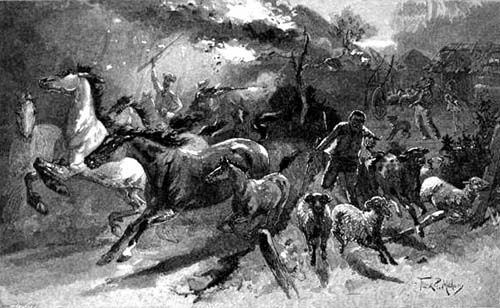
1822-William Becknell leaves from Franklin, Missouri, on what will be his second trip to Santa Fe. This time he takes 21 men and three wagons. The expeditions peioneers the Cimarron Cutoff, a shorter but much more hazardous route than the better-watered ‘Mountain Route’ of the Santa Fe Trail.
Month: May 2013
Fannie Sperry
Fannie Sperry came into this world on March 27, 1887. She was born and raised on a horse ranch in the Beartooth Mountains of Montana. She parlayed her natural easy way with horses into a lucrative career riding in rodeos and performing in various Wild West shows including Buffalo Bill Cody’s. Fannie’s parents helped mold her into a fine equestrian. They taught her how to transform horses into first-rate cowponies. She used her skill for breaking horses in her act with Cody’s Wild West Show. When Fannie joined the program in 1916, she had a number of roping and riding titles to her credit. The Women’s Bucking Horse Championship of Montana and the Lady Bucking Horse Champion of the World were two of the most prestigious. She died of natural causes on February 11, 1983 at the age of ninety-five.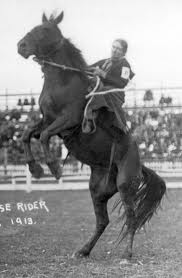
This Day…
The Sure Shot
Annie Oakley was born Annie Moses on August 13, 1860, in Drake County, Ohio. Her father’s untimely death when she was still a child forced Annie to find work to help support her seven brothers and sisters and their mother. Annie first learned to hunt with a rifle when she was eight. She used her natural markswoman ability to provide food for the evening meals. She became such a good shot that she was hired on by a merchant to supply his store with fresh game. A shooting match between Annie and Western showman Frank Butler in 1875 changed her life forever. The challenge was for each marksman to shoot twenty-five clay pigeons. Frank hit twenty-four of the twenty-five targets. Annie hit all of them. Buffalo Bill Cody hired Annie to join his Wild West cast in 1885. Annie packed the house nightly with her trick riding and trick shooting. Cody called Annie “the single greatest asset the Wild West ever had.”  Annie and her husband Frank enjoyed seventeen seasons with Buffalo Bill’s Wild West Show. She retired from the program in 1902 and died of pernicious anemia in 1926 at the age of sixty-six years old.
This Day…
The California Girl
Lillian Smith was born on February 3, 1871, in Coleville, California. Her first performance with the Wild West Show was in St. Louis in the later part of 1886. Her proficiency with the rifle left such a lasting impression on the audiences that within six months she had earned a spot on the regular show lineup. Lillian’s remarkable target-shooting act kept audiences on the edge of their seats. Each performance ended with her firing at a glass ball that was tossed into the air. She would purposely miss it three out of four times. The bullet from the last shot would shatter the ball into pieces. It was that display of skill that prompted U.S. and European newspapers to proclaim her to act to be “spellbinding and captivating.” Lillian Smith, who was billed as the California Girl, left Buffalo Bill’s Wild West Show in 1889 and formed her own short-lived western program. Lillian retired from performing in the mid-1920s and lived out the rest of her days in a cabin along the banks of the Salt Fork River in Oklahoma.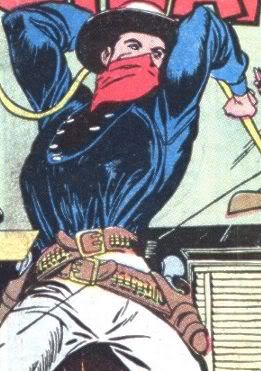
This Day…
The Oriental Saloon
Tombstone, in the Arizona Territory was notorious as the meanest mining town in the western frontiers, and Tombstone’s Oriental Saloon was similarly renowned. As many as 200 men may have been shot to death there in pointless even idiotic arguments that originated in the Oriental. On one occasion, John Ringo invited Louis Hancock to have a drink with him. When Hancock agreed and asked for a beer, Ringo said, “No man drinks beer with me. I don’t like beer.” Ringo finally shot Hancock who allegedly was buried with a bottle of beer. The original Oriental was started by Jim Vizina in a canvas tent with two wagon loads of whisky. It later moved to an actual building that was lavishly decorated by the new owner, Mike Joyce. Joyce later sold out to Lou Rickabaugh, who gave a quarter interest to Wyatt Earp for protection purposes. Gunmen Bat Masterson and Luke Short ran the gambling tables, with Earp and his friend Doc Holliday often present. Earp and Doc Holliday left town following the gunfight at the O.K. Corral. Tombstone’s silver mine died out, and the Oriental folded with it.
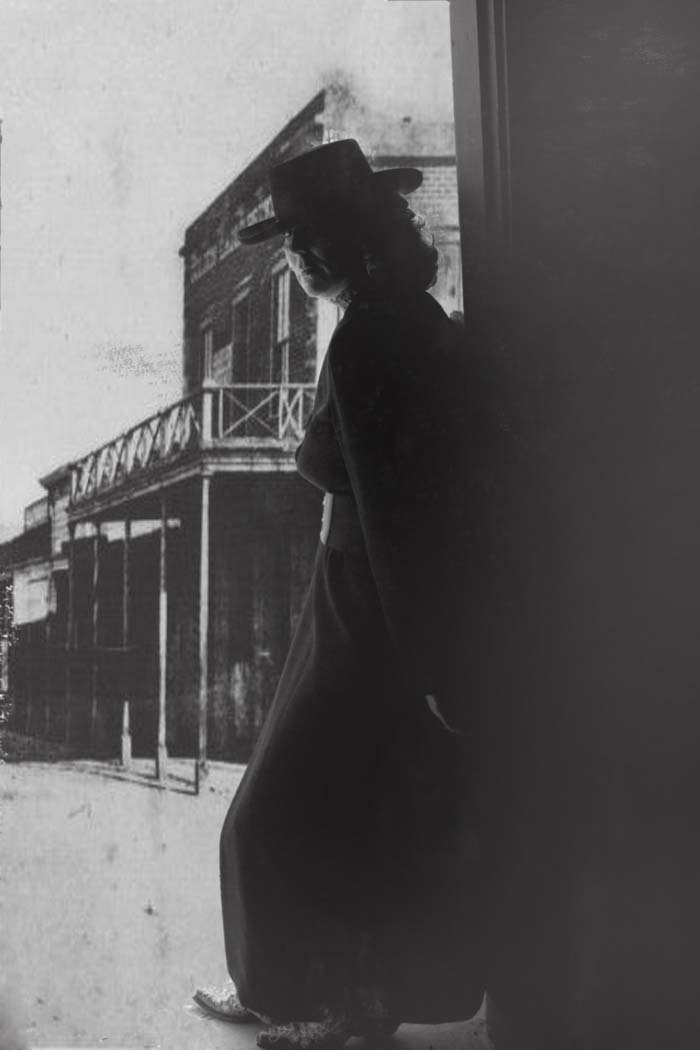
Standing in the shadows of a ghost town.
This Day…
The Horse Thief
Dutch Henry aka Henry Bourne, was an outlaw who died in 1930. Henry Borne, a German immigrant called Dutch Henry, became known for horse thievery. After arriving in the U.S. he joined the Seventh Cavalry, but quit in the late 1860s. Shortly afterward, Borne was arrested at Fort Smith, Arkansas, for absconding with twenty government mules. He was sentenced to prison, but escaped just three months later and became a full-time horse thief, an avocation he pursued until the automobile replaced the horse. Dutch Henry sometimes had over 300 men on his payroll who were prepared to steal any herd, no matter how large. It was said that the crafty Dutchman once sold a sheriff his own recently stolen horse, and “Dutch Henry” came to mean a stolen horse. In 1878, Bat Masterson arrested Henry, but he escaped punishment. The state of Arkansas finally succeeded in putting Dutch Henry away after they connected him with the Fort Smith robbery years earlier. He spent the next twenty years behind bars, and emerged from prison to discover that there was no longer a market for horse thieves. Hollywood borrowed his legendary name for many scripts featuring western badmen.