
1748-In the Ohio territory, the agents sent out from Pennsylvania, Croghan and Weiser, win a treaty with the Ohio River Valley Indians-an important first step to establishing a free flow of trade.
Month: May 2013
The Infamous Belle Starr
Myra Belle Shirley, better known as Belle Starr was born in Carthage, Missouri, the notorious Belle Starr moved with her family at the age of sixteen to Scyene, Texas, just outside of Dallas. In the 1860s, Starr became involved with bank robber Cole Younger, Jesse James’ partner. The couple spent several months together in a small cabin on the Oklahoma Strip with Younger was hiding out from the law after robbing several banks. After Younger rejoined the James Gang, Starr gave birth to a daughter, Pearl, who was though to be Younger’s child. Starr’s next romance was with another bank robber, Jim Reed. Along with Reed and two other criminals in 1869, Starr robbed a California prospector suspected of having hit a rich vein. The four tortured the prospector until he told them where his gold was hidden, and they got away with $30,000. After Reed was shot in a gun fight in 1874, Starr and an Indian outlaw named Blue Duck organized a horse-and-cattle-rustling ring. Starr then married a Cherokee Indian named Sam Starr were arrested in 1883 and sentenced to six months in jail. After their release, they returned to rustling and were arrested again in 1886. Although they appeared before ‘hanging’ Judge Isaac Parker at Fort Smith, they were released for lack of evidence. Sam Starr was shot and killed in a barroom brawl in December 1886. Starr’s last lover was a Creek Indian named Jim July. On February 3, 1889, after riding part of the way to Fort Smith with July, Starr turned back to her home in Younger’s Bend. A gunman apparently lying in wait shot her off her horse. She was found by a passing traveler who took her home to her daughter. When she died. Pearl had her tombstone engraved with the following inscription: “Shed not for her the bitter tear, Nor give the heart to vain regret, ’Tis but the casket that lies here, The gem that fills it sparkles yet.” 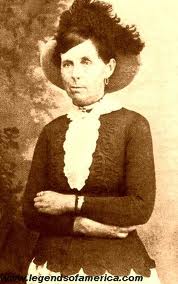
This Day…
Holliday the Dentist
J.H. Holliday, Dentist, very respectfully offers his professional services to the citizens of Dodge City and surrounding country during the summer. Office at room No. 24, Dodge House. Where satisfaction is not given money will be refunded.
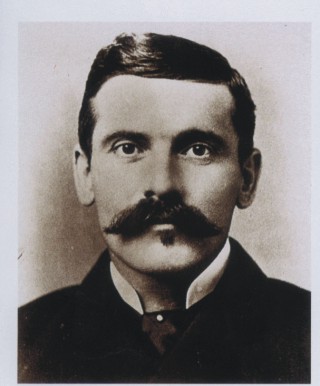
Denizens of Dodge whose ‘miscreant molars’ gave trouble were able to be ‘drilled’ by Doc without suffering from lead poison. One wonders if there were any dissatisfied customers with nerve enough to complain.
This Day…
With One Shot
As he lay hiding in the pine thicket along the Potomac River, seven days after assassinating President Lincoln, John Wilkes Booth began to think his act had been in vain. “I am here in despair,” he wrote. “And why? For doing what Brutus was honored for-what made Tell a hero. My action was purer than theirs…I have too great a soul to die like a criminal. O, may He spare me that, and let me die bravely.!” Booth, a strikingly handsome, successful actor and strong supporter of the Confederacy, had planned for months to abduct Lincoln to force the release of Southern prisoners. But after Lee surrendered on April 9, 1865, Booth’s plots were rendered useless. He spent the next few days glumly drinking muck brandy at John Deery’s billiard hall in Washington, D.C.. When he shot the President on April 14 the act apparently was unplanned until that day, when Booth happened to hear that Lincoln was to see Our American Cousin at Ford’s Theatre that night. It was during the second scene of the third act, after 10 p.m., that the 26-year-old Booth entered Lincoln’s box and shot him in the back of the head. He stabbed an officer who tried to grab him, then leaped to the stage 12 feet below, yelling, “Sic semper tyrannis! The South is avenged!” As he jumped his boot spur got caught in the folds of an American flag draped along the President’s box, causing him to fall and break his left leg as he hit the stage, where he stabbed the orchestra conductor, who tried to stop him, then struggled down the rear stairs to an awaiting horse that was being held by a stagehand. As Booth fled the city-his fractured leg tearing deeper and deeper into his flesh-he was joined by 19-year-old David Herold, who as one of eight in Booth’s gang had shot and wounded Secretary of State William Seward. Two men who were to kill Vice President Andrew Johnson backed out. Booth and Herold rode through the night southward in to Maryland. They turned eight miles out of their way to arrive at the home of Dr. Samuel Mudd, who set Booth’s leg at 4:30 a.m.. From there the two men rode on to the Potomac, where they hid along the banks for a week, surrounded by Army troops but supplied food and newspapers by a Confederate sympathizer. The troops finally caught up with the two men in the early morning hours of April 26, after they crossed the river and reached the home of Richard Garrett in Virginia. After the soldiers surrounded the barn where Booth and Herold were sleeping, one of Garrett’s sons was ordered to go in and convince them to surrender. Booth told the boy, “Damn you. You have betrayed me. Get out of here or I will shoot you.” Herold surrendered, but Booth stayed inside the barn, intent on a hero’s final blaze of glory. He yelled, “Captain, this is a hard case, I swear. Give a lame man a chance. Draw up your men 20 yards from the door, and I will fight your whole command.” When the troops refused Booth called out, “Well, my brave boys, you can prepare a stretcher for me.” Soldiers set the barn afire. Booth was seen briefly against he light of the blaze, leaning on a crutch, before a shot was heard. Booth was pulled from the barn with a bullet in the side of his neck that had broken his spinal column. A soldier, saying “Providence directed me,” claimed he shot Booth through a crack in the barn even though orders were to take the assassin alive. But some historians believe Booth had shot himself. The actor spent his final hours lying on the porch of Garrett’s house. Before he died at 7 a.m. he mumbled, “Tell mother, tell mother, I died for my country.” And then: “Useless, useless.” Although Booth’s body was identified by several people before he was buried outside Washington, near the U.S. Arsenal, legend has it that the Army had gotten the wrong man and Booth remained alive. He was spotted, it was said, in Europe and India, and many believed the self-acclaimed hero wandered around Texas and Mexico for the rest of the 19th century before committing suicide in Enid, Oklahoma, in 1903.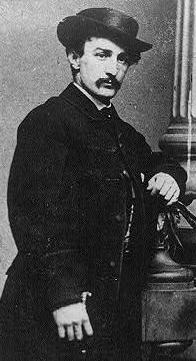
An Excerpt from High Country Women – Pioneers of Yosemite National Park
Annie Ripley, Elizabeth Fry, & Sara Haight
A Bride in Yosemite
At the turn of the century Yosemite Valley, in particular the area known as Bridalveil Falls, was referred to as the “show place of the Sierras.” Artists from every medium thought the falls cascading down more than six hundred feet of rock wall into the valley to be so beautiful that it was considered selfish for anyone who looked on the splendor of the setting not to share the pleasure with others using whatever talent they were given. Among the many famous guests who visited the most prominent waterfall in the Yosemite Valley were General Ulysses S. Grant, Horace Greely, General William T. Sherman, and Ralph Waldo Emerson. Naturalist John Muir entreated the public to visit the spot often. According to his memoirs he challenged park patrons to “climb the mountains and get their good tidings.” He assured them that “nature’s peace will flow into you as sunshine into trees.” 1
It’s not unusual that couples chose the stunning Bridal Veil Falls as the backdrop for their nuptials. The first bride to plan her wedding at the spot was a prominent young woman from Los Angeles. According to the August 6, 1901, edition of the newspaper The Boston Globe, the ceremony was “so incredible it defied description and started a trend in civil unions held at the majestic National Park.” The momentous occasion highlighted in The Boston Globe article was duplicated by hundreds of betrothed couples in the early 1900s. “With a mighty altar and the generous diapason of an incomparable waterfall furnishing the melody of a bridal march Miss Annie Ripley of Los Angeles and Henry C. Best of San Francisco were wed in the valley a few days ago,” The Boston Globe article continued. “It was the first marriage ceremony performed in Yosemite, and for solemnity and picturesqueness it was surpassingly notable.” 2
One hundred guests of the bride and groom were present and walked with them over trails and under trees to the place where the water crashed upon the rocks beneath the towering cliffs on either side of Bridalveil. “The day was a superb one and the scene one of matchless beauty,” The Boston Globe article continued 3
“Miss Ripley was prettily attired in a mountain costumes and the man who was to be made her husband had set aside the customary garments and wore camping attire as well. Their look was fitting for the setting.
The Yosemite populace made a holiday of it all. Men and women were brilliantly dressed and formed an attractive group when they arrived at the base of the falls a half an hour before noon. The Bohemian string orchestra was in attendance and rendered exquisite melody from a natural choir loft on a gigantic rock.
As the prospective bride and groom walked toward the altar-like stone on which the ceremony was to take place the orchestra began the melodious wedding march. The music of the stringed instruments at times was lost in the roar of the falling water, and the efforts of the well-intentioned melody makers were almost futile in comparison with the strength of the storm of sound nature had provided.
At the rock altar stood Rev. Walter Freeman of Portland, Maine, who was a guest at the hotel in the valley. The bridal couple passed through the semi-circle of friends and took their position before the clergyman. Miss Ripley was accompanied by Miss Helen Ripley, the bridesmaid, and Mr. Durrell attended the groom. The words of the marriage ritual were spoken, and Mr. and Mrs. Best returned to receive congratulations from friends, family, and witnesses.
The entire party then proceeded to the hotel where an elaborate wedding breakfast was served. Late in the afternoon Mr. and Mrs. Best left the valley in a stage profusely decorated with white ribbons. They would spend their honeymoon among the giant sequoias of the Mariposa big tree grove.
Henry C. Best was a well-spoken artist and was formerly employed by newspapers in San Francisco. He had come to Yosemite three months prior to paint scenery in the valley. He was a director of the Press Club in San Francisco.” 4
The scenic wedding of Annie Ripley and Henry Best was the first recorded ceremony performed at Yosemite, but William Chapman Ralston and his bride Elizabeth Fry were among the first to honeymoon at the park. The wedding journey from the Ralston’s villa in San Mateo County to Yosemite was written about quite extensively by wedding guests and Bay area newspapers. 5
On May 20, 1858, William Ralston, a banker, business owner, and investor in the Comstock mine, and debutant Elizabeth “Lizzie” Fry were married in San Francisco. He was thirty-two and Lizzie was twenty-one. According to the September 30, 1888, edition of the San Francisco Examiner, the afternoon wedding was held at the Calvary Church on Bush Street. “The church was crowded with their friends,” the newspaper article noted, “and the bride, a pretty brunette looked charming in a most becoming wedding costume. A short reception followed at the home of Mrs. Darling at North Beach, and then the ladies of the party donned Bloomer dresses and all departed for a honeymoon camping-out frolic in the Yosemite Valley.” 6
Sarah Haight, a member of the bride’s party, was among the guests to accompany the newlyweds to the park. She recorded in her journal that “three steamers, the Helen Hesley, the Sierra Nevada, and the Orizaba, carrying selected family and friends left the wharf at four o’clock in the afternoon.” “As the boats pulled away from the harbor,” Sarah continued, “hearty cheers were offered up to the happy couple and a salute was fired from the Sierra Nevada and the Orizaba. After traveling five days, first by steamer and then donkey, the wedding party passed through a cave which deposited the sojourners at the mouth of a cave which spilled out onto the Yosemite Valley. Looking up at the rock the stone formation around resembled a theatre with its side scenes. There were grotesque faces and bats and owls carved in rock, but when you change your position the resemblance would vanish.” 7
Sarah described the wildlife in the area which included a variety of birds, lizards, and fish. There were obstacles along the path that impeded their progress in some spots. Pine trees had fallen, and ferocious winds had covered crude trails with limbs and leaves, and little mountain brooks. At one point, Sarah, along with the bride and groom and other guests, tried to walk the steep ascent to the top of a mountain. After two miles they were too tired to go on and boarded their donkeys again. In the evenings the group slept in tents that were erected for them and dined on meals prepared over a campfire. “No supper that I ever ate tasted half so good as that one, the long ride having given us very good appetites,” Sarah wrote in her journal. 8
On the morning of May 25, 1858, William Ralston, his new wife, Sarah, and the other guests arrived at the foot of the mountains. Sarah remembered that it was one of the “most magnificent prospects” she had ever beheld. “The summits were so beautiful,” she wrote in her journal, “green level prairie with a little stream flowing through its midst and the trees were all like orchard trees. So cultivated did it look that we could scarcely believe that it was not cultivated. Above it on the opposite side toward a mountain covered with pine trees, and still beyond that rose another and another, range on range, and the last were covered with snow. How grateful the cold wind coming from the snow felt in the noon, and the snow was so pure and white that you could scarce distinguish it from the clouds resting midday on their sides. 9
Looking back of us we could see the coast range of mountains at a distance of two hundred miles and conspicuous among them was Mount Diablo. How that glimpse of the old veteran carried me home to my own room, where it is the first thing I can see on looking out of my window in the morning. 10
The road had been getting gradually wilder and the hills sterner. Immense granite rocks rest on the mountain above the trail with a threatening aspect. In some places they appear to have fallen and carried large pine trees along with them. In one place I saw where a large pine tree had torn up a rock in its fall, exactly as a dentist extracts a tooth with his pincers. These afternoon, when about two miles from the entrance of the valley, we saw the Bridalveil, the first fall in the valley. It looked like a silver thread in the distance and relieved the solemn grandeur of the surrounding hills,” Sarah recalled in her published journal. 11
After a short stop to enjoy the scenery, the wedding party continued on. “We rode through beautiful green meadows, under the shady branches of trees, and the fragrance of the wild honeysuckle was a pleasant exchange for the reflection of the sun’s rays from the great white rocks,” Sarah remembered in her journal. “We rode through beautiful green meadows, under the shady branches of trees, and the fragrance of the wild honeysuckle was a pleasant exchange for the reflection of the sun’s rays from the great white rocks. To the right of us was what is called a ‘Cathedral’ in the gothic style, and where could there be a church more magnificent? We rode on, at our left ‘El Capitan,’ a man wrapped in a Spanish cloak with a slouched hat. We drew rein on the banks of the Merced, where it was very still and deep, and lay down on our blankets under the protection of the ‘sentinel.’ Never did the beauty of the Twenty-Third Psalm present itself so before me. I had been frightened and disturbed and was very weary, and the words, “He maketh me to lie down in green pastures; he leadeth me beside the still waters. – Yea, though I walk through the valley of the shadow of death, I will fear no evil; for thou art with me; thy rod and thy staff they comfort me,” filled me with quiet and peace. We had been walking through the valley of the shadow of death, as it seemed. By my request the camp was called ‘Stillwater Camp.’ 12
From the camp we were not in sight of either of the falls, though we could hear very plainly. A large fire was burning. All the party was tired and stretched themselves out in various postures, but I was so happy and so occupied with the beautiful scene that I could not sleep. Behind me was the Sentinel – it was only by lying on my back that I could see its summit 4,000 feet above me. The valley was in shade when the mood began to shine on the Sentinel’s great bald head. I watched the moonlight creeping softly downwards until it was about half-way down its sides, and then I saw the moon itself advance hesitatingly above the brow of the opposite rocks. The hesitated advance withdrew and then came boldly forward. She was closely followed by a star that advanced trembling to the edge of the rocks, rose and fell several times, then followed her mistress. Gradually the moonlight advanced and covered the whole camp and shone on the beautiful river.” 13
Not long after the deluxe wagon train honeymoon, the Ralstons moved into a mansion William built for Elizabeth in San Mateo. 14
In August 1915, newlyweds Seth and Evelyn Bovial traveled from Janesville, Wisconsin, to celebrate their union. Evelyn was completely taken with Yosemite. She spent evenings writing about the day’s trek through the park. Seth complained that his new wife was neglecting him. Married on August 28, 1915, in Milwaukee, Seth hoped Evelyn’s focus would be solely on him. “Some things are too beautiful not to write about,” she recalled in her journal, “the trip must be noted for posterity’s sake if nothing else.” 15
Soon after Evelyn submitted a detailed account of her venture to the September 9, 1915, edition of the Janesville, Wisconsin newspaper The Janesville Daily Gazette, Seth filed a petition to the court to have the marriage annulled. He was convinced the lack of attention Evelyn paid him was indicative of how she would treat him in the future. Thus, Evelyn Bovial was the first woman to have lost a husband for recording the extraordinary sights of Yosemite. 16
This Day…
A Knight’s Oath
“Be without fear in the face of your enemies.
Be brave and upright that God may love thee.
Speak the truth always, even if it leads to your death.
Safeguard the helpless and do no wrong – that is your oath.”
This is a Knight’s Oath, but I believe it could have been adopted the brave men and women who dared to travel over the plains to a wild, uncivilized land.