1878-The Sam Bass Gang was surprised in their camp on Salt Creek in Wise County, Texas by a possee led by Sheriff W.F. Eagan and some Texas Rangers. The posse killed Arkansas Johnson and captured the gang’s horses, but the rest of the gang got away on foot. They soon stole other horses and made good their escape.
Month: June 2013
The Dream
This Day…
Outlaw Talk in Dodge City
I returned from Dodge City and other towns in Kansas yesterday. I had been traveling around the state promoting two books, one of which was The Bedside Book of Bad Girls: Women Outlaws of the Midwest. Outlaw Alice Ivers was one of many bad girls I had a chance to talk to readers about. Alice was born in Sudbury, Devonshire England in 1851. She immigrated with her family to the U.S., settling in Virginia first, then moving to Fort Mead, Colorado where her father was a school teacher. She married a mining engineer, who introduced her to the fast world of the gamblers and their known haunts. Ivers greatly admired the car sharps and high-hatted gamblers that traveled the cow towns and soon she learned their card-playing wiles. While in her teens, Ivers went to Deadwood, South Dakota, where she became a dealer, specializing in poker and soon earning the sobriquet “Poker Alice.” After her husband died, she devoted the rest of her life to gambling; traveling through Arizona, Oklahoma, Kansas, South Dakota, Texas, and New Mexico, or wherever the stakes were high and the whisky smooth. She smoked thick, black cigars, and during the 1870s and 1880s, became a well-known and successful gambler in all the famous cow towns, from Deadwood to Tombstone, Arizona. In her heyday, she would spend $6,000 in the fancy New York run shopping stores buying the finest garments, but later, in old age, Ivers took to wearing army surplus clothing. Poker Alice would not tolerate a cheat and was never challenged by other gamblers. She was known to carry sever guns, one in her purse and one in a pocket of her dress. On occasion, she would practice her marksmanship by shooting knobs off the frames of pictures hanging in bars to warn gambler gunmen that she was capable of defending herself. Wild Bill Hickok reportedly asked Poker Alice to sit in with him and others during the game of poker in Saloon No. 10 in Deadwood on the day he was shot by Jack McCall; she declined, saying that she had already agreed to play with another group down the street in Mann’s Saloon. When hearing that Wild Bill had been shot in the back, Ivers rushed to Saloon No. 10 and saw Hickok sprawled dead on the floor and McCall fleeing out the back door. “Poor Wild Bill,” she said of Hickok, peering down at his corpse, “he was sitting where I would have been if I had play with Wild Bill on that fateful day because she “had a queer feeling that all would not be right that day.” Alice Ivers later married Frank Tubbs, a gambler who did not possess half her playing talents and one who took to drink early in their marriage. Poker Alice was forever getting her husband out of trouble. Tubbs was knifed one night by a disgruntled player, and Poker Alice stormed into the bar and shot the man in the stomach, wounding him from a distance of thirty feet. She and Tubbs moved on to Silver City, Nevada, where she broke the bank in the biggest saloon, winning an estimated $150,000. She and Tubbs then brought a huge Colorado ranch which Poker Alice later lost. Following her husband’s death, Poker Alice moved to Rapid City, South Dakota, where she ran a small poker club. She died there, a grand old lady of western lore, on February 27, 1930. 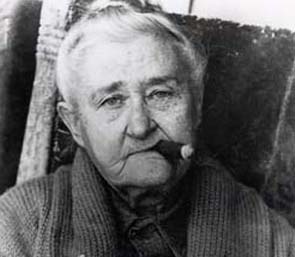
This Day…
1858-Commissioners from President Buchanan arrive at Camp Scott in Utah and proceed south to Provo. They bring a full pardon from the president ‘to all who will submit themselves to the just authority of the federal government.’ The pardon has been signed by the President two months earlier, and the commissioners admonished ‘to bring those misguided people to their senses.’ Only after the pardon is signed is the US Army allowed to march through Salt Lake City-still deserted-into an area soutwest of the city, where they will construct Camp Floyd.
The Hazards of Cowpunching
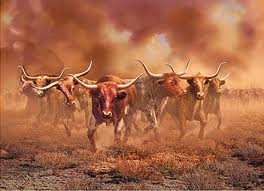
Stampede! This one word, more than the warning cry that Indians or outlaws were attacking, made any cowpuncher’s blood turn cold. There was no way of foretelling it; the sudden bark of a coyote, a rumble of a summer storm, lightning, the rearing of a horse, or the scream of a panther could all start a disastrous stampede. Sometimes there was no apparent reason; it seemed as though a half-wild but dormant instinct of flight had suddenly flared up in the brain of one of the steers. As many memoirs recall, it was a terrifying experience. There would be a sudden rumble like that of a far-off cannon; then the herd would bolt. Like an army of modern steam-rollers, the steers would move across the open prairie with the speed of an express train. No one could tell what direction they would take. Sometimes they plunged off cliffs, filling whole canyons with their broken bodies, or choked a river with their thrashing. The task of the cowpunchers was to divert that terrifying, fast-moving animal mass into a gigantic circle. To do that, cowboy and pony became as one. Sometimes the stampede went on for days. No one got any sleep. There was only time for a quick drink of scalding hot coffee and then back into the saddle. “I didn’t sleep for three days,” one puncher recalled. “The heard ran for miles…”