
An Excerpt From A Beautiful Mine

Frances Allen Noyes

Miner on Candle Creek

“If I can’t be in the hills, I would sooner be dead.”

France Noyes – 1928

A cluster of tents dotted a strip of frozen earth at the base of a massive glacier in Skagway, Alaska. Beyond the solid layer of ice was a thick forest that followed the contours of a mountain. The numerous trees that covered the ridge were like deep-pile carpet and the grassy scruff under the timbers were red and yellow with the coming of autumn. A clear, cold stream flowed swiftly from the white peaks, spilling over the layers of compacted snow. Pieces of the iceberg broke off and fell into the freezing water.

Frances Noyes, a pretty, determined woman dressed in a heavy wool coat, thick-soled, knee-high boots, and wool gloves traveled along a gravel trail running parallel to the stream. She stopped momentarily to plunge a gold mining pan into the rocky creek bed and sift through the pebbles. Like hundreds of other miners that rushed to Alaska in 1898 looking for gold, Frances was confident she would discover a fortune. The biting wind and snow flurries that cut across her path did not deter her from her work. She glanced around at the setting and smiled.

She was invigorated by her surroundings. “If there ever was a woman prospector, it was Frances,” Frances nephew William Simonds recalled of his aunt. “She was never as content in her life as she was mining in the Alaskan wilderness.”

Frances and her husband, Thomas C. Noyes, searched for gold along Otter Creek near Skagway from September 1899 to February 1900. She was one of a handful of women miners who dared to brave the sub-zero temperatures of the isolated Klondike. The intrepid female pioneer actually chose mining as her second career. Her first job was as a stage actress. Beautiful and talented, she spent years entertaining audiences in boomtowns across the Old West. One audience member was Thomas Noyes, a man she fell in love with and wanted to marry in spite of his family’s objections. Had he not stood up to his parents she might not have accompanied him on his mining expedition and might never realized her true calling.

“I shall conduct no training school for actresses,” Montana mining tycoon John Noyes declared. He sent his son Tom a withering glare. The boy had obviously been taken in by a pretty face. Mrs. Allen was not the type of woman he had in mind as a wife for his son. She’d been married and divorced, and that scandal had hardly quieted when a new one had erupted.


The full weight of his father’s displeasure only strengthened Tom’s resolve. “You have $2,500 in a trust fund that you are holding for me, have you not, Father?”

“Yes.”

“Well, give me that. I will start out for myself, and you can cut me off without a cent.” Tom had loved Frances Allen ever since he first saw her in a theatrical production. His father thought Tom was too young to marry and Frances too infamous to be his bride, but Tom intended to marry her, and soon. Frances clearly was in danger, however, as another would-be suitor from New Orleans was stalking her from state to state and might soon appear in Butte.

Tom did not change his mind, though his father continually dredged up the infamy of Frances’s past, starting with her divorce from Samuel Allen earlier in 1897. The newspapers had reported every titillating development. According to one account Samuel Allen had told his friends that his ex-wife “is a good woman, but has a passion for money, a siren who uses her charms to infatuate men to the point where they lavish their wealth upon her, but she never strays from the straight and narrow path.”


A report in Spokane’s Spokesman entitled “She’s An Actress, Ex-Prosecuting Attorney Objects to the Life,” claimed, “ The wreck of this family commenced about the time of the society circus at Natatorium Park in 1895, when Mrs. Allen rode two horses bareback. Mr. Allen did not enjoy this exhibition, and the family was never a happy one.”

Tom suspected his father had seen that article. He was certain the electrifying accounts had convinced his father to forbid him to marry the woman he loved. The newspapers, in Tom’s opinion, wrongly made Frances sound like a beautiful but heartless, money-hungry tease. Tom’s father certainly believed this and reminded his son that no respectable woman would flaunt herself on stage unless she was out to snare a rich husband. Tom knew Frances did not care about money. She would marry him with his small trust fund and no prospects of inheriting his father’s huge fortune.

What worried Tom was the threat hanging over Frances’s life. A would-be suitor, Alfred Hildreth, was stalking Frances, and his actions had steadily become more dangerous. At the Leland Hotel in Chicago, Hildreth had lain in wait for five days. The Southerner confronted Frances in the lobby, and witnesses said Frances agreed to dine with him at a downtown restaurant, only to have the impassion man


brandish a carving knife while declaring he would do something desperate if she wouldn’t have him. He had followed Frances through several states, and his ardor increased every time he caught up with her. Tom knew Alfred could show up at any time.

Newspapers in Chicago and New York recorded the tales of Hildreth’s obsession. The Chicago Chronicle carried one story that made Tom’s blood boil. “Alfred J. Hildreth loves Mrs. Frances Allen with such true and ardent affection that he has followed her 5,000 miles to prove it. Even though Mr. Allen secured a divorce from his wife because she rode bareback at a charity circus in Spokane, Wash., attired in the reddest of red silken tights, Hildreth says she is dear to him. Mrs. Allen, however, does not return the feeling of young Hildreth, and she has spent many weary hours moving from one city to another to escape the devoted lover.”

The tights had been pink, but Tom didn’t bother to correct the story. Frances Allen belonged to him, and neither Alfred Hildreth nor Tom’s own father was going to stand in the way of a wedding, Tom decided.

Arabella Frances Patchen Allen did not care that Tom’s father disapproved of her life on the stage. She intended to marry his son.


Of all the men who had pursued her since she had left Spokane after the fateful circus ride, Tommy was the one she truly loved. Her first marriage had been troubled from the start. On the day of her wedding to Samuel Allen in 1892, when she was barely eighteen, the groom had disappeared. His drunken companions had held a “special session” and voted to continue the wedding anyway, with a different groom. After several good-natured votes were taken among the unmarried men, each of whom had voted for himself, Samuel had finally reappeared, and the vows were spoken.

For a few years she had enjoyed the social life that was part of being married to a prominent lawyer. Samuel had even given his consent for her participation in the charity circus at Natatorium Park, since half the money would go to the family of a boy who had broken his back in a barrel slide. Her husband had stalked out in a rage when he discovered his beautiful young wife in form-fitting tights and short blue skirt, riveting the attention of every person in the place.

Samuel’s outrage had resulted in a huge quarrel, and she’d left his fine home for good that August. By April of the following year, she had succeeded on the stage. If she hadn’t ridden in the society circus, she might still be married to Samuel and living well, she knew, but by leaving


Spokane and taking parts in productions in Bradford, Pennsylvania, she’d achieved some success of her own. And her acting career had allowed her to meet Tom Noyes, whom she had fallen in love with and was prepared to marry.

The 1897 wedding of Tom Noyes and Frances Allen did not compare in any way to Tom’s sister’s wedding, which linked two prosperous mining families and was celebrated as the most brilliant wedding ever held in Montana. Tom and Frances were married in a small, quiet ceremony. By the time Tom’s sister, Ruth Noyes, married Arthur Heinz, Tom and Frances were already mining together in Skagway, Alaska, at the foot of a glacier on Otter Creek.

Tom knew he was a lucky man. Not many women would have smiled through the bitter cold and long darkness of an Alaskan winter. Unlike the California Gold Rush, few women had hurried to the rush in the frozen northland. But his petite, flirtatious Frances was one of a handful of women truly interested in mining. She loved the open country and the freedom from the society that had scorned her.

Frances was as eager as Tom to move on when Otter Creek didn’t provide the wealth they were seeking. They headed for wide-open, lawless Nome, located at the edge of the Seward Peninsula on the Bering Sea.


Gold had been discovered at Anvil Creek, and by the spring of 1900, somewhere between twenty and thirty thousand “stampeders” had come to Nome.

Camped above the tide line with thousand of others, Frances, who stood approximately 2 inches shorter than 5 feet tall, helped shovel sand into the portable rockers used to sift out the fine gold. Many people believed that the ocean was depositing gold at high tide. Tents and rockers stretched for miles along the beach.

Tom was appointed to a four-year term as a U.S. Commissioner for the Fairhaven District of Alaska, and soon Frances and Tom were again moving in the upper circles of society, albeit a much more flamboyant elite than the stuffy and conventional social strata they’d left behind. Tom’s knowledge of mining and his impeccable character, dubbed “pure gold” by one of the men he worked with on several claims, earned report in lawless Nome.

Tom wanted to find the Alaska mother lode, and Frances always followed where he led. He learned from one of the native people in the area that gold was easier to get on Candle Creek. Frances put away her silks and lace and followed Tom hundreds of miles north to Candle Creek, where they staked several claims.


Frances experienced “mushing” by dogsled and began to learn more and more about prospecting.

Alaskan newspapers covered some of the adventures of the prospecting newlyweds, reporting that they endured “perilous trips, lost trails, climbs over glacier fields, where steps had to be cut with an ax.” More than once Frances was credited with saving her husband’s life. Their claims paid off, and Tom became known as “King of the Candle.” He started a band and built a home for himself and Frances, where anyone was welcome.

In 1902 Tom’s father died, and Tom inherited an interest in a hotel in Seattle. Success piled on success, and Frances and Tom began to alternate between harsh conditions and adventures in Alaska and society teas and balls in Seattle and Butte.

In 1905 Tom and Frances adopted a half-Eskimo girl, Bonnie who was approximately five years old. During the winter she attended school in Butte; in the summer she often returned to Alaska with her parents.

As their success in Candle grew, Tom conceived of a plan to bring water to the rich placer diggings. In the autumn of 1907, he left for New York to obtain $200,000 to finance the completion of the Bear Creek ditch. Frances stayed at Candle to manage their interests.


He’d barely arrived in New York when a financial panic hit, jeopardizing the nation’s economy. No bank would loan him money for a project in Alaska, and funds were so tight Tom had to pawn his watch and jewelry to pay his hotel bills. Tom’s bank in Candle and the bank in Nome were threatened with a run by frightened customers eager to get their money into their own hands.

In an unprecedented feat of courage and strength, Frances once again came to her husband’s rescue, only this time she saved his financial life. Pawning her jewelry to raise ten thousand dollars, Frances mushed across the frozen Artic tundra in the dead of winter. The story was printed in the Seattle Times and many other newspapers. “With only a driver for her team of malamutes, she started out across the hundreds of miles of ice and snow, the thermometer so low it almost faded from view. Through the short days and into the nights this brave woman trudged on through the snow. Many days were needed for the journey, but the news that the money was coming had spread a better feeling in Nome and the bank was able to weather the storm until relief should arrive. The journey made by Mrs. Noyes was one of the most heroic ever attempted by a woman on her own initiative in the far North, and when she reached Nome she was accorded a welcome that was commensurate with her feat.

The bank was saved, and a woman had been the agent.”

Unfortunately, two years later Tom’s bank failed, and his claims at Candle were lost. Tom had made a critical mistake – failing to use his official bank title when he signed checks – that left him personally liable when the bank failed. Tom and Frances retreated to Tongass Island near Ketchikan. In 1913 Tom ventured out to try his luck during a stampeded to the Shushana gold strike. Shortly afterward, Frances joined him. There the harsh conditions of the Alaskan goldfields took their final toll.

Although they met with some success, one of the prospecting trips they took resulted in disaster. Days on the trail in temperatures as low as fifty degrees below zero with little shelter and poor food left Tom a “physical wreck.”

On December 15, 1915, Tom was hospitalized in Port Simpson General Hospital in British Columbia. Frances slept on a cot in his room, watching over and caring for him. Later, with Frances and his mother at his side, he was taken to a hospital in St. Louis, but he died of pneumonia on February 2, 1916.

Stunned and heartbroken, their fortune gone, Frances returned alone to Tongass Island. She received a letter that spring from one of their former partners who recalled Tom and Frances’s early days at Otter Creek.

“Nearly 17 years ago you said goodbye to me on the platform at Seattle and you knew that you were saying farewell to a friend who would have done anything for you. I have not altered. I am just the same William you knew at Otter Creek and in our little camp at the foot of the glacier.”

The letter goes on to remember Tom.

“I shall never realize that Tommy is dead. Since I left you I have been in many places and had dealings with many men, but I have never come across another Tommy, he was just pure gold. I was trying to think last night if I could remember him being out of temper or cross, but I could not, and we had some trying times. It is a great thing to have had a partner in life who you can look forward to meeting, to whom you can hold your hand out to and look straight in the eye and say “Tommy, I am glad to see you.”

Perhaps there may be another Klondike for us beyond the clouds; if there is I could ask for nothing better than my two dear friends of the glacier should be my partners again.”

The writer advised Frances not to return to Alaska, but the woman who had married at eighteen, divorced at twenty-three, and married again that same year to a man she cherished despite the scorn and anger of her father-in-law, returned to the northern land she loved.

She kept body and soul together by managing the Nakat Inlet cannery store, but her love of the Alaskan wilderness eventually lured her away from civilization. She went back to prospecting, where everything she’d learned from her beloved Tommy allowed her to prosper.

Frances married again at the age of forty-five, to William Muncaster, who was 15 years younger. Despite the age difference, Bill had been smitten for years with Frances. He’d sent her love letters and stopped in to visit her between trips to survey Alaska for the Coast and Geodetic Survey. Bonnie accompanied Frances and her new stepfather on their honeymoon trip to Alaska’s goldfields.

Frances and William lived in a cabin on Wellesley Lake. They prospected and often went on fishing and hunting trips even when the temperature dipped to fifty below zero. Tom’s memory, however, never faded from Frances. Visiting a place she and Tom had stayed during the Shushana gold strike, she wrote in her diary, “Everything looks different. Everything is different.”

One that never changed was Frances’s love of prospecting. She and William visited their claims until 1946, when Frances was seventy-two years old and living in Haines, a small town in southeastern Alaska.


The woman who scandalized Spokane with her daring ride in pink tights, the actress who caused a mining tycoon to shun his heir, the woman who saved her husband’s bank with a grueling trek across the frozen northland, the unlikely prospector who loved Alaska so much she spent fifty-four years there, died on October 28, 1952. William Muncaster provided the press with clippings and stories about her life in Alaska. He wrote a final letter for the local newspaper.

Dear Sir,

Please publish this letter, for I wish to thank with all my heart all the people, young and old alike, in the town of Haines, Alaska, and the adjoining vicinities North, South, East and West for the unbelievable 100 percent respect shown by them as Mrs. Frances Mucaster’s final rites. I thank you.

William Muncaster
Frances Allen Noyes

Miner on Candle Creek

“If I can’t be in the hills, I would sooner be dead.”

France Noyes – 1928

A cluster of tents dotted a strip of frozen earth at the base of a massive glacier in Skagway, Alaska. Beyond the solid layer of ice was a thick forest that followed the contours of a mountain. The numerous trees that covered the ridge were like deep-pile carpet and the grassy scruff under the timbers were red and yellow with the coming of autumn. A clear, cold stream flowed swiftly from the white peaks, spilling over the layers of compacted snow. Pieces of the iceberg broke off and fell into the freezing water.

Frances Noyes, a pretty, determined woman dressed in a heavy wool coat, thick-soled, knee-high boots, and wool gloves traveled along a gravel trail running parallel to the stream. She stopped momentarily to plunge a gold mining pan into the rocky creek bed and sift through the pebbles. Like hundreds of other miners that rushed to Alaska in 1898 looking for gold, Frances was confident she would discover a fortune. The biting wind and snow flurries that cut across her path did not deter her from her work. She glanced around at the setting and smiled.

She was invigorated by her surroundings. “If there ever was a woman prospector, it was Frances,” Frances nephew William Simonds recalled of his aunt. “She was never as content in her life as she was mining in the Alaskan wilderness.”

Frances and her husband, Thomas C. Noyes, searched for gold along Otter Creek near Skagway from September 1899 to February 1900. She was one of a handful of women miners who dared to brave the sub-zero temperatures of the isolated Klondike. The intrepid female pioneer actually chose mining as her second career. Her first job was as a stage actress. Beautiful and talented, she spent years entertaining audiences in boomtowns across the Old West. One audience member was Thomas Noyes, a man she fell in love with and wanted to marry in spite of his family’s objections. Had he not stood up to his parents she might not have accompanied him on his mining expedition and might never realized her true calling.

“I shall conduct no training school for actresses,” Montana mining tycoon John Noyes declared. He sent his son Tom a withering glare. The boy had obviously been taken in by a pretty face. Mrs. Allen was not the type of woman he had in mind as a wife for his son. She’d been married and divorced, and that scandal had hardly quieted when a new one had erupted.


The full weight of his father’s displeasure only strengthened Tom’s resolve. “You have $2,500 in a trust fund that you are holding for me, have you not, Father?”

“Yes.”

“Well, give me that. I will start out for myself, and you can cut me off without a cent.” Tom had loved Frances Allen ever since he first saw her in a theatrical production. His father thought Tom was too young to marry and Frances too infamous to be his bride, but Tom intended to marry her, and soon. Frances clearly was in danger, however, as another would-be suitor from New Orleans was stalking her from state to state and might soon appear in Butte.

Tom did not change his mind, though his father continually dredged up the infamy of Frances’s past, starting with her divorce from Samuel Allen earlier in 1897. The newspapers had reported every titillating development. According to one account Samuel Allen had told his friends that his ex-wife “is a good woman, but has a passion for money, a siren who uses her charms to infatuate men to the point where they lavish their wealth upon her, but she never strays from the straight and narrow path.”


A report in Spokane’s Spokesman entitled “She’s An Actress, Ex-Prosecuting Attorney Objects to the Life,” claimed, “ The wreck of this family commenced about the time of the society circus at Natatorium Park in 1895, when Mrs. Allen rode two horses bareback. Mr. Allen did not enjoy this exhibition, and the family was never a happy one.”

Tom suspected his father had seen that article. He was certain the electrifying accounts had convinced his father to forbid him to marry the woman he loved. The newspapers, in Tom’s opinion, wrongly made Frances sound like a beautiful but heartless, money-hungry tease. Tom’s father certainly believed this and reminded his son that no respectable woman would flaunt herself on stage unless she was out to snare a rich husband. Tom knew Frances did not care about money. She would marry him with his small trust fund and no prospects of inheriting his father’s huge fortune.

What worried Tom was the threat hanging over Frances’s life. A would-be suitor, Alfred Hildreth, was stalking Frances, and his actions had steadily become more dangerous. At the Leland Hotel in Chicago, Hildreth had lain in wait for five days. The Southerner confronted Frances in the lobby, and witnesses said Frances agreed to dine with him at a downtown restaurant, only to have the impassion man


brandish a carving knife while declaring he would do something desperate if she wouldn’t have him. He had followed Frances through several states, and his ardor increased every time he caught up with her. Tom knew Alfred could show up at any time.

Newspapers in Chicago and New York recorded the tales of Hildreth’s obsession. The Chicago Chronicle carried one story that made Tom’s blood boil. “Alfred J. Hildreth loves Mrs. Frances Allen with such true and ardent affection that he has followed her 5,000 miles to prove it. Even though Mr. Allen secured a divorce from his wife because she rode bareback at a charity circus in Spokane, Wash., attired in the reddest of red silken tights, Hildreth says she is dear to him. Mrs. Allen, however, does not return the feeling of young Hildreth, and she has spent many weary hours moving from one city to another to escape the devoted lover.”

The tights had been pink, but Tom didn’t bother to correct the story. Frances Allen belonged to him, and neither Alfred Hildreth nor Tom’s own father was going to stand in the way of a wedding, Tom decided.

Arabella Frances Patchen Allen did not care that Tom’s father disapproved of her life on the stage. She intended to marry his son.


Of all the men who had pursued her since she had left Spokane after the fateful circus ride, Tommy was the one she truly loved. Her first marriage had been troubled from the start. On the day of her wedding to Samuel Allen in 1892, when she was barely eighteen, the groom had disappeared. His drunken companions had held a “special session” and voted to continue the wedding anyway, with a different groom. After several good-natured votes were taken among the unmarried men, each of whom had voted for himself, Samuel had finally reappeared, and the vows were spoken.

For a few years she had enjoyed the social life that was part of being married to a prominent lawyer. Samuel had even given his consent for her participation in the charity circus at Natatorium Park, since half the money would go to the family of a boy who had broken his back in a barrel slide. Her husband had stalked out in a rage when he discovered his beautiful young wife in form-fitting tights and short blue skirt, riveting the attention of every person in the place.

Samuel’s outrage had resulted in a huge quarrel, and she’d left his fine home for good that August. By April of the following year, she had succeeded on the stage. If she hadn’t ridden in the society circus, she might still be married to Samuel and living well, she knew, but by leaving


Spokane and taking parts in productions in Bradford, Pennsylvania, she’d achieved some success of her own. And her acting career had allowed her to meet Tom Noyes, whom she had fallen in love with and was prepared to marry.

The 1897 wedding of Tom Noyes and Frances Allen did not compare in any way to Tom’s sister’s wedding, which linked two prosperous mining families and was celebrated as the most brilliant wedding ever held in Montana. Tom and Frances were married in a small, quiet ceremony. By the time Tom’s sister, Ruth Noyes, married Arthur Heinz, Tom and Frances were already mining together in Skagway, Alaska, at the foot of a glacier on Otter Creek.

Tom knew he was a lucky man. Not many women would have smiled through the bitter cold and long darkness of an Alaskan winter. Unlike the California Gold Rush, few women had hurried to the rush in the frozen northland. But his petite, flirtatious Frances was one of a handful of women truly interested in mining. She loved the open country and the freedom from the society that had scorned her.

Frances was as eager as Tom to move on when Otter Creek didn’t provide the wealth they were seeking. They headed for wide-open, lawless Nome, located at the edge of the Seward Peninsula on the Bering Sea.


Gold had been discovered at Anvil Creek, and by the spring of 1900, somewhere between twenty and thirty thousand “stampeders” had come to Nome.

Camped above the tide line with thousand of others, Frances, who stood approximately 2 inches shorter than 5 feet tall, helped shovel sand into the portable rockers used to sift out the fine gold. Many people believed that the ocean was depositing gold at high tide. Tents and rockers stretched for miles along the beach.

Tom was appointed to a four-year term as a U.S. Commissioner for the Fairhaven District of Alaska, and soon Frances and Tom were again moving in the upper circles of society, albeit a much more flamboyant elite than the stuffy and conventional social strata they’d left behind. Tom’s knowledge of mining and his impeccable character, dubbed “pure gold” by one of the men he worked with on several claims, earned report in lawless Nome.

Tom wanted to find the Alaska mother lode, and Frances always followed where he led. He learned from one of the native people in the area that gold was easier to get on Candle Creek. Frances put away her silks and lace and followed Tom hundreds of miles north to Candle Creek, where they staked several claims.


Frances experienced “mushing” by dogsled and began to learn more and more about prospecting.

Alaskan newspapers covered some of the adventures of the prospecting newlyweds, reporting that they endured “perilous trips, lost trails, climbs over glacier fields, where steps had to be cut with an ax.” More than once Frances was credited with saving her husband’s life. Their claims paid off, and Tom became known as “King of the Candle.” He started a band and built a home for himself and Frances, where anyone was welcome.

In 1902 Tom’s father died, and Tom inherited an interest in a hotel in Seattle. Success piled on success, and Frances and Tom began to alternate between harsh conditions and adventures in Alaska and society teas and balls in Seattle and Butte.

In 1905 Tom and Frances adopted a half-Eskimo girl, Bonnie who was approximately five years old. During the winter she attended school in Butte; in the summer she often returned to Alaska with her parents.

As their success in Candle grew, Tom conceived of a plan to bring water to the rich placer diggings. In the autumn of 1907, he left for New York to obtain $200,000 to finance the completion of the Bear Creek ditch. Frances stayed at Candle to manage their interests.


He’d barely arrived in New York when a financial panic hit, jeopardizing the nation’s economy. No bank would loan him money for a project in Alaska, and funds were so tight Tom had to pawn his watch and jewelry to pay his hotel bills. Tom’s bank in Candle and the bank in Nome were threatened with a run by frightened customers eager to get their money into their own hands.

In an unprecedented feat of courage and strength, Frances once again came to her husband’s rescue, only this time she saved his financial life. Pawning her jewelry to raise ten thousand dollars, Frances mushed across the frozen Artic tundra in the dead of winter. The story was printed in the Seattle Times and many other newspapers. “With only a driver for her team of malamutes, she started out across the hundreds of miles of ice and snow, the thermometer so low it almost faded from view. Through the short days and into the nights this brave woman trudged on through the snow. Many days were needed for the journey, but the news that the money was coming had spread a better feeling in Nome and the bank was able to weather the storm until relief should arrive. The journey made by Mrs. Noyes was one of the most heroic ever attempted by a woman on her own initiative in the far North, and when she reached Nome she was accorded a welcome that was commensurate with her feat.

The bank was saved, and a woman had been the agent.”

Unfortunately, two years later Tom’s bank failed, and his claims at Candle were lost. Tom had made a critical mistake – failing to use his official bank title when he signed checks – that left him personally liable when the bank failed. Tom and Frances retreated to Tongass Island near Ketchikan. In 1913 Tom ventured out to try his luck during a stampeded to the Shushana gold strike. Shortly afterward, Frances joined him. There the harsh conditions of the Alaskan goldfields took their final toll.

Although they met with some success, one of the prospecting trips they took resulted in disaster. Days on the trail in temperatures as low as fifty degrees below zero with little shelter and poor food left Tom a “physical wreck.”

On December 15, 1915, Tom was hospitalized in Port Simpson General Hospital in British Columbia. Frances slept on a cot in his room, watching over and caring for him. Later, with Frances and his mother at his side, he was taken to a hospital in St. Louis, but he died of pneumonia on February 2, 1916.

Stunned and heartbroken, their fortune gone, Frances returned alone to Tongass Island. She received a letter that spring from one of their former partners who recalled Tom and Frances’s early days at Otter Creek.

“Nearly 17 years ago you said goodbye to me on the platform at Seattle and you knew that you were saying farewell to a friend who would have done anything for you. I have not altered. I am just the same William you knew at Otter Creek and in our little camp at the foot of the glacier.”

The letter goes on to remember Tom.

“I shall never realize that Tommy is dead. Since I left you I have been in many places and had dealings with many men, but I have never come across another Tommy, he was just pure gold. I was trying to think last night if I could remember him being out of temper or cross, but I could not, and we had some trying times. It is a great thing to have had a partner in life who you can look forward to meeting, to whom you can hold your hand out to and look straight in the eye and say “Tommy, I am glad to see you.”

Perhaps there may be another Klondike for us beyond the clouds; if there is I could ask for nothing better than my two dear friends of the glacier should be my partners again.”

The writer advised Frances not to return to Alaska, but the woman who had married at eighteen, divorced at twenty-three, and married again that same year to a man she cherished despite the scorn and anger of her father-in-law, returned to the northern land she loved.

She kept body and soul together by managing the Nakat Inlet cannery store, but her love of the Alaskan wilderness eventually lured her away from civilization. She went back to prospecting, where everything she’d learned from her beloved Tommy allowed her to prosper.

Frances married again at the age of forty-five, to William Muncaster, who was 15 years younger. Despite the age difference, Bill had been smitten for years with Frances. He’d sent her love letters and stopped in to visit her between trips to survey Alaska for the Coast and Geodetic Survey. Bonnie accompanied Frances and her new stepfather on their honeymoon trip to Alaska’s goldfields.

Frances and William lived in a cabin on Wellesley Lake. They prospected and often went on fishing and hunting trips even when the temperature dipped to fifty below zero. Tom’s memory, however, never faded from Frances. Visiting a place she and Tom had stayed during the Shushana gold strike, she wrote in her diary, “Everything looks different. Everything is different.”

One that never changed was Frances’s love of prospecting. She and William visited their claims until 1946, when Frances was seventy-two years old and living in Haines, a small town in southeastern Alaska.


The woman who scandalized Spokane with her daring ride in pink tights, the actress who caused a mining tycoon to shun his heir, the woman who saved her husband’s bank with a grueling trek across the frozen northland, the unlikely prospector who loved Alaska so much she spent fifty-four years there, died on October 28, 1952. William Muncaster provided the press with clippings and stories about her life in Alaska. He wrote a final letter for the local newspaper.

Dear Sir,

Please publish this letter, for I wish to thank with all my heart all the people, young and old alike, in the town of Haines, Alaska, and the adjoining vicinities North, South, East and West for the unbelievable 100 percent respect shown by them as Mrs. Frances Mucaster’s final rites. I thank you.

William Muncaster

An Excerpt From Outlaw Tales of California

Four teams of tired, uninspired horses pulled a line of buckboards filled with coffins over the dry, dusty terrain twelve miles outside of the village of San Juan Capistrano. The wagon drivers and a dozen other men riding with them stared soberly out at the land. Ahead in the near distance they could see a smattering of dead bodies strewn across the semi-desert floor. Misshapen dead horses, bloating in the heat, lay beside their lifeless owners.
As the buckboards inched closer to the carnage, the vehicle’s wheels cut through clotted blood pools spread over the ground. The drivers slowed the teams to a halt and without speaking the men on board the wagons began unloading the wooden crates. Their busy hands then lifted the bodies off the hard earth and placed them in the caskets. All of the corpses were wearing badges, five of the men were deputies and one was Los Angeles Sheriff James R. Barton. Each of the lawmen were riddled with bullets, they had been stripped of their belongings and their right eyes had been shot out.
The objective of the slain posse, dispatched on January 22, 1857, was to track down a cattle rustler and horse thief named Juan Flores. Flores’s criminal activities began in 1855. He had run rough shot over a stretch of Southern California that extended from Sacramento to the San Joaquin Valley. Along the way he recruited more than 50 outlaws to assist him in the looting and killing of ranchers and their families. When Sheriff Barton learned of Flores’s hideout he wasted no time organizing volunteers. The experienced lawman believed he could apprehend the murderous bandit. He had no idea when he was riding hard towards the area where Flores was last seen that he was riding into an ambush.
Once the Sheriff’s body and that of his deputies were secured in the coffins the boxes were stacked inside the buckboards. Another posse was sent out to find Flores and bring him to justice, now not only for his existing sins, but for the brutal slaying of Barton and his men. The search for Flores was the largest manhunt in Old West history.
Juan Flores was born in 1835 in Santa Barbara, California. His parents were well respected members of the community and proud of the handsome son they believed would grow up to be an exceptional man. It is not known what prompted Flores to abandon the high hopes his mother and father had for him and embark on a life of crime. Historians suggest that the Floreses were a struggling family of farmers and that Juan aspired for a more affluent lifestyle. He was not opposed to achieving his goal illegally either. He left home at 17 and joined a gang of ruthless cattle rustlers made up of American drifters, Mexican bandits, ex-convicts, fugitives and army deserters.
Cattle was a critical element of the West’s economy. California grown beef used to supply the growing population of prospectors and immigrant families and it increased daily in price. Because of the escalated cost the territory was infested with bands of cattle thieves committing depredations upon the ranges. Ranchers not only had to worry about bandits stealing from them, but hungry and desperate Native Americans as well. Some cattle owners lost their entire herds to either the Indians or the rustlers. Flores rode with a bandito bunch that raided cattle farms around the area of Rancho Santa Margarita. He primarily focused on stealing horses and was eventually arrested for the offense in 1856. He was tried and convicted and was ordered to serve his time in the jail at San Quentin. Flores was bitter over his circumstances and restless with the wait inside a cell. Anxious to be free, he teamed up with a hundred other inmates in a massive jailbreak. The plans were thwarted before the prisoners were able to flee the premises, however.
Flores was discouraged, but not defeated. With the help of several fellow outlaws, his second attempt to bust out of prison was a success. The elaborate escape involved overtaking the crew onboard a ship docked at the wharf at Point San Quentin. The inexperienced bandit sailors steered the vessel out of the harbor amidst a barrage of gunfire from prison guards and law enforcement. The lawless crew navigated the ship through the open waters, making it to the Contra Costa shoreline where they docked. The men then split up and went their separate ways.
Law enforcement combed the hills around Santa Barbara looking for Flores and the others, but the felons could not be found. Flores had managed to allude the lawmen making his way to San Luis Obispo. Once he reached the picturesque town, the ambitious renegade immediately began enlisting a host of like-minded criminals to join him in his illegal ventures.
The most savage of all of Flores’s recruits was 20 year-old Andres Fontes. Fontes claimed he was driven to a life of crime by Sheriff James Barton. The two had been in love with the same woman when Barton accused Fontes of stealing a horse to get rid of him. Fontes spent two years in prison and vowed to kill Barton when he was released. His hatred for law enforcement and bent toward lawbreaking made he and Flores natural allies.
Bandits were drawn to Flores’s charm and criminal vision. He organized and led more than 50 men on numerous cattle rustling raids. It was an easy transition from cattle rustling to robbery for Flores. He organized the looting of small towns, stage holdups, and the ransacking of prospector’s camps. He and his men also kidnapped lone travelers and held them for ransom. Dead bodies were often times left in the wake of the mayhem. Residents in mining communities throughout the state were petrified of the fugitive. Flores fueled the fear with bold, public acts of violence. In late 1856, the bandit and his gang snatched a German settler off a trail outside of San Diego. They demanded the victim pay a hefty sum for his release, but the settler refused. Flores made an example of the man in the town square. With hundreds looking on, he shot the stubborn emigrant to death.
With the help of his love interest, Chola Martina, Flores and his desperados invaded the homes and businesses of two well-known mercantile owners in San Juan Capistrano. One of the men was murdered trying to protect his property. News of the outlaw’s continual vicious attacks prompted Los Angeles Sheriff Barton to form a posse and set out after the murderers and thieves. Barton had been informed that Flores’ band was some 50 men strong, but he believed the number had been exaggerated by hysterical crime victims. The Sheriff’s underestimation of the strength of Flores’s gang resulted in his death. One of the men that gunned down Barton was Andres Fontes. At last he had his revenge.
General Don Andres Pico, a prominent Los Angeles land owner, ranger and the brother of the last Mexican Governor of California, took charge of forming a posse after the slaughter of Barton and his deputies. Pico pulled together a 51 man army of Mexicans and Americans to go after Flores. Pauma Indian leader, Manuelito Cota in Temecula, joined the General in his efforts. Manuelito recruited 43 Indians for the task. A group of enraged citizens in the San Diego area made up a third posse out to track down Flores. Pauma scouts ventured ahead of the posses to look for clues as to where the bandit might have fled. The location of Flores camp was finally narrowed down to the mountains around El Cariso. With the assistance of one of Flores’s former gang members, Pico’s Californians, as they were known, were able to find the exact location of Flores’s cabin hideout. The Californians attacked the shelter under the light of a full moon. The desperados inside fired on the posse killing or wounding many of their pursuers. Some of the bandits were shot while trying to make a run for their horses, others were captured unharmed and some managed to get away. Juan Flores and Andres Fontes were two who escaped.
Flores and Fontes were lost in the smoke of gunfire and vanished into the tangled mountain thicket. General Pico sent for reinforcements and shortly after his supply of guns, ammunition and men were replenished, he continued the pursuit of the outlaw. On February 1, 1857, a faction of the posse headed by Doctor J. Gentry from Los Angeles, cornered Flores and two of his companions near Santiago Mountain. The bandits shot it out with the posse members, but realizing they were outnumbered they surrendered. Flores and his diminished band of followers were escorted to a nearby ranch were they were placed under guard in a weathered adobe building. The prisoner’s stay was meant to be temporary. Given Flores’s previous success at escaping his captures, the authorities wanted more law enforcement on hand to escort the criminal to the Los Angeles jail.
In spite of the precautions taken, Flores wriggled out of his cuffs and broke out of the crumbling, clay holding cell. Posse member’s tempers flared at the news that Flores had gotten away. General Pico ordered his deputies to immediately put to death the members of Flores’s gang that were arrested with him. Pico then helped enlist more than 120 men to join the manhunt to find Juan Flores. For eleven days, one of the largest posse assembled in the Old West searched the territory along the Los Angeles River between San Juan Capistrano and Temecula.
Almost 24 hours after Flores had escaped he was stopped by two armed sentinels patrolling the grounds at a Simi Valley ranch. He lied about his identity, but his suspicious behavior led the guards to take him to the ranch owner to be questioned further. The land baron recognized the bandit and informed his men that the scoundrel in custody was none other than Juan Flores. Flores was taken to Los Angeles where he was tried and sentenced to death. After his trial ended on February 14, 1857, a hostile crowd surrounded the jail demanding the notorious outlaw be turned over to them. They wanted Flores hung at that moment. On February 21st the criminal was turned over to the enraged mob and they led him to the gallows.
Before the noose was placed around his neck, Flores’s arms and legs were bound and his eyes were covered with a white handkerchief. He whispered a few last words and then the trap door was sprung. He did not die instantly. The fall was shorter than planned and the rope was a bit too long. After a gruesome six minute struggle it was over. Flores was 22 years-old when he died.

An Excerpt From The Young Duke

Shy, thoughtful, overly generous, modest and compassionate – this doesn’t describe the John Wayne most people remember from the very public person he projected in the 1960s and 70s, when his body of work was filled with tough-talking, aggressive, out-for-justice characters. But articles and interviews done with him early in his career suggest John Wayne grew up as a not-so-confident, no-so-outspoken young man.


He rode into the motion picture realm in 1930 with a purposeful swagger and a hard, no-nonsense manner of speaking that epitomized the American cowboy. When the 23 year-old hard fisted, quick-shooting, daredevil accepted a summer job at Fox Films, three years prior to his first starring role in The Big Trail, he could not have foreseen the impact he would have on the film industry. After five decades in the business the gallant 6’2 actor would brand movie going audiences with an indelible image and would forever be recognized as a sagebrush hero.

Born on May 26, 1907, in Winterset, Iowa he was given the name Marion Michael Morrison. When he was seven his parents left the Midwest and moved to a ranch in the Mojave Desert in California.


Marion spent a great deal of time outdoors, hiking through the valley and teaching himself to ride one of the two plow horses his father owned. Just as the young boy was adjusting to life in the rural area his folks relocated to Glendale.

According to an interview Wayne did with Motion Picture Magazine in February 1931, his parents were an unhappy couple and had frequent and heated arguments. He avoided the disharmony by staying away from home. A busy young boy, he got a part time job delivering medicines and supplies for the pharmacy where his father worked and joined the Boy Scouts and YMCA.

A bit of a loner, he spent long hours exploring the neighborhood with his Airedale, Duke. The firefighters Marion befriended in the area referred to the boy as Big Duke and the Airedale as Little Duke. The nickname stuck, and his given name Marion, which he had always disliked, was replaced with one more fitting his independent personality.

Duke did extremely well in school and was involved in numerous extra-curricular activities. He was an exceptional football player, class president and a member of the drama club. In addition to his studies and athletic pursuits, Duke kept up with his various part time jobs. One of which was delivering handbills for the Palace Grand Movie Theatre.  When he wasn’t at school or work he was at the Palace.


Three or four times a week Duke would escape into the world of motion picture cowboys and Indians by watching films starring his idols, Tom Mix and Harry Carey. His appreciation for the actors and the art form grew until he was no longer content to simply enjoy the finished movie. Duke wanted to know how motion pictures were made and decided to venturing onto the lot of a silent-movie studio called the Kalem Motion Picture Company. Many well-known stars of the time like Douglas Fairbanks Jr. and Helen Holmes worked at the studio. Duke was enamored with the process – the actors, set directors, camera operators and stunt performers.

Although young Duke Morrison’s had a keen interest in filmmaking his life’s ambition was to serve in the military. He was bitterly disappointed when his application to the Naval Academy was denied in 1925. A football scholarship to the University of Southern California momentarily shifted his focus off his misfortune. He tackled this new direction with gusto and verve, extensively training for games with Trojan’s coach Howard Jones.

Off of the football field, Duke was a popular student who thrived on the camaraderie of his fellow class and teammates.


He was handsome, smart and easy to get along with and whether he was attending an event at the fraternity he belonged to, or working at one of the two jobs he had to help pay his living expenses, Duke was happy. The pleasing lifestyle he enjoyed at college was in stark contrast to the tense and distraught existence he had staying with his parents. Their relationship continued to be combative and after more than 20 years of marriage, the pair decided to go their separate ways.

In 1927, at the age of 20, he would be denied another career opportunity. A severe shoulder injury sidelined the college sophomore an eventually cost him a place on the USC team and his scholarship. Once again the tenacious Duke had to make a shift in his pursuit. It was time to see if he could make a living in the movie industry he admired.

During his freshman year in college, cowboy actor Tom Mix had offered Duke a part time job at Fox Films Corporations. He worked in prop department and was considered by many of the top directors at the time to be one of the best “prop boys” in the business. A prop boy’s job was to see to it that every item an actor is required to handle in a scene is available when the director wants it.


Duke was good at his job because he could anticipate what a director would need and if the item wasn’t available, he would nail, whittle or weld a reasonable facsimile before anyone found out.

Mix felt that Duke had a future in front of the camera as well as behind. “He had shoulders like the Golden Gate bridge and the kind of pale blue eyes you find in a long riding cowboy,” Mix told Fox executives. He had Duke cast as a bit player in a few of his films and on occasion hired him to work as a stuntman. Duke had a natural aptitude for the job and wasn’t afraid to take risks to achieve the effect the directors called for.

A supporting role seemed to fit Duke just fine. He didn’t deliberately strive to be an adored movie star, but if Duke was not pursuing stardom, others saw greater roles in his future.

John Ford was the first to appreciate Duke’s physical courage on the set. During the filming of “Men Without Women” Ford hired Duke to act in the movie and used him as a stunt double as well. The script called for several sailors, trapped in a doomed vessel, to escape their death by being shot out of the torpedo tubes.


Trained divers were on hand to rescue the actors once they made it to the surface, but still the men playing the sailors refused to take part in the stunt because the conditions of the water off the coast of Catalina were too dangerous. Ford disregarded their warning and prevailed upon Duke to do the stunt. Duke eagerly obliged.

Content to work in the prop department and with no thought of ever being a screen legend, Duke accepted offers to appear in a variety of low budget films. His passion for film acting and stunt work grew and although John Ford had assured Duke his first shot at a starring role, it was director Raoul Walsh who made that happen. Walsh was searching for a tough, good-looking lead for a Western he was making called The Big Trail. Duke had all the qualities necessary for the part, but before the studio would hire him on they insisted he change his name. Fox executives selected a handle they felt sounded rugged and captured the essence of an American cowboy. Duke Morrison, now known as John Wayne, galloped into theatres on October 2, 1930.

The Big Trail was not a huge money maker for the studio, but John Wayne’s performance did not go overlooked.


Fox Films signed him as a regular contract player and for nine years Wayne twirled six guns, tossed rope, busted broncos and foiled cattle rustlers in a series of low-budget, quickie westerns. During that time he honed his skills as a stuntman, training with one of Hollywood’s finest stuntmen, Yakima Canutt. Canutt was a rodeo champion turned actor who was known for his amazing leaps from and onto horses and wagons. Together the two created a technique that made on-screen fight scenes more realistic.

By the time John Ford offered Wayne the part of John Ringo in the movie Stagecoach, the Duke had made more than 80 films and was one of the top sagebrush heroes of the screen. Stagecoach was released in March 1939 and received glowing reviews. The critics singled out Wayne’s performance, praising him for his fine and memorable work. The film changed the course of Wayne’s career and did the same for westerns as a film genre.

After the success of Stagecoach, the battle-scarred veteran of the B-Western was given the opportunity to make other pictures outside that of horse operas. Instead of searching out a big-budget movie to boost his popularity, Wayne trusted his career to his mentor, John Ford.


In 1940, he again worked with Ford, this time he played a sailor on a tramp freighter who is drugged and shanghaied in Eugene O’Neill’s dreamy tragedy, The Long Voyage Home. Wayne’s strong performance proved that he had range as an actor and reassured filmmakers that he could handle new roles.

During this time Duke was paired with some of Hollywood’s most compelling leading ladies – Marlene Dietrich, Paulette Goddard and Clair Trevor were among his costars. The on-screen chemistry he shared with those starlets and his versatility made films like Reap the Wild Wind, Dark Command, and A Lady Takes a Chance classics.

From 1943 to 1945, Wayne alternated between appearing in westerns and war epics, forever solidifying his film persona as a stalwart soldier and a champion of the range. His portrayal of Sergeant Stryker in Sands of Iwo Jima earned him an Academy Award nomination and his work in She Wore A Yellow Ribbon was hailed by critics as “spectacular and noble.”

One of the most challenging cowboy roles Wayne ever took on was that of Thomas Dunson in Red River. After seeing the movie, Ford admitted that he had underestimated Duke’s capabilities. He told Daily Variety magazine, “I didn’t know the son-of-a-bitch could act.”


Ford rewarded Duke’s efforts in Red River with an offer to play the lead in another western. The movie promised to be a wide cut above the average cowboy film, depending on human relationships for its value as well as on the customary chase.

The complex part had the potential of further enhancing Wayne’s career. On the other hand, the near villainous role of Ethan Edwards in The Searchers could threaten his top box office status. Wayne took a chance that the film and his performance would be well received by moviegoers who saw him not only as an actor, but a larger than life hero.


The Young Duke: The Early Life of John Wayne is available at bookstores everywhere.

Becoming Duke

An Excerpt From Happy Trails

Hundreds of excited children, with hard-earned nickels and dimes clutched tightly in their fists, exchanged their money for a ticket at Saturday matinees across the country in the 1940s. The chance to see singing cowboy Roy Rogers, his horse, Trigger, and leading lady Dale Evans come up against the West’s most notorious criminals brought young audiences to theatres in droves. And, in the process, it elevated western musicals to one of the most popular film genres in history.

Roy Rogers and Dale Evans were the reigning royalty of B-rated westerns for more than a decade. They helped persuade moviegoers that good always triumphs over evil in a fair fight and that life on the open range was one long, wholesome sing-along. Together, the King of the Cowboys and the Queen of the West appeared in more than 200 films and television programs.

Roy and Dale made their first pictures together in 1994. The film, The Cowboy and the Senorita, brought an estimated 900,000 fans to movie houses in America and began a partnership for the couple that lasted fifty-two years. The chemistry between Roy and Dale was enchanting, and together they were an entertainment powerhouse. In addition to their films, they had popular radio programs, comic book series, albums, and a long list of merchandise (including clothes, boots, and toys), all bearing their names.

Roy and Dale were successful individuals, as well, Dale, a talented singer-songwriter, performed with big band orchestras, shared the stage with Edgar Bergen and Charlie McCarthy, and penned many popular tunes, including the song that would be Roy and Dale’s theme, “Happy Trails.” Roy was a co-founder and member of the group the Sons of the Pioneers. The band made a name for itself singing original country music songs, including “Cool Water” and “Tumblin’ Tumbleweeds.”

Roy Rogers and Dale Evans were married in 1947. As a couple they were consistently ranked in the top ten among the western stars at the box office. They costarred in twenty-nine movies and recorded more than 200 albums together. In 1951, they parlayed their fame to the small screen, appearing in a half-hour television show aptly called The Roy Rogers Show.

When they weren’t working, the western icons spent a great deal of time visiting children in hospitals and orphanages. They were dedicated Christians who sought to serve the hurt and needy. They would later be recognized by national civic organizations for their humanitarian efforts.

Roy and Dale’s off-screen life was filled with a great deal of love and happiness. They had nine children, whom they adored and showered with affection. Their family was no stranger to tragedy though. One child, Robin, died of complications associated with Down syndrome. An adopted daughter, Debbie, died in a church bus accident when she was twelve; their adopted son, Sandy, suffered as accidental death while serving in the military in Germany. Robin’s death inspired Dale to write Angel Unaware, the first of her more than twenty books.

After the couple was semi-retired from the entertainment industry, they greeted fans at the museum in Victorville, California, and enjoyed life with their children, grandchildren, and great-grandchildren. Thousands of western enthusiasts and fans alike now make the pilgrimage to Branson, Missouri, where the Roy Rogers-Dale Evans Museum is currently located. They come to get a glimpse of their heroes’ six-shooters, boots, costumes, and other personal artifacts on display.

The Rogers family’s collection of priceless items elicits fond memories of an inspirational pair who used their immense talent to encourage moral and spiritual strength. The artifacts draw visitors back in time to when knights of the American plains yodeled, wore white hats and fancy boots, and thrived on defeating the outlaws and rescuing the defenseless.

An Excerpt From The Lady Was a Gambler

Kitty LeRoy

The Unfortunate Gambler

“Spirits of the good, the fair and beautiful, guard us through the dreamy hours. Kinder ones, but, perhaps less dutiful, keep the places that once were ours.”

Poetic editorial in memory of the slain Kitty LeRoy from the Black Hills Daily Times – 1883A grim-faced bartender led a pair of sheriff’s deputies up the stairs of Deadwood’s Lone Star Saloon to the two lifeless bodies sprawled on the floor. One of the deceased individuals was a gambler named Kitty LeRoy and the other was her estranged husband, Sam Curley.

The quiet expression on Kitty’s face gave no indication that her death had been a violent one. She was lying on her back with her eyes closed and if not for the bullet hole in her chest, would simply had looked as though she were sleeping. Sam’s dead form was a mass of blood and tissue. He was lying face first with pieces of his skull protruding from a self inflicted gunshot wound. In his right hand he still held the pistol that brought about the tragic scene.

For those townspeople who knew the flamboyant 28 year-old LeRoy, her furious demise did not come as a surprise.

She was voluptuous beauty who used her striking good looks to take advantage of infatuated men who believed her charm and talent surpassed any they’d ever known.

Nothing is known of her early years; where and when she was born, who her parents and siblings were and what she was like as a child. The earliest historical account of the entertainer, card player and sometime soiled dove, lists her as a dancer in Dallas, Texas in 1875. She was a regular performer at Johnny Thompson’s Variety Theatre. She had dark, striking features, brown curly hair and a trim, shapely figure. She dressed in elaborate gypsy-style garments and always wore a pair of spectacular diamond earrings.

Kitty’s nightly performances attracted many cowboys and trail hands. She received standing ovations after every jig and shouts from the audience for an encore. The one thing Kitty was better at than dancing was gambling. She was a savvy faro dealer and poker player. Men fought one another sometimes to death for a chance to sit opposite her and play a game or two.

In early 1876, after becoming romantically involved with a persistent saloon keeper, Kitty decided to leave Texas and travel with her lover to San Francisco.

Their stay in Northern California was brief. Kitty did not find the area to be as exciting as she had heard it had been during the Gold Rush. To earn the thousands she hoped as an entertainer and gambler she needed to be in a place where new gold was being pulled out of the streams and hills. California’s findings were old and nearly played out. Kitty boarded a stage alone and headed for a new gold boom town in the Black Hills of South Dakota.

Deadwood Gulch, South Dakota was teaming with more than six thousand eager prospectors, most of whom spent their hard earnings at the faro tables in saloons. Kitty hired on at the notorious Gem Theatre and danced her way to the same popularity she had experienced in Dallas. Enamored miners competed for her attention, but none seemed to hold her interest. It wasn’t until she met Sam Curley that the thought of spending an extended period of time with another man seemed appealing.

Thirty-five year-old Sam Curley was a cardsharp with a reputation as a peaceful man who felt more at home behind a poker table than anywhere else. Kitty and Sam had a lot in common and their mutual attraction blossomed into a proposal of marriage. On June 10, 1877, the pair exchanged vows at the Gem Theatre on the same stage where Kitty performed.

Unbeknownst to the cheering onlookers and the groom, however, Kitty was already married. Her first husband lived in Bay City, Michigan with her son who was born in 1872. Bored with the trappings of a traditional home life, Kitty abandoned the pair to travel the west.

When Sam learned that he was married to a bigamist he was upset and the pair quarreled. He was not only dissatisfied with his marital status, but he was fiercely unhappy with the law enforcement in the rough town. He didn’t like Sheriff Seth Bullock’s “strong arm tactics” and within six months after marrying Kitty he left Deadwood Gulch for Colorado.

Perhaps she was distraught over the abrupt departure of her current husband, but Kitty’s congenial personality suddenly turned cold and unfriendly. She was distrusting of patrons and began carrying six-shooters in her skirt pockets and a Bowie knife in the folds of the deep curls of her hair. She moved from Deadwood Gulch to Central City where she ran a saloon. Because she was always heavily armed she was able to keep the wild residents who frequented her establishment under control.

Restless and unable to get beyond Sam’s absence, Kitty returned to Deadwood and opened a combination brothel and gambling parlor.

She called her place The Mint and enticed many miners to her faro table where she quickly relieved them of their gold dust. On one particularly profitable evening she raked in more than 8 thousand dollars. A braggadocios, German industrialist had challenged her to a game and lost. The debate continues among historians as to whether Kitty cheated her way to the expensive win. Most believe she was a less-than-honest dealer.

Kitty’s profession and seductive manner of dress sparked rumors that she had had many lovers and had been married five times. Kitty never denied the rumors and even added to them by boasting that she had been courted by hundreds of eligible bachelors and “lost track of the numbers of times men had proposed” to her. Because she carried a variety of weapons on her at all times, rumors also abounded about she had shot or stabbed more than a dozens gamblers for cheating at cards. She never denied those tales either.

By the fall of 1877, the torch Kitty carried for Sam was temporarily extinguished by a former lover. The two spent many nights at the Lone Star Saloon and eventually moved in together.

News of Kitty’s romantic involvement reached a miserable Sam who had established a faro game at a posh saloon in Cheyenne, Wyoming. Sam was furious about being replaced and immediately purchased a ticket back to Deadwood. Hoping to catch Kitty alone with her lover, he disguised his looks and changed his name.

When Sam arrived in town on December 6, 1877, he couldn’t bring himself to face the pair in person. He sent a message to Kitty’s paramour to meet with him instead, but the man refused. In a fit of rage Sam told one of the Lone Star Saloon employees that he intended to kill his unfaithful wife and then himself.

Frustrated and desperate, Sam sent a note to Kitty pleading with her to meet him at the Lone Star Saloon. She reluctantly agreed. Not long after Kitty ascended the stairs of the tavern, patrons heard her scream followed by the sound of two gunshots.

A reporter for the Black Hills Daily Times visited the scene of the murder-suicide the morning after the event occurred. “The bodies were dressed and lying side by side in the room of death,” he later wrote in an article for the newspaper.

“Suspended upon the wall, a pretty picture of Kitty, taken when the bloom and vigor of youth gazed down upon the tenements of clay, as if to enable the visitor to contrast a happy past with a most wretched present. The pool of blood rested upon the floor; blood stains were upon the door and walls…. The cause of the tragedy may be summed up in a few words; aye, in one “jealousy.”

A simple funeral was held for the pair at the same location where they had met their end. Although they were placed in separate pine caskets they were buried in the same grave at the Ingleside Cemetery. According to the January 7, 1878 edition of the Black Hills Daily Times, Kitty had “drawn a holographic will in ink on the day prior to her death.” Her estate amounted to $650 dollars. A portion of the funds were used to pay for the service, burial and tombstone.

It seems that Kitty LeRoy and Sam Curley’s spirits would not rest after they were lowered into their shared grave. A month after the pair had departed from his world their ghosts were reportedly haunting the Lone Star Saloon. Patrons claim the phantoms appeared to “recline in a loving embraces and finally melt away in the shadows of the night.”

The editor of the Black Hills Daily Times pursued the story of the “disembodied spirits” and after investigating the disturbances, wrote an article on the subject that was printed on February 28, 1878.

“The Lone Star building gained its first notoriety from the suicide, by poisoning, of a woman of ill repute last spring. The house was subsequently rented by Hattie Donnelly, and for a time all went smoothly, with the exception of such little sounds and disturbances as are incident to such places. About the first of December the house was rented by Kitty LeRoy, a woman said to be well connected and possessed of intelligence far beyond her class. Kitty was a woman well known to the reporter, and whatever might have been her life here, it is not necessary to display her virtues or her vices, as we deal simply with information gleaned from hearsay and observation. With the above facts before the reader we simply give the following, as it appeared to us, and leave the reader to draw their own conclusions as to the phenomena witnessed by ourselves and many others. It is an oft repeated tale, but one which in this case is lent more than ordinary interest by the tragic events surrounding the actors.

To tell our tale briefly and simply, is to repeat a story old and well known – the reappearance, in spirit form, of departed humanity. In this case it is the shadow of a woman, comely, if not beautiful, and always following her footsteps, the tread and form of the man who was the cause of their double death. In the still watches of the night, the double phantoms are seen to tread the stairs where once they reclined in the flesh and linger o’er places where once they reclined in loving embrace, and finally to melt away in the shadows of the night as peacefully as their bodies’ souls seem to have done when the fatal bullets brought death and the grave to each.

Whatever may have been the vices and virtues of the ill-starred and ill-mated couple, we trust their spirits may find a happier camping ground than the hills and gulches of the Black Hills, and that tho’ infelicity reigned with them here happiness may blossom in a fairer climate.”

The bodies of Kitty LeRoy and Sam Curley were eventually moved to the mountain top cemetery of Mount Moriah in Deadwood and their burial spot left unidentified.

An Excerpt From Buffalo Gals

Lucille Mulhall, Cowgirl

A pair of large, mean steers burst out of the gate and raced onto the parade field. Eighteen-year-old Lucille Mulhall bolted after the beasts atop her trained horse, Governor. The beautiful blond with petite features and blue-gray eyes quickly tossed the lasso she was twirling and snagged one of the animals around its neck. The steer jerked to a stop as Governor planted his feet firmly on the ground. Lucille leapt at the steer with another rope and began to tie its feet together. In thirty seconds she had completed the task, breaking the steer-roping record at the rodeo grounds in Denison, Texas.

On a hot September day in 1903, Lucille won the Grayson County Fair’s roping contest, beating out two of the top cowboys in the county in the process. She was awarded a pendant of gold with a raised star in which was imbedded a diamond. In the center of the pendant was a steer-roping scene set in blue enamel. It was a prize she wore with pride for the rest of her career.

Lucille Mulhall was destined to be a cowgirl. Her father, Zack Mulhall, had her on the back of a horse before she could walk.

She was born on October 21, 1885, and raised on her family’s 80,000-acre ranch near Guthrie, Oklahoma. At an early age she showed a talent for horse riding. She was a natural in the saddle, at training horses, roping, branding cattle, and all the other chores associated with ranch hands. History records that she was extremely bright and could have gone on to be a teacher, but she preferred cowboying, and with her father’s help, she made it her life’s work.

After a successful roping-and-riding contest in 1899, Zack decided this form of entertainment had massive monetary potential. He put together a group of horseback performers and called them Mulhall’s Congress of Rough Riders and Ropers. Lucille was a part of the group and began her career at a riding exhibition in Oklahoma City. She was fourteen years old. Lucille and her horse captivated audiences with their speed and precision. In less than a year, she was the best-known cowgirl performer in the West.

In 1902 Lucille had an accident that would have caused any professional rider to give up the sport. It happened during a relay race in St. Louis when she was dismounting a bronco. She was struck by the pony of one of the other cowboys in the show and the muscles and tendons of her ankle were torn away and the limb badly bruised. She finished the tour with her leg in a cast.

Throughout the course of her lifetime Lucille had many suitors, but her allegiance was to her father and the rodeo show first. Zack often ran interference between his daughter and the young men interested in courting her. He was protective of Lucille and didn’t want her settling down too soon.

Her busy schedule kept her mind off matters of the heart. She performed at such prestigious venues as Madison Square Garden, the World’s Fair in St. Louis, and in Washington, D.C.. Among the celebrated people she rode with were movie star Tom Mix and Apache Indian Chief Geronimo.

In 1906 Mulhall’s Congress of Rough Riders and Ropers disbanded. Lucille returned to the family ranch for awhile, but she was soon lured back into show business by her father when an offer came for her to join a vaudeville review. Her new show was billed as “Lucille Mulhall and Her Ranch Boys.” Theatres had to be adapted to accommodate the show. A unique portable fence designed to hang from the fly loft and fasten between the stage and the orchestra pit was installed at each venue. Several inches of dirt had to be spread out over the stage floor.

Lucille’s rodeo career spanned more than 30 years. The loss of her parents in 1932, her declining health, and the depletion of the resources of the family ranch due to the Great Depression, forced her into retirement.

Brokenhearted and living in poverty, she turned to alcohol for solace. By the spring of 1935, she had pulled herself together and accepted an offer from her hometown of Guthrie, Oklahoma, to lead its annual Frontier Celebration Day parade. Encouraged by the crowd’s response to her parade appearance, Lucille agreed to join her brother’s Wild West show. Now fifty years old, she participated only in special acts and didn’t take part in the rodeos as a contestant.

On December 21, 1940, Lucille was on her way back to the family ranch when a truck broadsided the car she was riding in, killing her instantly. She was laid to rest alongside her parents in Guthrie.

Will Rogers was among the talent that initially performed with Mulhall’s Congress of Rough Riders. He and Lucille became good friends and he was quite taken with her horseback-riding ability. “Lucille was just a kid when we began working together,” he wrote. “She was riding her pony all over the place…it was the direct start of what has since come to be known as the Cowgirl.”

An Excerpt From How the West Was Worn

Legendary Trendsetter

Amelia Bloomer

The daughter of Dr.Hanson, of this city, appeared in the bloomer suit at a convention last week. It was scandalous.

The Sacramento Bee, California, May 26, 1861

Amelia Jenks Bloomer was a newspaper editor, public speaker, and a proponent of women’s rights and other social reform. She did not design the then-daring outfit that carries her name – a short dress that reaches below the knees with frilled Turkish-style trousers gathered in ruffles at the ankles. She did promote the costume, wore it herself, and watched it become a symbol of the fledgling women’s movement.

Journalists in San Francisco were fascinated with the look. One reporter described the outfit he noticed on an attractive woman as a “green merino fitted over garment complete with loose, flowing trousers of pink satin, fastened at the ankle.” His story included news that a dress shop owner on Clay Street not only had the bloomers on display in her window but was wearing them herself.

In yet another sighting, the city was taken quite by surprise yesterday afternoon by observing a woman in company with her male companion, crossing the lower side of the Plaza dressed in a style a little beyond the Bloomer. She was magnificently arrayed in a black, satin skirt very short, with flowing red satin trousers, a splendid yellow crepe shawl and a silk turban a la Turque. She really looked magnificent and was followed by a large retinue of men and boys, who appeared to be highly pleased with the style.

Daily Alta California, September 1853

Read more about the fashions of the Old West and legendary trendsetters in  How the West Was Worn: Buckskins on the Wild Frontier.

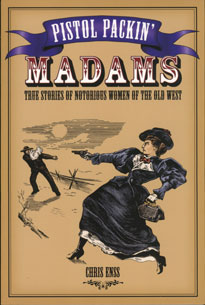
An Excerpt From Pistol Packin’ Madams

Tessie Wall
Barbary Coast Madam

Madam Tessie Wall’s invitation to officers at the annual Policeman’s Ball after laying a $1,000 bill on the bar – 1913

A parade of horse drawn carriages deposited fashionably dressed San Francisco citizens at the entrance of the Tivoli Theatre. A handsome couple holding hands and cooing as young lovers do, emerged from one of the vehicles. A figure across the street, hidden in the shadows of an alleyway, eyed the pair intently. Once the couple entered the building Tessie Wall stepped out of the darkness into the subdued light of a row of gas lamps lining the busy thoroughfare. Tears streamed down the svelte, blonde’s face. The pain of seeing the man she loved with another woman was unbearable.

Several hours before, Tessie and her ex-husband, Frank Daroux entertained passerbys with a robust argument over the other woman in his life. After accusing the man of being a liar and a thief, Tessie begged him for another chance and promised to make him forget anyone else he was involved with.


Frank angrily warned Tessie that if she started anything he would put her “so far away that no one would find her.”

The words he had said to her played over and over again in her head. “You’ve got my husband,” she mumbled to herself. “And you’ll get yours someday. It’s not right.” She chocked back a torrent of tears, reached into her handbag and removed a silver-plated revolver. Hiding the weapon in the folds of her dress, she stepped back into the dark alleyway and waited.

It wasn’t long until Frank walked out of the theatre, alone. Standing on the steps of the building, he lit up a cigar and cast a glance into the night sky. Preoccupied with view of the stars, Frank did not see Tessie hurry across the street and race over to him. Before he realized what was happening, Tessie pointed the gun at his chest and fired. As Frank fell backwards he grabbed hold of the rim of a nearby stage. Tessie unloaded two more shots into his upper body. Frank collapsed in a bloody heap.

Tessie stood over his near lifeless frame, sobbing. When the police arrived she was kneeling beside Frank, the gun still clutched in her hand. When asked why she opened fire on him she wailed, “I shot him, cause I love him, God-damn him!”


Tessie Wall was one of the Barbary Coast’s most popular madams. Since entering the business in 1898 her life had been mired in controversy. Born on May 26, 1869, she was one of ten children. Her mother, who died when she was forty-four, named her chubby, ash-blond daughter Teresa Susan Donahue. Her father, Eugene was a dock worker and spent a considerable amount of time away from home. Teresa and her brothers and sisters took care of themselves.

By the time she turned thirteen, Teresa, or Tessie as she was referred to by friends and family, had developed into a beautiful, curvaceous young woman. She turned heads everywhere she went in the Mission District where she lived.

In 1884, Tessie accepted a marriage proposal from Edward M. Wall, a handsome fireman twice her age. Edward was a heavy drinker and was often out of work because of his “weakness.” Tessie supported them with her job as a housekeeper. Two years after the pair married they had a son. Joseph Lawrence Wall’s life was short. He died four months after his birth from repiratory complications. Tessie was devastated and following her husband’s example, took up drinking to dull the pain.

Joseph’s death had an adverse effect on Edward and Tessie’s relationship. Both blamed the other for their loss. The Wall’s marriage ended in bitter divorce.


Historians believe heartbreak over her child’s death and subsequent demise of her marriage contributed to Tessie’s decision to enter into a life of prostitution.

Before venturing out on her own, Tessie continued to keep house for some of San Francisco’s most prominent citizens. While in their employ, Tessie learned about the unconventional desires and habits many of the elite society members possessed. After learning how much money they were willing to pay for their debauchery, she decided to go into business for herself. In 1898, she purchased a brothel and hired a stable of beautiful young ladies to work for her.

In two years time Tessie’s “lodging house” had become so successful that she was able to open a second brothel.

Tessie Walls’s bordello was visited by some of the wealthiest business men and politicians in the state. Upon entering her business clients were greeted by elegantly dressed women offering them wine and champagne. The home itself was equally inviting and posh. It was furnished with antiques, plush red-velvet sofas and armchairs and a large gold fireplace. The draperies and bedroom furniture was just as ornate. She had a giant, gold Napoleon bed decorated with swans and cupids. The dresser and matching mirror was gilded in gold.


Madam Wall’s parlor house was recognized as one of the best in the city. Tessie herself would spend time with her guests before they left with a lady of their choosing. She listened intently to their stories about life and work and would laugh uproariously at their jokes. Patrons were so captivated by the charms of their host that they often admitted that when they sat down in the parlor and started talking to Tessie they often forgot what they came for.

Tessie Wall knew the importance of advertisement. The method she used to promote her house was unconventional, but effective. She would clothe her girls in the latest garments from Paris and New York and send them out on the street for all to admire. Every Saturday afternoon Tessie’s girls would hold a parade on Market Street. Everyone in the neighborhood would come out to see the new fashions being worn by the demimonde.

Once other madams saw how popular the parades were they launched their own exhibitions. It wasn’t uncommon on weekends to see numerous women marching on opposite sides of the thoroughfare modeling the latest styles. Parlor houses with the best showing reaped the benefits in the evening. Due in large part to Tessie’s welcoming personality and the voluptuous ladies that worked for her, Tessie’s brothel was usually the one that did the most business.


Madam Wall’s parlor house yielded a sizeable profit, but the opportunities the income afforded her and the conversation she enjoyed with an array of customers, couldn’t keep her from thinking about her son. During those melancholy moments she would once again turn to alcohol. By this point in her life Tessie was able consumed enormous quantities of wine and drink most men under the table. Often times she challenged beer drinkers to champagne drinking contests. The famous boxer John L. Sullivan was one such participant. Sullivan was unaccustomed to the effects of champagne and after twenty-one drinks he passed out. Still standing after twenty-two drinks, Tessie won the contest and was forever referred to as “the woman who licked John L. Sullivan.”

The life and business Madam Wall had built for herself was almost destroyed by the great fire of 1906. A massive earthquake rocked San Francisco on August 1, causing electric lights to fall, spark and set fire to buildings and homes along Market Street. The blaze spread throughout the city reducing multiple structures to ash.

Despite her best efforts Tessie’s parlor house did not survive the inferno. The only item she managed to save was the gold fireplace. When she rebuilt the brothel a year later the resilient item was put back in place.


It became the focal point of the house and the subject of much conversation for years to come.

The new parlor house was just as popular as before, but competition from new rival houses had heightened. Jessie Hayman, the madam from a high-class establishment near Tessie’s, had attracted many clients and the business continued to grow daily. Madam Wall was forced to come up with fresh ways to promote her house.

In addition to the weekly parades of her employees dressed in their finest, Tessie decided to show off her staff at music halls and theatres. Every Sunday evening Tessie and her ladies would attend a vaudeville performance at the Orpheum Theatre. She purposely arrived late so all eyes would be focused on her beauties as they made their way to their seats.

The stunt drastically increased nightly business. When Jessie Hayman learned what Tessie was doing she began taking her ladies to the theatre too. On Sunday nights the two madams would try and best each other with grand entrances that seemed to upstage the performers. Determined not to be out done, Tessie decided to keep her girls from attending a couple of shows. The spectacle of their arrival always generated a lot of attention and she hoped their absence would do the same.


The empty seats did peak the public’s interest and just as the conversation about where they were died down, Tessie and her ladies returned. As the lights dimmed, the curtain went up, the music started and Madam Wall and her girls made their way down the aisle. As though on cue, the show suddenly stopped, the house lights were turned up again and all eyes were on Tessie and her ladies.

For every public attempt to increase business there were private deals being made to do the same. It was not uncommon for hotel clerks, bell boys, head waiters, chefs at restaurants and cabbies to be paid handsome sums to direct wealthy men to the finer parlor houses. Such help was generally worth ten percent of the amount earned from that customer.

Over her long career Tessie made friends with several well known figures. One such man was politician Milton Latham who would later become the Governor of the state. At the time of their meeting he was a struggling architect. Tessie was struggling herself. A public outcry against houses like hers from moral citizens prompted city officials to place restrictions on a madam’s ability to add more rooms to their business. Construction on new houses of ill repute were also restricted.


In spite of the limitations Latham wanted to build Tessie a new bordello. Madam Wall laughed at the thought and reminded him of the police blockade on houses like hers. “It’s so strict right now,” she told Latham, “that I can’t even put out red lights or hang red shades.” After Latham managed to convince Tessie that it was doable and his offer was sincere, she agreed to try and acquire a building permit. To her surprise she was granted one.

Latham built an exquisite home in the city’s Tenderloin district. The three story, terra-cotta structure had twelve suites, a large kitchen and dining room, a saloon, three parlors and a ballroom. An average of fourteen women lived and worked at the house. Some came to the ornate business from as far away as France. The majority of Madam Wall’s highly sought after employees were young and blonde. A thirty something brunette known as Black Gladys garnered the most attention at the home.

Madam Wall’s parlor house on 337 O’Farrell Street was a popular stop for college men and young entrepreneurs. Tessie’s clients could pay for the services of her ladies by cash or credit and did not normally spend the night. If gentlemen did stay overnight however, they were sent on their way only after their clothes were pressed and they were served a full breakfast.


Among the many repeat customers at Tessie’s establishment was Frank Daroux. Frank was a gambler and politician. He held a high ranking position within the Republican Party and had a weakness for brothels. One evening in 1909, he wandered into Tessie’s place and was instantly captivated by the flamboyant madam. She was equally charmed by him. Frank invited Tessie to dinner and the two laughed and conversed through an elaborate meal.

The evening left a lasting impression on Frank, not merely because the company was stimulating, but because Tessie drank a considerable amount of wine. In addition to the fine French food the pair was served in a private dining room, Tessie enjoyed twenty bottles of champagne and never left the table.

Tessie was attracted to Frank for a variety of reasons. He resembled Napoleon, a man she thought was devilishly handsome. He was cleaver, smart and well respected in the community. It was that kind of respectability that Tessie longed for. After a whirlwind courtship and significant persuasion on her part, the pair were married.

Frank felt his career in politics would suffer if it was widely known he married a madam so he insisted the wedding take place out of town and then be kept a secret.


Tessie reluctantly agreed to his terms, but made him promise she could host a party to celebrate their commitment to one another. One hundred guests attended the grand affair. They were treated to a delicious feast and eighty cases of champagne.

The Daroux’s marriage was rocky from the start. Preoccupied with his public image, Frank demanded Tessie remove herself as madam and run the business in a more covert manner. Tessie agreed hoping the action would also allow the two to spend more time together. Frank, however, often left his new wife alone while he oversaw the activities at various gambling houses he owned. When he was home neighbors would overhear the pair loudly arguing in the early hours of the morning.

The difficulties between the two worsened when a new mayor and city council, bent on reform, was elected to office. The conservative public servants wanted to stamp out gambling and prostitution in San Francisco. Once the Daroux’s livelihoods were threatened they turned on one another.

In an effort to convince politicians that his business practices and personal life were respectable, Frank removed himself even further from his bride.


He befriended the new elected officials, convincing them that profits earned from his establishment could financially benefit themselves and the city. He attended posh social engagements and rallies unaccompanied by Madam Wall.

The more powerful Frank became politically, the more he tried to persuade Tessie to sell the parlor house. He reasoned that if she got out of the business it would ultimately make him look better once news of their marriage became common knowledge. As further enticement to give up the parlor house, Frank purchased a home for Tessie in the country. The gesture did not bring about the desired result. Tessie refused to leave the bustle of the city. “I’d rather be an electric light pole on Powell Street,” she told her husband, “than own all the land in the sticks.”

No matter how much she might have questioned the wisdom of marrying a man who did not accept her as she was, Tessie’s dreams of being embraced socially by San Francisco’s elite never wavered. She longed to be invited to chic affairs where important and well respected guests appeared.

By the spring of 1911, she had managed to wrangle an invitation to the Greenway Cotillion, a dinner and dance held to honor the city’s founding fathers.


The invitation, for Madam Wall and twelve of her girls, was procured by a politician and regular guest of the parlor house and came with a stipulation. If the ladies chose to attend their identities had to be disguised by champagne bottle costumes they would be required to wear. Tessie agreed.

Her appearance at the cotillion, even if it was disguised, impelled an unnamed socialite to invite Madam Wall to the annual Mardi Gras Ball. Wearing tails and a top hat, Frank attended the gala with his wife. Tessie’s dress was tasteful and understated. She was disappointed, but not surprised that her name was not listed in the local newspaper as one of the Mardi Gras attendees. She remedied the omission by reporting the loss of an expensive diamond broach at the location of the ball. The report was followed by a lost and found article placed in the San Francisco Examiner. Everyone who read the newspaper that day knew the notorious O’Farrell Street madam had been at the Mardi Gras Ball.

Having managed to get herself on the guest list for many more engagements, Tessie was able to convince Frank that she was no longer political poison and was now worthy of a church wedding. Frank consented to a public ceremony, but was adamant about Tessie retiring from the business.


This time she acquiesced and transferred the management of the house to one of her employees. Given the magnitude of the sacrifice, Tessie expected Frank to do something for her. At her request he promised to make all the arrangements for the reception and agreed to her guest list, choice of music and location.

Once a priest who would marry them was secured a wedding date was set. Nearly two years from the date Frank and Tessie were initially married, the two renewed their vows. The second ceremony was held in the rectory of St. Mary’s Cathedral.

Within hours of the nuptials the Darouxs were exchanging insults. Frank had disregarded all of Tessie’s requests for the reception and she verbalized her irritation in a toast where she announced that she was returning to her parlor house business as quickly as she could. Towards the end of the evening the pair had once again reconciled. Frank took that opportunity of brief calm to present his wife with a wedding gift. News of the expensive gesture of affection made the papers the following day.

“$10,000 Pearl Necklace Wedding Gift to Bride/Frank Daroux Marries Miss Theresa Donahue.”

The San Francisco Chronicle – July 12, 1911


After a brief honeymoon, Frank and Tessie returned to the lives they had made for themselves. Frank kept active in politics and oversaw business at his gambling dens. Tessie focused on her brothel. Religious groups staunchly opposed to parlor houses began a crusade to drive them out of business. Madam Wall’s place was a prime target. Frank did nothing to stop the powers-that-be from threatening her livelihood. But that was the least of her problems. Unbeknownst to Tessie, her husband was betraying her in a more profound way.

The Daroux’s relationship had always been a volatile one. They never shied away from quarreling in public. Frank grew tired of the embarrassing outbursts and was frustrated with the way it was diminishing his influence on key political figures. His attention eventually turned to a less combative woman he met at a fund raiser. In 1915, the two began having an affair. Tessie found the pair out and vowed to kill the woman if she came near her husband again. Frank stayed in the marriage another two years before walking out on Tessie and filing for divorce.

Like all of the other disagreements Tessie and Frank had in their eight years of marriage, the fight over how their union would end was made public as well.


Tessie made it clear to all who would listen that she did not want to lose Frank and she contested the divorce numerous times. After a long and vicious court battle the marriage was finally dissolved.

Tessie returned to her house to nurse her wounds. Her heart was broken. She couldn’t accept that Frank was officially out of her life. In a desperate attempt to win him back she secretly followed him around, waiting for a chance to speak with him and convince him to return to her.

The evening Frank was shot the two had quarreled over Tessie’s threat to appeal the divorce. Frank warned his ex-wife that he’d “break her” if she went through with the action. He hurled a string of obscenities at her as he turned and walked away. She heard from a friend that Frank and his mistress were going to attend the theatre that evening and she decided to confront the two there.

“Then I didn’t know what I did,” Tessie explained to the police after the shooting. When asked about the gun Tessie told authorities that she bought it because of the other woman. “That woman took my husband away from me,” she cried. “For three or four years she has been going with him. It made me mad.” Tessie pleaded with police to take her to the hospital where Frank was so she could see him.


As they transported the sobbing madam to the sanitarium, she professed her undying love for her “darling husband.”

Frank was conscious when Tessie entered the emergency room. The three bullets she had emptied into his upper torso had missed his vital organs. Doctors expected him to make a full recovery. The police escorted Tessie to his bedside and asked Frank if she was the one who shot him. “Yes, she shot me,” he responded. “Take her away. I don’t want to see her.” According to the San Francisco Chronicle, “Tessie Daroux lifted her handkerchief to her face in a gesture of horror and reeled back into the arms of the officer.”

Madam Wall was booked on a charge of intent to kill and held without bail for three months. Bail was finally granted when Frank was given a clean bill of health. In a move that surprised everyone, Frank announced to authorities that he had made a decision not to press charges on Tessie. She took the news as a sign of his continued affection for her and filed an appeal on the divorce. Frank had hoped the incident and his willingness not to prosecute would drive Tessie away. Once he found out that she was appealing the divorce he changed his mind about pressing charges.

?


The shooting and subsequent court activity was front page news. The scandal reeked havoc on Frank’s political future. His peers informed him that he was a liability and suggested relocating. Frank agreed, reversed his decision again about having Tessie prosecuted and made arrangements to marry his mistress.

Days before Frank was to marry the other woman. Madam Wall again took gun in hand. This time she set out to kill her rival. When she found her eating lunch at a popular restaurant, Tessie shot through the glass window at the future Mrs. Daroux. Her aim was poor and the woman was not hit. Tessie was arrested and while she was being held, Frank remarried. With the stipulation that Tessie not be released until they left town, Mr. And Mrs. Daroux agreed not to press charges. Frank and his bride then moved to the east coast.

Madam Wall went back to her parlor house, boxed up all of the busts and painting she had of Napoleon and stored them away. She never fully retired from the trade and remained a controversial figure throughout the duration of her life.

On the morning of April 28, 1932, Tessie pulled an impacted tooth that had been bothering her. That evening she died of a hemorrhage following the extraction.


Newspapers marked her passing with an obituary Tessie had preapproved.

“One more bit of “the San Francisco that was” has drifted off in that uncharted Sargossa that holds the old Barbary Coast, the Poodle Dog, the Silver Dollar, the Bank Exchange, the Mason Street Tenderloin and those other gay haunts that made San Francisco famous through the Seven Seas.”

The San Francisco Chronicle – April 30, 1932

Mrs. Teresa Susan Wall Daroux was 63 years-old.

“Drink that up, boys! Have a drink on Tessie Wall!”

An Excerpt From The Doctor Wore Petticoats

Nellie Mattie MacKnight

The Beloved California Physician

“Taken as a whole they will probably never amount to much unless the experience of the past belies that of the future. While this is so, yet no person of extended views or liberal ideas can desire to see the doors of science closed against them.”

Doctor R. Beverly Cole, prominent male physician in a speech delivered to members of the California Medical Society -1875Eighteen year-old Nellie Mattie MacKnight stepped confidently into the spacious dissecting room at San Francisco’s Toland Hall Medical School. Thirty-five male students stationed around cadavers spread out on rough board tables, turned to watch the bold young women enter. The smell of decomposing corpses mixed with tobacco smoke wafting out of the pipes some of the students were puffing on assaulted Helen’s senses. Her knees weakened a bit as she strode over to her appointed area, carrying a stack of books and a soft, rawhide case filled with operating tools.


To her fellow students Nellie was a delicate female with no business studying medicine. Determined to prove them wrong she stood up straight, opened her copy of Gray’s Anatomy and removed the medical instruments from the case.

It was the spring of 1891. She nodded politely at the future doctors glowering at her. A tall, dapper, be speckled professor stood at the front of the classroom watching Nellie’s every move. The sour look on his face showed his distain for a woman’s invasion into this masculine territory. “Do you expect to graduate in medicine or are you just playing around,” he snarled? The blood rushed to Nellie’s face and she clinched her fists at her side. She had expected this kind of hostile reception when she dared to enroll, but was taken aback just the same. “I hope to graduate,” she replied firmly. Disgusted and seeing that Nellie could not be intimidated, the professor turned around and began writing on a massive chalk board behind him. The students quickly switched their attention from Nellie to their studies. Nellie grinned and whispered to herself, “I will graduate…and that’s a promise.”

Nellie got her resolute spirit from her mother. Olive Peck MacKnight raised her daughter virtually alone, enduring many trials while providing for her only child.

Nellie was born to Olive and Smith MacKnight on December 15, 1873 in Petrolia, Pennsylvania. She was one of three children for the MacKnights. Their son and first daughter died shortly after they were born.

Olive was very protective of her surviving child and Smith, a land surveyor by trade, constantly showered his “only little girl” with attention. According to her autobiography Nellie’s early years were happy ones. She was surrounded by the love and affection of her parents and numerous extended family members.

In 1878, Smith MacKnight contracted a contagious case of gold fever that drove him to leave his wife and child and head West. Before he left he sent Olive and Nellie to live with his mother and father in New York. He promised to send for the pair once he had found gold. Olive was distraught about having to move from their home and the prospect of being without her husband. It was a heartbreaking experience from which Olive never fully recovered.

By the time Smith’s first letter from California arrived, five year-old Nellie and her mother had settled into life on the MacKnight farm. The absence of Smith made Olive quiet, withdrawn and despondent. Outside of her daughter she seemed content to be left alone. Nellie on the other hand was outgoing and cheerful. She was particularly close to her grandmother whose character was much like her own. Grandmother MacKnight taught Nellie how to cook and quilt and how to prepare homemade remedies for certain illnesses.

Her grandfather and uncle taught her how to ride a horse and care for animals.

As Olive slipped further into depression, Nellie became more attached to her grandparents. A letter from Smith announcing that he had purchased a mine with “great potential” momentarily lifted Olive’s spirits and gave her hope that they might be together soon. Several days later news that Olive and Nellie would have to wait for the mine to pay off before Smith sent for them left devastated all over. The dispirited woman nightly cried herself to sleep.

The stability Nellie had come to know at her grandparent’s home ended abruptly one evening in October of 1880. Her grandmother contracted typhoid fever and died after a month of suffering with the illness. Helen watched pallbearers carry her grandmother’s wooden coffin into the cemetery. She wept bitterly wishing there had been something she could have done to save her. The subsequent death of her favorite Uncle, suffering from the same ailment, served as a catalyst for her interest in healing.

Fearing for the physical well being of her daughter, Olive moved Nellie to her father’s home in Madrid, Pennsylvania. Any hopes the two had that their circumstances would improve at their new location were dashed when Olive became sick and collapsed. The high temperature from the typhoid fever mad Olive delirious. She didn’t recognize her surroundings, her family or her child and cried out constantly for her husband.

Olive recovered after several weeks, but the fever and the sadness of being separated from Smith, had taken its toll. Her dark hair had turned gray and the dark hollows under her eyes were a permanent fixture.

Smith’s mine in Bodie, California had still not yielded any gold and he was unable to send any money home to support his family. In order to keep herself and Nellie fed and clothed, Olive took a job at the Warner Brothers’ Corset Factory. Nellie attended school and excelled in all her subjects, showing an early aptitude in medicine. She poured over books on health and the human body.

When Nellie wasn’t studying she spent time trying to lift her mother’s melancholy spirit. Letters from Smith made Olive all the more anxious to see her husband again and even more broken hearted about having to wait for that day to come.

She began using laudanum, a tincture of opium used as a drug, to ease the pains she had in her hands and neck. The pains in her joints was a lingering effect of the typhoid fever. Olive developed a dependence on the drug and one night overdosed. She left behind a note for her daughter that read, “Be a brave girl. Do not cry for Mamma.” Smith was informed of his wife’s death, and although he was sad about the loss, he opted to continued working his claim.

The day after Olive was laid to rest, ten year old Nellie was sent back to New York to live with her father’s brother and his wife. Nellie’s uncle was kind and agreeable, but her aunt was not. She was resentful of Nellie being in the home and treated her badly. Nellie endured her aunt’s verbal and physical abuse for two years until her mother’s sister invited Nellie to live with her at her farm four miles away.

Nellie adapted nicely to the congenial atmosphere and learned a great deal from her aunt about primitive medicine. After a short time with her aunt, Nellie finally received word from her father. Smith was now living in Inyo County, California and working as an assayer and surveyor. Nine years of searching for gold had turned up nothing. Smith decided to return to his original line of work and he wanted his daughter by his side.

Fourteen year-old Nellie met her father on the train in Winnemucca, Nevada. Smith agreed to meet with her there and escort her the rest of the way to his home. Although his face was covered with a beard and his eyes looked older, Nellie knew her father when she saw him. Smith, however, did not instantly recognize his child. He wept tears of joy as she approached him. “You’re so grown up!” he told her. Little time was spent before the pair were made to take their seats to continue their journey. Father and daughter had a long way to travel before they reached Smith’s cabin in Inyo County. As the train sped along the tracks, Nellie was in awe of the purple blossoming alfalfa that grew along the route and of the grandeur of the Sierra Mountains.

Nellie continued to be impressed with the sights and people she encountered during their two day trip to the homestead in Bishop. Smith promised his daughter a happy life among the beauty and splendor of the California foothills. Nellie recorded in her journal how exciting, gay, and carefree she found her new home to be.

“The streets of the town were like a country road, lined with tall poplars and spreading cottonwoods – quick growing trees marked boundary lines and gave shelter to man and beast. Their leaves were pieces of gold in the sunshine.”


Nellie MacKnight – 1887


After a brief stay at her father’s ranch, Smith enrolled Nellie at the Inyo Academy. Not only would she be studying at the school, but living there as well. Smith spent a great deal of time on surveying trips and wanted Nellie to be in a safe place while he was gone. The Inyo Academy was home to many young men and women whose parents were ranchers and cattlemen from all over the country. Nellie thrived at the school, and once again excelled in ever subject. She was valedictorian of her class when she graduated from the Academy.

Smith insisted the now seventeen year-old Nellie should go to college and continue her education. She was in favor of the idea and decided to pursue studies in literature. Smith promised to pay for her schooling only if she chose law or medicine as her point of interest.

“If I wished an education I must abide by his decision. My only knowledge of the law was “the quality of mercy.”

My only picture of a woman doctor was that of Doctor Mary Walker, dressed in men’s clothes and endeavoring in every way to disguise the fact that she had been born a woman. That I should choose neither was unthinkable.”

Nellie MacKnight – 1887

As Nellie contemplated her decision her thoughts settled on her grandmother’s struggle with typhoid fever and her mother’s fatal attempt to ease the physical pain she suffered. It didn’t take Nellie long to come to the conclusion that her “calling” was in medicine.

Just prior to Nellie graduating from the Academy her father remarried. Nellie’s initial reaction to her step-mother was one of indifference, but as she got to know her she had a change of heart. She was an extremely kind woman and never failed to show Nellie love and compassion. She encouraged her step-daughter in her future endeavors and cried for days when Nellie moved to San Francisco to attend medical school.

Smith accompanied his only child to the Bay area and on to Toland Hall Medical College. He paid her tuition, helped her find a place to live, wished her well, and returned to Bishop. Their parting was difficult. Nellie was grateful for the opportunity he was giving her and vowed to be home soon with a diploma in hand.

Neither fully realized how difficult it would be to fulfill that promise.

The attitude of many of the Toland Hall professors and students towards women in medicine was vicious. Most felt a female’s presence in the medical profession was a joke. Nellie was aware of the prevailing attitude and was determined to prove them wrong. She devoted herself to her studies, arriving at school at dawn to work in the lab. She kept late hours, pouring over Gray’s Anatomy and memorizing the definitions of various medical terms.

The harder she worked the more resentful her male counterparts became. Classmates exchanged vulgar jokes with one another whenever the women were around in hopes of breaking their spirits. Professors were cold and distant to Nellie and the two other women at the school – often times refusing to answer their questions. Doctor R. Beverly Cole, Toland Hall’s Professor of Obstetrics and Gynecology, delighted in insulting female students during his lectures. He maintained publicly that “female doctors were failures.” “It is a fact,” he told students, “that there are six to eight ounces less brain matter in the female. Which shows how handicapped she is.”

Nellie quietly tolerated Doctor Cole’s remarks and allowed them only to spur her on towards the goal of acquiring a degree.

While in her third year of medical school, Nellie took an intern position at a children’s hospital. Many of the patients that allowed her to care for them were Chinese. She assisted in many minor operations and births and helped introduce modern forms of cures that countered the Far East’s approach to handling illnesses.

Months before Nellie was to graduate she was granted permission to assist in a major surgery. Two physicians were required to perform an emergency mastoid operation on a deathly ill docks worker. Nellie was one of two interns on duty and the only woman. The male intern fainted at the site of the first incision. Nellie was a bit uneasy as well, but assured the doctor she could do the job when he ordered her at his side.

“The surgeon talked as he worked. He described the blood supply, the nerve supply, the vessels that must be avoided, the paralysis that would follow if he invaded the sacred precinct of the facial nerve. Chip by chip he removed the bone cells, but the gruesome spectacle had been magically transformed into a thrilling adventure.

I forgot that I had a stomach; forgot everything but the miracle that was being performed before my eyes, until the last stitches were placed, the last dressings applied.”

Nellie MacKnight – 1893

Nellie eagerly looked forward to graduation day. In spite of the fact that her grades were good and her talent for medicine was evident, the male faculty and students remained unimpressed with her efforts. She was confident that when she and the two other female students accepted their diploma the men would be forced to recognize that a woman’s place in the emerging profession is a definite.

Shortly after passing her final examination Nellie was summoned to the Dean’s office. He was a man who did not share Nellie’s vision for a woman’s role in medicine and because of that she feared he was going to keep her from graduating. The matter he wanted to discuss was how she wanted her name to appear on the diploma. She told the Dean that her christened name would be fine. The man was furious. “Nellie Mattie MacKnight?” He asked her annoyed? “Nellie Mattie?” Nellie did not know how to respond. “How do women ever expect to get any place in medicine when they are labeled with pet names,” he added?

The Dean persuaded Nellie to select a more suitable name. She searched her mind for names in which her name had been derived. “I had an Aunt Ellen…and there was Helen of Troy…,” she thought aloud. “You may write Helen M. MacKnight,” she said after a moment of contemplation. The Dean informed her that he would make the necessary arrangements. Before she left his office he added, “See that it is Helen M. MacKnight on you shingle too!”

Nellie graduated with honors from Tolland Hall Medical School. Her father and step-mother were on hand to witness the momentous occasion. As her name was read and the parchment roll was placed in her hands she thought of her mother and grandmother and pledged to help cure the sick. Chances for women to serve the public in that capacity were limited, however. Widely circulated medical journals stating how “doubtful it was that women could accomplish any good in medicine,” kept women doctors from being hired. They criticized women for wanting to “leave their position as a wife and mother,” and warned the public of the physical problems that would keep women from being professionals.

“Obviously there are many vocations in life which women cannot follow; more than this there are many psychological phenomena connected with ovulation, menstruation and parturition which preclude service in various directions.

One of those directions is medicine.”

The Pacific Medical Journal – 1895

In San Francisco in 1983, there was only one hospital for women physicians to practice medicine. The Pacific Dispensary for Women and Children was founded by three female doctors in 1875. The facility was designed to provide internship for women graduates in medicine and training for women in nursing and like professions. Nellie joined the Pacific Dispensary staff, adding her name to the extensive list of women doctors already working there from all over the world.

In the beginning, Doctor MacKnight’s duties were to make patient rounds and keep up the medical charts by recording temperatures, pulses and respiration. After a short time she went on to deal primarily with children suffering from tuberculosis. She also assisted in surgeries, obstetrics, and was involved in diphtheria research.

In 1895, Nellie left the hospital and returned home to help take care of her ill stepmother. Within a month after arriving at her parent’s her stepmother was on her way to a full recovery. Nellie decided to stay on in Bishop and set up her own practice.

The response she received from the community and the two other male physicians in town was all too familiar to her.

She persevered, however. She set up an office in the front room of the house where she lived, stocked a medicine cabinet with the necessary supplies, and proudly hung out a shingle that read Helen M. MacKnight, M.D., Physician and Surgeon.

Doctor MacKnight traveled by cart to the homes of the handful of patients who sought her services. She stitched up knife wounds, dressed severe burns, and helped deliver babies. As news of her healing talents spread her clientele increased. Soon she was summoned to mining camps around the area to treat typhoid patients. Although her diploma and shingle read Helen M. MacKnight, friends and neighbors who had known her for years called her “Doctor Nellie.” It became a name the whole countryside knew and trusted.

While tending to a patient in Silver Peak, Nevada, Nellie met a fellow doctor named Guy Doyle. The physicians conferred on a case involving a young expectant teenager. Doctor Doyle treated Doctor MacKnight with respect and kindness. Nellie was surprised by his behavior.

“I had worked so long, fighting my way against the criticism and scorn of the other physicians of the town, that it seemed a wonderful thing to find a man who believed in me and was willing to work with me to the common end of the greatest good to the patient.”

Nellie MacKnight – 1898

What began as a professional relationship grew quickly into romance. The couple decided to pool their resources and go into business together. They opened an office inside a drugstore on the main street of Bishop. In June of 1898, Helen and Guy exchanged vows in a ceremony that was attended by a select few in Inyo County.

“My wedding dress was a crisp, white organdy, with a ruffled, gored skirt that touched the floor all the way around. The waist had a high collar and long sleeves. The wedding bouquet was a bunch of fragrant jasmine…. A small group of friends came to witness the ceremony, and the gold band that plighted our troth was slipped over my finger.”

Nellie MacKnight – 1898

Doctor Nellie MacKnight Doyle and Doctor Guy Doyle provided the county with quality medical care for more than twenty years. The couple grew their practice and took care of generations of Bishop residents. Nellie and Guy had two children – a girl and a boy.

When their daughter grew up she decided to follow in her mother’s footsteps and pursue a medical degree. Upon her graduation from college she was given a foreign fellowship in bacteriology.

Doctor Nellie M. MacKnight spent the last thirty years of her life studying and practicing anesthesiology. She died in San Francisco in 1957 at the age of 84.

An Excerpt From Hearts West

Eleanor Berry and Louis Dreibelbis

The Schoolmarm and the Scoundrel


“Lonesome miner wants wife to share stake and prospects. Please respond to Louis Dreibelbis in Grass Valley, California.”

The San Francisco Magazine – April 12, 1873


“Please come out, Eleanor,” the frail voice of an elderly Ida Eigleberry pleaded from one side of a closed door leading into one of the rooms in her boarding house. She knocked lightly, but urgently on the frame, but there was no answer. Ida turned the knob and gently pushed the door open. Her senses were immediately assaulted with chloroform fumes.

Choking back violent coughs she made her way to a still body on the other side of the suite. Twenty-two-year-old Eleanor Berry was laying face down on the mattress and a handkerchief was covering her head. The old woman quickly evaluated the desperate scene and panicked, racing out into the hallway. “Norman!” Ida called out to her husband. “Run and get the doctor. I’m afraid our Eleanor has gone and done something foolish.”


According to the historical publication The Californians, if Eleanor Berry had gotten her wish she would have expired a month prior on July 27, 1873. She reasoned that if her life had ended on her wedding day she might have escaped the degradation and heartbreak that was to come. But alas, God had not struck her dead and now the deed was left to her.

Eleanor’s life began in the spring of 1851 in Gilroy, California. Her parents died when she was an infant and so she was raised by the Eigleberrys, the family neighbors. She grew to be an attractive young lady, and chose to teach school as her profession. Still single at the age of twenty-two and fearing she always would be, Eleanor responded to an advertisement posted in a bay area literary journal. Louis Dreibelbis, the author of the advertisement, was searching for a wife and was thrilled to receive Eleanor’s letter about his ad. In the advertisement, Louis described himself as a wealthy, average looking man eager to settle down.

Letters between the two went back and forth from Eleanor’s home in Gilroy to Louis’s in Grass Valley. The pair corresponded for three months. She was quite taken with his candor and praise of her desire to work with children.


“Such a woman will make a fine mother,” he wrote. Louis found Eleanor’s letters to be “intelligent and sincere in tone.”

It did not take long for the mutual attraction to evolve into affection. Louis’s letter of proposal was met with enthusiastic acceptance. The couple decided on a wedding date of July 27, 1873. After resigning her position as Gilroy’s school mistress, Eleanor packed her trunk and boarded an East-bound train to meet Louis for the first time and marry him.

Eleanor fanned herself with a newspaper as she took her seat on the train. The temperature inside the Central Pacific passenger car was oppressive. Hotter than the ninety-five degrees outside the train. She was accompanied by several passengers who were making their way to the mining camps near Grass Valley in Nevada County. Once the train reached Colfax the bride-to-be and her belongings were transferred to a six-horse stage coach. Of the thirteen passengers on board, Eleanor was the only woman.

The stage driver promised Eleanor and the other passengers a safe trip and tried to assure them that they would not be overtaken by *highwaymen. Given the cargo, the driver no doubt needed to reassure himself of that notion as well.


Nestled between the trunks and suitcases was a safe containing $7,000 in gold that was to be deposited into a Grass Valley bank.

The trip was relatively uneventful for the first leg of the journey. According to one newspaper account, the passengers passed the time on the eight hour journey swapping stories about the places they had lived or visited. Eleanor contributed to the conversation as well, trading brilliant remarks and witty banter with other passengers. The men admired her “vivacity and charm.”

During lulls in the conversation, Eleanor daydreamed about her upcoming nuptials and life thereafter. She removed a few letters from her handbag that Louis had written her and reread them. She smiled to herself imagining she and her betrothed standing at the altar, looking into one another’s eyes, and seeing all the possibilities to come. The coach’s abrupt stop brought her back to the present, tossing her on the floor in the stagecoach.

A gruff voice outside the buggy demanded the passengers step out with their hands in the air. She exchanged anxious glances with the wide-eyed travelers next to her as they reluctantly did as they were told.


Four armed men wearing gunny-sack masks over their heads shouted at the passengers. The bandits eyed their victims carefully. For a moment no one made a move. Then the driver lowered his arms a bit and a highwaymen with a six-shooter pulled the hammer back on the gun. The driver’s arms shot back up.

“We’ll take your treasure box,” the man with the six-shooter demanded.

“It’s on the other stage,” the driver insisted. The bandit snickered. “Then we’ll keep you here until the other stage comes around,” he warned.

The driver studied the dress of the bandits for a quick moment. Their feet were encased in gunny-sacks and tied in place at the ankle, a trick professionals used so no visible footprints would be left for a posse to follow. The driver realized these were ruthless desperados who would make good on their threats and finally relented. “It’s no use fooling any longer,” he said. “This is the only stage tonight.”

The man with the six-shooter snickered again. “That’s what we thought.” A bandit carrying a shotgun aimed the barrel of the weapon at the driver’s head and motioned for him to move away from the stage. The two other thieves instructed the passengers to do the same.


After lining the travelers up against a nearby fence, the gunmen climbed on top of the stage and headed for the strongbox attached to the coach. Several attempts were made to break into the safe with a pick, but to no avail. The thieves decided to blow the lock with gunpowder.

Eleanor looked on in horror as one of the men hauled a small canister of gun powder from his saddlebag on the stage. The safe was in direct proximity to the passengers luggage. An explosion would destroy the trunks and all of their belongings. “Stop,” Eleanor yelled. The men halted their work to listen to the prospective bride. “Gentlemen, my trousseau is in my trunk. Won’t you take it down before you blow up the coach?”

The thief with the six-shooter stood up and backed away from the safe. “With pleasure, miss,” he replied. Eleanor walked over to the stage as the robber chief jumped off and motioned for the gunmen near the safe to toss her trunk down. As he reached up to take hold of the trunk Eleanor noticed a long, jagged scar on the back of the man’s hand. She filed the image away in her mind and was pleased at the site of her possessions being returned to her. The highwaymen turned away and went about his business.

KABOOOOOOMMMM!!!


Seconds after the robbers lit the fuse on the canister of gun powder a fierce explosion ripped through the stage coach. The thieves wasted no time searching through the rubble to find the gold. After securing their ill-gotten-gain in their saddlebags, the leader hopped on the back of his horse. “Come on!” He yelled to his cohorts. Following suit the gunmen leapt onto their rides and all four hurried off into the trees, disappearing from sight.

The shaken driver inspected the damage to the coach and determined that the frame of the stage and the running gear were still intact. The spooked horses were settled and readied to continue the journey to Grass Valley. The passengers found their places on the shattered coach and they were off.

Upon their arrival into Nevada City, the crime was quickly reported to the authorities and police officers immediately set out to apprehend the culprits. The stage then proceeded on to its appointed destinations, first depositing Eleanor at the cottage of her betrothed.

Louis Dreilbebis’s landlady greeted the exhausted bride and informed her that her fiancé had been called out of town, but that he would return shortly. The kind woman escorted Eleanor into the home and to a room where she could prepare for the wedding.


The bride-to-be washed away the dust and dirt from her travels in a bath the landlady drew for her. After which she dressed in her most elegant attire, pinned up her hair and made up her face.

“It’s time, dear,” the landlady said as she burst into the bedroom. Eleanor quickly stood up, smoothed down her dress and checked her look in the mirror. The next time she would see her reflection she would be Mrs. Louis Dreilbebis.

Eleanor entered the parlor smiling nervously. There were two men sitting off to one side, one a minister and the other a witness. Opposite the pair, Louis stood dressed in his Sunday best. Eleanor found his eyes and the pair sized each other up for the first time. He looked considerably older than she expected, but there was a strength of character in his face that she always imagined her husband to have. Louis, on the other hand, was taken aback for a moment, almost as if he was surprised to see her. He covered his response with a slight smile before drinking in the petite, agreeable features of his fiancé.

The minister took his place in front of a fireplace and the bride and groom made their way towards him. The minister happily opened the Bible he was holding and began the proceedings. As the couple recited their vows to one another Eleanor paused between pledges to think.


Louis’s voice sounded strangely familiar.

“We’ve been corresponding for months,” she thought to herself. “Perhaps what I recognize is the echo of the idea of him in my head.” The minister pronounced the two “man and wife” and Louis timidly leaned in to kiss his spouse. Their embrace was brief and awkward. The minister rescued them from the tense moment by escorting the newlyweds to a table to sign the marriage license.

Eleanor took the ink pen in hand and placed her name in the appropriate area. Louis followed suit once she passed the pen to him. The light from the flames in the fireplace reflected off his hand revealing a long, jagged scar. Eleanor knew in an instant where she’d seen the mark before the color drained from her face and she screamed. She hurried out of the parlor and locked herself in her assigned quarters.

Louis looked on, stunned, not knowing what to say or do. Of course he had recognized Eleanor as the young woman on the stage he had robbed earlier, but did not imagine that she had recognized him. He raced out the home, mounted his horse, and rode off into the night, saying nothing to the landlady, minister, or witness when he left.

The landlady pressed her ear to the bedroom door and listened for a sound on the other side. Eleanor was crying.


Too ashamed to face anyone and wishing she would simply expire, she remained holed up in the room until the next morning.

The unfortunate bride stepped into the parlor the next day, her face wet with tears. The minister and landlady greeted her with apologies and words of comfort. Eleanor looked at them confused. “Mr. Dreilbebis and I never married,” she told her compassionate new friends. “I have no memory of a wedding, only a dream that in the night I was carried off by robbers.”

The minister and the landlady exchanged a worried glance. The shock from the previous day’s events must have left her disoriented they thought. “I’ve changed my mind about taking, Mr. Dreilbebis as my husband,” she told the pair before her. “He’s not as well fixed as I expected to find him.”

After packing her trunk and soliciting a ride to the stage stop from the minister, Eleanor was on her way back to her home in Gilroy.

Nevada County Sheriff’s deputies caught up with Louis Dreilbebis more than two months after the wedding. He confessed to his crime, turned states evidence, testifying against his fellow bandits, and was subsequently released without charge.


The detective who initially located Louis, bought him a one-way ticket to his hometown in Illinois and warned the robber against ever returning to California.

Eleanor slipped into Gilroy under the cover of darkness. She was too embarrassed and ashamed to admit to her friends and neighbors she had married a thief. For anyone who dared ask what happened she maintained that her mail-order groom had not been what she expected. Eventually the truth of the ordeal became public knowledge and Eleanor was the topic of conversation. Humiliated beyond words, the young woman decided to commit suicide.

The distraught mail-order bride’s life was saved by the fast action of her guardian and local doctors. It is not known what became of Eleanor after she was revived and brought back to good health. Historians speculate that her broken heart mended and that true love eventually made her forget her first trip to the altar.

*Highwaymen – One who robs on the public road; a highway robber.