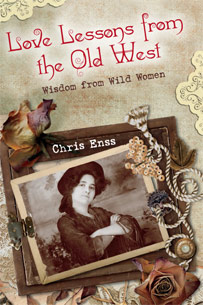
Most men in the early days of the Old West lost interest in a woman who was skilled in the art of cursing. Some believed that St. Peter wouldn’t accept women who used profanity regularly. Too bad Calamity Jane didn’t know this love lesson. Love Lessons of the Old West coming soon to a book store near you. 
Journal Notes
Zorro
Zorro was a huge hit during the fifties and sixties. The daring masked man in black cape who made his signature Z with quick slashes of his rapier was imitated by millions of kids; Z’s carved into the tops of wooden school desks across the country became epidemic. There were many Zorros, but the one best known on the early TV series was played by Guy Williams, born Armando Catalano-six feet 2 inches, handsome, athletic. He had more than a few would-be senorita-moms turning the show on for their children. Finally unmasked, Zorro died in 1989 at age sixty-five of a brain aneurysm. 
Red River Star
If you die at the height of your fame, you can achieve immortality. If you live long enough for your fame to fade, you are forgotten. Montgomery Clift belongs in the latter category. In the early 1950s his moody, sensitive performances in A Place in the Sun, From Here to Eternity and Red River made him a major heartthrob. More than that, he added an introspective, psychological dimension to those roles which made him the idol of two men who would become the most popular actors of the decade, Marlon Brando and James Dean. But by the time Clift died a little over a decade later, his obituary wasn’t front-page news. And unlike other ill-fated stars of the decade, such as James Dean and Marilyn Monroe, the forty plus years since Clift’s death have produced only three or four biographies of his life. Clift had been on Broadway since he was 14, but fame in Hollywood seemed to strike him differently. Three years after his first film, in 1948, he was treated for alcoholism. Some said it had to do with his insecurity concerning his many clandestine homosexual affairs. But whatever the cause, it turned a thoughtful, delicate actor into an inarticulate one. He soon began mixing pills, mostly depressants, with his drinks. He threw food at dinner parties, threw childish tantrums, and suffered blackouts. By the late 1950s movie studios were reluctant to cast Clift, especially since his last few films had not been hits. He showed up in supporting and cameo roles, but even then his long scenes would have to be chopped up because he couldn’t remember all his lines for one take. In 1966, after not working at all for four years, Clift was cast as the lead in The Defector. It was a B-movie spy thriller and he knew it, but he treated it as his comeback. To prove to the studios he was reliable star, he insisted on performing all his own stunts, including a grueling swim in the freezing Danube River, even as he was suffering from phlebitis and cataracts and was trembling. Clift, still drinking, seemed happy with his performance. But then he saw a rough version of the movie. In it the 45-year-old actor looked like an old man. He returned to New York that summer deeply depressed and drinking even more. In mid-July he saw or spoke to several of his remaining friends. He was uncharacteristically emotional, and some later believed he was telling them goodbye. He spent Friday night, July 22, alone in his bedroom, which was not unusual. But his male nurse was concerned when he found the door locked at 6 a.m. Saturday. He discovered Clift lying face up on his bed, dead, and wearing only his glasses. An autopsy revealed that the faded film star had suffered a heart attack. But one friend, reflecting on Clift’s last thirteen years, called it “the slowest suicide in show business.” 
Brando
Marlon Brando, born to two alcoholic parents, was the third actor to receive two best actor Oscars: On the Waterfront (1954) and The Godfather (1972). He turned down the second award in protest for treatment of Native Americans, as well as a reluctance to glorify the mafia. Toward the end of his days, his life became more of a drama than any he portrayed on screen: His self-imposed exile on Tahiti, his son’s murder trial (where he refused to take an oath, claiming he as an atheist), and his growing size, obesity, and blindness. He died in 2004 at the age of eighty of lung failure owing to pulmonary fibrosis, excessive scar tissue in the lung. Brando said, “I don’t mind that I’m fat. You still get the same money.” He was paid $4 million for his ten minutes’ performance in the movie Superman. 
Chalk Beeson
Well-known Dodge City, Kansas lawman and politician, Chalk Beeson claimed he “drank bullets in his coffee for breakfast.” Few doubted how tough Sheriff Beeson was particularly desperados raising hell in Ford County, Kansas. Born in Salem, Ohio in 1876, the highly esteemed, man of nerve had a reputation for tracking even the most wanted criminals down until they were caught. On November 1892, Chalk decided to ride into the Oklahoma Territory on his own to capture the notorious Doolin Gang. The gang had robbed the Spearville Ford County Bank in broad daylight and Chalk was not going to let them get away with it. According to the August 12, 1912 edition of the Hutchinson, Kansas newspaper the Hutchinson News, Chalk was so provoked by the Doolin Gang’s actions that he refused to wait until a posse was formed before he took out after the bandits. “He went to Oklahoma under an alias”, the newspaper article read, “and when he found the headquarters of the gang neat Ingalls, he went to Guthrie and was appointed a deputy United States marshal, as he was far out of his juristic as sheriff.” One particular man in the gang Chalk was determined to arrest was Oliver Yantes, who was living with a woman in a cabin five miles from Ingalls. Chalk and a lawman he believed he could trust, rode to the Yantes cabin and they hid along the path a few feet away from the entrance. Chalk concluded that Yantes would have to travel the path the following morning in order to take care of his horses. When Yantes appeared Chalk ordered him to throw up his hands, but instead of doing what the officer ordered the bandit attempted to run. The plan had been for the deputy to shoot the desperado if he offered resistance while Chalk watched for fear other members of the gang might be there. The mist had dampened the caps of the deputy’s gun and when he failed to fire Chalk believed the lawman had been betrayed. Chalk fired on Yantes just as the woman ran from the house with the bandit’s revolver. Yantes was fatally wounded and died before Chalk could get him to Ingalls. Chalk collected the reward offered by the state, the banks, the railroads, and the insurance company for the apprehension of any member of the Doolin Gang, dead or alive. In addition to serving three terms as sheriff of Ford County, Chalk also served as a representative of the area in the state legislature from 1902 to 1906. Chalk’s abilities extended beyond his work in law enforcement and politics. He was an accomplished horse trainer and an expert musician. He could play the violin, trombone, and French horn. In 1885 Chalk founded the Dodge City Cowboy Band. The band was made up of more than eighteen men – drummers, trumpet and fiddle players. The Dodge City Cowboy Band performed at the Long Branch Saloon, owned by Chalk, and entertained local citizenry by marching in parades. The band wore they best cowboy attire including their six guns which they fired in the air to punctuate a chord or musical phrase. The tough and talented Chalk met his demises on August 9, 1912. Three days prior to his death Chalk was sitting atop his horse at the C.O.D. Ranch, watching a nearby road construction crew work. His mount was suddenly spooked. The horse bucked and reared and before Chalk was able to get the animal under control it threw him hard against the saddle horn. Chalk never recovered from the serious injury. Chalk Beeson’s well-attended funeral was held on August 11, 1912 at his ranch. Local businessmen and luminaries spoke highly of the contributions he had made to the community. Benevolent and fraternal society members, as well as civic and church representatives turned out to brag about all he did to make Dodge City a safe place to live. The comment mourners uttered the most, after noting the positive impact he’d had on Ford County, was “we just thought that one of Chalk Beeson’s strengths could withstand the worst kind of injury.” 
True Grit
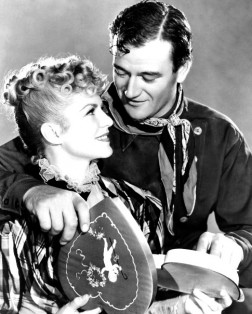
After acting as either a cowboy or a soldier in nearly one hundred films, John Wayne finally won a best Oscar for True Grit (1969). The quintessential macho man was himself exempt from service during World War II owing to a serious shoulder injury. Winning the Oscar, some say, added another ten years to his life. Although he was a longtime smoker, averaging four packs a day, Wayne nevertheless died of gastric cancer at age seventy-two in 1979. In 1955 John Wayne was among two hundred twenty cast and crew members who worked on the film The Conqueror. It was shot on a location in Utah, which was contaminated by radioactive fallout from atomic bomb tests. Much of the soil was transported back to Hollywood for studio scenes. By 1980 more than ninety of those who had worked on the movies contracted cancer; forty-six died. Even though Wayne knew of the danger, often carrying a Geiger counter onto the set, he believed the risk insignificant. 
Arizona in Florida
“I’ll never have a close relationship with anyone other than my boys. After all, they know what my heart sounds like on the inside.” With that being said, Arizona Barker, Ma Barker to the world, set out to raise four sons to be criminals. It’s believed by many that the Ma Barker image was originated by J. Edgar Hoover’s FBI in an effort to justify the killing of an old lady. She has been portrayed as the mastermind of the Barker-Karpis gang, while surviving gang members absolutely denied the allegations. However, evidence indicates that she was much more involved in criminal activity than some think, whether she was the “mastermind” or not is debatable. To say the least, she was a willing accomplice, if nothing else. Arizona Donnie Clark was born near Springfield, Missouri, the exact year is not known, though most agree that she was born on October 8, 1873. In 1892, she married George Barker and in time gave birth to four of the meanest examples of humanity ever to exist! The boys were named Herman, Lloyd, Arthur and Fred. After the birth of Fred, George Barker left the family, though it may have been at the insistence of his wife. At some point, she began using the name Kate Barker. On several occasions Kate faced the authorities on behalf of her sons, trying to keep them from serving jail time. She was usually successful. It all came to an end for Ma in early 1925. Posing as J.E. Blackburn and wife, Ma and her son Freddie rented a house on the northern banks of Lake Weir, near the town of Ocklawaha, Florida. The neighbors thought they were an odd couple with him being so young and her being so much older. They didn’t associate with the neighbors and frequently large cars were seen entering and leaving the place. Unknown to the Barkers, the FBI had the map they had taken from Doc’s apartment and had been checking their mail through the postal service to positively identify them. Disguised as county road workers, the FBI kept surveillance on the house. Upon seeing the Blackburns, the FBI positively identified the Barkers. The FBI was under the impression that several members of the gang were in the house. Just before daybreak on January 16, 1935, the FBI arrived outside the two-story house. There were agents from Jacksonville, reinforced by agents who had been flown in from Chicago and Cincinnati. A call for their surrender was met with no response. After a few moments, Agent Earl Connelly of Cincinnati yelled, “Unless you come on out, we’re going to start shooting!” Ma replied, “Go ahead.” What followed was the longest gun battle the FBI was ever involved in; it lasted four hours and there are reports that a minimum of 1500 rounds of ammunition were poured into the house. The FBI requested that the bodies of Ma and Freddie be held in a morgue for an extended time, thinking that other gang members would show up to pay their respects – and be captured. Eight months later, they were removed from the morgue, transported to Welch, Oklahoma and buried alongside Herman, in the Williams Timberhill Cemetery. Ma Barker is the latest book I’m researching. It’s going to be quite a ride. 
Only At the Point of Dying
Perhaps it’s because I like my agony in widescreen that I so appreciate any Sergio Leone movie. Or perhaps it’s the reoccurring theme of the bad guy getting his due that’s so appealing. If imitation is the sincerest form of flattery, then Leone was the most esteemed film director of the sixties. The popularity of his debut Western, A Fistful of Dollars (1964), turned Clint Eastwood into a worldwide star and founded the ‘spaghetti western’ style. U.S. publicists called Eastwood’s hero ‘The Man With No Name’, which became his name. Fistful’s success ensured two sequels: For a Few Dollars More (1965) and The Good, the Bad and the Ugly (1966). These films became very popular, resulting in dozens of imitative European westerns. As Leone noted, ‘They call me the father of the Italian western. If so, how many sons-of-_____ have I spawned?’ Conservative estimates exceed 500. Once Upon a Time in the West is not only my favorite Leone film, but my favorite film period. Key Largo runs a close second. Claire Trevor’s performance is spectacular. Once Upon a Time in the West is the quintessential ‘bad guy gets his due’ flick. Charles Bronson plays the protagonist and proves as Pete Townsend once said, “All the best cowboys have Chinese eyes.” Henry Fonda, with his shocking blue eyes, is the villain. Bronson pursues Fonda through the entire film. Fonda has committed a crime against Bronson and his brother and he can’t live a full life until he makes sure Fonda pays for what he’s done. The shootout between Bronson and Fonda is like every other shootout in a Leone film. It’s grand and the pacing makes you feel every anxious moment. The bad guy goes down. When he looks into the face of the person he’s wronged he knows exactly what he’s done. He’s not necessarily sorry for his actions, but he is fully and completely aware of what he’s done. That’s what makes Once Upon A Time in the West great. For me it fulfills the overwhelming desire to see justice served here and now. Fonda’s character doesn’t die to serve as a model for what will happen to all bad guys if they don’t do right. Fonda’s character dies because of what he did to Bronson’s character’s brother. It doesn’t matter if anyone else knows why he was killed. It only matters that the bad guy knows. Real life bad guys get away with murder. They go on with their lives without a care in the world, without a moments thought to the lives they’ve ruined by their actions. It must be wonderful to look into the face of the bad guy as she goes down for her crime and know that she is completely aware of what got her to the ‘point of dying.’ Think I’ll watch Once Upon a Time one more time. 
Twain was Here
There is no doubt Virginia City is the best known of the early Nevada mining towns. This is where it all began. It’s difficult to properly and adequately describe all that happened in the city that gave birth to the fabulous history of Nevada’s gold and silver mining processes. To say there is much to see, appreciate and understand from a visit to Virginia City is an understatement. If one has sufficient interest in what the town has to offer, be prepared to spend some time there. It will be time well spent for Virginia City is neither dead nor abandoned.
Looking Like Lillian Russell
Condensed milk was invented by Gail Borden in 1853. After one bad invention followed by another, he finally hit on the idea of food concentrates as an economical way to safeguard the food supply. He once said he conceived the notion by observing his wife adding sugar to her milk to keep her full-figured voluptuousness, a sign of beauty and wealth at the time. Lillian Russell had the full-figure look women tried to emulate. Before, milk was shipped in unsanitary oak barrels, and its spoiled quickly. Although he didn’t invent the tin can, his marketing skills in effect launched the canned food industry. Canning food diminished the possibility of food-storage spoilage, subsequent short supplies from the whims of natural elements, and contamination by vermin. He died in Borden, Texas, of gastrointestinal flu (possibly from drinking from a dented container) in 1874 and had his body packed in a tin can of a railroad car to be buried in Woodland Cemetery in New York.