
Journal Notes
The Road to Tombstone
Enter now to win a copy of
According to Kate: The Legendary Life of Big Nose Kate, Love of Doc Holliday
Spent some time in Tombstone last week. I went to high school close by in Sierra Vista, so it was like going home again. The rich history of the area didn’t mean much to me when I was a teenager. I never considered the legendary Western figures that traveled the dusty backroads leading in and out of Tombstone. The only significance those roads had for me then was that they were great places to park and make out. I also thought Sean Penn was a city in China. I was young and obviously not very bright.
When I visit Tombstone now, I can’t help but think about Kate Elder and her time there with Doc Holliday. I’m grateful to have been able to write her biography and thankful the title has been well-received.
Thomas J.
5.0 out of 5 stars Another great read by Chris Enss
Reviewed in the United States on January 3, 2023
Verified Purchase
It’s hard in my mind to go wrong with any books written by Chris Enss. She has established herself as one of the great historians of old west history. Another aspect of her that I enjoy is she does not always attack the normal topics and characters that have tended to receive and captivate everyone’s attention but also dives into the more side characters such as Kate. Doc and the Earps punched their tickets to eternal western history fame but others like Kate were just as much a part of that history.
There are a lot of unknowns when it came to Kate but Chris did a great job digging up as much as she could find to bring her full story to life and show that while Doc was a big part of that, there was more to her story.
I highly recommend this to anyone who is a student of the old west.
Straight Lady Honored by Foreword Review Magazine
On the Road
Thought for the day: Dance like nobody’s watching because they are not, they’re all checking their phones. I look forward to seeing some or all of you at the book events noted below.
February 24, 2023
Scottsdale Museum of the West Scottsdale, AZ. 2:30 – 3:30 P.M.
February 26, 2023
Tucson Transportation Museum Tucson, AZ. 3-4 P.M.
February 28, 2023
Sun City Library Oro Valley, AZ. 12:30 P.M.– 2 P.M.
March 1, 2023
Tombstone Book Festival Tombstone, AZ. 10 A.M.– 8 P.M.
March 2, 2023
Sierra Vista Public Library Sierra Vista, AZ. 1 P.M.– 2 P.M.
March 3, 2023
La Posada Green Valley, AZ. 1-2 P.M.
March 4 & 5, 2023
Tucson Festival of Books Tucson, AZ. 9 A.M. – 6 P.M.

Travels with Kate Elder
Enter now to win a copy of
According to Kate:
The Legendary Life of Big Nose Kate, Love of Doc Holliday
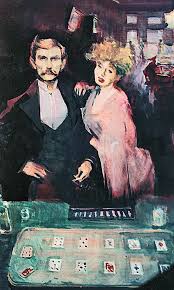
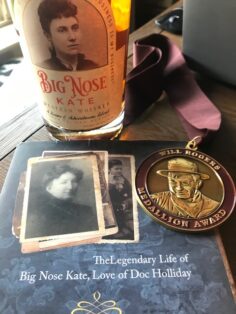
This particular piece was done by Bob Boze Bell to go along with the article about Kate Elder in True West magazine. Bob is a genius and Kate is legendary. I was proud to have been able to write about her life and so pleased Big Nose Kate’s Whiskey took a shine to the book According to Kate. On my tour through Arizona next week, I’ll be promoting the book and the drink named for the woman who made history with Doc Holliday.
Enter now to win a copy of
According to Kate:
The Legendary Life of Big Nose Kate, Love of Doc Holliday
Riding With Doc Holliday
Enter now to win a copy of
According to Kate:
The Legendary Life of Big Nose Kate, Love of Doc Holliday
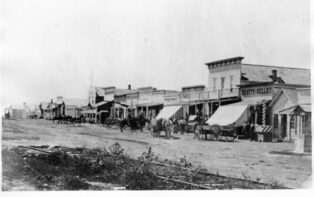
The main thoroughfare of Sweetwater, Texas, was so crowded with hunters, trappers, wagons, teams of horses, and soldiers that passing streams of people jostled each other, and some walked shoulder to shoulder. The air was charged with excitement. Rumors that Tom Sherman, Kate Elder, Mollie Brennan, and the other five members of the Seven Jolly Sisters were on their way had caused a mild panic, and lonely men desperate for female companionship had flocked to the burg.
Sweetwater was a trading post along the Jones Plummer Trail. That trail was connected to the major cattle drive town of Dodge City. Sweetwater was a destination for bullwhackers, buffalo skinners, and cowhands. Troops from Fort Elliott, eleven miles from town, enjoyed time at Sweetwater, too. The fort was established [in 1875] to protect the buffalo traders from being raided by Indians.
For Kate, the busy town provided a fresh crush of people to meet and with whom to do business. Soiled doves relished a change of scenery from time to time. They liked the possibility of enticing new patrons in a different location. It also brought renewed business when sporting girls returned to the town where their house of ill repute was located.
The August 24, 1876, edition of the Dodge City Times described the setting where Kate and the other entertainers arrived as a “thriving hamlet overrun with tradesmen.” Fourteen wagon loads of buffalo hides for a general outfitter in Dodge City known as Chas. Rath & Co. lined the sides of the dusty roadways. A report that a band of twenty-one hundred Indians south of Sweetwater had been spotted rattled some of the citizenry, but, as long as the soldiers remained in town, panic was abated.
Tom Sherman and his help erected a canvas tent, set up a makeshift -stage, and the Seven Jolly Sisters went to work. Among the many individuals who spent time with Sherman’s employees was a twenty-three-year-old buffalo hunter and army scout named Bat Masterson. In late 1875, Bat had taken a job as a faro dealer at the Lady Gay Saloon. After Sherman’s outfit arrived, Bat could either be found in the saloon or with Mollie Brennan.
On January 24, 1876, Kate and Mollie concluded their dance routine and set off to explore additional business. They ventured to the Lady Gay for a drink. The two ladies met Bat at the bar, and he bought them a drink. Once their drinks were finished, Bat and Mollie retired to his room. Kate recalled the couple hadn’t been gone long when Sgt. Melvin A. King, one of the men with whom Bat had been playing cards earlier in the evening, charged toward Bat’s room. King was furious with Bat over what he perceived as “underhanded dealings.” With a loaded gun in hand, King pounded on Bat’s room door and waited for an answer. Assuming it was Kate wanting to join the pair for a nightcap, Bat unlocked the door. Sgt. King burst into the room and opened fire. Mollie came between Bat and one of the bullets and was critically wounded. Bat was shot in the pelvis, but he managed to grab his gun and kill King before collapsing.
Despite his best efforts, the local physician could not save Mollie. An army surgeon was called to the scene to remove the bullet from Bat’s lower mid-section and stayed with him until he recovered.
Soiled Dove in a Cow Town
Enter now to win a copy of
According to Kate:
The Legendary Life of Big Nose Kate, Love of Doc Holliday

In the winter of 1872, Wendell Phillips, orator, attorney, and the soul of John Brown marching on, delivered a lecture to a large audience of concerned citizens in St. Louis, Missouri, about the social cancer that plagued society. He pounded the lectern he stood behind while addressing the crowd and advised them to take a stand against intemperance, crime, and prostitution. Phillips was appalled that city officials had legalized the profession and were issuing licenses to the owners of houses of ill repute and the bawdy women who worked there. Almond Street, a popular thoroughfare five blocks west of the riverfront, was the location of many of those houses. It was Phillips’ hope that after the residents of St. Louis heard his fiery speech, they would demand the businesses be closed.
“The root of this vice is poverty,” Phillips proclaimed. “It is because the poverty of a certain class makes them the victims of the wealth and leisure of another. Give one hundred men anywhere an honest career and a chance at the grand opportunities of life, and ninety out of the hundred will distain to steal. Give one hundred women a fair chance at the grand opportunities that their brothers have and ninety out of the hundred will disdain to barter virtue for gold.” Mary Katherine Horony, now known as Kate Fisher, was one of those near Almond Street who bartered virtue for gold. Poverty had played a part in her decision to become a sporting woman, but she was satisfied the work possessed possibilities beyond money. Kate was a businesswoman — nothing more, nothing less.
St. Louis had given Kate and other sporting women the opportunity to do their job without fear that law enforcement would interfere. The “social evil ordinance” the city had passed in March 1870 not only required prostitutes to obtain licenses but also mandated business women to submit to medical exams testing for venereal diseases. Civic leaders hoped the controversial ordinance would reduce the spread of disease. Many opposed the idea, arguing that it “encouraged the very vice which all good men and women destined to see suppressed.” Many soiled doves never bothered to register. Kate was one of those women.
The spirited, Hungarian woman must have been able to take care of herself against intoxicated and belligerent clients. Prostitutes sometimes found themselves in the company of men who resented their services. They hated themselves for hiring sporting women and blamed those women for the ills of society. A listing of arrests in daily, St. Louis papers showed how many acts of violence against prostitutes occurred nightly. The August 29, 1872, edition of The Macon Republican contained information about the circumstances surrounding the beating deaths of more than ten, bawdy ladies in the area of Popular Street in St. Louis. “Eleven wretched criminals victimized prostitutes overnight,” The Macon Republican article began. “A man named Burklin shot a sinful woman when crazed with drink and jealousy; another killed a woman with a grubbing hoe; a third tossed the prostitute out a third story window; three were stabbed to death; the seventh prostitute was beaten to death with a soda water bottle; two were strangled; two were hanged by the neck with a rope.”
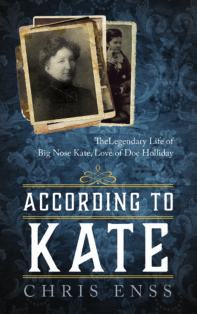
To learn more about Doc Holliday’s love interest read According to Kate
Arizona Daily Star Review of According to Kate
Enter now to win a copy of
According to Kate:
The Legendary Life of Big Nose Kate, Love of Doc Holliday
“Seldom does a book debuting in the Wyatt Earp field elicit anything but yawns. “According to Kate” is the remedy for ennui. Chris Enss is a longtime established writer of all things feminine in the Old West. In her latest masterpiece, she delves into the life of Kate Elder, paramour of legend “Doc” Holliday. The book is captivating, from page one to page last.
Kate, born Mary Harony, had this remarkable life journey that author Enss captures; highs and certainly lows, that any Western movie script would embrace. In fact, many did. `Kate made do on the frontier primarily dealing in prostitution. Kate had the wits and resolve to survive Holliday, Tombstone, and everything else that threatened her existence. She lived to be 90, and “According to Kate” chronicles every step of her back trail.
This book can be relished by the average reader looking for something different and will be an attraction to any Wild West history buff, as it supplies an extended fleshing out of one of the West most notorious figures.
The book belongs on that special shelf that contains first rate biographies of Western icons. It is a winner.”
Scottsdale Museum of the West
According to Kate and Big Nose Kate Whiskey
Enter now to win a copy of
According to Kate:
The Legendary Life of Big Nose Kate, Love of Doc Holliday
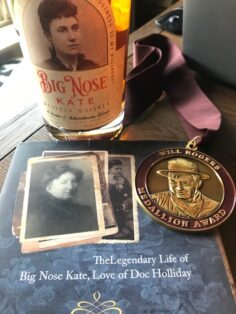
Not too long ago, According to Kate: The Legendary Life of Big Nose Kate, Love of Doc Holliday won gold at the Will Rogers Medallion Awards for Best Western Biography. It was also honored with a New Mexico/Arizona Book Award and the Elmer Kelton Book Award from the Academy of Western Artists. I’d like to think Kate would be proud. I know I’m grateful to have been able to have written her story. There are others who see value in Kate’s tale and the makers of Big Nose Kate’s Whiskey falls into that category. They recently purchased several copies of According to Kate to distribute with their drink. I’ll be promoting Big Nose Kate’s Whiskey along with According to Kate on an upcoming book tour.