The sidewalk that lined the thoroughfare in front of the Broadway Theatre in New York was filled with fashionably dressed ticket holders ready to see the musical The Summer Widowers. Written by Glen MacDonough, who also wrote Babes in Toyland, and with music by A. Baldwin Sloane, The Summer Widowers is the story of a female detective hired to keep tabs on three men whose wives are spending the summer in the country. The star-studded cast included comedienne and songstress Daisy Dumont. The reviews received for her role in the musical were beyond favorable. “It is doubtful there is any woman on the American stage who is more strikingly attractive or talented,” the September 23, 1910, edition of the New York Tribune read. “Miss Dumont has had several excellent opportunities in the last few seasons, and she has benefitted by all her stage experience…. She is about the most sought-after woman for light musical comedy roles that there is in the United States. Not only because of her attractiveness but because of her pleasing abilities.”
Daisy was particularly radiant when she stepped onto the stage to regale the audience with one of the production’s most popular songs. She cast a glance toward the balcony area to the right of the stage and smiled lovingly at the distinguished gentleman in the plush box seat. Wealthy, forty-year-old, ex-golf champion John Moller, Jr., nodded and winked at the twenty-seven-year-old actress. At the conclusion of the musical number, he stood up and applauded Daisy’s performance. The theatregoers below him followed suit. Daisy was grateful for the enthusiastic reception and offered a dignified bow in response. Suddenly, a large wedding bell was lowered over the stage and a shower of rice fell from the flies as the orchestra played the wedding march. Daisy was just as surprised by the display as the audience. This was not part of the show. She took another bow as the crowd looked on, still applauding. She blew a kiss to John before sashaying into the wings.
Just twenty-four hours prior to the curtain going up, Daisy and John had been married in a simple ceremony in Greenwich, Connecticut. Irene Franklin, known as the “most popular vaudeville actress,” and her husband, dramatic actor Burton Green, were matron of honor and best man. After they exchanged vows, the four made their way to the New York Athletic Club for a celebratory dinner.
“Yes, it was all very sudden,” Daisy told entertainment reporters. “But I have known Mr. Moller for two and a half years. We couldn’t have been married before because he was only divorced last week.”

Last week my sweet friend Laurie Cockerell escorted me to the town of Paradise, Texas, to do some research for the book I’m working on about George “Machine Gun” Kelly and his wife Kathryn Thorne. One of the stops made was to Kelly’s grave. While searching for Kelly’s final resting place we met a man wandering through the cemetery taking pictures. After helping us locate Kelly’s grave marker he asked us we were aware that Elvis was alive and shared that the singer and actor was preaching sermons at a church in Georgia. He went on to inform us that JFK and Princes Diana were also alive and serving pie at a local eatery. We smiled politely and nodded before telling the curious man that we’d love to stay and chat, but we needed to get back to the planet earth.
I wasn’t the slightest bit surprised to find that this misguided fellow has his own Youtube channel where he talks about the famous men and women the public believes are dead but are living and working at places like Chick-fil-A and Boot Barn. The followers of this silly man are staggering. More than thirty thousand individuals tune in regularly to hear what he has to say! I couldn’t help thinking after watching a few moments of the “show” that it seems like the only people who are quiet and don’t film themselves saying such crazy things are serial killers. We live in a nauseatingly confessional society, but it wasn’t always that way. There was a time when you wouldn’t dream of telling a person you just met that you were an alcoholic. Unless, of course, you met the person because you had driven your car into their swimming pool.
The thing about the entertainment media’s brand of voyeurism is, we’re so easily bored that if somebody wants to keep our attention, they must continually supersize the freak value. What I can’t fathom are the people who auction off their privacy on the open market. You can go on-line now and watch mutants and cybergeeks who record every nanosecond of their lives – every snore, every burp, every restraining order filed against them by Oprah or Taylor Swift. It all raises the philosophical question: how can you broadcast your life when you don’t have a life?
What’s really bothering me is that in retrospect, I should have stayed at the cemetery long enough to ask the man if George Kelly was still alive. I’m kicking myself now thinking that I could have driven to Home Depot and chatted personally with the gangster about his misdeeds.
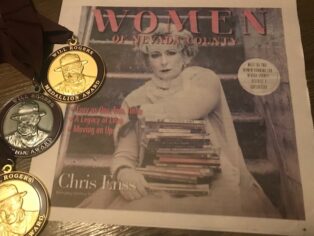
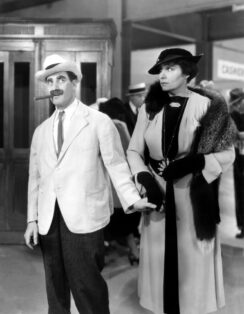
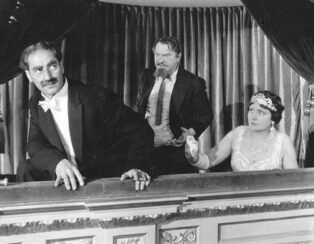
When death took comedy star Margaret Dumont in March 1965, no doubt many had to be reminded just who she had been. Millions of Marx Brothers’ fans around the world would recognize her immediately as Groucho’s long-suffering foil in many of their films. For more than four decades, the statuesque funny lady played the role of an austere dowager and grand dame of the social set on stage and screen. Margaret starred opposite such comedic geniuses as W. C. Fields, Laurel and Hardy, Jack Benny, and Bud Abbott and Lou Costello, but she was known best for the inspired pairing with Groucho Marx.
In the Marx Brothers’ film Duck Soup, her military allies pelted her with fruit for singing their national anthem. In A Day at the Races, employees of a health resort showered her with water from an overhead sprinkler system. In Animal Crackers, bridge playing opponents cheated her out of a win and threw cards at her. In A Night at the Opera, she waited more than an hour for Groucho to arrive for their date and eventually found him sitting behind her with another woman. “Mr. Driftwood, you invited me to dine with you at seven o’clock,” Margaret’s character, Mrs. Claypool, scolded Groucho who played Otis B. Driftwood. “It is now eight o’clock and no dinner.” Groucho is outraged by the reprimand and scolds her for having his back to him throughout the meal. “When I invite a woman to dinner, I expect her to have to look at my face. That’s the price she has to pay.” Whether she was playing the widow of the president of Freedonia, a wealthy hypochondriac residing at the Standish Sanitarium, or a respectable Manhattan hostess, Margaret suffered each insult or physical assault with a classic assurance that made her the greatest grand dame in the history of filmed comedy.
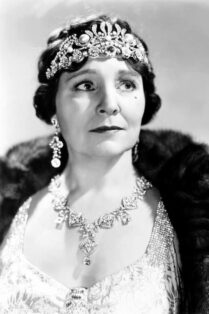
It was Groucho’s idea to recreate a scene from Animal Crackers on the television variety show The Hollywood Palace in the spring of 1965. When he contacted his aged costar, Margaret Dumont happily agreed to take part in the broadcast. She graciously accepted Groucho’s invitation to come to his home to rehearse the scenes from the movie they perfected in 1929. The pair reminisced for a few moments before practicing the piece to be performed, a reprise of Hooray for Captain Spaulding. The taped recording of Margaret and Groucho’s routine was aired on national television on April 17, 1965.
The actress, often referred to as the fifth Marx Brother, and the celebrated, caustic comedian she’d shared the stage with numerous times before, delivered their lines just as they did many years prior. Groucho adlibbing to draw out the audience’s laugh and Margaret reacting to his quips with raised eyebrows and stoic disregard. The well received broadcast was bittersweet for Marx Brothers devotees. Margaret had passed away five weeks before her sketch with Groucho was shown on the American Broadcast Company network.
“Margaret Dumont was the epitome of the word trouper,” Groucho told reporters. “She gave her all to the business she loved even to the last. It is possible that she wasn’t well even as we taped the show. However, she was so delighted at the prospect of repeating a sketch of ours, which has oftentimes been labeled classical, that she would never have let us know.
“It has been a pleasure beyond words over the years to work with Miss Dumont and to have been with her before an audience, which was a great part of her life, even until the last curtain.”
The statuesque comedy star who perfected the role of austere dowager, died of a heart attack at her home in Los Angeles on March 6, 1965. A private service was held for Margaret at the Chapel of the Pines Crematory in Los Angeles. Film critics and fans alike remembered her as “the greatest grande dame in the business.”
Milton R. Bass columnist and entertainment editor for the Berkshire Eagle paid tribute to Margaret in the March 16, 1965, edition of the publication. It is recognized as the most fitting of all salutes to the actress and her work.
“They don’t make comedies like that anymore. The recent death of actress Margaret Dumont at the age of seventy-five brought to mind all those marvelous Marx Brothers movies that pop up now and then on the television screen. Hollywood is now going through a farcical circle (in more ways than one), but they have nothing to compare with the wild gambolings of the madcap Marxes in their days of pristine glory.
“And no small portion of their success was due to Miss Dumont who played, nay, who was THE aristocratic grand dame of society. Mistress of the most elegant bosom and haughtiest stars in film history, Miss Dumont would throw back her head and peer through those lorgnettes as though she were throwing laser beams at those nuts who were tearing her house to shreds or making the ball of the year seem like a rumble between the Jets and the Propellers.
“She was always the victim of Groucho’s amorous greed, but she always submitted with such grace and dignity that an added dimension of humor was added to a preposterous situation. Everyone has his favorite Dumont-Groucho scene, but my very favorite of all took place in a dilly titled A Day at the Races. Groucho played Dr. Hugo Quackenbush, a phony M. D. who was treating Miss Dumont for a nonexistent disease while bleeding her financially. Finally, she has had enough, and she goes to a legitimate doctor who takes X rays that prove she is in perfect health.
“She confronts Groucho at the racetrack with the doctor’s report, which he pooh poohs. Triumphantly she pulls out the X rays and flourishes them as the coup de grace. For the first time in his innumerable movies, Groucho is taken aback. Has he at last been shown in his true colors? There is that marvelous moment of silence as the devious mind works behind those shifty eyes. Finally, it comes. ‘Who are you going to believe?’ he demands. ‘Me or those crooked X rays?’ Miss Dumont caves in defeat.
“And then there was the time in Animal Crackers when Miss Dumont was trapped into a bridge game with Harpo as an opponent. He triumphantly made a grand slam by playing thirteen aces. It was something to watch her face as each ace after number four appeared, but she never lost her dignity and went down to defeat with a stiff upper half that would have done honor to a very, very, very Lord High Admiral.
“Once you start thinking about Marx Brothers gags you can’t stop. There was the time in the train when Groucho was talking to somebody and Gummo went running past clutching an empty carton for oranges. Groucho looked reflective for a moment and then said: ‘I hate to send a kid up in an old crate like that.’ Completely devastating every flying film that had ever played.
“And then there was the classic court scene where prosecutor Chico was grilling Groucho on the witness stand. ‘What has four legs, a trunk in front and a tail behind?’ Chico wanted to know. The judge turned purple (in a black and white picture) and barked, ‘That’s irrelevant. That’s irrelevant.’ Whereupon Chico turned in bewildered hurt and said ‘No fair telling. Let him get it himself.’
“And can you forget that Night in Casablanca where Harpo was leaning against the building when the cop came up. ‘What do you think you’re doing,’ the cop asked, ‘holding up the building?’ Harpo nodded happily. ‘Move on, move on,’ the policeman ordered. And Harpo did and the building fell down in a spectacular display of plaster and dust.
“If I had to pick my list of ten favorite actresses, Miss Dumont would be right in there. She was no stooge or supporting player in the Marx Brothers films, but the other side of the scale, the balance wheel that pulled their absurdities into a proper perspective. There, is no one of such stature in the field of comedy today. Jack Lemmon strikes his own balance by a split in character, but all the other comic characters lack a Dumont in their lives. Consequently, the days of mad splendor are gone. Expect for such things as Peyton Place on television. Oh, how that series cries for Margaret Dumont to give some belly to the laughs.”
Groucho Marx paid homage to Margaret’s talent at the Academy Awards ceremony in 1974 when he was presented with an Honorary Oscar. “I want to thank those that voted for me to get this award,” he told the celebrity audience. “I wish that Harpo and Chico could be here to share it with me, this great honor. I wish Margaret Dumont could be here too.” At that statement, the audience applauded. “She was a great straight woman for me, even though she never understood my jokes….”
Funny man Groucho Marx died on August 19, 1977, at the age of eighty-six. He had written his epitaph himself which read, “I hope they buried me near a straight man.”
The Marx Brothers, with Margaret Dumont by their side, mastered a comedy approach no one had seen before of have been able to duplicate since. The Marx Brothers were an ensemble group, but Groucho was the star. One reporter wrote of the star, “Too bad he never played Hamlet. I’d have loved to see him upstage the ghost of Hamlet’s father and sell Denmark to Margaret Dumont.”
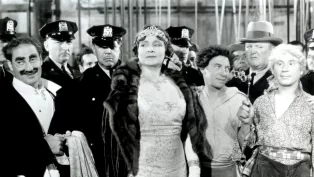
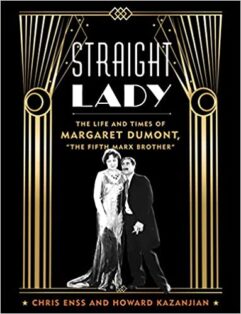
“As Variety film critic Cecelia Ager once wrote: “There ought to be a statue erected, or a Congressional Medal awarded, or a national holiday proclaimed, to honor that great woman, Margaret Dumont, the dame who takes the raps from the Marx Brothers. For she is of the stuff of which our pioneer women were made, combining in her highly indignant Duse, stalwart oak, and Chief Fall Guy—a lady of epic ability to take it, a lady whose mighty love for Groucho is a saga of devotion, a lady who asks but little gets it.” Thankfully, there is now STRAIGHT LADY by Chris Enss and Howard Kazanjian to properly celebrate the underrated Margaret Dumont. Chris has such a gift for telling fascinating tales about fascinating women, but this is my favorite. Delightful surprises in store for the fortunate reader. Marx Brothers’ and MGM fans are going to love this book!” Michael Troyan, author MGM; HOLLYWOOD’S GREATEST BACKLOT
It’s official! Proud to announce I’ll be writing a book for Kensington Publishing entitled Meet the Kellys: The Life and Times of Gangsters Machine Gun Kelly and Kathryn Thorne Kelly. All the world likes an outlaw. For some darn reason they remember them. Thank you, Gary Goldstein!
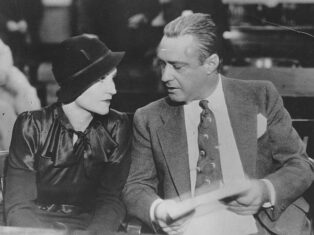
American gangster George Kelly Barnes (1895 – 1954), aka Machine Gun Kelly, with his wife Kathryn at their trial for the kidnapping of businessman Charles F. Urschel, at the Federal Court in Oklahoma City, 9th October 1933. Kelly has a bump on his head after being hit with a pistol butt during an altercation on his arrival at court. Kelly and his wife pleaded guilty and were sentenced to life imprisonment. (Photo by FPG/Archive Photos/Getty Images)