The Critics


Criticism and rejection are a part of a writer’s life.  It’s certainly not the part most writers like, but as author Elbert Hubbard wrote “To escape criticism – do nothing, say nothing, be nothing.”

A few years ago, I wrote a book about the life of Elizabeth Bacon Custer, George Custer’s widow.  The book is entitled None Wounded, None Missing, All Dead:  The Story of Elizabeth Bacon Custer.  She was a fascinating woman, an amazing writer, a gifted artist, and I wanted to tell her story.  I was surprised by the critics who blasted me for not covering the Battle of Washita River or Custer’s Civil War career.  The title clearly indicates the work is about Elizabeth Bacon Custer’s life, so I was a bit confused by the remarks.

I was confused, but not surprised.  Over the years, I’ve had my fair share of poor reviews including one that read, “My family doesn’t care much for history.  We like magic.”

If you’re a working writer, you’re going to face criticism and rejection.  From the literary agent who isn’t interested in representing you, editors who don’t want your manuscript, publishers who give you an insulting advance, to the ultimate rejection and criticism – poor sales.  The world is filled with critics.  No one is immune, particularly those who are creative.

Authors, poets, songwriters, even inventors working on designing better faucets are subject to criticism.  Okay, THAT guy is a moron.  The faucets are fine, stop messing with the faucets, all right.  The ones in airports are like science projects with electronic eyes and motion sensors that never work no matter how many times you wave your hand under the device.  Hey faucet guy!  Stop it!

I’m not saying there isn’t a place for solid, intelligent, constructive criticism, but when was the last time you read a review of a western novel or nonfiction work, song, poem, or western film that gave you a real feel of what the author was trying to say?  Critics don’t always get it right either.  In 1884, Mark Twain’s book The Adventures of Huckleberry Finn received the following review.  “A gross trifling with every fine feeling…Mr. Clemens has no reliable sense of propriety.”  A reviewer of Owen Wister’s work The Dragon of Wontley wasn’t shy with his criticism when he shared, “Wister’s story is a burlesque and grotesque piece of nonsense…it is mere fooling and does not have the bite and lasting quality of satire.”   An editor reviewing one of Tony Hillerman’s manuscripts in 1970 noted “If you insist on rewriting this, get rid of all that Indian stuff.”  After reading Zane Grey’s book The Last of the Plainsmen, an editor informed him, “I do not see anything in this to convince me you can write either narrative or fiction.”   Another editor wrote the following about Grey’s book Riders of the Purple Sage, “It is offensive to broadminded people who do not believe that it is wise to criticize any one denomination or religious belief.”  Even John Steinbeck was subject to critics who didn’t get it right as evidence in a review for his book Of Mice and Men that appeared in the May 1937 edition of Time Magazine.  “An oxymoronic combination of the tough and tender, Of Mice and Men will appear to sentimental cynics, cynical sentimentalists…Readers less easily thrown off their trolley will still prefer Hans Anderson.”

What danger is to a cop, rejection is to a writer – always hanging in the air dripping with possibility.  And drip it does onto the talented and untalented in almost equal measure.  Some days it’s hard to find the drive to keep writing when you consider your work might be ridiculed and or tossed aside but you have to power on.  How you master this challenge will have a profound effect on your career.  I once received a rejection letter that read, “Something stinks, and I think it’s this manuscript.”  Did I let it stop me?  No, I continued churning out stinky material…wait, that came out wrong.

Louis L’Amour admitted “I do not believe writers should read reviews of their own books, and I do not.  If one is not careful one is soon writing to please reviewers and not their audience or themselves.”  One of the keys to becoming a contented writer is to not let people’s compliments go to your head and to not let their criticism get to your heart.  If you’re one of those writers who have mastered this idea, I’d love to hear from you.  In the meantime, I’ll be at my desk rereading an Amazon review of my work which simply stated, “Maybe you should think about becoming a mime.”


Happy Trails & Dale Evans

Enter now to win a copy of

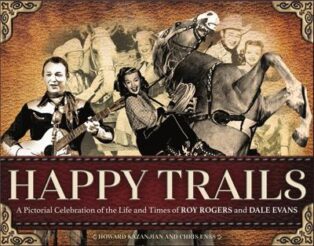
Happy Trails:  A Pictorial Celebration of the Life and Times of Roy Rogers and Dale Evans


Dale Evans was born Frances Octavia Smith on October 31, 1912, in Uvalde, Texas. In her words, her upbringing was “idyllic.” As the only daughter of Walter and Betty Sue Smith, she was showered with attention and her musical talents were encouraged with piano and dance lessons. While still in high school, she married Thomas Fox and had a son, Thomas Jr. The marriage, however, was short-lived. After securing a divorce, she attended a business school in Memphis and worked as a secretary before making her singing debut at a local radio station. In 1931 she changed her name to Dale Evans. By the mid-1930s, Dale was a highly sought-after big-band singer performing with orchestras throughout the Midwest. Her stage persona and singing voice earned her a screen test for the 1942 movie Holiday Inn. She didn’t get the part, but she ended up signing with the nationally broadcast radio program the Chase and Sanborn Hour and soon after signed a contract with Republic Studios. She hoped her work in motion pictures would lead to a run-on Broadway doing musicals

In August 1943, two weeks after signing a one-year contract with Republic Studios, Dale began rehearsals for the film Swing Your Partner. Although her role in the picture was small, studio executives considered it a promising start. Over the next year Dale filmed nine other movies for Republic, and in between she continued to record music. When she wasn’t working, Dale spent time with her son, Tom, and her second husband, orchestra director Robert Butts. Her marriage was struggling under the weight of their demanding work schedules, but neither spouse was willing to compromise. “I was torn between my desire to be a good housekeeper, wife, and mother and my consuming ambition as an entertainer,” Dale told the Los Angeles Daily News in 1970. “It was like trying to ride two horses at once, and I couldn’t seem to control either one of them.” Dale’s marriage might have been suffering, but her career was taking off. Republic Studios’ president Herbert Yates summoned Dale to a meeting to discuss the next musical the studio would be doing. She took this as a hopeful sign. It was common knowledge around the studio lot that Yates had recently seen a New York stage production of the musical Oklahoma and had fallen in love with the story. Dale imagined that the studio president wanted to talk with her about starring in a film version of the play. It was the opportunity she had always envisioned for herself. For a brief moment she was one step closer to Broadway.


Happy Trails Cover


To learn more about the Queen of the West and the King of the Cowboys read

Happy Trails


Tales & Margaret Mitchell

Enter now to win a copy of the books
Tales Behind the Tombstones and More Tales Behind the Tombstones:
More Deaths and Burials of the Old West’s Most Nefarious Outlaws,
Notorious Women, and Celebrated Lawmen


Gone With the Wind, the first and only novel written by Margaret Mitchell was a runaway success from the moment it was published in 1936. The book won the Pulitzer Prize and is still considered the most purchased book, other than the Bible, selling over two hundred thousand copies a year. Mitchell learned of the stories she used in her epic while sitting on the laps of Confederate veterans when she was a young girl growing up in Georgia. In fact, she wasn’t told the South lost the war until she was ten. She wrote her book while laid up with a broken ankle and told no one other than her husband of her literary aspirations. At the time she was employed by the Atlanta Journal and had an assignment to take publisher Howard Latham from Macmillan Publishing Company around town supposedly in search of the new southern writers. Margaret brought the partially completed and heaping Gone With the Wind manuscript to Latham’s hotel later that night after a friend of hers laughed at the possibility that she possessed any talent. She sent a telegram the next day, asking Latham to send the manuscript back. He refused, convinced her of its worth, and sent Margaret Mitchell an advance to finish the book. Supposedly, Margaret wrote another book, which was found in notebooks among her letters, but she never pursued publication of anything else.  In 1949 she was heading to see a movie and stepped into the street without looking and was hit by a taxi. She died five days later of internal injuries at age forty-eight. The twenty-five-year-old taxi driver Hugh D. Gravitt was convicted of involuntary manslaughter and sentenced to one year to eighteen months in jail.


To learn about Tales Behind the Tombstones and More Deaths and Burials of the Old West’s Most Nefarious Outlaws, Notorious Women, and Celebrated Lawmen read
the books Tales Behind the Tombstones and More Tales Behind the Tombstones


Tales & Jessie Fremont

Enter now to win a copy of
Tales Behind the Tombstones and More Tales Behind the Tombstones:
More Deaths and Burials of the Old West’s Most Nefarious Outlaws,
Notorious Women, and Celebrated Lawmen


On December 27, 1902, the woman many historians referred to as the “Guardian of Yosemite National Park” passed away. Jessie Anne Benton Fremont was born on May 31, 1824, in the Blue Ridge Mountains of Virginia. Her father, Thomas Hart Benton, was an ambitious man who went from farming into politics and eventually became a United States senator from Missouri (and great-uncle of twentieth-century muralist Thomas Hart Benton). Jessie visited Washington, D.C., often as a child and met with such luminaries as President Andrew Jackson and Congressman Davy Crockett.

Jesse and her sister, Elizabeth, attended the capital’s leading girl’s boarding school, alongside the daughters of other political leaders and wealthy business owners. It was for that very reason Jessie disliked school. “There was no end to the conceit, the assumption, the class distinction there,” she wrote in her memoirs. In addition to the lines drawn between the children of various social standings, Jessie felt the studies were not challenging to her. “I was miserable in the narrow, elitist atmosphere. I learned nothing there,” she recalled in her journal. The best thing about attending school was the opportunity it afforded her to meet John Fremont, the man who would become her husband.

Born on January 21, 1813, John was an intelligent, attractive man with gray-blue eyes who excelled in mathematics and craved adventure. While awaiting an assignment from the United States Corp of Topographical Engineers (a war department agency engaged in exploring and mapping unknown regions of the United States), John was introduced to Thomas Benton. Benton was a key proponent in Washington for western expeditions. He and John discussed the great need for the land west of the Missouri River to be explored. Benton invited the young surveyor and map maker to continue the conversation at his home over a meal with his family. It was there that Jessie and John first met, and they were instantly smitten with each other. Within a year, they were wed.
Jessie Benton was sixteen years old, and John Fremont was twenty-seven when they married on October 19, 1841. The newlyweds lived at the Gatsby Hotel on Capitol Hill until John was assigned to lead a four-month expedition to the Rocky Mountains. Jessie helped him prepare for the journey by reviewing information about the plant life, Indian encampments, and rock formations he would come in contact with during his trip. John headed west on May 2, 1842. Jessie, who was pregnant with their first child, moved into a small apartment near her parents’ home.
John returned to Washington, D. C., in November 1842, just two weeks before their daughter was born. He watched over baby Elizabeth Benton “Lily” Fremont while Jessie reviewed the slim notes John had taken during the expedition and fashioned a report for the government using his data and detailed recollections of life on the trail. Politicians such as Missouri Senator Lewis Linn praised the report for being not only practical and informative but entertaining as well. The material would be used by emigrants as a guidebook.

In early 1843, John moved his family to St. Louis, Missouri, where his next expedition would be originating. Jessie took on the role as John’s secretary, reviewing mail from suppliers and frontiersmen such as Kit Carson. She wrote the necessary correspondence to members of the Topographical Bureau, apprising them of the date the expedition would begin, how long it would take, and what the party planned to accomplish. Shortly before John departed to explore a route to the Pacific Coast, a letter came to the Fremont’s home instructing him to postpone the expedition until questions over a request to purchase weapons had been settled. Fearing the entire mission would be jeopardized if the journey were delayed, Jessie did not give the letter to her husband. John set out on the expedition on May 13, 1843. He returned home the following August, having successfully begun opening up the great territory between the Mississippi Valley and California.


To learn about Tales Behind the Tombstones and More Deaths and Burials of the Old West’s Most Nefarious Outlaws, Notorious Women, and Celebrated Lawmen read
More Tales Behind the Tombstones


Behind James Beckwourth’s Tombstone

Enter now to win a copy of Tales Behind the Tombstones and More Tales Behind the Tombstones:

More Deaths and Burials of the

Old West’s Most Nefarious Outlaws, Notorious Women, and Celebrated Lawmen


James Beckwourth was one of the most legendary mountain men of the early 1800s. He was the son of a Maryland Irishman and a slave girl, and he was born in Virginia in 1798. When he was very young, his family moved to St. Charles, Missouri. James worked as an apprentice to a blacksmith until the age of nineteen, when he left the anvil and the forge to sign on as a trapper with the Missouri Fur Company, then challenging Hudson Bay trappers working the rich beaver streams beyond the crest of the Rockies.

In 1824, Beckwourth joined William H. Ashley and Andrew Henry on a fur-trapping expedition in the Rocky Mountains; he was one of the first trappers to go into the new country. During various expeditions, he participated in skirmishes with the Blackfeet and other Indians. He became skilled in the use of the bowie knife, tomahawk, and gun.

In 1828, he was adopted into the Crow Indian tribe. He packed his traps and buckskin shirts on his horses and moved to the headwaters of the Powder Rivers and into a new life among the ancient people. He proved himself quickly among his adopted people and rose to the position of war chief. His skill as part of a raiding party to steal Comanche horses was exceptional. His prowess and bravery in battle against the hated Blackfoot Indians earned him the name Bloody Arm.

James Beckwourth helped make the Crow a more powerful nation. No more would they give away a tanned buffalo hide for a pint of trade whiskey. Bloody Arm knew the value of hides and the wiles of the whites. He knew the worth of powder and ball and traps and horses and finery for Crow women.

When a fur company opened a trading post among the feared Blackfeet, Beckwourth got the same company to make him its agent among the Crow to see that his adopted people were treated fairly in the trade of pelts for guns. When the beaver trade began fading, Beckwourth went to the Southwest and joined with another ex–mountain man to lead a war party of Utes to raid Spanish ranches in Southern California. They headed east with three thousand head of California horses.

He spent a while in Taos, moved onto Colorado to become a contract hunter supplying meat in places like Bent’s Fort, and then became a trader among Indians. Showing up again in Southern California, he raised a company of Yanquix to fight Governor Micheltorena of Mexico in a quickie revolution.

By the time of the California Gold Rush and the westward movement of hundreds of wagon trains over the worst passes of the Sierra, James, then in his fifties, led a wagon train over a sizable mountain pass that was to be named after him. He still had years of adventure before him. He scouted for the Third Colorado Cavalry tracking Black Kettle to Sand Creek and turned away in disgust at the massacre.

At the age of sixty-eight, Beckwourth embarked on another venture, this one in a bid for peace. The Oglala Sioux were pressing the Crow to join against the whites. The US Army sent for Beckwourth to advise his adopted tribe. He thwarted the alliance.

Mystery surrounds James Beckwourth’s death in Colorado in 1866 in a Crow village. Some historians note he was poisoned by a Crow warrior who caught him cavorting with his wife. The most reliable account of his passing reports that he was poisoned by order of the Crow’s tribal council because he would not accept their offer to go on the warpath with them again. If they could not keep him as a chief, they decided to have the honor of burying him in their burial ground near Laramie, Wyoming. Beckwourth was seventy-eight when he died.


Tales & Victoria Clafin

Enter to win a copy of
Tales Behind the Tombstones and More Tales Behind the Tombstones:
The Deaths and Burials of the Old West’s Most Nefarious Outlaws,
Notorious Women, and Celebrated Lawmen


When Victoria Claflin Woodhull died on June 9, 1927, news of her passing was announced on two continents. The press referred to the controversial writer, stockbroker, and politician as a “most immoral woman.” Not only was Victoria the first woman to be officially nominated for president of the United States, but she was also one of the first individuals to have been jailed on federal obscenity charges. Both events occurred in 1872.

Before her involvement with the women’s rights movement in the mid-1860s, Victoria and her sister, Tennessee, were the owners and publishers of a newspaper called the Woodhull and Claflin Weekly. They printed scandalous articles promoting the idea of “free love.” In a letter Victoria sent to the New York Times in 1871, she claimed that free love was the “only cure for immorality, the deep damnation by which men corrupt and disfigure God’s most holy institution of sexual relations.” She continued, “It is not marriage but sexual intercourse, then, that is God’s most holy institution.” Victoria and Tennessee’s progressive views on sex and the brazen printing of those ideals appalled citizens not only in the United States but also in other countries like Germany and Russia, as well. They “threaten to destroy the morals nations so desperately needed to cling to,” was the opinion voiced in the New York Times on November 23, 1871.

Victoria and Tennessee were not strangers to confrontation with the law. Their father, Reuben Buckman “Buck” Claflin, was a scoundrel who excelled at breaking the rules of conventional society and spent time behind bars for his actions. Buck and his wife, Roxanna Hummel, lived in a rundown house in Homer, Ohio. The couple had ten children. Born on September 23, 1838, Victoria was the Claflins’ sixth child. Although Victoria’s father claimed to be a lawyer with his own profitable practice, he was actually a skilled thief with no law degree at all. He owned and operated a gristmill and also worked as a postmaster. Buck supplemented his income by stealing from merchants and business owners, and he was a counterfeiter and a suspected arsonist.

Victoria’s mother was a religious fanatic who dismissed Buck’s illegal activities in favor of chastising her neighbors for what she claimed was hedonism. Her public prayers were loud, judgmental, and dramatic. She preached to her children and insisted they memorize long passages of the Old Testament. By the time Victoria was eight, she was able to recite the Bible from cover to cover. Reflecting on her life, Victoria wrote in Autobiography of Victoria Claflin that her mother’s spiritual zeal so influenced her childhood that young Victoria believed she could see into the future and predict what was to come of those who sought her out to preach.

Tennessee was reported to be the true clairvoyant of the family. Born in 1845, she was the last child born to Roxanna and Buck. Roxanna claimed Tennessee had the power to perceive things not present to the senses. She would slip into trances and speak with spirits, answering voices no one else could hear.

Victoria and Tennessee had very little formal education. Although Victoria attended school for only four years, she was bright, precocious, and well read. She was uninhibited and at the age of eleven delivered sermons from a busy location in Homer, Ohio.

In 1849, the Claflins left Homer and moved to Mount Gilead, Ohio. Victoria’s father had abandoned gristmill work and decided to venture into the field of psychic phenomena with his daughters in tow. He introduced Victoria and Tennessee to the public and announced the girls’ talent for “second sight” or “extrasensory perception, the ability to receive information in the form of a vision by channeling spirits.” Buck rented a theater and charged patrons seventy-five cents to watch the four-year-old and eleven-year-old communicate with deceased Claflin family members and predict the future. One such specific prediction was that one day a woman would be president of the United States.

Victoria and Tennessee’s shows, in which they would conduct séances and interpret dreams for audience members, attracted a large following, and in a short time the two young girls became the sole source of income for their family.


To learn about the Deaths and Burials of the Old West’s Most Nefarious Outlaws, Notorious Women, and Celebrated Lawmen read
Tales Behind the Tombstones and More Tales Behind the Tombstones