It’s a dog-eat-dog world and most of the time I feel like I’m wearing Milk-Bone underwear.
And then something like this happens.


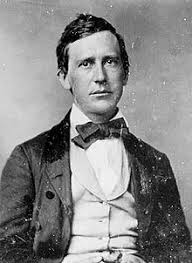
“Now the nodding wild flow’rs may wither on the shore. While her gentle fingers will cull them no more. Oh! I sigh for Jeannie with the light brown hair. Floating like a vapor, on the soft summer air—from “Jeannie with the Light Brown Hair” by Stephen Foster
Songwriter and composer Stephen Collins Foster was lying face down in a pool of his own blood when a housekeeper at a cheap New York boarding house found him on the morning of January 13, 1864. The man who had penned such popular tunes as “Oh! Susanna” and “Jeannie with the Light Brown Hair” collapsed from a fever while walking to a wash basin to get some water. He struck his head on the porcelain bowl and cut a large gash in his face and neck. He was taken to Bellevue Hospital where he was pronounced dead.
Stephen Foster was born on July 4, 1826, in Lawrenceville, Pennsylvania. He was the youngest of eleven children and from an early age displayed exceptional musical talent. At seven years old his parents gave him a flageolet, a sixteenth-century woodwind instrument. Within a short time, Stephen mastered the flute-like whistle and expanded his abilities to include harmonica, piano, and guitar. Although his talent captivated family and friends, he did not have a desire to perform. Stephen preferred to write and wanted to study music as a science.
In 1841, Stephen’s mother hired a tutor to teach her son the fundamentals of music as well as how to speak French and German. Stephen composed his first published song, entitled “Open Thy Lattice Love,” in 1842 at the age of seventeen. A short time later he moved to Cincinnati, Ohio, and took a job working for his brother as an accounting clerk. He wrote many more songs during this time, all of which were published, but the money he received for his work was next to nothing.
By 1850, he decided to abandon the accounting business and devote himself full-time to writing music. His gift for harmony and poetry led to the creation of such well-known tunes as “Camptown Races” and “My Old Kentucky Home.” During this time, he met Jane McDowell, the daughter of a physician from the Pittsburgh area. The two fell in love and were married on July 22, 1850. Stephen continued writing songs that were published and well received, but he realized very little financially for his music at the onset of his career because he allowed his work to be published without thought of compensation. He earned $15,000 for the song “Old Folks at Home,” and many of his other tunes were equally as profitable. Unfortunately, multiple publishers often printed their own competing editions of Stephen’s songs, paying him nothing and eroding any long-term monetary benefits.
Stephen’s struggles with managing his money and the loss of his parents as well as many of his siblings in a short time period proved more than he could bear. Consequently, he sought comfort in drinking. The alcohol soon became all-consuming and quickly became an issue in his marriage. Stephen became addicted and after numerous ultimatums and attempts to get him to stop drinking, Jane decided to take their daughter back to her parents’ home in Pittsburgh.
Stephen sank into a deep depression and continued drinking. He spent all his income on alcohol, and when he ran out of money, he sold his clothing to buy more to drink. He wore rags and went days without eating. His brothers and sister would step in to help, but Stephen would not and could not change. On Saturday evening, January 9, 1864, the thirty-seven-year-old man passed out in a drunken stupor in his hotel room. When he awoke, he was violently ill from liver failure and in his weakened condition he fell and hit his head.
Stephen’s wife Jane and one of his brothers came to the hospital to claim his body. Nurses gave his family his clothes along with 38 cents that were found in his pocket and a scrap of paper upon which he had written the words, “Dear Friends and Gentle Hearts.”
He was buried in Alleghany Cemetery in Pittsburgh, beside his mother. Upon his plain marble headstone is the simple inscription: “Stephen Foster of Pittsburgh. Born July 4, 1826. Died January 13, 1864.”

Visitors walking through the graveyards often find themselves stepping over weeds that have grown around fallen headstones. Sadly, the final resting place for many small families and communities has been left unattended or even forgotten. The seasons have taken with them the names chiseled in the granite, nearly erasing all memory of those mourned beneath the dilapidated tombstones.
Aside from the normal life and death cycle in New England, it is estimated that one in every seventeen people died on the journey west from 1847 to 1900. Oftentimes the men, women, and children who died en route to the gold hills of California and Colorado, or the fertile farmlands of the Pacific Northwest, were buried on the spot where they died. A proper burial and lengthy funeral were forfeited in favor of pushing on to the far-off destination. Traveling across the plains demanded that sojourners be constantly on the move. The threat of bad weather, hostile Indians, wild animals, or desperados kept pioneers from staying too long in one area.
Contrary to popular belief, the thousands of settlers who perished on the trail west did not solely die in gunfights or Indian attacks. Scorching deserts, starvation, and dehydration claimed many lives. Poor sanitation bred typhoid, cholera, and pneumonia. Blood poisoning brought on by a cut or scrape from a sharp object, or shock from an accident, such as a wagon spilling over with travelers inside, brought about numerous deaths as well.
There were pioneers, though, who could not be persuaded to forgo a ceremonial funeral if they lost a loved one. Nothing could keep them from burying the deceased in a plot where they could be remembered. A section of ground in a scenic location with trees to shade the grave was the preferred spot. To leave someone dear in an unmarked plot was impossible for some to accept.
As pioneers established homesteads and built towns around their farms and ranches, the dead were buried either in family cemeteries near where they had lived or next to churches where they worshipped. For nineteenth-century ancestors, it was important to remember death. The fact of death served as a reminder to those who continued to persevere and do good works as preparation for a final judgment by a righteous God.
Whatever the cause of death or wherever it occurred, the need to take care of a deceased person’s remains was a necessity. Until the discovery of formaldehyde in 1867, and the subsequent introduction of the product and its use as an acceptable embalming method in America in 1872, there were limited ways to deal with the dead. Immediate burial was preferred. If a person died in the winter and the ground was frozen and a grave could not be dug, the body was stored in a barn or woodshed until the earth thawed and the departed could be buried.
As in the cities, carpenters in mining camps or cattle towns were usually the undertakers since they had the tools and supplies to build coffins. The wooden caskets might be lined with white linen if it was supplied by the deceased’s family or friends. Sextons, people who looked after a church and churchyard, would determine where in the cemetery a person was to be buried. They would also dig the grave and fill it again.
People who lived in small towns would often gather at the graveyard where the coffin was placed atop two sawhorses. For those who lived in less rural areas, there were hearses to rent to transport the dead from the undertaker’s office to the cemetery. The vehicle had glass sides and was decorated with elaborate carvings and brass ornaments. On top were tall, shako-like plumes, one on each corner.
While cemeteries house the dead, the tombstones record not only their pleasures, sorrows, and hopes for an afterlife, but also more than they realize of their history, ethnicity, and culture. In this book are true stories about thirty real people who are buried in marked and unmarked graves throughout the frontier and elsewhere. How these famous and infamous individuals lived and then exited this world is reflected on their headstones. Tales of their demise add details of their courage, adventure, hardship, and joy not included on those tombstones.
The dead included in the book More Tales Behind the Tombstones will never exhaust their potential to enlighten.

Jack Zahran, president of the Pinkerton National Detective Agency, wrote the foreword for The Pinks.
I’m honored he contributed to the book.
When Allan Pinkerton founded the Pinkerton Detective Agency in 1850, he not only became the world’s first “private eye,” he also established an organization that would set the global standard for investigative and security excellence for generations to come.
But the agency had only just begun the process of setting that standard when Kate Warne walked into Allan Pinkerton’s office six years later and asked for a job. Her request was well timed. Pinkerton was keenly focused on new opportunities and was consciously looking to make bold choices that reinforced his vision of Pinkerton as an innovator and a disruptor.
Warne’s confidence and persuasive skills were impressive, and Pinkerton’s flexibility and willingness to “defy convention” perhaps equally so. It is to his credit, and to the enduring credit of the Pinkerton Detective Agency, that it took Pinkerton less than twenty-four hours to inform Warne that he would hire her—a decision that made her the nation’s first female detective. It was a remarkable turn of events at a time when only 15 percent of women held jobs outside of the home, and contemporary ideas about what constituted “women’s work” severely limited employment opportunities for women.
Kate Warne, and the accomplished women who played such an important role in building the Pinkerton Detective Agency into an iconic global security and law enforcement institution, made it abundantly clear that the prevailing definition of “women’s work” was not just inadequate, but wholly obsolete.
Kate’s story, and the stories of all these remarkable female operatives—presented so beautifully and in such rich detail here in this fascinating and important book—are not just a moving reminder of the achievements of a handful of bold pioneers, they are also a remarkable testament to the exemplary tradition of innovation that has distinguished the Pinkerton name over the course of more than a century and a half of dedicated service.
Allan Pinkerton was very clear about the fact that he wanted his company to be fearless and to have a “reputation for using innovative methods to achieve its goals.” What is remarkable is not just the aspiration, but the execution: This founding vision would grow into a long-standing tradition of innovation and a commitment to inspired service that became intricately woven into Pinkerton’s organizational DNA.
Pinkerton’s enduring legacy of bold moves, brave choices, and the relentless pursuit of excellence is much more than just an aging résumé—it is the foundation for an organization that remains on the cutting edge. Today, the company that predates the Civil War not only remains relevant but has continued to establish itself as a dynamic and innovative presence on the world stage. Pinkerton is a recognized industry leader in developing forward-looking security and risk management solutions for national and international corporations. Remarkably, an organization that once protected Midwestern railways and pursued famous outlaws like Jesse James and Butch Cassidy is now providing sophisticated corporate risk management strategies and high-level security services for clients across the globe, setting a twenty-first-century standard for corporate risk management.
Now, as then, Pinkerton understands that combating new and emerging threats and serving its clients requires a willingness to challenge conventional wisdom and embrace new assets and new ideas—whether they are the world’s first female detectives or new cybersecurity protocols. From investigative and private detective work to security and corporate risk consulting, Pinkerton prides itself on doing whatever it takes to keep its clients safe and to protect their assets and their interests. That resolve is one of the biggest reasons why an agency that was protecting Abraham Lincoln was also on the ground in the aftermath of Hurricane Katrina, and why the principles and practices that were in place almost eighty years before the discovery of penicillin still apply to an organization that provides risk management services to some of the world’s most innovative enterprises in 2016.
As you read and enjoy these fascinating profiles of gifted Pinkerton operatives, you will readily see how their work and their character exemplified the agency’s values of Integrity, Vigilance, and Excellence. Ultimately, those attributes are at the heart of these tales, and at the heart of the larger Pinkerton story. It’s a history that spans three centuries, with compelling new chapters still being written each and every day.
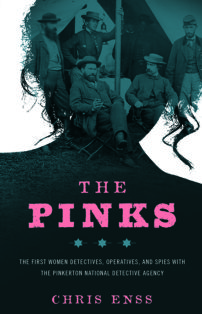
From the Women’s Studies Shelf
The Pinks
Chris Enss
TwoDot
c/o Rowman & Littlefield
9781493008339 $16.95 www.rowman.com
The Pinks: The First Women Detectives, Operatives, and Spies with the Pinkerton National Detective Agency is recommended for history, women’s issues, and sociology holdings with a special interest in law enforcement as it surveys the Pinkerton Detective Agency and the true stories surrounding the first woman detective in America and those who came after her. Chapters capture feats of courage, daring, and historical import as they follow female agents who pursue justice and whose exploits added to American history and early struggles for justice. No women’s history collection should be without this lively, important survey.
This from the Midwest Book Review
The Midwest Book Review
Established in 1976, the Midwest Book Review is an organization committed to promoting literacy, library usage, and small press publishing. The MBR publishes the following monthly book review magazines specifically designed for community and academic librarians, booksellers, and the general reading public.