Broadway Bound

Enter now to win

The Cowboy & the Senorita: A Biography of Roy Rogers and Dale Evans.


In August 1943, two weeks after signing a one-year contract with Republic Studios, Dale began rehearsals for the film Swing Your Partner. Although her role in the picture was small, studio executives considered it a promising start. Over the next year Dale filmed nine other movies for Republic, and in between she continued to record music.

When she wasn’t working, Dale spent time with her son, Tom, and her second husband, orchestra director Robert Butts. Her marriage was struggling under the weight of their demanding work schedules, but neither spouse was willing to compromise.

“I was torn between my desire to be a good housekeeper, wife, and mother and my consuming ambition as an entertainer,” Dale told the Los Angeles Daily News in 1970. “It was like trying to ride two horses at once, and I couldn’t seem to control either one of them.”

Dale’s marriage might have been suffering, but her career was taking off. Republic Studios’ president Herbert Yates summoned Dale to a meeting to discuss the next musical the studio would be doing. She took this as a hopeful sign. It was common knowledge around the studio lot that Yates had recently seen a New York stage production of the musical Oklahoma and had fallen in love with the story. Dale imagined that the studio president wanted to talk with her about starring in a film version of the play. It was the opportunity she had always envisioned for herself. For a brief moment she was one step closer to Broadway.


cowboy and the senorita


To learn more about Roy Rogers and Dale Evans read

The Cowboy and the Senorita.

Roy Rogers & Sons of the Pioneers

Enter now to win

The Cowboy & the Senorita: A Biography of Roy Rogers and Dale Evans.


Before he got his big break, Leonard Slye toured the country with various bands he helped form. One such band, the Sons of the Pioneers, became a popular western group on Los Angeles radio station KFWB. By 1935 the five-minute combo was playing a variety of dates and doing background music for motion pictures.

After hearing about a Republic casting call to find a new singing cowboy, Leonard decided to venture away from troupe to audition. He snuck onto the studio lot and wound up in the office of the producer who had initiated the search for a singing cowboy. Leonard was just what the producer was looking for, and on October 13, 1937, a newly named Roy Rogers signed a contract with the studio.


To learn more about Roy Rogers and Dale Evans read

The Cowboy and the Senorita.

Introducing Dale Evans

Enter now to win

The Cowboy & the Senorita: A Biography of Roy Rogers and Dale Evans.


Dale Evans was born Frances Octavia Smith on October 31, 1912, in Uvalde, Texas. In her words, her upbringing was “idyllic.”  As the only daughter of Walter and Betty Sue Smith, she was showered with attention and her musical talents were encouraged with piano and dance lessons.

While still in high school, she married Thomas Fox and had a son, Thomas Jr. The marriage, however, was short-lived.  After securing a divorce, she attended a business school in Memphis and worked as a secretary before making her singing debut at a local radio station.  In 1931 she changed her name to Dale Evans.

By the mid-1930s, Dale was a highly sought-after big-band singer performing with orchestras throughout the Midwest. Her stage persona and singing voice earned her a screen test for the 1942 movie Holiday Inn.  She didn’t get the part, but she ended up signing with the nationally broadcast program the Chase and Sanborn Hour and soon after signed a contract with Republic Studios.  She hoped her work in motion pictures would lead to a run on Broadway doing musicals.


cowboy and the senorita


To learn more about Roy Rogers and Dale Evans read

The Cowboy and the Senorita.

Introducing Roy Rogers

Enter now to win

The Cowboy & the Senorita: A Biography of Roy Rogers and Dale Evans.


Roy Rogers was born Leonard Franklin Slye on November 5, 1911, in Cincinnati, Ohio. His parents owned a farm near the small town of Duck Run, and it was there that he developed his love for music. By the age of ten he was playing the guitar and calling square dances.

In 1929 Leonard left the Midwest and headed for Hollywood. In between occasional singing engagements with the various bands he helped form (including Sons of the Pioneers) he worked as a truck driver and a fruit picker.

His big break came in 1937, when he snuck onto the lot of Republic Pictures and landed a contract paying seventy-five dollars a week. Republic Studios’ president Herbert Yates was looking for a musical actor to go boot-to-boot with singing-cowboy sensations Gene Autry. Renamed Roy Rogers, Leonard had the integrity, the talent, and the look the studio was hoping to find.

Three short years after singing with Republic, Roy Rogers would be the number-one-box-office draw in the country and be crowned the King of the Cowboys.


cowboy and the senorita


To learn more about Roy Rogers and Dale Evans read

The Cowboy and the Senorita.

Time for Heroes

Enter now to win

The Cowboy & the Senorita: A Biography of Roy Rogers and Dale Evans.


Hundreds of excited children, with hard-earned nickels and dimes clutched tightly in their fists, exchanged their money for a ticket at Saturday matinees across the country in the 1940s. The chance to see singing cowboy Roy Rogers, his horse, Trigger, and leading lady Dale Evans come up against the West’s most notorious criminals brought young audiences to theatres in droves.  And, in the process, it elevated western musicals to one of the most popular film genres in history.

Roy Rogers and Dale Evans were the reigning royalty of B-rated westerns for more than a decade. They helped persuade moviegoers that good always triumphs over evil in a fair fight and that life on the open range was one long, wholesome sing-along.  Together, the King of Cowboys and the Queen of the West appeared in more than 200 films and television programs.

Roy and Dale made their first picture together in 1944. The film, The Cowboy and the Senorita, brought an estimated 900,000 fans to movie houses in America and began a partnership for the couple that lasted fifty-two years.  The chemistry between Roy and Dale was enchanting, and together they were an entertaining powerhouse.  In addition to their films, they had popular radio programs, comic book series, albums, and a long list of merchandise (including clothes, boots, and toys), all bearing their names.

Roy and Dale were successful individually, as well. Dale, a talented singer-songwriter, performed with big band orchestras, shared the stage with Edgar Bergen and Charlie McCarthy, and penned many popular tunes, including the song that would be Roy and Dale’s theme, “Happy Trails.”  Roy was a co-founder and member of the group the Sons of the Pioneers.  The band made a name for itself singing original country music songs, including “Cool Water” and “Tumblin’ Tumbleweeds.”


To learn more about Roy Rogers and Dale Evans read

The Cowboy and the Senorita.

Goodbye to America’s Sweetheart

Enter now for a chance to win a copy of

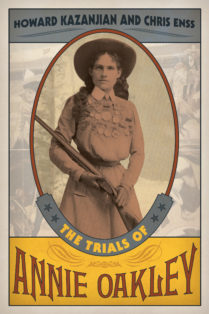
The Trials of Annie Oakley.


When humorist Will Rogers visited Annie at her home in Ohio in the spring of 1926, the peerless, lady wing shot was pale and physically exhausted, but the spark in her eyes was just as vibrant as it had always been. The two, old friends sat and talked of days gone by and of when she was a young girl in the Wild West shows. She remembered staring down the barrel of a rifle with confidence at a target across the arena and waving to the cheering crowd when the target was hit. “Ladies and gentlemen,” Buffalo Bill Cody would announce. “I present to you Little Annie Oakley. Little Sure Shot. Positively the world’s champion shot; the world’s one and only of her kind.”

Annie and Will reminisced about friends they had in common and of comedian and actor, Fred Stone. It was through Fred that Annie and Will had met. The Stones and the Butlers had been neighbors when they lived in the Northeast. Stone had a small estate in the exclusive community of Forest Hills Gardens in Bayside, New York. Annie, Frank, Will, and Fred hunted together on the land.

Annie shared an article with Will from the June 7, 1925, edition of the San Antonio Light entitled “Women Must Prepare to Go Into the Trenches When Next War Comes.” The report echoed Annie’s sentiments regarding how a woman’s skill for shooting could be put to use for the country.

“Women will be part of the regular army, the volunteers, and the draft troops,” the story proclaimed. “And why not? There have been ferocious women warriors in history…. Women go to the polls now, run for all offices and appear in all the businesses. Why should they not take their place in the trenches? For one thing, the women will not object.

“Women can shoot as well as men. Some women shoot better than most men. How many men ever equaled Annie Oakley?”

Shortly after Will Rogers left the Butlers’ home, he wrote a piece about the time he spent with Annie and the colorful life she’d lived.

“She [Annie Oakley] was the reigning sensation of America and Europe during the all the heyday of Buffalo Bill’s Wild West show,” Rogers boasted. “She was their star. Her picture was on more billboards than a modern Gloria Swanson.

“She is bedridden from an auto accident a few years ago. What a wonderful, Christian character she is! I have talked with Buffalo Bill cowboys who were with the show for years and they worshipped her….

“I want you to write her, all of you who remember her, and those that can go see her. Her address is 706 Lexington Avenue, Dayton, Ohio. She will be a lesson to you. She is a greater character than she was a rifle shot.

To learn more about the famous sure shot read

The Trials of Annie Oakley.


As Good As Ever

Enter now for a chance to win a copy of

The Trials of Annie Oakley.


A gray automobile sped toward the entrance of Bohannon Hospital and Sanitarium in Daytona, Florida, on November 20, 1922, and jerked to a stop. Nurses and doctors scrambled out the building to meet the vehicle. The driver jumped out and raced to meet the medical team. He flung the back door of the car open and removed the limp body lying on the seat. The doctors surrounded the disheveled figure and immediately began examining the unconscious patient. Annie Oakley was pale and bruised, and the sheet under her head was stained with blood from a cut over her right eye. It was a mad dash to get the sixty-two-year-old woman inside the building and into the emergency room.

When the police arrived on the scene, they informed the physicians that the noted rifle shot was the victim of a car accident. She was with a party of five, including her husband, when the accident occurred. They were en route from the north to Leesburg where they had been vacationing. The chauffer driven Cadillac was forced off the road by a vehicle trying to pass at a high rate of speed. The chauffer tried and failed to keep the car on the Dixie Highway. It overturned, and the passengers were injured.

According to the November 12, 1922, edition of the Daytona Beach Morning Journal, Annie was nearly crushed to death. “The huge car careened off the roadside and ‘turned turtle,’ pinning Annie under the vehicle,” the article read. She was in critical condition when she arrived at the hospital. The Cadillac, which weighed more than two tons, fractured her hip and her right ankle.

Mr. B. Benson of Fort Pierce was following behind the Cadillac in his car when he witnessed the automobile Annie was in leave the road. Mr. Benson stopped to assist the shaken passengers. He helped free Annie from the rubble and drove her to the nearest hospital forty-six miles away in Daytona.

Doctor Clyde C. Bohannon, the well-respected physician for whom the hospital was named, attended to the hurt markswoman. Annie was in shock and in a great deal of pain. Once she was stabilized, Doctor Bohannon determined the extent of her injuries. The break in the upper quarter of the femur bone was substantial. Surgery was required for both the hip and the ankle. Annie would never fully recover.


To learn more about the famous sure shot read

The Trials of Annie Oakley.


Tombstone Epitaph & The Pinks


The Tombstone Epitaph is a Tombstone, Arizona, based monthly publication that serves as a window in the history and culture of the Old West. Founded in January 1880 (with its first issue published on Saturday May 1, 1880), The Epitaph is the oldest continually published newspaper in Arizona.

It long has been noted for its coverage of the infamous Gunfight at the O.K. Corral on Oct. 26, 1881, and its continuing research interest in Wyatt Earp, Doc Holliday and their cowboy adversaries. In 2005, for example, it presented for the first time a sketch of the O. K. Corral gunfight hand drawn by Wyatt Earp shortly before his death. 

An article about The Pinks was featured in a recent edition of the Epitaph.  Thanks to the paper’s editor Mark Boardman for the kind review.  In celebration of the article I’m going to giveaway two copies of The Pinks today.  Drop me a line at gvcenss@aol.com and I’ll send you the book. 


Life At Pinehurst

Enter now for a chance to win a copy of

The Trials of Annie Oakley.

A row of ten, smartly dressed women stood side by side carefully scanning the horizon. Each was holding a rifle and waiting patiently for the instructor to give her directions. A genteel, smiling Annie Oakley stepped forward carrying her own weapon. A handful of ladies who had arranged to take shooting lessons from the famous markswoman stood near the side entrance of the firearms school in Pinehurst, North Carolina, anxiously awaiting the opportunity to draw a bead on a target and fire their guns.

Shooting at clay targets a few inches wide as they flew past at fast speed and actually hitting them was a thrill like none other. Annie had assured her students of that fact. Trap shooting involved speed, accuracy, and eye-hand coordination, something Annie had in abundance. For years she had extolled the virtues of trapshooting and was proof it could be done for pure enjoyment or competition. She reminded her class to keep both eyes opened, be aware of the position of their bodies while holding their .22- caliber shotguns, keep their cheek glued to the stock, point, and shoot.

KaBang! Kabang! Kabang! The weapons rang out in succession. The women were thrilled that their guns fired without incident and were excited to try again. Annie had warned them the sport could be addictive once they took the plunge.

From the time the United States entered World War I in early 1917 to November 1918, Annie had instructed more than 4,000 men and women on how to shoot. For many women, the time learning how to use a firearm led to regular participation in the sport of trapshooting. For many men the instruction helped them prepare for battle. Annie’s desire to serve her country in combat was realized through the soldiers who admired how she used a gun and employed what she taught in battle.

The Great War ended at the eleventh hour on the eleventh day of the eleventh month of 1918. Annie Oakley was fifty-eight years old. Although she had appeared in numerous exhibitions at cantonments throughout the east and demonstrated her skill to thousands of recruits bound for Europe to fight, many people wrote letters to the author of a syndicated column called “Trap, Gun and Rod,” hoping to find out what became of the once popular markswoman. “Is she still living,” a reader in Pittsburg, Pennsylvania, asked? “If so, how old would she be?”

“Annie Oakley (Mrs. Frank Butler) is very much alive and very much active in shooting game,” responded reporter Tom Marshall. “The last time I saw her shoot she performed with the old time vim and accuracy.”

If Annie had ever forgotten her age, newspapers across the country reminded her. An article that appeared in the January 3, 1919, Wilmington, Delaware, newspaper The Morning News told of an occasion where Annie’s age was the topic of conversation. It was a gathering of New York sportswriters. After much speculation, the writers were unable to agree on how old the sharpshooter was and couldn’t guess what the future held for the talented woman. The author of The Morning News article decided to take the questions to the source.

Annie was not ashamed to admit her age or to share her future plans. “On my sixtieth birthday next November, I will make my farewell appearance before the American public in an exhibition of shooting with the revolver, rifle, and shotgun,” she informed the reporter. “The exhibition will be in New York. When I begin to make plans for this shoot you will know that I am nearing the three-score of year’s mark – also that it will be the final appearance of Annie Oakley in public as a shooter.”

To learn more about the famous sure shot read

The Trials of Annie Oakley.


A Very Clever Woman

Enter now for a chance to win a copy of

The Trials of Annie Oakley.


Three dozen, fresh-faced young men jockeyed for position behind a row of windows on a train leaving Poughkeepsie, New York, bound for Camp Mills on Long Island. The new Army recruits waved goodbye to those on the railroad platform; they wore happy expressions and cheered as the car lurched forward. The men were excited and blissfully naïve about the journey ahead of them. Family and friends on the platform offered last minute farewells as the train slowly began to move ahead. Some people cried as the vehicle left the station and blew kisses to the courageous souls who had answered the call to serve their country when America announced it would join Britain, France, and Russia to fight in World War I.

The United States entered the war on April 6, 1917, and by the end of that same month thousands of men had eagerly flooded recruiting stations, enlisted in the Army and Navy and promised to defend the nation in time of peril.

On July 6, 1917, newspapers and unofficial dispatches from Canadian army headquarters in Europe documented when America went into battle for the first time during the World War. A young Texan who had traveled to Ontario to enlist had the honor of being the first to carry the American flag in the European war. He was carrying the Stars and Stripes on his bayonet when he was wounded and subsequently transported to a medical unit.

According to the July 20, 1917, edition of the Democrat and Chronicle News the Texan’s brave action prompted even more patriotic men to join a branch of the service. Men did not have a moratorium on devotion to country. Women also wanted to do their part. Annie Oakley was among them. From the time the Spanish American War began in 1898, Annie had desired to recruit and train women to be expert shots and fight for the United States. She offered her unique services to President William McKinley.

“Dear Sir,” her letter dated April 5, 1898, began, “I for one feel confident that your good judgment will carry America safely through without war. But in case of such an event I am ready to place a company of fifty lady sharp shooters at your disposal. Every one of them will be an American and as they will furnish their own arms and ammunition will be little if any expense to the government. Very Truly, Annie Oakley.”

President McKinley politely declined her office, but Annie never abandoned the idea. More than nineteen years after the initial proposal, Annie again offered to raise a regiment of women volunteers to fight. She received more than 1,000 letters from women throughout the United States anxious to join the regiment. Three thousand women had participated in Annie’s shooting school in Pinehurst, North Carolina, during the 1916-1917. If necessary she could call on the best students from her classes to take part in the program. Many of the women were willing to serve as well.


To learn more about the famous sure shot read

The Trials of Annie Oakley.