
1833 – (Birth of a Spy): Birth of Pauline Cushman, an actress who became a celebrated Union spy during the Civil War.
The Pinks Reads Like A Historical Thriller
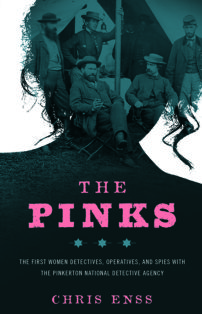
Chris Enss’s The Pinks offers an engrossing look at the women’s flank of the famed Pinkerton group, which provided services of security, protection, investigation, and, in many cases, infiltration by its initially all-male staff of “private eyes.”
Allan Pinkerton had an innovative and invasive approach to dealing with crime and criminals. After immigrating to the United States from Scotland, he eventually established the Pinkerton offices in Chicago. Six years after the agency opened, Kate Warne had the audacious foresight to apply for a job as a Pinkerton detective, despite the fact that Pinkerton himself had never considered hiring women. Warne argued that women could assume undercover roles as ably as men, and that feminine intuition and charm could help them excel as undercover agents.
Though Pinkerton knew the work would be dangerous, he hired Warne and assigned her to numerous cases. Enss depicts Warne as an excellent actress, able to alter her appearance, accent, and mood quickly and convincingly. Pinkerton’s investigations were often complex and went on for extended periods of time as the agents gained the confidence of key individuals—or the guilty parties themselves. Warne rose to every challenge, including escorting a disguised Abraham Lincoln to Washington via train in 1861. The then president-elect was in danger of assassination by a Baltimore cadre of secessionists who wanted Lincoln dead before he even had a chance to take office.
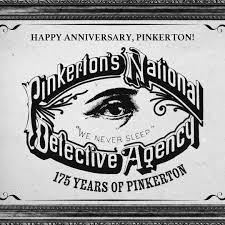
The Pinks notes how Warne’s success encouraged Pinkerton to employ other women, placing them in roles of general investigation or even espionage during the Civil War. They pursued murderers, carried classified documents, decoded messages, and maintained their cover in highly charged situations. Ultimately, the Pinkerton logo became that of a watchful female eye, accompanied by the apt motto of “We Never Sleep.” However, despite Pinkerton’s equal-opportunity mind-set, official American police forces did not hire female detectives until the late nineteenth century.
The Pinks details Warne’s career as a Pinkerton detective, along with various other cases assigned to female agents like Hattie Lawton, Dr. Mary Edwards Walker, and the artistically gifted Lavinia “Vinnie” Ream. Filled with intrigue, suspense, bravery, and women’s accomplishment,The Pinks reads like a historical thriller with one fascinating plot twist: it is based wholly on truth.
Foreword Review Magazine
The Pinks 6
I'm looking forward to hearing from you! Please fill out this form and I will get in touch with you if you are the winner.
Join my email news list to enter the giveaway.
"*" indicates required fields
Enter to win a copy of The Pinks:
The First Women Detectives, Operatives, and Spies with the Pinkerton National Detective Agency
This Day…
1920 – 125 National Woman’s Party members surrounded the Chicago Coliseum to picket the Republican National Convention, demanding the 36th state ratification of the Susan B. Anthony Amendment. [1]
The Pinks Book Review
Book Review: The Pinks
Reviewed by Chris Hertig, CPP
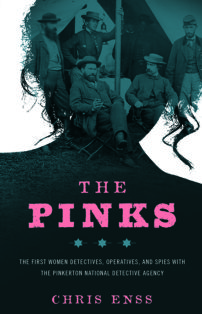
The Pinks: The First Women Detectives, Operatives, and Spies wih the Pinkerton National Detective Agency. By Chris Enss. Published by TwoDot; rowman.com; 184 pages; $16.95.
Undiscovered history is that which exists but is not commonly known. The security industry has a rich and diverse amount of such history. The Pinks: The First Women Detectives, Operatives, and Spies with the Pinkerton National Detective Agency is loaded with undiscovered history and told in an easily read, engaging style by best-selling author and licensed private investigator Chris Enss.
Enss reveals the stories of 12 women who were Pinkerton Agency operatives, paid informants, or others who reported to Alan Pinkerton during the American Civil War. Beginning with Kate Warne, who started with the agency in 1856 and went on to head the Woman’s Detective Bureau, Enss enthralls the reader with the exploits of the female operatives and those they worked with. As a result, there is additional perspective on founder Alan Pinkerton, operative Timothy Webster, and others.
Hattie Lewis Lawton was the second woman hired by Pinkerton (1860). She may also have been the first mixed-race detective in history. Lawton worked with Timothy Webster when the two posed as man and wife in Richmond, Virginia. Lawton and Webster were captured by the Confederates. Webster was hanged, but Lawton was exchanged for other prisoners a few months later. She also worked with John Scobell, a former slave who had been educated by his master.
These and other tidbits speak volumes about how Pinkerton was an independent thinker. The idea of hiring women and African Americans during this time period was truly revolutionary.
Enss describes additional cases handled by female operatives. A fair portion of the book deals with the assassination plot on President-Elect Abraham Lincoln. Kate Warne played a key role in this operation. She hung out in places where secessionists could be overheard, gaining key details of the plot. Her role expanded to carrying a pistol and posing as Lincoln’s sister who was caring for her ill brother on a covert train ride through Baltimore.
Another fascinating case describes operative Elizabeth Baker and her work forwarding information to the Union about Confederate shipbuilding activity, including submarines. Freed slave Mary Touvestre collected information on the rebuilding of the ironclad Merrimac. Six months after her information was forwarded, the Union launched the Monitor—its first ironclad—which went on to severely damage the Merrimac.
The Pinks belongs on the shelf of history buffs, academicians, and security professionals. It sheds new light on the important contributions that the Pinkerton Agency made to American history.
Reviewer: Chris Hertig, CPP, CPOI (Certified Protection Officer Instructor) is a longtime member of the ASIS Professional Development Council. He was the principal author of “The Evolution of Asset Protection & Security” chapter in The Professional Protection Officer, the text for the Certified Protection Officer (CPO) program.
The Pinks 6
I'm looking forward to hearing from you! Please fill out this form and I will get in touch with you if you are the winner.
Join my email news list to enter the giveaway.
"*" indicates required fields
This Day…
1920 – Protesting the GOP: According to Ms. Magazine, Alice Paul announced plans for National Woman’s Party members to picket the Republican National Convention in Chicago with large banners, continuing their advocacy for the 19th Amendment.
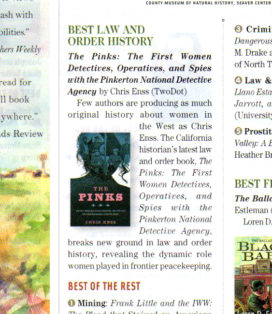
Best Law & Order History
Enter now to win a copy of
The Pinks: The First Women Detectives, Operatives, and Spies
with the Pinkerton National Detective Agency
What did it take to become one of America’s first female detectives?
Discover the remarkable true stories in The Pinks: The First Women Detectives, Operatives, and Spies with the Pinkerton National Detective Agency. From undercover investigations to daring pursuits of justice, these pioneering women broke barriers and helped shape American law enforcement history.
The Midwest Book Review calls the book “a lively, important survey” and notes that it is “recommended for history, women’s issues, and sociology holdings with a special interest in law enforcement.” The review further praises the book for capturing the courage, determination, and historical significance of the female Pinkerton agents whose work influenced both American history and early struggles for justice.
If you enjoy stories of extraordinary women, true crime, Western history, or law enforcement history, this book belongs on your reading list.
Enter to win a copy today by visiting www.chrisenss.com!
The Pinks 6
I'm looking forward to hearing from you! Please fill out this form and I will get in touch with you if you are the winner.
Join my email news list to enter the giveaway.
"*" indicates required fields
#ThePinks #Pinkerton #WomensHistory #WomenDetectives #TrueCrimeHistory #AmericanHistory #ChrisEnss #BookGiveaway #HistoryBooks #WomenWhoMadeHistory
This Day…
Investigate The Pinks
An Interview with History Muse
I knew Allan Pinkerton had hired a woman detective just as his agency was getting started. I’ve thought about creating a fictional woman detective working for Pinkerton after the Civil War—but it never occurred to me that he’d hired more than one. Chris Enss, with her excellent book, The Pinks: The First Women Detectives, Operatives and Spies with the Pinkerton National Detective Agency, shows us the work of ten “Lady Pinks,” women of intelligence and nerve who carried out complicated spy missions for the Union during the Civil War.
Kate Warne was the first. She was a young widow when she walked into Pinkerton’s office in 1856, and asked for a job as a detective. She told him women could often find out things that men could not. Pinkerton was an enthusiastic innovator, willing to defy convention if he thought it would work, and he hired her.
A complicated first case
Two days after she was hired, Kate Warne was on her first case. Large sums of money had disappeared from the care of an elite express company: one locked pouch with $10,000, and another with $40,000. Pinkerton suspected the manager of the company, but the case against him seemed very weak. Still, when the manager left town for a while, the Pinkertons followed him, and noted that he purchased expensive clothes for himself and his wife, stayed at the finest hotels, and invested in racehorses. His actions prompted his arrest. He was taken to a prison in New York.
His wife left town, to visit relatives in Philadelphia. Six Pinkerton agents went to work.
A 19th century Mission: Impossible
Enss spins a suspenseful story of how the Pinkertons worked this case. Kate Warne made friends with the wife, telling her a long story about a husband falsely imprisoned as a forger. Another Pinkerton agent, tall and remarkably good-looking, charmed her at dinner gatherings. A third agent got himself hired as the husband’s lawyer, with another agent as his courier. After several deftly told twists and turns, the Pinkertons win the case. I couldn’t help but think of the various Mission: Impossible teams.
Author interview
Chris Enss is not only an author, but also a scriptwriter, a comedienne, a wonderful writer about the American West, and a private detective. She graciously agreed to answer some questions I posed:
History Muse: How did you decide to write this book?
Chris: I am fascinated with women in history who excelled in non-traditional roles. Kate Warne was one of those women. I was equally intrigued by Pinkerton himself. He was a pioneer in the industry of private investigation. The story of women Pinkerton detectives was begging to be told.
History Muse: I think many of us think of detective work and spy work as solitary, but these women were often part of teams that, frankly, reminded me of Mission: Impossible. How often does that happen? And are you considering a screenplay based on any of these chapters?
Chris: What’s interesting about PI work is that every case is different. There are times working alone has its advantages and just as many instances when working with a team is important. I’m am amazed at the dedication The Pinks had to stay on the job for so long. They had to go undercover for several months and they were content with the case being solved. No one was out for individual glory.
In my PI work I am generally alone. I’ve not been involved in any team investigations. I’m sure the Pinkerton National Detective Agency continues to work with teams to get their suspect.
I am happy to report that Alan Kaplan and Alicia Keyes have optioned The Pinks. I’m not sure if the program will be a cable series or what, but I’m excited to see what they’ll do.
History Muse: The stories in your book are mostly from the Civil War, but the Pinkerton Agency has been, and remains, part of American society to the present day. Did the agency continue to hire women after the Civil War? It was also noteworthy to me that Pinkerton hired at least one person of color and one bi-racial woman during the period covered in your book. Was that something he continued to do?
Chris: The Pinkerton National Detective Agency has always been a progressive operation. They hired women from all walks of life and color. Gender or race had no bearing on being hired because all Pinkerton was focused on was solving crimes. Once Kate Warne introduced the idea of hiring a woman the flood gates were open. I applaud Pinkerton for taking the chance he did at a time when no one else would have entertained the idea.
History Muse: The women you profile in The Pinks are remarkable women—from the first operative Kate Warne to Mary Edwards Walker, one of the few women to hold a medical degree. Is there one whose work you particularly admire? Do you think the brains and resourcefulness these women showed is rare, or do you think a lot more people (including female people) could do what they did, given the chance?
Chris: Kate’s story is my favorite. The spunk it took to walk into Pinkerton’s office and announce you are looking for work as a detective is such a bold, admirable act. She was a versatile agent too. She could play the part of a [spiritualist] medium or woman in distress very easily. One of the key ingredients of being a good private investigator is patience. You have to plan, execute, and wait, wait, wait. Kate was good at the waiting. Many people change their minds about the profession because there is so much waiting. Motion pictures and television make it seem as though the culprit is apprehended in a matter of days, but that’s not usually the case. Anyone with great patience can excel as a private investigator.
History Muse: What’s next for you? Do you think you’ll be making more use of the extensive Pinkerton archives?
Chris: I have two new books coming out in 2018. The first is entitled The Principles of Posse Management. Principles of Posse Management tells the stories of the lawmen and leaders of the Old West who organized citizens in the pursuit of law and order. This collection of tales reveals what Wyatt Earp, Bat Masterson, Buffalo Bill Cody, and other legends of the old west knew about leadership with a clever twist on the classic shoot-em-up, black-hats-vs-white-hats tale. In the fall the book Killer Bs will be released. That book is about the B movies made by Republic Pictures. I am writing a book about Big Nose Kate and about the women who played important roles in building the railroad.
History Muse: I, for one, am really looking forward to reading about Big Nose Kate!
Enter now to win a copy of The Pinks
One Last Day in Deadwood
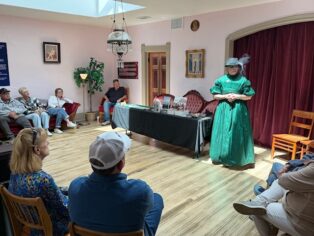
My last day in Deadwood could not have been more memorable. I spent the afternoon speaking with visitors touring the Brothel Deadwood Museum, dealing Faro between book presentations, and enjoying the stories and laughter that make this town unlike any other in the West.
One of the highlights was riding in the Save Our Tails parade with Deadwood History, Inc. Executive Director Jim Williams, followed by a wonderful group photo with the incredibly generous Rose Speirs, Co-Executive Director of Deadwood History, Inc. A nicer person one could not meet.
Thank you to everyone who attended the presentations, stopped by to visit, and shared your love of Deadwood history. I’m already looking forward to returning in June 2027 with more books to present and for the screening of the film According to Kate.
This Day…
1870 – Arguments for women’s suffrage were prominently advocated during a period of rapid development for the American feminist movement, a time later archived and recalled by the Ms. Magazine archives.