
Enter now to win a copy of
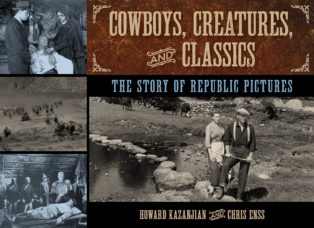
Cowboys, Creatures and Classics: The Story of Republic Pictures
About two hundred miles north of Hollywood is the small town of Lone Pine. Almost at the dawn of motion picture making, the Eastern Sierra hamlet became a popular outpost for location filming. It offered scenery ranging from Sierra peaks to sand dunes. The mountain scenery there could double for the Himalayas, and the desert landscape could double for Salt Lake Valley. Lone Pine has proven to be as versatile as some of the most gifted actors performing on screen.
Movie cowboys from Hopalong Cassidy to John Wayne and Gene Autry to Rex Allen chased innumerable bad guys in the hills around Lone Pine. The cry of “Hi-Yo, Silver, Away!” still echoes through the canyon where the masked marvel and his sidekick Tonto rode. The songs sung by Roy Rogers can still be heard in the hills on quiet nights, and the report from shotguns fired by hundreds of celluloid outlaws ricochet off the ancient rocks.
Films requiring a foreign country’s rocky, desert landscape have been shot at Lone Pine. Even films depicting lunar landscapes have been shot on location there. Lone Pine has served as a supporting player of sorts for more than fifty studios for more than ninety years.
The first movie production came to Lone Pine in 1914. It was a William S. Hart western, but the name of the project has been lost to time. Historical records note that the town’s elders recalled only that it involved “a lot of riding and shooting” and that practically every able-bodied male in the community was pressed into service as either a member of law-abiding vigilantes or as one of the bad men being chased by Hart.
The 1920 silent film The Roundup, starring Rosco “Fatty” Arbuckle and Wallace Berry, was the first commercial production shot at Lone Pine. Locals loaned horses, wagons, and talent to make the movie. Lone Pine evolved from being a mining community when it was founded in 1865 to being one of the most favored spots to shoot motion pictures. Owens Valley in which the community is situated is regarded as one of nature’s masterpieces. Surrounded by massive ranges, it is not only one of the most richly endowed scenic areas in the world but also one of the most compelling.
Most of the actual filming at Lone Pine was either done on the desert bed of the valley, which is rimmed on all sides by towering mountains, or in the hills. From Lone Pine itself can be seen seven peaks more than fourteen thousand feet high, with Mt. Whitney reaching 14,496 feet into the sky. Nearby Death Valley, on the other hand, is 287 feet below sea level. There is snow all year on the mountain tops, and Palisade Glacier, the most southerly glacier in the United States, is less than sixty miles away.
Republic Pictures’ president Herbert Yates was enamored with Lone Pine and suggested the setting to film John Wayne’s first feature for the studio, Westward Ho. Wayne plays a character named John Wyatt who, at a young age, saw his parents killed and his brother kidnapped. Wayne’s character is leading a wagon train west when he meets up with his brother now working for the people who murdered their mother and father. The movie received high marks, and one of the reasons cited is that it was filmed on location and not on the studio’s backlot.
An article in the September 6, 1935, edition of The Times Recorder noted:
To learn more about the many films Republic Pictures produced read
Cowboys, Creatures and Classics: The Story of Republic Pictures