
Profanity and Poise: When Western Dialogue Needs Cursing and When It Doesn’t
The Western has always been a genre of extremes. Vast landscapes. Stark moral codes. Sudden violence. Deep silences. And, perhaps surprisingly, wildly different approaches to language. Some Westerns lean into rough, profane speech to convey grit and realism. Others strip dialogue down to something cleaner, sharper, and almost poetic, proving that restraint can be just as powerful as rawness.
The question isn’t simply whether cursing belongs in Westerns. It’s when it works and when it doesn’t.
There is a persistent belief that earlier Westerns avoided profanity because audiences were more polite or moral. That’s only partially true. The real reason is largely industrial: the Motion Picture Production Code (enforced from the 1930s through the 1950s) placed strict limits on language. Writers had to find other ways to convey anger, menace, and humor.
And they did – brilliantly.
Instead of explicit language, classic Westerns relied on rhythm, implication, and subtext. A line could cut deeper because it wasn’t cluttered with profanity. A threat didn’t need embellishment; tone and timing carried the weight.
Consider how often a single word, “Mister,” could sound like a warning.
Or how a pause could speak louder than a shouted insult.
These films created a legacy of dialogue that still shapes the genre today.
Many of the most memorable Westerns contain little to no profanity, yet their dialogue remains iconic. The absence of explicit language forces writers to sharpen every line.
Take High Noon. The tension builds not through shouted obscenities, but through clipped, urgent exchanges. Every word feels measured, as if time itself is running out, which in the film, it is.
Or Shane, where the dialogue is almost lyrical. The famous plea, “Shane, come back!” lands with emotional force precisely because it isn’t surrounded by noise. It’s simple, direct, and devastating.
In The Searchers, Ethan Edwards expresses hatred, obsession, and grief without relying on profanity. His words are often restrained, but his tone carries the fury. The absence of cursing doesn’t make the character less intense, it makes him more controlled, and therefore more unsettling.
And then there’s Rio Bravo, where humor and camaraderie emerge through wit rather than vulgarity. The banter feels natural, unforced, and timeless.
The following are a few examples of clean, powerful lines from classic Westerns:
Here’s an exchange between saloon singer Frenchie (Marlene Dietrich) and Sheriff Tom Destry (James Stewart) from the 1939 film Destry Rides Again.
“You’d better mind your own business or you’re heading for trouble,” Frenchie warns the sheriff. “Trouble is my business,” Sheriff Destry responds.
Between good son Jesse McCanles (Joseph Cotton) and his father Senator Jackson McCanles (Lionel Barrymore) in the 1946 film Duel in the Sun.
“You mean to shoot down unarmed men?” Jesse asks the senator. “Just like he was a rattlesnake,” his father tells him.
And from the 1959 film The Hanging Tree – Ben Piazza’s character Rune to Doc Joe Frail played by Gary Cooper, “If you ain’t the devil, well, he’s sure sitting on your shoulder.”
By the late 1960s and 1970s, Westerns began to shift. The Production Code faded, and filmmakers pushed toward realism – grittier visuals, morally ambiguous characters, and yes, more explicit language.
This was partly influenced by broader trends in cinema, but also by a desire to strip away the mythic polish of earlier Westerns. The Old West, after all, was not a polite place.
In The Wild Bunch, language becomes part of the film’s brutality. Characters speak as harshly as they act. The profanity isn’t ornamental, it reinforces the moral decay and desperation of the world they inhabit.
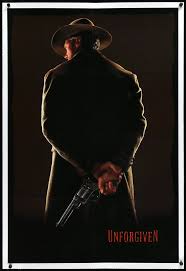
Unforgiven uses cursing more sparingly, but when it appears, it feels earned. Clint Eastwood’s William Munny doesn’t waste words. When he does speak harshly, it lands like a gunshot – rare, but final.
Then there’s Deadwood, perhaps the most famous example of profanity in Western storytelling. The show is saturated with inventive, relentless cursing and yet it’s often delivered in elaborate, almost Shakespearean rhythms. The language is paradoxical: vulgar and sophisticated at the same time.
And Tombstone strikes a middle ground. While not devoid of profanity, it relies more on stylized, memorable lines, especially through Doc Holliday. His insults and observations are cutting without always being crude.
Here’s an example of an exchange between Doc Holliday (Val Kilmer) and Ike Clanton (Stephen Lang) who wasn’t doing well at the gambling table.
“It seems poker’s just not your game, Ike. I know, let’s have a spelling contest! “
Kurt Russell as Wyatt Earp in Tombstone warned the cowboys at the Tucson train depot, “You tell ’em I’m coming! And Hell’s coming with me! You hear? Hell’s coming with me!”
And then there’s John Wayne’s character Rooster Cogburn in True Grit from 1969. “Fill your hand, you son of a bitch!”
Not all uses of profanity improve a Western. In fact, overuse can flatten dialogue, making it feel repetitive or lazy.
If every line is laced with the same expletives, they lose their impact. Characters begin to sound interchangeable. The language stops revealing personality and starts masking a lack of specificity.
In some modern Westerns, profanity is used as shorthand for toughness. But toughness isn’t about volume, it’s about presence. A quiet threat can be far more intimidating than a shouted obscenity.
There’s also the risk of anachronism. While people in the 19th-century West certainly used coarse language, not all modern profanity translates historically. Overly contemporary phrasing can pull audiences out of the story.
One of the most effective techniques in Western dialogue is contrast, using both restraint and profanity strategically. A character who rarely curses but suddenly does can command attention instantly. The shift signals a change in stakes or emotion.
Similarly, placing a profane character alongside a more restrained one can create dynamic tension. Their differing speech patterns reveal their worldviews without exposition. This contrast is often what makes dialogue memorable. It’s not the presence or absence of cursing alone, it’s how it’s used in relation to everything else.
Perhaps the most overlooked aspect of Western dialogue is silence.
The genre is uniquely suited to pauses. Wide-open spaces invite stillness, and that stillness can be filled with meaning. A look, a gesture, or the absence of a response can say more than any line, profane or otherwise. Many classic Westerns understood this instinctively. Modern ones sometimes forget it. When every moment is filled with words, especially loud, profane ones, there’s no room for tension to breathe.
One of the most powerful near-silent moments in a Western comes from the 1966 film The Good, the Bad and the Ugly, during the final three-way duel in Sad Hill Cemetery. Three men – Blondie (Clint Eastwood), Tuco (Eli Wallach), and Angel Eyes (Lee Van Cleef) stand in a vast circular graveyard. No dialogue is exchanged. No one explains the stakes. Everyone already knows: only one (or perhaps two) will walk away.
Or the doorway ending from 1956 film The Searchers. Ethan Edwards (John Wayne) stands in the doorway after returning his niece Debbie. The family goes inside. He doesn’t. There’s no speech a hand flexing at his side, a slight shift of posture, then he turns and walks back into the desert.
And then there’s William Munny (Clint Eastwood) stepping into the bar at the end of the 1992 film Unforgiven, after his friend Ned’s death. Before the violence the room goes still. Men stop talking. No one reaches for a gun. The silence signals a moral shift. It’s not a flashy showdown, it’s the quiet arrival of something inevitable and deadly. The silence carries dread rather than suspense.
Westerns thrive on tension, between civilization and wilderness, law and chaos, myth and reality. That tension extends to language. Some stories demand grit. Others demand grace.
The greatest Westerns understand that dialogue isn’t about how much is said, or how loudly, but how precisely it captures the soul of the moment. A single clean line can echo for decades. A well-placed curse can hit like a hammer. But in both cases, the principle is the same: Say only what matters. And let the rest hang in the air like dust at sunset.