
1865 – US President Abraham Lincoln is shot in the head by John Wilkes Booth at Ford’s Theater in Washington; he dies a day later.
A Letter From a Reader
Enter to win a copy of Iron Women: The Ladies Who Helped Build the Railroad
Always a pleasure to hear from readers! Thank you, John James.
Hello Chris, Thank you for all your writings. I have bought your books for my daughter (now 34) because they’re empowering. You are an American Treasure. I don’t need to tell anyone that there are many scenarios where women actually do ALL the work and receive little or no credit. I’m a member of several “fraternal” organizations (FOE, BPOE, LOOM) and I’ll reference one with which I’m most familiar l…. the FOE (Fraternal Order of Eagles). Some Eagle Aeries are integrated (men & women), ours isn’t. We have the general Aerie for men, and the Woman’s Auxiliary for women. Women do much or most of the work (like organizing and operating charity and other events) and men not only take the credit, they treat the women as if they’re considered and treated as lesser human beings. Not so much these days, but in the past, when I was new to the FOE, I was frequently told “This is a man’s club.” Ironically, the FOE professes 4 great pretexts (Liberty, Truth, Justice and EQUALITY). That’s a laugh.!! The FOE even (incredulously) claim that they originated “Mother’s Day” and “Social Security”. I was drawn to the group because I’m an advocate for the LTJE pretexts, but I remain with the group because I support charities …… and the drinks are cheap. Indeed, male-dominated structure is conspicuously illustrated throughout all aspects and areas of our society and throughout our HIS-tory.
Read Iron Women
This Day…
Harvey Car Courier Corps
Enter now to win a copy of Iron Women: The Ladies Who Helped Build the Railroad
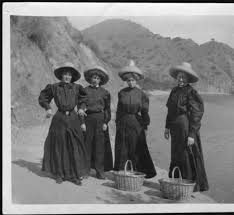
The Harvey Car Courier Corps will take you away “into the beckoning, foot-loose distances of New Mexico,” reads the Santa Fe Railway brochure on Indian Detours. The brochures were distributed to train travelers crossing the arid Southwest desert in the late 1920s, who were looking for adventure and romance.
Indian Detours were created by the Fred Harvey Company in 1925. The popularity of the automobile and the airplane had created a lull in railroad travel. The Harvey Company introduced the detours in hopes of encouraging the public to journey by train to their next vacation destination. The tours were only available for the Southwest part of the country, from the Grand Canyon to Santa Fe. The specialized tours by car were to divert passengers from the train for one to three days and drive them through the “wilderness panoramas” of northern New Mexico to Indian ruin sites and living pueblos.
The drivers of the Harvey vehicles, which included Packards, Franklins, Cadillacs, and White Motor Company buses, were always men. The tour guides or “couriers” were always women. Executives at the Harvey Company believed following the business model of the Harvey Girls would assure the success of the Indian Detours.
The women selected to be members of the Harvey Car Courier Corps spent weeks training for their positions. To be qualified tour guides, they were required to know the archaeological, ethnological, cultural, geological, botanical, historical, and legislative makeup of New Mexico. It was necessary that the information they shared with travelers was accurate. The couriers attended lectures and participated in trips along the detour trail. According to the March 12, 1975, edition of the Santa Fe New Mexican, most of the Harvey Car Courier Corps members found the work interesting. Aside from teaching school, there were very few interesting jobs for women post World War I. Couriers earned $150 a month, $160 a month if they spoke a foreign language and could communicate with travelers from other countries.
Among the well-known individuals who took advantage of the Indian Detours was Albert Einstein, John D. Rockefeller, Will Rogers, and Guglielmo Marconi, the inventor of the wireless telegraphy.
The Harvey Couriers were required to dress in Navaho-style costumes while giving the tours. The authentic outfit consisted of velveteen skirt, concha belts, and squash blossom necklaces.
The tours originated from the Harvey Houses: the Castaneda in Las Vegas, New Mexico; the Alvarado in Albuquerque; the Ortiz in Lamy; and the Navajo in Gallup. The most popular detour trips were to the Painted Desert, the Petrified Forest, and the Indian Pueblos in Taos and Santa Clara. The cost for the tours ranged from $10 to $14 a day.
The Great Depression brought about the end of the Indian Detours and the Harvey Couriers.
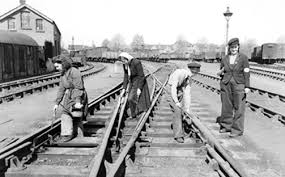
To learn more about the Harvey Girls read Iron Women: The Ladies Who Helped Build the Railroad
This Day…
1961 – “Show Girl” closes at Eugene O’Neill Theater NYC after 100 performances.
The Telegraphers
Enter now to win a copy of
Iron Women: The Ladies Who Helped Build the Railroad
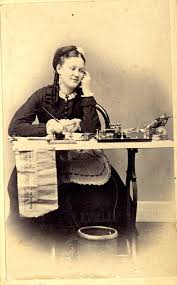
Twenty-eight-year-old Elizabeth Cogley sat at a small desk in the Pennsylvania Railroad ticket office in Lewiston Junction, Pennsylvania, on April 16, 1861, frantically writing down the message coming through the telegraph. The smartly dressed woman wore a serious expression; the message she was transcribing was vital and history making. The day before, a similar wire had reached Elizabeth. She carefully noted its contents and passed it along to the ranking military official in the area. It was from President Abraham Lincoln, and it read, “I appeal to all loyal citizens to favor, facilitate, and aid this effort to maintain the honor, the integrity, and the existence of our National Union, and the perpetuity of popular government; and to redress the wrongs already long enough endured.” This was Lincoln’s first call for troops. He asked for 75,000 volunteers.
The following day, Pennsylvania’s first war governor, Andrew G. Curtin, sent a telegram to Captain Selheimer, commander of the First Defenders Association in Lewiston, to rally his men together to report to Harrisburg, Pennsylvania, as soon as possible. After delivering the message to the captain, Elizabeth was instructed to respond to Governor Curtin with news that he and his troops would “move at once.” The railroad telegrapher dispatched the essential information quickly and accurately. Little did Elizabeth know the event would be remembered as the first telegraph exchange of the Civil War.
Born on November 24, 1833, Elizabeth learned telegraphy in the office of the National Telegraph Company. She entered the service of the Pennsylvania Railroad Company on April 13, 1856. She was stationed in the Lewiston office until the beginning of the Civil War. She remained with the railroad company for more than forty years.
Some of the earliest women in railroading can be found in telegraph stations. The job of the telegrapher was to transfer information between the train dispatcher and the train operator. A telegrapher copied train orders and messages from the train crew and reported the passing trains to the dispatcher. They also received and sent Western Union telegrams. Most learned the trade from another operator. Some attended schools such as the Cooper Union for the Advancement of Science and Art in New York and the Pittsburgh Female College in Pittsburgh.
The qualifications needed to be a telegrapher were to be well read, to know how to spell, and to be able to learn Morse code. According to author Virginia Penney’s book written in 1870 entitled How Women Can Make Money, a good lady telegraphist could make between $300 and $500 a year. With that in mind, many women with some knowledge of electricity and good penmanship decided to pursue a career in the field.
To learn more about the women who helped build the railroad read Iron Women
This Day…
1949 – “South Pacific” opens at Majestic Theater NYC for 1928 performances
Iron Women Still Going Strong
This Day…
1914 – Film serial “Perils of Pauline” shown for the first time in Los Angeles
Praise for Iron Women
Iron Women: The Ladies Who Helped Build the Railroad has been recognized with a
Spur Finalist Award from Western Writers of American and
two finalist awards from Foreword Review magazine.