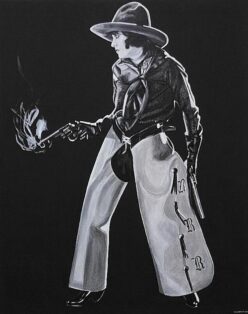
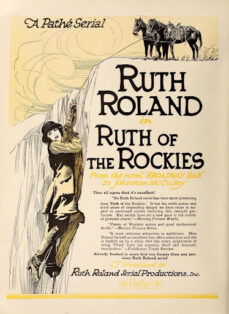
Reel Cowgirl Ruth Roland


Reel cowgirl Ruth Roland portrayed Pearl Marvin in a dozen silent films in The Perils of Pauline series between 1915 and 1917. Fans were on the edge of their seats watching the spunky actress ride her way in and out of trouble while solving crimes.  They waited in suspended animation for the film operator to change reels so they could learn the fate of the lead character. In the stuffy darkness of the theater the piano player tried, unsuccessfully, to quiet the audience’s nerves with a tasteful rendition of “Hearts and Flowers” to a gum-chewing accompaniment. Yet the suspense was a terrific ordeal, and the projector flickered out just as Ruth, all lost save honor, lay roped to a filthy pallet, with a leering bad guy rubbing his hands in the doorway. All wondered if the heroine would make it out alive!  Audiences loved Ruth.

Ruth Roland, who took Pearl White’s place in the hearts of the hair-breadth escape fans when Pearl deserted Hollywood for Europe just before World War I, remained for a heart-throbbing period the star of the serial “flickers.”  Whether in chaps or elegant gown, Ruth was always just slipping by the flick of an eyelid from the most appalling situation in her pictures; and with an astute comprehension of interest “build-up” her director always left her, at the conclusion of each performance, tied to a railroad track with the express thundering around the bed, or shackled in a sinister basement while the water crept upward from knees to waist, or leaping on horseback from the edge of a cliff to escape “a fate worse then death.”

Born in San Francisco on August 26, 1892, the daughter of John R. Roland, a newspaperman who had worked on the New York Sun and San Francisco Chronicle, Ruth began her stage career at the age of three, when she went on tour with Edward Holden’s “Cinderella” company.  Ruth’s screen career began in 1910. “I reached Los Angeles on April Fool’s Day,” she once related, “and stepped out at once and got a job. I fixed up a stage sketch with my horse and we were booked to perform in Los Angeles and dozens of nearby towns.”  Shortly thereafter, she was signed with the Kalem Film Company earning $115 a week. Her first picture was The Last Shot, one of the earliest westerns made. In ten years, she made a hefty sum making movies and she invested her earnings in real estate.

In the late 20’s Ruth retired from the screen to devote her entire time to her extensive real estate holdings, consisting principally of business lots in the Wilshire-Fairfax district in Los Angeles. At one time she reputedly had property worth three and a half million dollars.

Ruth did her own stunts in all her pictures until she was thrown from a horse. The accident caused injury to her spine which gave her much pain in later years. She was diagnosed with cancer in early 1937. The illness took her life on September 22 of the same year.

Ruth Roland was thirty-nine years old when she died.


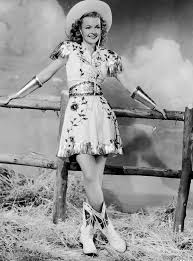
Cowgirl Dale Evans

Enter now to win

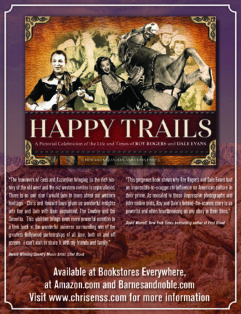
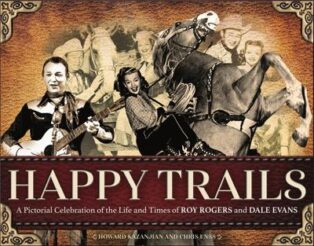
Happy Trails:

A Pictorial Celebration of the

Life and Times of Roy Rogers and Dale Evans


A few quotes by Dale Evans


Time and experience have taught me a priceless lesson: Any child you take for your own becomes your own if you give of yourself to that child. I have born two children and had seven others by adoption, and they are all my children, equally beloved and precious.


Christmas, my child, is love in action.  Every time we love, every time we give, it’s Christmas.


Cowgirl is a spirit, a special brand of courage. The cowgirl faces life head on, lives by her own lights, and makes no excuses. Cowgirls take stands. They speak up. They defend the things they hold dear. A cowgirl might be a rancher, or a barrel racer, or a bull rider, or an actress. But she’s just as likely to be a checker at the local Winn Dixie, a full-time mother, a banker, an attorney, or an astronaut.


Every day we live is a priceless gift of God, loaded with possibilities to learn something new, to gain fresh insights.


If we never had any storms, we couldn’t appreciate the sunshine.


To learn more about Dale Evans read

Happy Trails


This Day…

1939 Gone With The Wind Premiers

Gone With The Wind Premiers in Atlanta, Georgia. The movie adapted from the novel by Margaret Mitchell published in 1936. The movie, starring Clark Gable, Vivien Leigh, Leslie Howard, Olivia de Havilland, and Hattie McDaniel set in the deep south tells a story of the Civil War and its aftermath from a white Southern viewpoint.

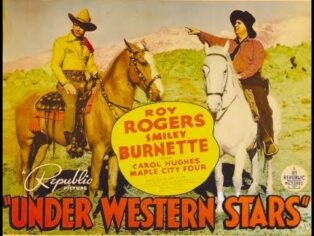
Under Western Stars

Enter now to win a copy of

Happy Trails: 

A Pictorial Celebration of the Life and Times of Roy Roger and Dale Evans


Under Western Stars

An Essay for the National Film Registry

By

Howard Kazanjian and Chris Enss


King of the Cowboys Roy Rogers made his starring motion picture debut in Republic Studio’s engaging western musical Under Western Stars.  Released in 1938, the charming, affable Rogers portrayed the most colorful Congressman ever to walk up the steps of the nation’s capital.  Rogers’ character, a fearless, two-gun cowboy and ranger from the western town of Sageville, is elected to office to try to win legislation favorable to dust bowl residents.

Rogers represents a group of ranchers whose land has dried up when a water company controlling the only dam decides to keep the coveted liquid from the hard working cattlemen.  Spurred on by his secretary and publicity manager, Frog Millhouse, played by Smiley Burnette, Rogers campaigns for office.  The portly Burnette provides much of the film’s comic relief and goes to extremes to get his friend elected.  His tactics include pasting stickers on the backs of unsuspecting citizens he engages in conversation and helping to organize a square dance to highlight Rogers’ skill and dedication to solving the constituent’s crisis.  Using his knowledge of land and livestock and his talent for singing and yodeling, Rogers wins a seat in Congress.

The sweep of this picture, which moves rapidly from physical action on the western plains to diplomatic action in Washington and back again, is distinctively thrilling.  The surging climax in the dust-stricken cattle country makes for one of the most refreshing films of its kind.  The politicians Rogers appeals to about the drought are not convinced the situation is as serious as they are led to believe and decide to inspect the scene for themselves.  The investigation committee is eventually trapped in a real dust storm.  The shots of the storm and the devastation left in its wake are spectacular.

Roy Rogers came to Hollywood from Duck Run, Ohio.  He made a name for himself as a member of the successful singing group the Sons of the Pioneers.  Reigning box office cowboy Gene Autry’s difficulties with Herbert Yates, head of Republic Studios, paved the way for Rogers to ride into the leading role in Under Western Stars.  Yates felt he alone was responsible for creating Autry’s success in films and wanted a portion of the revenue he made from the image he helped create.  Yates demanded a percentage of any commercial, product endorsement, merchandising, and personal appearance Autry made.  Autry did not believe Yates was entitled to the money he earned outside of the movies made for Republic Studios.  He refused to include Yates in the profits and threatened to leave the studio if Yates did not reconsider.  Autry was also demanding a raise in pay.

Yates decided it was time to begin grooming another talent to take Autry’s place should the need arise.  Rogers was a contract player with the studio making $75 a week.  Billed as Leonard Slye he appeared in a handful of films with Gene Autry singing along with the Sons of the Pioneers.  Rogers even had a part as a bad guy in one of Autry’s films.  When Autry caught up with Rogers in the picture, instead of taking him to jail he demanded the wily character yodel his way out of his troubles.

Yates had been looking for a musical actor to go boot-to-boot with Autry and Rogers was to be the heir apparent.  His sweet, pure voice and wholesome image made him a natural for the hero in Under the Western Stars.  Whether regaling the audience with a song about fighting the law entitled Send Our Mail to the County Jail or delivering a stump speech via a tune called Listen to Rhythm of the Range, Rogers makes the most of his leading role.

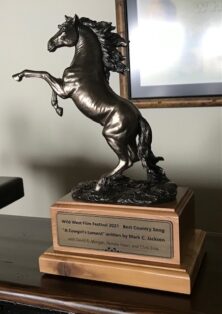
The Maple City Four, the well-known quartet who made the number Git Along Little Dogies popular, added their talents with Rogers harmonizing on the film’s most important song entitled Dust.  Written by Johnny Marvin, a recording artist from Oklahoma, Dust was nominated for an Academy Award for Best Original Song.  It was the first song from a B-western to be Oscar nominated.

According to the February 24, 1938, edition of the Hollywood Reporter, Dust was purchased by Republic Studios from the composers, Gene Autry and Johnny Marvin, for use in Under Western Stars.  A subsequent news item in Hollywood Reporter on April 13, 1938, just prior to the film’s release, noted that Autry was suing the studio for $25,000 for unauthorized use and dramatization of the lyrics with Dust.  According to contemporary sources, the suit over Dust was settled out of court and Johnny Marvin is listed as sole writer of the song.

Audiences made Under Western Stars a box office success and critics called its star “the new Playboy of the Western World.”

Director Joseph Kane, Republic’s top director of westerns delivered a film with a slight new slanting to make it different from all other B-westerns before it.   In addition to the political intrigue in Under Western Stars there is a fair amount of gunfights, fast horses, and unforgettable stunts.  What makes Kane’s film unique is that the fight is not over horse thieves, but the rights of man.  Critics at the Brooklyn Daily Eagle newspaper sited Kane’s “sensitive directing eye with giving the horse opera a social consciousness.”

Actors Carol Hughes, Guy Usher, Tex Cooper, Kenneth Harlan, Curley Dresden, Bill Wolfe, Jack Ingram, Jack Kirk, Fred Burns, and Tom Chatterton round out the exciting cast of players and no happy ending would be possible at all if not for Roy’s magnificent Palomino horse Trigger.  Brothers and veteran western writers Dorrell and Stuart McGowan penned the screenplay for Under Western Stars along with actress and screenwriter Betty Burbridge.

The film was shot in the Alabama Hills of Lone Pine, California.  The scenic location has been used for the backdrop in hundreds of motion pictures and television programs.  The high desert surroundings are integral to the story line of Under Western Stars and could be billed as a supporting role in the film.

Roy Rogers’ first starring vehicle solidified his place as a rising star in B westerns.  Film writer and critic Louella Parsons likened Rogers to “Gary Cooper in personal appeal.”  According to her report with the International News Service on November 29, 1938, she called Rogers an “upstanding young American who made the picture Under Western Stars a delight.”


Happy Trails Cover


To learn more about Roy Rogers and Dale Evans and Under Western Stars read Happy Trails.

 

Memories of Teachers Pack a Punch


This spring I met with a handful of California State Board of Education members to discuss Packing the West and learn the criteria to be followed when writing the Gold Rush curriculum for the program.  Some of the meetings were held in elementary school classrooms after students had left for the day.  Being in that setting brought back a flood of memories, primarily of one of the teachers who helped spark my desire to write.

Dr. Augustus Bock was my high school English teacher.  He loved the flirtatious tango of consonants and vowels, the steady dependability of nouns and the capricious whimsy of verbs, the strutting pageantry of the adjective and the flitting evanescence of the adverb, all kept safe and orderly by those reliable little policemen, punctuation marks.  He wanted to write the great American novel and when that didn’t happen, he turned to teaching.  Most of the time his passion for the vocation was infectious, but there were weeks when it was clear he believed he’d settled.  It was then that the tweed jacket with suede patches at the elbows he always wore appeared as if he’d slept in it, and he started to smell like cherry pipe tobacco and defeat.  I guess he didn’t understand how much his students valued him even if he never penned his version of East of Eden.

The same couldn’t be said for my British literature teacher, Evelyn DeLagrange, an Amazonian-looking woman with long red hair and an unnatural obsession with Geoffrey Chaucer.   Our troubles began after she read a book report I’d written about The Canterbury Tales in which I noted that “Chaucer was an expert at making nothing happen slowly.”  In a meeting Ms. DeLagrange had with my parents at the end of the semester, she suggested they take the college money they’d been saving for me and buy themselves a fishing boat because the only college she thought I’d be able to attend would have the word “beauty” or “clown” in front of it.

But I showed her.  After two years studying journalism at Cochise College, in Sierra Vista, Arizona, I went on to attend the University of Arizona, where I majored in drama.  When you tell someone you majored in drama, the first thing they do is mentally subtract twenty grand off what they think you make for a living.  The second thing they do is ask you to bring them a menu and tell them about the soup for the day.

Some teachers make a person want to become a writer, scientist, historian, etc., because they love the subjects they teach, and that ignites a desire in their students.  Other teachers drive students to their life’s pursuit just to prove that they were meant to do more than wear a multicolored wig, a rubber nose, and a massive bow tie.  And that brings me back to Packing the West.  With the Packing the West program, we hope to not only stir in students a love for the American West but to encourage them to strive for more, in the same way that the men and women on the frontier did.  We’re just getting started, but the historical figures we’ve included in the first set of learning materials for youngsters are impressive.  With Nat Love, Louisa Clappe, William Bent, Mary Graves, Buffalo Bill Cody, and Jim Bridger as teachers, anything is possible.  And that should be the mantra for every teacher.

*Note to Buena High School Friends – Evelyn DeLagrange is not the real name of the teacher in the story. The name has been changed to protect Chaucer.