
1955 – “Marty” directed by Delbert Mann and starring Ernest Borgnine and Betsy Blair premieres in New York (Best Picture 1956)
The Posse After Bronco Bill Walters
Enter now to win a copy of
Principles of Posse Management:
Lessons from the Old West for Today’s Leaders
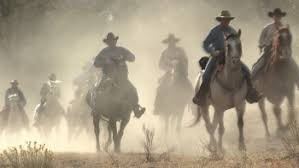
Five riders moved swiftly across the open country through Granite Pass in southwest New Mexico. An electrical storm lit up the sky around them, and a deluge of hail broke free from the clouds, pelting the men in their saddles and their horses. Sounding like a troop of demons advancing, the wind howled and screamed as it pushed over the massive walls of rock the riders passed.
Former peace officer Jefferson Davis Milton rode in front of the others. He was a tall man with sloping shoulders, his granite like visage partly hidden by a dark mustache that curled around to meet his thick sideburns. George W. Scarborough, a blue-eyed, gruff looking, one time law man from El Paso, Texas, took a position on Jeff’s left. Eugene Thacker, a youthful son of a railroad detective, rode on Jeff’s right side. Directly behind the three were Bill Martin and Thomas Bennett, Diamond A ranch cowboys turned bounty hunters. The men pulled their slickers around their necks and urged their mounts on through the tempest. Claps of thunder ushered in another downpour of hail.
The determined riders, members of a posse pursuing a gang of train robbing outlaws, were soaked to the bone once they reached Fort Apache, a military post near Coolidge Lake. No one said a word as they made camp outside the garrison’s gates. Discussing the obstacles on the way to achieving that goal wasn’t necessary. Their focus was on capturing Bronco Bill Walters and his boys.
William E. Walters, also known as Bronco Bill Walters, was from Fort Sill, Oklahoma. What he did before being hired at the Diamond A ranch in 1899 is anyone’s guess. It’s what he did after getting a job as a cowhand that warranted attention. The Diamond A was a five hundred square mile spread nestled in the boot heel of New Mexico. The magnificent acres of grass there made it the perfect spot for raising cattle. The ranch was always in need of workers. Cowpunchers that dropped by looking for employment were generally hired on the spot. It was considered a rude violation of the proprieties of a cow camp to inquire into a man’s connections or character. Just wanting to work was enough. Bronco Bill Walters wanted to work, and that’s all that mattered and all the foreman at the Diamond A would have cared about if Bronco Bill hadn’t had desired more than the job had to offer.
During long, dull evenings around the campfire, Bronco Bill contemplated a life that was exciting and profitable. He thought about robbing a stage or a train. He imagined how he would tackle such a daring feat and rehearsed a getaway. After a while, it wasn’t enough only to imagine such actions. Bronco Bill left the Diamond A ranch in the fall of 1890 in search of excitement and money.
To learn more about Bronco Bill and the posse after him read
Principles of Posse Management.
This Day…
Principles of Posse Management
Enter now to win a copy of The Principles of Posse Management
Pat Garrett and Wyatt Earp, management experts? Expert management skills were necessary to quickly organize a group of law enforcement officers able to effectively keep the peace and pursue and arrest felons.
The actual work of transforming the frontier into farms and cities was carried on by the stream of settlers, but working with, or sometimes ahead of them were the business people who directed the conquest of the wilderness and law enforcement officials who helped protect their interests.
The business people brought capital and labor together, sent logging crews into the forests; built bridges, canals, and railways; bought, sold, and transported commodities; laid out town sites and planned cities; started industries; developing mines; and nearly always speculating in land. Often times their efforts were thwarted by criminal elements who kept the goods, services, and funds from their appointed destination. Posses were formed to make sure fleeing desperados were brought to justice. In the process civility was brought to the lawless territory as well.
This month enter to win a copy of The Principles of Posse Management
This Day…
1912 – Captain Robert Scott, storm-bound in a tent near South Pole, makes last entry in his diary “the end cannot be far”.
The Harvey Girls
Enter now to win a copy of
Iron Women: The Ladies Who Helped Build the Railroad
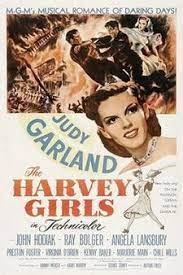
One of the chapters in the book Iron Women: The Ladies Who Helped Build the Railroad is about the Harvey Girls. Judy Garland portrayed Susan Bradley in the musical The Harvey Girls released in April 1926. The movie was a huge success for MGM. The subject matter and Judy Garland made the film popular. Garland was a much-loved performer whose warmth and spirit, along with her rich and exuberant voice, kept theatergoers entertained with an array of delightful musicals. The singer-actress died on June 22, 1969.
Standing in line outside the funeral home, a 23-year-old Queens housewife explained why she had joined thousands to pass by the coffin of Judy Garland. “Everyone’s got sadness and problems, everyone gets lonely,” she said. “Judy Garland made all of us feel something tied her and us together.” It is not to say that Judy Garland would never have been a legendary entertainer had she led a happy life, but certainly part of what captivated her audiences was the awareness of what she brought onstage with her. She was a child star, a superstar at 17 in The Wizard of Oz, and the leading movie musical actress by 1948. She also was seeing a psychiatrist when she was 18, attempted suicide at 28, had four failed marriages, and had been addicted to uppers to perform and downers to sleep since her early years at the movie studio.
For almost the last twenty years of her life – more than half her career – Garland followed failures with smashing comebacks almost with regularity, most notably in A Star is Born in 1954 and at London’s Palladium in 1960. Even after her voice failed Garland pushed her frail legs and bony face through exhausting performances, so that, in 1967, Vincent Canby wrote in a review, “that the voice is now a memory seems almost beside the point.”
In 1969, Garland was living in London with her fifth husband, Micky Deans, a 35-year-old New York discotheque manager. She had performed unevenly at a London supper club earlier that year, but in June seemed happy in her new marriage. At 10 A.M. on Sunday, June 22, Deans was awakened by a telephone call from one of Garland’s friends in the United States. His wife wasn’t in bed, so he called her in the bathroom. He got no answer, but found the door locked, which was usual for Garland since her early days on crowded movie sets. He climbed out onto the roof of their house to look in the bathroom window. He saw her sitting with her head slumped over in her lap.
Doctors said Garland had died of “an incautious self-over-dosage of sleeping pills.” They said it was not a suicide, that probably she had taken her usual
dose of Seconal to get to sleep, then awakened and confused, swallowed more pills. Liza Minnelli saw her mother’s death in less clinical terms. “It wasn’t suicide,” she said in a statement soon after. “It wasn’t sleeping pills, it wasn’t cirrhosis. I think she was just tired, like a flower that blooms and gives joy and beauty to the world and then wilts away.”
This Day…
1939-“Wuthering Heights” based on the novel by Emily Brontë, directed by William Wyler and starring Merle Oberon and Laurence Olivier, premieres in Los Angeles
Still #1
This Day…
1948 – Musician Nat King Cole (29) divorces dancer Nadine Robinson after 11 years of marriage
Women vs. the Railroad The Fight for Fairness on the Rails
Enter now to win a copy of
Iron Women: The Ladies Who Helped Build the Railroad
The creation of the railroad system in the United States is a stirring story of American initiative and enterprise. Every conceivable obstacle stood in the way of the railroad’s success. An apathetic public jeered at early efforts to provide rail transportation; it was difficult to convince them that it was safe or would make a profit. Mechanical difficulties ran all the way from finding engines that would run to perfecting rails, wheels, and signals.
In some eastern locations, tracks were torn up by indignant citizens, and in one city they were declared a public nuisance. A famous newspaper issued a warning that “the use of steam with its train of coaches, its ‘soft effeminate cushions causing easement to bodies and legs,’ would rob passengers of manliness.”
The close relation of railroads to all the people was aptly described by railroad historian Agnes C. Laut in an article in the October 24, 1929, edition of The Daily Republican. Laut noted that the railways can prosper “only as the communities they service prosper and their empires prosper. The well- being of one is bound up in the well-being of the other; and neither can be hurt without hurting the other.”
The first routes where the tracks could be laid were little more than crude trails through thick undergrowth that led west from Boston and New England along the Mohawk Valley to Lake Erie, from Philadelphia and Baltimore across the Appalachians to the Ohio River Valley, and from Virginia and North Carolina to Nashville and Louisville. For more than thirty years, railway tracks were laid without interruption across the country from the late 1820s. By 1850, they crisscrossed many states totaling more than nine thousand miles of tracks. Men from all walks of life and many ethnic backgrounds, from the Chinese to the Irish, carved out sections in the vast grasslands, dense forests, and rolling mountains. Women contributed to the grand effort in many ways, not the least of which was refining the creation and making it suitable for all who hoped to benefit from the revolutionary mode of transportation. Women also played a part in bringing about an end to the discriminating tactic employed by railroad companies.
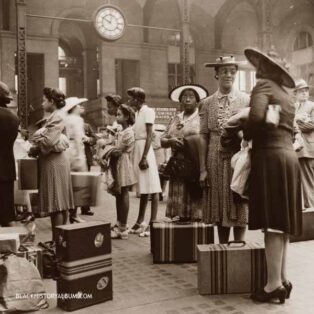
A great deal was accomplished technologically in a relatively short amount of time in the railroad industry. What didn’t progress as quickly as the advancement in conveyance was the acceptance of the population regardless of race or ethnic background. The less attractive element of railroad development was the creation of the Jim Crow car. The car was identical in structure to other passenger cars but contained a patrician which would separate the races. The section where the Black Americans would sit had no restroom and often times no water fountain.
In 1870 and 1881, the practice of segregating ticket buyers was challenged by two women. In early 1870, Mary Jane Chilton boarded a train in St. Louis with her fifteen-year-old daughter and eight-year-old nephew. The trio were bound for Carondelet, an annexed neighborhood in St. Louis, Missouri. With tickets in hand, Mary proceeded to the ladies’ car. A brakeman quickly stepped in front of her and blocked her way. The conductor following behind him approved of his actions. Mary was told that the ladies’ car was not for women of color and was instructed to find a place to sit in the smoker’s car. Men rode in the smoker’s car, most of which smoked and drank while traveling.