Meeting Mountain Jim

Enter now to win a copy of

The Lady and the Mountain Man: 

Isabella Bird, Mountain Man Jim Nugent, and their Unlikely Friendship. 
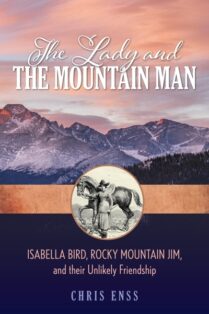
 

The Lady and the Mountain Man Book Cover


Twenty-three-year-old Platt Rogers and his friend, twenty-one-year- old Sylvester Downer, waited at the front entrance of a hotel in Longmont for the woman they promised to escort to Longs Peak.  The two men hadn’t been in Colorado long.  Rogers had recently graduated from Columbia Law School and Downer, a student at the same college, decided to go West and see the Rocky Mountains.  They hadn’t planned to venture into the high country with anyone else.  “…we were traveling light and free,” Rogers wrote of the experience years later, “and the presence of a woman would naturally operate as a restraint on our movements.”

The offer to add another body to the expedition was agreed upon only after they learned they would be paid for their trouble.  “We consoled ourselves with the hope that she would prove young, beautiful, and vivacious,” Rogers later confessed.  “Our hopes were dispelled when in the morning, Miss Bird appeared wearing bloomers, riding cowboy fashion, with a face and figure not corresponding to our ideals.”

Isabella’s outfit was one of the traditional Hawaiian riding dresses she usually wore for such an occasion.  The pa’u, as it was called, was a voluminous skirt or sarong that was tucked in around the legs.  When riding astride, the garment resembled wings.  The dress was more for comfort than style.  If the trip from Denver to Estes Park was any indication, Isabella anticipated the journey would be rough and at least wanted to feel at ease with what she was wearing.  Rogers and Downer were taken aback because of her clothing and by her ride, a horse named Birdie which looked as though it was not strong enough to make the trip.  When the two men asked Isabella about the stamina of the animal, she was quick to come to Birdie’s defense.  She assured them he had the “cat like sure-footedness of a Hawaiian horse.”  Isabella might have been confident her ride would not disappoint, but the young guides were not convinced her horse would withstand the trip.  However, they didn’t argue the point.  They simply loaded the supplies and ropes on their horses and a pack mule and started on the quest.

 

To learn more about Isabella Bird and her time with Mountain Man Jim Nugent read

The Lady and the Mountain Man.

Colorado Bound

Enter now to win a copy of the new book

The Lady and the Mountain Man:  Isabella Bird, Rocky Mountain Jim, and their Unlikely Friendship


The Lady and the Mountain Man Book Cover


Isabella slowly made her way through a lush field of heather and wildflowers toward a cluster of boulders on the Isle of Iona.  John Campbell, the Duke of Argyll, and Alexander Ewing, the Bishop of Argyll, followed after the fragile woman.  Iona was a little island in the midst of the Outer Hebrides or Western Isles of Scotland.  The small plot of land was rich in Christian history.  This was Isabella’s first time on the Isle of Iona, and she wanted to learn about the community where missionaries had been dispatched for the conversion of the pagan tribes of Scotland and northern England in the late 1760s.  She was compiling another book on religion and believed the information would prove vital.  Aside from her research, she hoped the scenery would improve her frail health.  Such outings always made a difference to her condition.

While waiting for the duke and bishop to reach her, she gazed out over a nearby pasture at the great horned, shaggy Highland cattle tromping through the fields and thought how much her father would have appreciated the serene setting.  Reverend Bird had left behind copious notes and essays about such historic locations important to the faith.  Not long after his passing, Isabella her father’s compilations published.  Out of respect for her him, she wanted to continue writing on the subject.  In addition to focusing on religion in Europe, she planned to study religious revivals in the United States.  For that, her health would need to be rejuvenated.  At the time, she suffered from muscle weakness in the legs, painful muscle spasms, and periods of extreme exhaustion.

Regardless of her physical struggles, Isabella’s friends noted she was always cheerful and positive.  Socially influential people in Edinburgh sought out her company after reading the complimentary article she wrote about the country published in The Leisure Hour magazine and The Sunday Magazine.  All who encountered Isabella found her lively disposition infectious.  Those who knew her only through her writings would never have imagined she suffered from recurrent spinal attacks.  She was good at working through the pain, but there were times when the frustration of having to deal with the ailment would eventually take its toll.  When that happened, she would vent about the problem in letters to those closest to her.

“I feel as if my life were spent in the very ignoble occupation of taking care of myself,” she wrote in 1864, “and that unless some disturbing influences arise I am in great danger of becoming encrusted with selfishness, and, like the hero of Romola, of living to make life agreeable and its path smooth to myself alone.  Indeed, this summer I have made very painful discoveries on this subject and long for a cheerful intellect and self-denying spirit, which seeketh not its own and pleaseth not itself.”


The Lady and the Mountain Man Book Cover


To learn more about Isabella Bird and Mountain Man Jim Nugent read

The Lady and the Mountain Man.


Romance in Estes Park

Enter now to win a copy of the new book

The Lady and the Mountain Man:  Isabella Bird, Rocky Mountain Jim, and their Unlikely Friendship

The Lady and the Mountain Man Book Cover


A heavy snow blanketed the Hotel Interlaken in Switzerland in early September 1874.   The spectacular mountains surrounding the country’s oldest lodge were awash with light from a brilliant sun rising slowly over the peaks.  That same light tried desperately to break through the dark curtains covering the massive ornately designed windows of English sojourner Isabella Bird’s room.  The petite, forty-seven-year-old woman was reclining on a plush upholstered sofa.  She had fallen asleep, but it was a fitful sleep.  She tossed from side to side, mumbling and crying.

Suddenly Isabella awoke and sat up straight.  There, standing before her, was Jim Nugent, a broad, thickset man of medium height with golden, shoulder length hair that framed his handsome but scarred face.  The scars were the result of an altercation with a grizzly bear.  He was missing an eye, but the one that remained was blue gray.  He was smooth shaven except for a dense mustache.  Jim wore a low crown hat, fur-trimmed sack coat, and cloth breeches.  Isabella was taken aback by his presence in her room.  She knew it couldn’t be possible because Jim was in Colorado where she had left him more than seven months prior.  Their goodbye had been a tearful one with Jim vowing the pair would meet again.

Isabella couldn’t look away.  She was a bit frightened, but happy to see the man who had been such an important part of her life, and she almost smiled.  His eyes were fixed on her.  The pair watched one another for several moments before Jim slowly and distinctly announced to Isabella, “I have come as I promised.”  He then waved to her and said, “Farewell.”  Tears welled in Isabella’s eyes.  She’d missed Jim terribly, and their brief encounter wasn’t enough to satisfy her longing.


To learn more about Isabella Bird and Mountain Man Jim Nugent read

The Lady and the Mountain Man


Ginsu Knives and Book Promotions


Selling.  The very idea conjures up images of pushy, ruthless individuals peddling whole life policy insurance, Ginsu knives, or used cars – all committed to the same of objective.  “Get their confidence, get their friendship, get their trust, then get their money,” as Kurt Russell’s character in the film Used Cars instructed his salesforce.  It’s unfortunate that sales have that reputation because whether we’re employees pitching colleagues on a new idea, entrepreneurs enticing funders to invest, or parents and teacher cajoling children to study, we spend our days trying to move others.  Selling is a part of life.  If you’re a working author with hopes of staying a working author, it must be a part of your life, too.

Advertising what we have is not merely a human phenomenon, but a biological impulse found throughout the natural world.  Peacocks attract mates through a multicolored feather display, the puffer fish draws attention creating symmetrical patterns in the sand, and both the duck and gecko offer a broad range of attractively priced car-insurance packages.

The job of writing doesn’t end with creating a quality book.  The notion that a publisher has the sole responsibility for selling your book is antiquated.  Most publishers won’t set up book events for you, pay for print or digital ads, arrange for guest appearances on podcasts or regional morning news shows, have bookmarks or postcards made, and they won’t purchase billboard space to promote your newest title on Sunset Boulevard.  Believe me, I’ve asked.

Your publisher may send out a press release announcing the release of your book and send review copies.  They may make sure you have enough books on hand for a signing or pay for a poster to display at that signing.  Regardless of what they will do there are actions authors need to employ to make sure a book sells.

I’ve been writing about women in the Old West for more than twenty-eight years.  I’ve made the New York Times Bestseller list three times.  I’m sure there are some who will read that and think, “My stuff is much better than anything that big-haired woman has written.  I should be on that list.”  You might be right, but there’s more to it than just the material.  That’s where selling, and promotions come in.

The marketing tips I offer here are for all the authors who have emailed or phoned to ask the best way to sell their books during the pandemic.

Create an Email List

Having a website is not enough.  Without the contact information, nothing else will work.  Many publishers and agents will not take you on as a client unless you have a strong, targeted email list.  Having several thousand targeted ‘contacts’ of a particular demographic profile suggests that many will buy your book when it is released.  Without them, your website will not have the power to draw business.  Create a strong email list or avid readers, bookstores, and museums before spending your time on social media advertising.

Virtual Book Promotions

Once you have set the email list process in motion, ramp it up and attract more readers by creating free website content.  Examples include short newsletters, special reports, podcasts, and live video presentations.  Seek out organizations that are looking for speakers for their virtual programs.  Authors sell books when they make personal appearances, but it’s not impossible to sell books at virtual events.  Before you commit to giving a ZOOM or Google Meets presentation, ask the producer of the event if they would commit to purchasing a dozen of your books.

There are some authors who find the whole idea of peddling their product in such a way distasteful.  For them literature is not a #teamfollowback sport.  Those authors might be content with only selling a couple hundred copies of their book.  On the other hand, if you’re a writer like Kat Martin or Kathleen and Michael Gear readers come looking for you.  I’ve never personally experienced this and that’s why I employ a variety of marketing techniques to let buyers know my books are out there.

It’s a bit of work, but at least I’m selling something I feel strongly about, as opposed to Ginsu knives.