
1948 – Musician Nat King Cole (29) divorces dancer Nadine Robinson after 11 years of marriage
Women vs. the Railroad The Fight for Fairness on the Rails
Enter now to win a copy of
Iron Women: The Ladies Who Helped Build the Railroad
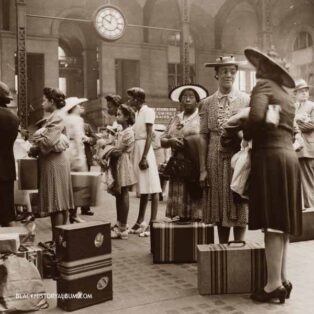
The creation of the railroad system in the United States is a stirring story of American initiative and enterprise. Every conceivable obstacle stood in the way of the railroad’s success. An apathetic public jeered at early efforts to provide rail transportation; it was difficult to convince them that it was safe or would make a profit. Mechanical difficulties ran all the way from finding engines that would run to perfecting rails, wheels, and signals.
In some eastern locations, tracks were torn up by indignant citizens, and in one city they were declared a public nuisance. A famous newspaper issued a warning that “the use of steam with its train of coaches, its ‘soft effeminate cushions causing easement to bodies and legs,’ would rob passengers of manliness.”
The close relation of railroads to all the people was aptly described by railroad historian Agnes C. Laut in an article in the October 24, 1929, edition of The Daily Republican. Laut noted that the railways can prosper “only as the communities they service prosper and their empires prosper. The well- being of one is bound up in the well-being of the other; and neither can be hurt without hurting the other.”
The first routes where the tracks could be laid were little more than crude trails through thick undergrowth that led west from Boston and New England along the Mohawk Valley to Lake Erie, from Philadelphia and Baltimore across the Appalachians to the Ohio River Valley, and from Virginia and North Carolina to Nashville and Louisville. For more than thirty years, railway tracks were laid without interruption across the country from the late 1820s. By 1850, they crisscrossed many states totaling more than nine thousand miles of tracks. Men from all walks of life and many ethnic backgrounds, from the Chinese to the Irish, carved out sections in the vast grasslands, dense forests, and rolling mountains. Women contributed to the grand effort in many ways, not the least of which was refining the creation and making it suitable for all who hoped to benefit from the revolutionary mode of transportation. Women also played a part in bringing about an end to the discriminating tactic employed by railroad companies.
A great deal was accomplished technologically in a relatively short amount of time in the railroad industry. What didn’t progress as quickly as the advancement in conveyance was the acceptance of the population regardless of race or ethnic background. The less attractive element of railroad development was the creation of the Jim Crow car. The car was identical in structure to other passenger cars but contained a patrician which would separate the races. The section where the Black Americans would sit had no restroom and often times no water fountain.
In 1870 and 1881, the practice of segregating ticket buyers was challenged by two women. In early 1870, Mary Jane Chilton boarded a train in St. Louis with her fifteen-year-old daughter and eight-year-old nephew. The trio were bound for Carondelet, an annexed neighborhood in St. Louis, Missouri. With tickets in hand, Mary proceeded to the ladies’ car. A brakeman quickly stepped in front of her and blocked her way. The conductor following behind him approved of his actions. Mary was told that the ladies’ car was not for women of color and was instructed to find a place to sit in the smoker’s car. Men rode in the smoker’s car, most of which smoked and drank while traveling.
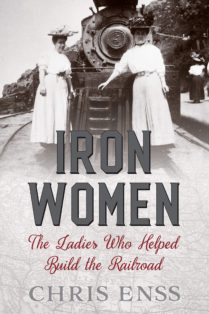
To learn more about the heroic Mary Chilton read Iron Women
This Day…
1831 – 1st US bank robbery, the City Bank in New York robbed of $245,000.
Artist for the Pioneer Zephyr
Enter now to win a copy of Iron Women: The Ladies Who Helped Build the Railroad
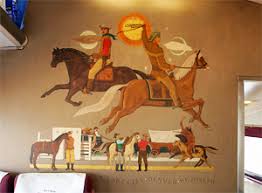
While attending college in Pennsylvania, Mary Lawser was part of a group comprised of several accomplished female artists. They were known as the Philadelphia Ten.
Among the members was a talented painter and sculptor named Mary Louise Lawser. Like Mary Colter, Mary Lawser was hired by a major rail line company to help promote westward travel.
Born in 1906 in Pennsylvania, she exhibited at a young age. She attended the Pennsylvania Museum School, the Pennsylvania Academy of Fine Arts, and the Ecole des Beaux Arts in Paris. Mary’s work was exhibited in galleries in Europe and New York. She was recognized by her peers as a gifted, bronze work artist. After graduation she took a position as an art instructor at Cedar Crest College in Allentown, Pennsylvania, and at Bryn Mawr.
In early 1940, she was hired to work for notable architect Paul Cret. The French-born, Philadelphia architect and industrial designer was impressed with Mary’s design and execution of bronze tablets found inside Alexander Hamilton’s home, The Grange. Commissioned by the American and Historic Preservation Society, the tablets were made to honor Alexander Hamilton, first secretary of the United States treasury. In addition to designing buildings on the University of Texas campus and the Pan American Union Building in Washington, D.C., Paul Cret designed railroad cars for the Burlington and Santa Fe rail lines. While Mary was employed by Cret, she contributed to decorating various railroad passenger cars with sculptures, wood carving, and mixed metal creations.
When Cret passed away in 1945, Mary was hired by another respected Pennsylvania architect, John Harbeson, to aid him in creating a new look for Burlington’s Pioneer Zephyr. Although in the employ of Harbeson, Mary was singled out by the Budd Company, a railroad industry manufacturer, to design murals for the interior of the passenger cars that would inspire ticket-buyers to go west.
In 1948, Mary began work on a mural for the California Zephyr’s Silver Lariat. The train was built as a dome coach, a series of cars that have glass domes on the top where passengers can ride and see in all directions around the train. Mary painted a mural of the Pony Express in the large dining and lounge car.
Over the course of her five-year business relationship with the Budd Company, she created murals for the Atchison, Topeka and Santa Fe, the Denver and Rio Grande Western, and the Western Pacific Railroad. Mary’s murals generally adorned the end walls of the dome coaches and they always depicted Western historical themes. She also sculpted the appliques of apples and grapes which hung at each end of the dining cars as well as the lyre-based radio speakers.
Mary Lawser died in 1985 at the age of seventy-nine.
To learn more about Mary Lawser and the other ladies who helped build the railroad read
Iron Women
This Day…
1834 – The first railroad tunnel in the U.S. was completed. The work was in Pennsylvania.
The Trouble With Some Authors
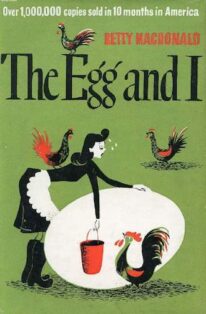
Betty MacDonald put her heart and soul into her humorous memoir. The Egg and I, which became an unexpected 1947 bestseller. The film rights to this story about a young woman on a chicken farm in Washington state were purchased for a down payment of $100,000, a large sum at the time, with a percentage of movie profits to follow. However, soon after this financial windfall, MacDonald was sued for libel for $975,000 by the people of the small town, which was the basis of her book on the grounds that they felt their portrayal was a humiliation. Defending herself caused the author to spend considerable money and grief, though MacDonald finally won the case when she proved that the characters in the book were composites. MacDonald eventually moved from the Washington area she loved to California, but the whole episode had put a crack in her joy and she died of cancer at the age of forty-nine in 1958.
This Day…
1892 – 1st escalator patented by inventor Jesse W Reno (NYC).
No Place for a Woman Foreword Review Magazine Book of the Year Finalist
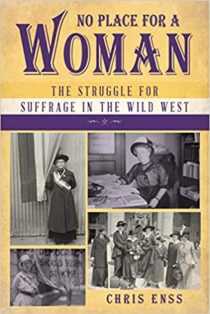
Several years ago, there was a television show called M. A. N. T. I. S. I thought it was one of the greatest shows ever. It was about a guy that was half man, half praying mantis, and he fought crime. And the network cancelled it! A regular guy who, when trouble reared its ugly head, half of him would turn into a praying mantis. It’s interesting how some bad television shows become cult classics. I wrote a book entitled No Place for a Woman: The Struggle for Suffrage in the Wild West. I spent more than two and a half years researching and writing the book. I thought it was going to be a good book, but alas… Like M. A. N. T. I. S., the problem wasn’t the idea, it was the presentation. In addition to the various chapters about how suffrage was achieved in the Wild West there were several shorter stories about the movement. Those sidebars should have been placed at the end of the chapters. Instead, they were placed in the MIDDLE of the chapters. The sidebars were supposed to be on darker gray paper, but that never happened. The result, it’s difficult to read. I’ve received numerous emails from people who think there are pages missing or simply find the work too complicated to muddle through. It’s unfortunate. I worked hard on that book and it turned out to be a disaster. I had no control over the printing of the book, but my name is on it and readers blame me for everything about the book. I’ve entered No Place for a Woman in a few book contests including the Spur Awards. I’m so sorry for the judges. They had the unfortunate task of trying to figure out just how to read the book. The book didn’t win, place, or show. The judges reviewing books for the Foreword Review Magazine Book of the Year award managed to look past the issue of the poor presentation. I was informed yesterday that No Place for a Woman was one of five titles in the running for Book of the Year. I’m sure it won’t do any better than that but given the issues with the book I’m grateful it got that far. Bad TV and bad books are part of our culture and harmless enough when properly abused. Like M. A. N. T. I. S., the only way to make No Place for a Woman better is if a laugh track is added.
This Day…
The Telegraphers
Enter now to win a copy of
Iron Women: The Ladies Who Helped Build the Railroads
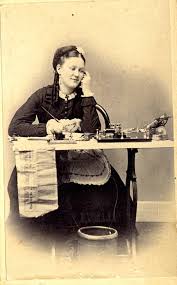
Twenty-eight-year-old Elizabeth Cogley sat at a small desk in the Pennsylvania Railroad ticket office in Lewiston Junction, Pennsylvania, on April 16, 1861, frantically writing down the message coming through the telegraph. The neatly dressed woman wore a serious expression; the message she was transcribing was vital and history making. The day before, a similar wire had reached Elizabeth. She carefully noted its contents and passed it along to the ranking military official in the area. It was from President Abraham Lincoln, and it read, “I appeal to all loyal citizens to favor, facilitate, and aid this effort to maintain the honor, the integrity, and the existence of our National Union, and the perpetuity of popular government; and to redress the wrongs already long enough endured.” This was Lincoln’s first call for troops. He asked for 75,000 volunteers.
The following day, Pennsylvania’s first war governor, Andrew G. Curtin, sent a telegram to Captain Selheimer, commander of the First Defenders Association in Lewiston, to rally his men together to report to Harrisburg, Pennsylvania, as soon as possible. After delivering the message to the captain, Elizabeth was instructed to respond to Governor Curtin with news that he and his troops would “move at once.” The railroad telegrapher dispatched the important information quickly and accurately. Little did Elizabeth know the event would be remembered as the first telegraph exchange of the Civil War.
Born on November 24, 1833, Elizabeth learned telegraphy in the office of the National Telegraph Company. She entered the service of the Pennsylvania Railroad Company on April 13, 1856. She was stationed in the Lewiston office until the beginning of the Civil War. She remained with the railroad company for more than forty years.
Some of the earliest women in railroading can be found in telegraph stations. The job of the telegrapher was to transfer information between the train dispatcher and the train operator. A telegrapher copied train orders and messages from the train crew and reported the passing trains to the dispatcher. They also received and sent Western Union telegrams. Most learned the trade from another operator. Some attended schools such as the Cooper Union for the Advancement of Science and Art in New York and the Pittsburgh Female College in Pittsburgh.
The qualifications needed to be a telegrapher were to be well read, to know how to spell, and to be able to learn Morse code. According to author Virginia Penney’s book written in 1870 entitled How Women Can Make Money, a good lady telegraphist could make between $300 and $500 a year. With that in mind, many women with some knowledge of electricity and good penmanship decided to pursue a career in the field.