1918 – WWI armistice signed by the Allies and Germany comes into effect and World War I hostilities end at 11am, “the eleventh hour of the eleventh day of the eleventh month”

1918 – WWI armistice signed by the Allies and Germany comes into effect and World War I hostilities end at 11am, “the eleventh hour of the eleventh day of the eleventh month”

Three dozen fresh-faced young men jockeyed for position behind a row of windows on a train leaving Poughkeepsie, New York, bound for Camp Mills on Long Island. The new Army recruits waved goodbye to those on the railroad platform; they wore happy expressions and cheered as the car lurched forward. The men were excited and blissfully naïve about the journey ahead of them. Family and friends on the platform offered last-minute farewells as the train slowly began to move ahead. Some people cried as the vehicle left the station, and they blew kisses to the courageous souls who had answered the call to serve their country when America announced it would join Britain, France, and Russia to fight in World War I.
The United States entered the war on April 6, 1917, and by the end of that same month thousands of men had eagerly flooded recruited stations, enlisted in the Army and Navy, and promised to defend the nation in time of peril.
On July 6, 1917, newspapers and unofficial dispatches from Canadian army headquarters in Europe documented when America went into battle for the first time during the World War. A young Texan who had traveled to Ontario to enlist had the honor of being the first to carry the American flag in the European war. He was carrying the official Stars and Stripes on his bayonet when he was wounded and subsequently transported to a medical unit.
According to the July 20, 1917, edition of the Democrat and Chronicle News the Texan’s brave action prompted even more patriotic men to join a branch of the service. Men did not have a moratorium on devotion to country. Women also wanted to do their part. Annie Oakley was among them. From the time the Spanish-America War began in 1898, Annie had desired to recruit and train women to be expert shots and fight for the United States. She offered her unique services to President William McKinley in a letter dated April 5, 1898.
Dear Sir,
I for one feel confident that your good judgement will carry America safely through without war. But in case of such an event I am ready to place a company of fifty lady sharp shooters at your disposal. Every one of them will be an American and as they will furnish their own arms and ammunition there will be little if any expense to the government.
Very Truly,
Annie Oakley
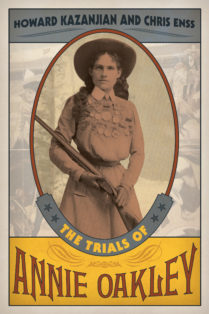
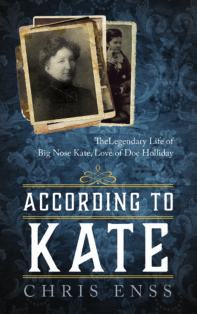
Doc Holliday’s paramour Big Nose Kate could never get a publisher to give her the big bucks she demanded to tell the story of her life, but that didn’t mean she didn’t collect material she wanted to use in a biography. Over the fifty years Mary Kate Cummings, alias Big Nose Kate, traversed the West she saved letters from her family, musings she had written about her love interests, and life with the notorious John Henry Holliday. Using rare, never before published material Big Nose Kate stock-piled in anticipation of writing the tale of her days on the Wild Frontier, the definitive book about the famous soiled dove will finally be told.
Kate claims to have witnessed the Gunfight at the OK Corral and exchanged words with the likes of Wyatt Earp and Josephine Marcus. There’s no doubt she embellished her adventures, but that doesn’t take away from their historical importance. She was a controversial figure in a rough and rowdy territory. What she witnessed, the lifestyle she led, and the influential western people she met are fascinating and represent a time period much romanticized.
1927 – The George Gershwin musical Oh, Kay! began its Broadway run at New York’s Imperial Theatre on this day. Starring Gertrude Lawrence, it introduced such pop music standards as “Someone To Watch Over Me” and “Do-Do-Do”. The show ran for 256 performances before transferring on 21st September, 1927 to His Majesty’s Theatre in the West End of London, where Ms Lawrence gave another 214 performances.
Say the name Annie Oakley and the image of a young woman who could shoot targets out of the sky without a miss and rode across the frontier with Wild West showman Buffalo Bill Cody comes to mind. Annie Oakley was a champion rifle shot and did perform alongside well-known riders, ropers, and Indian chiefs in Colonel Cody’s vaudevillian tour, but there was more to Annie Oakley’s fame than her skill with a gun. The diminutive weapons wonder was a strong proponent of the right to bear arms, a noted philanthropist, and warrior against libel who fought the most powerful man in publishing and won.
The native Ohioan astonished the world with her almost unbelievable feats of rifle marksmanship. She could pepper a playing card sailing through the air, puncture dimes tossed into the sky, and break flying balls with her rifle held high above her head. She once shot steadily for nine hours, using three sixteen-gauge hammer shotguns which she loaded herself, breaking 4,772 out of 5,000 balls.
Annie Oakley fell in love with and married the first man she defeated in a rifle match. Frank E. Butler was one of the most noted marksmen in the West and he and Annie were married for more than fifty years. The couple never had any children of their own. The reasons they were childless are varied and speculative at best. What is not without question is how Annie helped fund the care and education of orphaned children from coast to coast.
Annie Oakley was a combination of dainty, feminine charm and lead bullets, adorned in fringed handmade fineries and topped with a halo of powder blue smoke. She had a reputation for being humble, true, and law abiding and was careful with her character at all times. When powerful, newspaper magnate William Randolph Hearst challenged her honor and questioned her respectability in his publication in 1903, Annie filed a lawsuit against him that’s still discussed at universities today.


Kate Elder’s hotel in the remote copper and silver mining town of Globe, Arizona, was a small, unassuming establishment that catered to prospectors, assayers, and occasionally outlaws. For twenty-five cents a night, guests were offered a clean room complete with a wash bowl, towel, chamber pot, and a pitcher of fresh water. For an additional ten cents, Kate would provide breakfast. Patrons were served in the saloon in the front of the building located a short distance from Alice Gulch, the site of the first silver claim.
In late December 1881, a merchant named Mrs. Alonzo Bailey escorted a potential boarding house customer into the saloon where the last of the regular guests were finishing their morning meal. According to Kate, although it was past the time to serve food, the pair made themselves comfortable at a table and ordered coffee. The gentleman accompanying Mrs. Bailey was carrying a copy of the Tombstone Epitaph, and, when Kate approached the duo with coffee cups and coffee pot, the man began to discuss the incident that had occurred at the OK Corral the previous month. “Some how Doc and I were mentioned,” Kate noted when sharing the story with her niece several years later.
Kate noted she didn’t say a word about the happenings in Tombstone; she simply poured the coffee and went about the business of clearing the dishes. The chatty customer continued with his thoughts about the location of the gunfight and the people involved in the incident. “There are so many that claim they saw the shooting on Allen Street,” Kate wrote her niece in March 1940, “It was not on Allen Street but nearer Freemont [sic] Street in an open lot.”
Kate invited Mrs. Bailey and her friend to help themselves to the bacon and eggs sitting on the buffet table near a stack of plates, forks, and knives. The man reluctantly set the newspaper aside to get a plate of food but never stopped talking. “He told Mrs. Bailey that Doc took me to New Mexico and killed me up in the mountains and that he helped to bury me,” Kate recalled. “That poor woman,” I remarked. “Mrs. Baily [sic] and I laughed but when the man found out he made a fool of himself he never came back. But it is laughable how some people will talk. I often laugh how often I have been dead and buried and turn up some place full of life.”
It was a chilly evening in mid-March 1881. Kate had traveled from Globe to Tombstone to see Doc. According to her, she had made the trip at his request. She noted in her memoirs that they lost no time settling their differences. The smoke from an oil lamp in his room coiled wraith-like to the ceiling, smirching the cobwebs that festooned the top of the faded curtains. Kate studied the sad looking, window coverings in the reflection of the mirror into which she was staring. She had been pinning her hair up and playing with a pair of earrings when she noticed the breeze from the partially opened window ruffle the curtains. Kate anticipated spending a great deal of time with Doc in the room and pondered whether to update the décor.
Doc had taken up residence on Sixth Street in a small boarding house positioned between a funeral parlor and a winery. The furnishing was sparse and covered with dust. Kate’s things were scattered about the room. Doc had promised to take her to dinner when he returned from the errand he had rushed off to handle. Once she finished getting ready for the night out she turned her attention to a copy of the Arizona Weekly Citizen lying on a chair by the door. A story about a murder and an attempted stage robbery twenty-eight miles from Tombstone caught her eye.
“Detective R. H. Paul was on the box with the driver at the time, and his double-barreled Winchester rested by his side,” the March 20, 1881, article noted. “It is believed that the Cow-boys were completely surprised to find Paul upon the stage, as no two of them would attempt to tackle Paul. At the first word, ‘Hold!’ Paul coolly reached for his gun, exclaiming, ‘By God! I hold for nobody!’ It is a question who fired first, Paul or the robbers; but the crack of the rifles were almost simultaneous, frightening the leaders into a run. Paul emptied both barrels of his gun, and his revolver, while the stage was rattling along as fast as the horses could haul it. The driver had fallen dead from the box, and a passenger who was upon the box was dying with a mortal wound. As soon as Paul could regain the lines that had fallen from the hands of Bud Philpot, who was shot through the heart, he drove and transferred Wells, Fargo & Co.’s box and the United States mail intact to J. D. Kinnear, the agent of the line at Benson, and the frightened passengers were sent through to Tombstone. Paul then started back, accompanied by four men, to the scene of the attack. Later particulars are awaited here with great interest.
“A vigilance committee was lately formed at Tombstone, backed by all the money necessary to take these parties in hand and teach them a lesson.”