The Devine Sarah

Enter to win a copy of the book

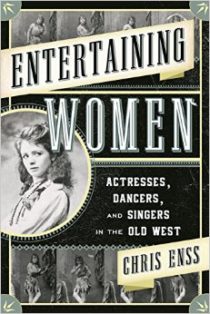
Entertaining Women:  Actresses, Dancers, and Singers in the Old West
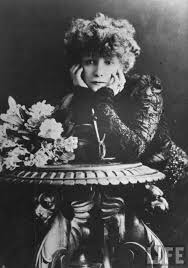


The pliant figure leaned over the ship’s rail, expressive eyes intent on the blue-green waters of the harbor. A mass of wavy light-brown hair with tints of gold lifted and curled with every breeze, its arrangement a matter of complete indifference to the angler. Suddenly the slender form froze, breath held, and then, with a quick yank and a breaking smile, lifted the rod and hauled a wriggling fish aboard the Cabrillo. Exclaiming in French, dark eyes sparkling with pleasure, Sarah Bernhardt ordered her catch, small as it was, to be prepared for dinner.

It was May 19, 1906, and the farewell production of Camille was scheduled for a few hours later at the ocean auditorium built on the water at Venice, California. Sarah stayed, and fished, at the hotel built like a ship, and she performed in the adjacent theater on the wharf at the seaside resort, Venice of America. Having caught a fish, Sarah wended her way to her quarters. Piled high in her dressing room were the results of a recent shopping trip to the Oriental bazaar nearby: silk and crepe matinee coats of pink and pale blue and mauve, all embroidered with butterflies and bamboo designs.

The tiny window in the dressing room provided a sparkling view of the ocean, and the streaming sunshine picked out details of the furnishings: a repoussé silver powder box, containers of pigment, eyebrow pencils, silver rouge pots, and scattered jewelry twinkling in the light. The tragedienne who attracted huge audiences wherever she went swooped up a small tan and white fox terrier, wriggling with joy at her return, and snuggled it close for a moment as she related the happy details of her fishing venture to a visiting reporter. Then she put down the small dog and closed her mind to the fun waiting outside the porthole.

Within moments Sarah became Marguerite Gautier, filled with the sadness and torment of the beautiful French courtesan in Camille, the play by Alexandre Dumas that became her signature role, performed all over the world more than three thousand times. Sarah’s ability to sink fully into the character of the play made the tragic death scene so convincing that it became a trademark for “the Divine Sarah.”

No one played tragedy with such believable intensity as Sarah Bernhardt, and no one brought as much passion and enthusiasm to the pursuit of pleasure. From fishing on the Southern California coast to bear hunting in the woods outside Seattle, on every western tour the French actress indulged in some kind of adventure. Sarah Bernhardt threw herself into life with the same characteristic energy she put into her stage appearances. Yet she often slept in a coffin, preparing for that final sleep.
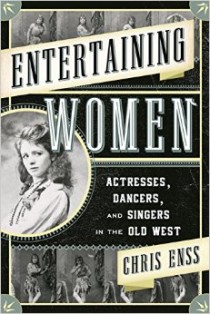
 

To learn more about Sarah Bernhardt and about the other talented performers of the Old West read

Entertaining Women: Actresses, Dancers, and Singers in the Old West.
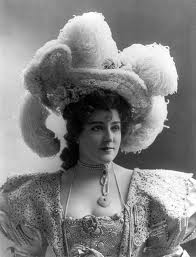
 

Lillian Russell, America’s Greatest Beauty

Enter to win a copy of

Entertaining Women:

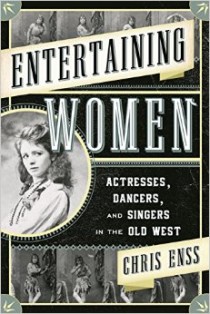
Actresses, Dancers, and Singers in the Old West


It was not so much the late Lillian Russell’s great dramatic ability or her clear, well-trained voice as her personality and physical beauty that made her the most famous musical comedy star of her day and acclaimed for more than a generation as “America’s Greatest Beauty.” And after she had ceased to sing and act for the public the compelling charms that had lifted her to the stage’s topmost pinnacle persisted and made her up to the very day of her death one of the most admired of women.

Other women marveled to see how Lillian Russell, as she neared sixty years of age, still retained the clear complexion, soft skin, unwrinkled face, youthful expression and all the vivacity of earlier life.

How did she achieve these modern miracles? What was the secret of her unfading beauty?

Lillian Russell made no secret of some of the measures and means she employed to retain her extraordinarily good looks, but she did not tell the whole story. She did not say that in addition to the baths, cold creams, cosmetics, exercise and wholesome living she made liberal use of common sense, self-control, persistence, energy and cheerfulness-factors neglected by many women who faithfully follow her other formulas.

She employed the combination of mental qualities and drug store and beauty parlor accessories not only during her whole stage career, but long after the time when most women realize that they are growing old and believing that they have become passé and unattractive, make no effort to improve their appearance. At sixty Lillian Russell was even more careful of her appearance her face and figure, than she was at twenty or thirty.


To learn more about Lillian Russell’s career and her beauty regiments, read

Entertaining Women:

Actresses, Dancers, and Singers in the Old West.
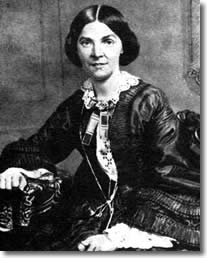


Caroline Chapman, The Quick-Change Artist

Enter to win a copy of

Entertaining Women:  Actresses, Dancers, and Singers in the Old West


The theater at Camp Seco, a gold camp in California, could hardly compare to the Greenwich Theater in New York, or the Jenny Lind in San Francisco, or theaters in New Orleans, Philadelphia, or other cities she’d played in, but Caroline Chapman had rarely seen a more enthusiastic audience.  Twitching her skirts into place, she waited for her cue.  Tonight they would conclude the program with a spoof of notorious entertainer Lola Montez, an act that always brought down the house.

Caroline and her brother, “Uncle Billy” Chapman, had left San Francisco in an uproar after starring in a hilarious play by Dr. Robinson.  Newspaper editors had sharp words for Who’s Got the Countess? and Caroline’s part in it.  How, they asked, could the “modest” Miss Caroline Chapman descend to such tasteless, even cruel burlesque of the lovely Lola?

That was easy, Caroline thought.  She was a professional actress, and as she waited for her cue, she could balance that accomplishment against a lack of beauty that had also been politely noted in the press.  Critics admired Lola’s stunning face and form, but few of them considered her a serious actress.  Lola’s stage career in Europe had included a stint as the mistress of the King of Bavaria, who had made her Countess of Landsfelt.  Caroline, on the other hand, had started learning stage work as a child on her father’s riverboat and had garnered praise from her first performance.

Beauty was not Caroline’s stock in trade.  Caroline was too plain to compete with the legendary Lola’s charms.  The most complimentary report on her appearance had come from theater historian Joseph Ireland, who described her as slender and plain-featured but with excellent teeth in a large, mobile mouth.  Her face was radiant with expression communicated by a pair of gleaming, dark eyes that could convey more meaning, either of mirth or sadness, said Ireland, than any contemporary female on the New York stage.

Unlike the scandalous Lola, Caroline had never indulged in affairs with royalty or famous authors and had never smoked a cigar, kept a pet bear, or threatened to take a riding whip to a cynical newspaper editor.  Caroline Chapman had what Lola lacked:  talent.  Nowhere did she find it more fun to exhibit than in Dr. Robinson’s send-up of the glamorous Countess of Landsfelt, whose stage reputation depended more on her display of shapely legs than on a demonstration of acting ability.

Lola became famous for her Spider Dance–a frantic effort to shake blackened cork “spiders” from her skirts that required lifting and shaking of dress and petticoats–which shocked the polite world but attracted droves of admirers to the theater.  Lola’s well-attended appearances in San Francisco in 1853 inspired local theatrical entrepreneur Dr. G. C. Robinson to pen the hilarious farce Who’s Got the Countess? in which Caroline performed.  “Some weeks ago the Countess came to fill us with delight and drew admiring throngs to see her spider dance each night. . . .”  As Dr. Robinson’s familiar song rang out over the heads of miners crowded into the makeshift theater, Caroline swirled haughtily onstage.  She might not be beautiful, but she could act rings around the likes of Lola Montez.


To learn more about Caroline Chapman and other female entertainers of the Old West read Entertaining Women:  Actresses, Dancers, and Singers in the Old West

Laura Keene, The President’s Actress

Enter now to win a copy of

Entertaining Women:  Actresses, Dancers, and Singers in the Old West


Mary Todd Lincoln screamed.  Clara Harris, seated in the balcony adjacent to President Abraham Lincoln’s wife, jumped out of her seat and rushed to the hysterical woman’s side.  “He needs water!”  Harris cried out to the audience at Ford’s Theatre staring up at her in stunned silence.  “The President’s been murdered!”  The full, ghastly truth of the announcement washed over the congregation, and the scene that ensued was as tumultuous and as terrible as one of Dante’s pictures of hell.  Some women fainted, others uttered piercing shrieks and cries for vengeance, and unmeaning shouts for help burst from the mouth of men.  Beautiful, dark-haired actress, Laura Keene hurried out from the wings dressed in a striking, maroon colored gown under which was a hoop skirt and number of petticoats that made the garment sway as she raced to a spot center stage.  She paused for a moment before the footlights to entreat the audience to be calm.  “For God’s sake, have presence of mind, and keep your places, and all will be well.”  Laura’s voice was a brief voice of reason in a chaotic scene.  Few could bring their panic under control.  Mary Lincoln was in shock and sat on her knees beside her mortally wounded husband rocking back and forth.  She cradled her arms in her hands and sobbed uncontrollably.

Laura ordered the gas lights around the theatre turned up.  Patrons bolted toward the building’s exits.  As they poured out into the streets, they told passersby what had occurred.  Crowds began to gather, and there were just as many people coming back into the theatre as were trying to leave.  Laura stepped down off the stage and began fighting against the current of people pressing all around her.  Word began to pass through the frantic group that John Wilkes Booth was responsible for shooting the President.  Sharp words were exchanged between the individuals coming in and going out the building.  Insane grief began to course through the theatre, and ugly suppositions started to form.  “An actor did this!”  Laura wrote in her memoirs about what people were saying at the event.  “The management must have been in on the plot!  Burn the damn theatre!  Burn it now!”  Laura disregarded the remarks and somehow worked her way to the rear box where Mr. Lincoln was and stepped inside.

According to the biography of Laura Keene by Vernanne Bryan, when the actress entered the President’s box he was laying on the floor.  “At first glance it was as if he had only fallen and his usual black, unruly hair had simply become more tousled from the fall,” Bryan reported what Laura witnessed.  “But upon closer scrutiny, the picture became distorted and took on the shadowy quality of the non-rational, for under his great head, seeping slowly across the floor in a crimson pool, came his life’s blood.”  Doctor Charles Leale was attending to President Lincoln while Laura was there and told other physicians on the scene that Mr. Lincoln’s wounds were fatal.  “It is impossible for him to recover,” he is noted telling his colleagues.


To learn more about Laura Keene and other thespians like Laura read Entertaining Women:  Actresses, Dancers, and Singers in the Old West


Adah Menken, The Frenzy of Frisco

Enter now to win a copy of

Entertaining Women:  Actresses, Dancers, and Singers of the Old West


Adah Menken in a scene from Mazzepa.


In 1847 the western territory of the United States was a sleepy wilderness populated mostly by Indians and Mexicans.  But when word reached the eastern states that there were rich deposits of gold in the mountains of the frontier, the region changed virtually overnight.  Two hundred thousand restless souls, mostly men, but including some women and children, traveled to the untamed western lands, primarily to California, during the first three years of the Gold Rush.  They came from all over the world, leaving homes and families for the dream of finding riches.

Soon the West was dotted with mining boomtowns and bustling new cities.  Fortunes were made and lost daily.  Lawlessness was commonplace.  At first gold seekers were content with the crude entertainment provided by ragtag bands and their own amateur fiddle-playing neighbors.  They flocked to bear-wrestling and prize fighting exhibitions.  In these impetuous atmosphere gambling dens, saloons, brothels, and dance halls thrived, but after a while the miners and merchants began to long for more polished amusements.  Theatre, backstreet halls, tents, palladiums, auditoriums, and jewel-box-sized playhouses went up quickly and stayed busy, their thin walls resounding with operas, arias, verses from Shakespeare, and minstrel tunes.

The western pioneers’ passion for diversion lured brave actors, dancers, singers, and daredevils west.  Entertainers endured the same primitive conditions as other newcomers.  They lived in tents and deserted ship and canvas houses or paid enormous rents for the few available wooden cabins.  But nineteenth-century thespians were often prepared for such a lifestyle.  Acting was largely an itinerant profession at the time, and most players earned their living barnstorming from town to town and even from country to country, performing different plays or musical numbers from a large repertoire every night of the week.  Bored miners were willing to pay high sums to these entertainers, especially to the females.

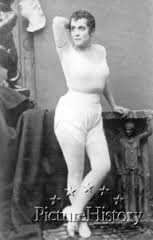
Many of the most popular women entertainers of the mid-and late-1800s performed in the boomtowns that dotted the West, drawn by the same desire for riches and bringing a variety of talents and programs.  They were mostly well received and sometimes literally showered with gold.   Adah Menken was one of those celebrated entertainers.  She was said to have had one of the most beautiful figures in the world.

On August 24, 1863, San Francisco’s elite flocked to Maguire’s Opera House.  Ladies in diamonds and furs rode up in handsome carriages; gentlemen in opera capes and silk hats strutted in stylishly.  It was an opening night such as the city had never before seen.  All one thousand seats in the theatre were filled with curious spectators anxious to see the celebrated melodramatic actress Adah Menken perform.

Adah was starring in the role that made her famous, that Prince Ivan in Mazeppa.  It was rumored that she preferred to play the part in the nude.  Newspapers in the East reported that audiences found the scantily clad thespian’s act “shocking, scandalous, horrifying and even delightful.”  The story line of the play was taken from a Byron poem in which a Tartar prince is condemned to ride forever in the desert snipped naked and lashed to a fiery, untamed steed.  Adah insisted on playing the part as true to life as possible.

The audience waited with bated breath for Adah to walk out onto the stage, and when she did, a hush fell over the crowd.  She was beautiful, possessing curly, dark hair and big, dark eyes.  Adorned in a flesh-colored body nylon and tight-fitting underwear, she left the audience speechless.  During the play’s climatic scene, supporting characters strapped the star to the back of a black stallion.  The horse raced up the narrow runway between cardboard mountain crags.  The audience responded with thunderous applause.  Adah Menken had captured the heart of another city in the West.


To learn more about Adah Menken and other thespians of the Old West read Entertaining Women:  Actresses, Dancers, and Singers of the Old West

Follow Me

facebook twitter youtube instagram
History of the Old West | Wild West Costume | Great Women in History | Wild West Outlaws | Famous Women Biologists | American Old West | What Was the Role of the Pioneer Women | American History West | American Gold Rush 1800s California | 1800's West | Wyatt Earp Biography

© 2026 Chris Enss | Privacy Policy | Design by Winter Street Design Group | Login