1806 – Approaching the Colorado foothills of the Rocky Mountains during his second exploratory expedition, Lieutenant Zebulon Pike spots a distant mountain peak that looks “like a small blue cloud.” The mountain was later named Pike’s Peak in his honor.
How the West Was Worn & Amelia Bloomer
Enter to win a book of your choice from the books in the
Chris Enss catalog.
Find the hidden turkeys on the site and you’ll be entered to win.
The winner will be announced on November 23.
Thanks for your readership.
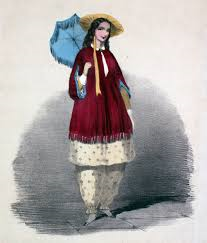
“The daughter of Dr. Hansen, of this city, appeared in the bloomer suit at a convention last week. It was scandalous.”
The Sacramento Bee, California, May 26, 1861
Amelia Jenks Bloomer was a newspaper editor, public speaker, and proponent of women’s rights and other social reform. She did not design the then-daring outfit that carried her name – a short dress that reaches below the knees with frilled Turkish-style trousers gathered in ruffles at the ankles. She did promote the costume, wore it herself, and watched it become a symbol of the fledgling women’s movement.
To learn more about the fashion trendsetters of the Old West read
How the West Was Worn.
How the West Was Worn & President Andrew Johnson
Enter to win a book of your choice from the books in the
Chris Enss catalog.
Find the hidden turkeys on the site and you’ll be entered to win.
The winner will be announced on November 23.
Thanks for your readership.
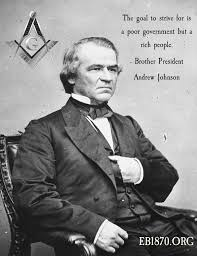
Before he became the President of the United States, Andrew Johnson was a tailor of renowned reputation. He began his career as an apprentice to a tailor in Raleigh, North Carolina. During the twelve-hour workday, he became an expert fabric cutter and tailor. In 1827 he opened his own shop and created a popular variation on the Prince Albert-style coat. The double-breasted, knee-length coat was reproduced by other tailors and worn by politicians and wealthy businessmen heading to San Francisco during the height of the Gold Rush. Johnson charged $8.00 for each coat, but following the custom of the time, he often bartered with his clients, accepting flour, beef, wood, and other goods as a form of payment.
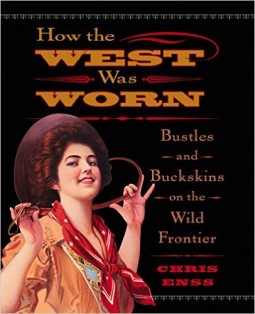
To learn more about popular fashion trendsetters of the Old West read
How the West Was Worn.
This Day…
How the West Was Worn & Oscar Wilde
Enter to win a book of your choice from the books in the Chris Enss catalog. Find the hidden turkeys on the site and you’ll be entered to win.
The winner will be announced on November 23.
Thanks for your readership.
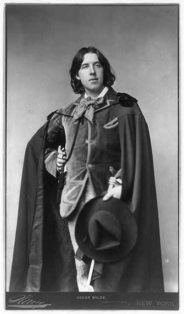
“Fashion is a form of ugliness so intolerable that we have to alter it every six months.”
Oscar Wilde, 1883
When playwright Oscar Wilde made the long journey from London to California, he brought with him a flamboyant wardrobe. In 1882, he attracted large crowds of settlers in Leadville, Colorado, who were interested in seeing Wilde’s velvet knicker suit and flowing bow tie. His outrageous costume was made complete with a high-crowned, large-brimmed cowboy hat and knee-high cowboy boots.
Although men found his fashion sense questionable, women admired the frilly, soft-collared shirts he wore, and they made patterns of the garments, so they could replicate the design for themselves.
To learn more about the fashion trendsetters in the Old West read
How the West Was Worn.
This Day…
A Fashionable Encounter – From How the West Was Worn
This month enter to win a book of your choice.
All you need to do is
find the turkeys hidden on the site and enter your findings.
The Winner will be announced on November 23.

A hot July breeze skidded across the banks of the Green River south of Fort Bridger, Wyoming. The clear water flowed swiftly past a grove of trees, waving with the wind. The grass on both sides of the river was spangled with flowers.
Elizabeth Graves, a handsome woman in her late 40s, was decorating a tree branch hanging over the water’s edge with bluebonnets. She was dressed in a green calico garment with short sleeves, lace collar and lace caplets. Her long brown hair was twisted in a bun on top of her head.
Elizabeth’s husband Franklin stood nearby, looking uncomfortable. He tugged at the tie around the neck of his linen pullover shirt as he dragged a couple of chairs out of the back of the wagon and sat them under the copse of trees. He stopped to admire the placement of the chairs and adjust the pant-leg of the scratchy wool trousers he was wearing. His steady, steel blue eyes were wet from crying. Three of the Graves’ children, ranging in age from five to nine, brushed by Franklin as they chased one another around the wagon. He backhanded the tears out of his eyes and smiled after his brood.
“I can’t believe my little girl is getting married,” he told his wife after a few moment’s contemplation.
“She’s not so little,” Elizabeth replied. “She’s twenty. She’s older than I was when we got married.”
“Is that right?” Franklin shrugged.
“You don’t remember?” she quipped impatiently.
“That was a hundred years and nine children ago, Lizzie,” he retorted. Franklin stared out over the water then turned to Elizabeth and smiled confidently. “Ray Fosdick is a good man,” he said. “He’s a good worker. He’ll make a good husband.”
“And she’ll make a good wife,” Elizabeth added.
“That she will,” Franklin agreed.
Elizabeth walked over to a baby’s crib sitting by the wagon, reached down and picked up her nine-month-old son. Franklin strolled over to her and kissed her on the cheek and she handed him the bluebonnets.
“Why don’t you finish putting those posies around,” she suggested. “I’ve got to change your son. All we want anyone to smell at this wedding are the wild flowers.” Franklin grinned, then buried his nose in the bouquet.
The Franklin’s daughter, Mary, walked along he hillside overlooking the setting.
She strolled through a colorful assortment of blossoms, carefully selecting the best flowers and adding them to a bouquet she had started and had bound together with a lace ribbon. Mary looked up from her work and gazed out at the marvelous valley spread out before her. A gentle breeze blew past her and she held out her arms pretending to be caught up in the wind. The edges of her hand-sewn cape with a delicate, blue rose pattern danced over her hoopless, straight, cotton skirt. Without thinking she opened her hand and the loose flowers scattered about. The wind blew the flowers across the ground and over to the feet of Charles Stanton. Charles, an attractive, bespectacled man of medium height and build, bent down and retrieved the bundle. His opened vest with wide fashionable lapels revealed a soft display of ruffled material running up and down his chest. His trousers were loosely tucked into his wide-mouthed boots.
“These must belong to you,” Charles said to Mary as he handed her the bouquet.
Mary smiled politely. “Actually, they’re for my sister,” she said.
“I can help you pick more flowers if you like,” Charles offered.
“Thank you,” she replied, “I can manage.”
Mary bent down to pick more flowers and Charles watched her closely.
“I hope I’m not intruding,” he probed.
“Not at all,” she said kindly.
“It sure is beautiful here,” he added staring out over the valley. “You can almost see right into the future.”
“And what does the future hold for you, Mister…?” she inquired.
“Stanton, Charles Stanton,” he told her. “In my future I see my own piece of land, my own home, my own hearth fire, the heads of my own horses looking over the gate bars for my hands to feed them.”
Mary giggled a little. “You can see all that from here?” she asked playfully.
“Can’t you, Miss…?” Charles questioned.
“Mary Graves,” she said giving a slight curtsy. “My view isn’t as clear. All I see is a new world filled with exciting prospects.”
“That’s good enough for now,” he assured her.
“Are you part of the Donner party heading out West too?” she asked.
“Yes,” he nodded.
Mary stared out at the beautiful view, took a deep breath of fresh air, then said, “I heard someone say that there’s no Sunday west of Independence, no law west of Dodge City, and no God west of Fort Bridger.”
“Don’t believe it, Miss Graves,” Charles said bending down to pick a particularly breathtaking flower. He presented a delicate red bloom to Mary and she gave him a coquettish smile.
“I’ll see you on the trail, Mr. Stanton,” she promised.
“Yes, ma’am,” Charles responded.
Mary pulled her blue slat bonnet hat down over her head and started down the hill. Charles watched her disappear into the horizon.
The pilgrimage west was an arduous undertaking. Emigrants hurriedly loaded their wagon trains with as many personal belongings as they could, and if they were unable to make what little they had fit, it was left behind. Limited space forced many to wear all the clothing they owned on their backs. The basic outfit for a pioneer woman consisted of a gingham or calico dress, a sunbonnet, and a muslin apron. Men pioneers wore simple overalls, cotton work shirts, and caps or broad-brimmed hats.
Many who made the trek were poor, possessing only a single pair of boots or shoes, the soles of which would be worn off long before arriving at their final destination. Socks wore out as well, forcing settlers to wrap their feet in rags to protect them from the elements. When traveling through snow and ice, they wrapped their footwear in gunnysacks to keep their feet from freezing.
In preparation for the trip, women altered their dressed to make walking easier. Several inches were cut off the bottom of the skirt and lead shot was sewn into the hem to keep the billowing material from blowing in the wind. Men wore their trouser legs tucked into their boots for the same reason. Wearing them in this manner also kept out mud and reptiles. Pioneer women’s dresses were worn without a hoop, and the bodice was lined with canvas for strength and warmth.
To learn more about how pioneers dressed for their journey west read
How the West Was Worn.
From the book How the West Was Worn – Legendary Trendsetter Elizabeth “Baby Doe” Tabor
We’re thankful for the many readers of author Chris Enss’s books.
To show our appreciation find the hidden turkeys at www.chrisenss.com
and enter to win a book of your choice.
The winner will be announced November 23.
Good luck and thank you.
Colorado socialite Elizabeth Tabor had golden hair, blue eyes, porcelain skin, and a sense of style that rivaled that of any woman in Leadville. She arrived married to a struggling miner but dressed like she was the belled of the ball. She paraded down the main street of town wearing a sapphire-blue costume with dyed-to-match shoes. Her stunning style caught the attention not only of neighbors and storekeepers but also of millionaire Horace Tabor. Horace and Elizabeth scandalized the community by falling in love, divorcing their spouses, and marrying one another. Horace showered his new bride with jewels and the finest outfits from Boston and Paris. She wore one-of-a-kind outfits to opening nights at the opera house he had built for her.
All eyes were on the young Mrs. Tabor as Horace escorted his young bride into the theatre. Her dresses were made of Damasse silk, complete with a flowing train made of brocaded satin. The material around the arms was fringed with amber beads. The look was topped off with an ermine opera cloak and muff. Pictures of the Tabors appeared in the most-read newspapers, and soon, women from San Francisco to New York copied the outfit. The only part of the costume admirers were unable to reproduce to their satisfaction was Mrs. Tabor’s $90,000 diamond necklace.
To learn more about how infamous characters in the Old West dressed read How the West Was Worn: Bustles and Buckskins on the Wild Frontier.