Life At Pinehurst

Enter now for a chance to win a copy of

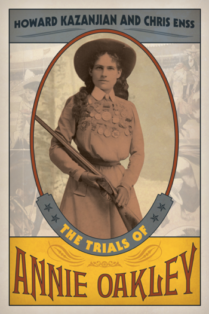
The Trials of Annie Oakley.
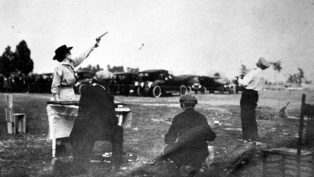
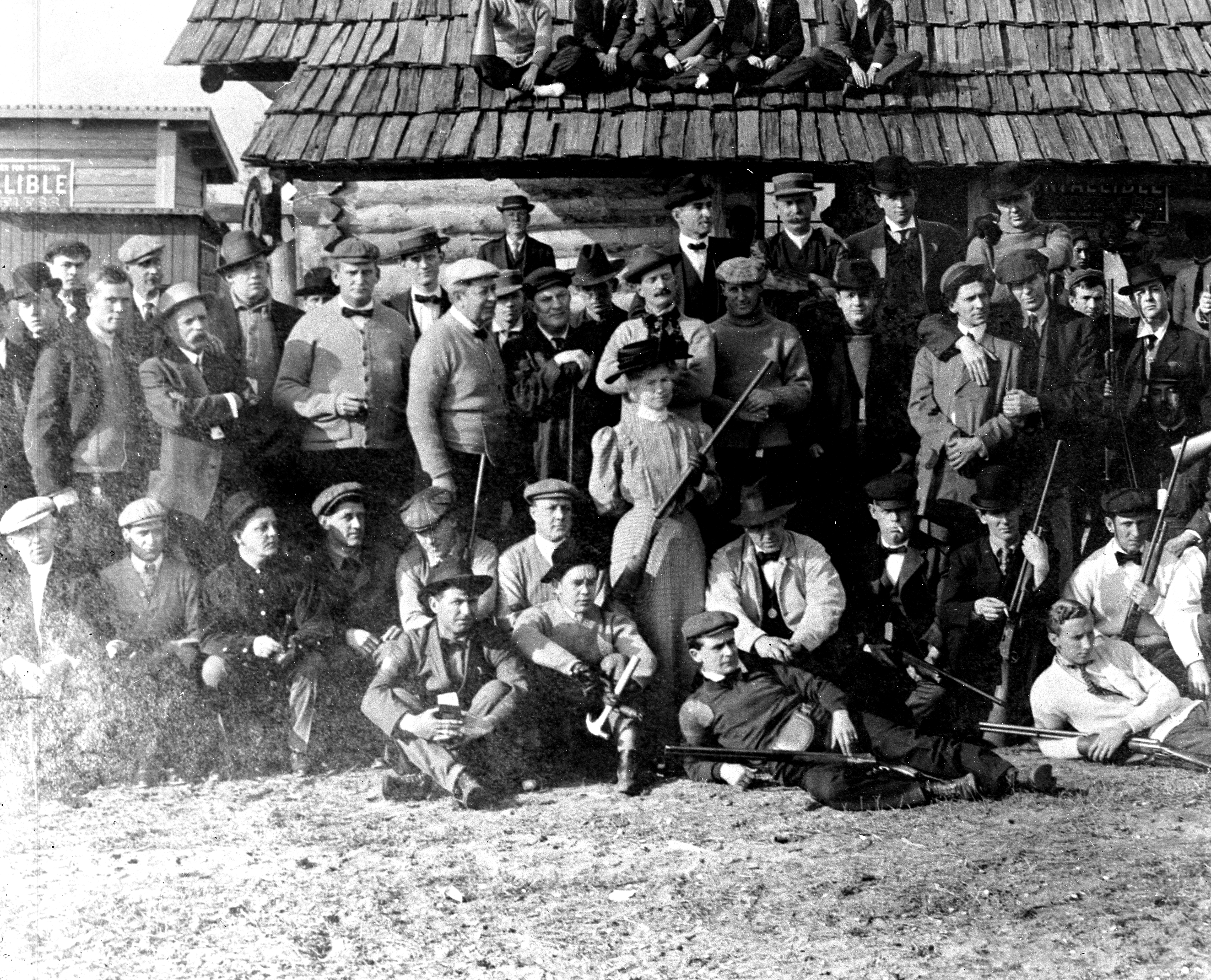
A row of ten, smartly dressed women stood side by side carefully scanning the horizon. Each was holding a rifle and waiting patiently for the instructor to give her directions. A genteel, smiling Annie Oakley stepped forward carrying her own weapon. A handful of ladies who had arranged to take shooting lessons from the famous markswoman stood near the side entrance of the firearms school in Pinehurst, North Carolina, anxiously awaiting the opportunity to draw a bead on a target and fire their guns.

Shooting at clay targets a few inches wide as they flew past at fast speed and actually hitting them was a thrill like none other. Annie had assured her students of that fact. Trap shooting involved speed, accuracy, and eye-hand coordination, something Annie had in abundance. For years she had extolled the virtues of trapshooting and was proof it could be done for pure enjoyment or competition. She reminded her class to keep both eyes opened, be aware of the position of their bodies while holding their .22- caliber shotguns, keep their cheek glued to the stock, point, and shoot.

KaBang! Kabang! Kabang! The weapons rang out in succession. The women were thrilled that their guns fired without incident and were excited to try again. Annie had warned them the sport could be addictive once they took the plunge.

From the time the United States entered World War I in early 1917 to November 1918, Annie had instructed more than 4,000 men and women on how to shoot. For many women, the time learning how to use a firearm led to regular participation in the sport of trapshooting. For many men the instruction helped them prepare for battle. Annie’s desire to serve her country in combat was realized through the soldiers who admired how she used a gun and employed what she taught in battle.

The Great War ended at the eleventh hour on the eleventh day of the eleventh month of 1918. Annie Oakley was fifty-eight years old. Although she had appeared in numerous exhibitions at cantonments throughout the east and demonstrated her skill to thousands of recruits bound for Europe to fight, many people wrote letters to the author of a syndicated column called “Trap, Gun and Rod,” hoping to find out what became of the once popular markswoman. “Is she still living,” a reader in Pittsburg, Pennsylvania, asked? “If so, how old would she be?”

“Annie Oakley (Mrs. Frank Butler) is very much alive and very much active in shooting game,” responded reporter Tom Marshall. “The last time I saw her shoot she performed with the old time vim and accuracy.”

If Annie had ever forgotten her age, newspapers across the country reminded her. An article that appeared in the January 3, 1919, Wilmington, Delaware, newspaper The Morning News told of an occasion where Annie’s age was the topic of conversation. It was a gathering of New York sportswriters. After much speculation, the writers were unable to agree on how old the sharpshooter was and couldn’t guess what the future held for the talented woman. The author of The Morning News article decided to take the questions to the source.

Annie was not ashamed to admit her age or to share her future plans. “On my sixtieth birthday next November, I will make my farewell appearance before the American public in an exhibition of shooting with the revolver, rifle, and shotgun,” she informed the reporter. “The exhibition will be in New York. When I begin to make plans for this shoot you will know that I am nearing the three-score of year’s mark – also that it will be the final appearance of Annie Oakley in public as a shooter.”
To learn more about the famous sure shot read

The Trials of Annie Oakley.
 

A Very Clever Woman

Enter now for a chance to win a copy of

The Trials of Annie Oakley.


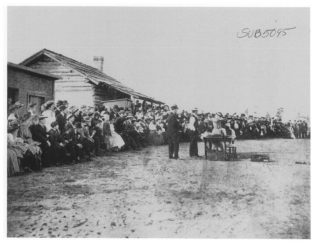
Three dozen, fresh-faced young men jockeyed for position behind a row of windows on a train leaving Poughkeepsie, New York, bound for Camp Mills on Long Island. The new Army recruits waved goodbye to those on the railroad platform; they wore happy expressions and cheered as the car lurched forward. The men were excited and blissfully naïve about the journey ahead of them. Family and friends on the platform offered last minute farewells as the train slowly began to move ahead. Some people cried as the vehicle left the station and blew kisses to the courageous souls who had answered the call to serve their country when America announced it would join Britain, France, and Russia to fight in World War I.

The United States entered the war on April 6, 1917, and by the end of that same month thousands of men had eagerly flooded recruiting stations, enlisted in the Army and Navy and promised to defend the nation in time of peril.

On July 6, 1917, newspapers and unofficial dispatches from Canadian army headquarters in Europe documented when America went into battle for the first time during the World War. A young Texan who had traveled to Ontario to enlist had the honor of being the first to carry the American flag in the European war. He was carrying the Stars and Stripes on his bayonet when he was wounded and subsequently transported to a medical unit.

According to the July 20, 1917, edition of the Democrat and Chronicle News the Texan’s brave action prompted even more patriotic men to join a branch of the service. Men did not have a moratorium on devotion to country. Women also wanted to do their part. Annie Oakley was among them. From the time the Spanish American War began in 1898, Annie had desired to recruit and train women to be expert shots and fight for the United States. She offered her unique services to President William McKinley.

“Dear Sir,” her letter dated April 5, 1898, began, “I for one feel confident that your good judgment will carry America safely through without war. But in case of such an event I am ready to place a company of fifty lady sharp shooters at your disposal. Every one of them will be an American and as they will furnish their own arms and ammunition will be little if any expense to the government. Very Truly, Annie Oakley.”

President McKinley politely declined her office, but Annie never abandoned the idea. More than nineteen years after the initial proposal, Annie again offered to raise a regiment of women volunteers to fight. She received more than 1,000 letters from women throughout the United States anxious to join the regiment. Three thousand women had participated in Annie’s shooting school in Pinehurst, North Carolina, during the 1916-1917. If necessary she could call on the best students from her classes to take part in the program. Many of the women were willing to serve as well.


To learn more about the famous sure shot read

The Trials of Annie Oakley.
 

This Day…

1877 Outlaw Wild Bill Longley, who killed at least a dozen men, is hanged, but it takes two tries; on the first try, the rope slips and his knees touch the ground.

The Troubles & Triumphs Of A True American Hero

Enter now for a chance to win a copy of

The Trials of Annie Oakley.

“There was a time when one’s impressions of performing sharpshooter Annie Oakley were based on the 1950s musical film Annie Get Your Gun – nothing could be further from the truth. Chris Enss uses her sleuthing savvy to uncover myth-busting details of Oakley’s life, revealing a multifaceted woman who was at once a larger-than-life character, a legend, a role model, and, most of all, a strong and selfless human being.”

Henry B. Crawford, Founder, History By Choice

“This is a story about a woman before her time. As a strong, independent female figure in American history, Annie Oakley paved the way for other young women to follow their dreams. This book beautifully tells an amazing story from our country’s history, with the grit and womanly ruggedness that Annie Oakley exuded.”

Carly Twisselman, TV Show Host/Personality for NRATV, GUNTV, and RIDETV,

and 2nd Amendment Advocate

To learn more about the famous sure shot read

The Trials of Annie Oakley.
 

This Day…

1864 – Battle of Tom’s Brook  Union cavalry in the Shenandoah Valley deal a humiliating defeat to their Confederate counterparts at Tom’s Brook, Virginia. Confederate General Jubal Early’s force had been operating in and around the Shenandoah area for four months. Early’s summer campaign caught the attention of Union General-in-Chief Ulysses S. Grant, who was laying…

America’s Shooting Star

Enter now for a chance to win a copy of

The Trials of Annie Oakley.


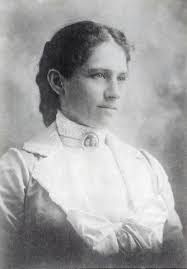
Long before the name Annie Oakley was on the lips of every man, woman, child, and newspaper editor in America, the sight of the demure woman, whether in a courtroom or on stage, seldom failed to inspire enthusiastic approval.

From the beginning of her career with Buffalo Bill Cody’s Wild West show in 1885, audiences were captivated by the petite sure shot. Her entrance into the arena of the western show was always graceful. She never walked. She tripped in, bowing, waving, and wafting kisses. The first few shots she delivered with her twelve gauge shotgun brought forth a few screams of fright from spectators, but they were soon lost in cheers and applause. Annie set audiences at ease and prepared them for the continuous cracks of firearms which followed.

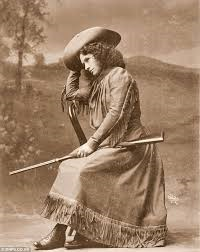
Annie posed with her guns for a variety of advertisements from festivals and circuses to weapons and ammunition. The armed woman had been a fixture of American life for several years prior to Annie Oakley’s image being used in posters promoting firearms for females. The firearms industry directed its first major ad campaign to women in the 1880s and Annie was a living, breathing promotion for shotguns and revolvers. By making shooting appear like something even a lady could comfortably do, Annie helped make the sport of shooting popular with women everywhere.

By 1904, women were being featured in ads with weapons less and less as regulations against guns were being drafted. The 1911 Sullivan Law, a band to prohibit the act of carrying and concealing firearms prompted antigun activists to request further ordinances to be placed upon weapons. Soon, licenses were required to possess firearms. Possession of certain weapons without a license was a misdemeanor and carrying them was a felony. Those opposed to such regulations, Annie Oakley being one of them, maintained that disarming good citizens put them at the mercy of thugs and crooks. Suffragists such as Alice Paul were outraged by what was perceived to be an impediment that would keep women from being able to protect themselves. “Not only did women not have the right to vote, but if they weren’t free to defend themselves they weren’t free at all,” Paul announced.

Annie Oakley weighed in on the subject in an interview with a Cincinnati newspaper in November 1904. “It’s reasonable that women should prepare to defend themselves when they are out alone at night,” she told an Ohio reporter. “Miss Oakley’s scheme is to have every lady provided with a .32-caliber revolver,” the reporter noted in his article, “which she is to wear in a pocket so large as to enable her to keep a proper grip on the weapon all the time. She advises that unless the person attacked is able to shoot first and hit the mark, the best thing is not to shoot at all.”


To learn more about the famous sure shot read

The Trials of Annie Oakley.
 

This Day…

1866 – The Reno gang carries out the first robbery of a moving train in the U.S., making off with over $10,000 from an Ohio & Mississippi train in Jackson County, Indiana. Prior to this innovation in crime, holdups had taken place only on trains sitting at stations or freight yards.

More From Annie Oakley

Enter now for a chance to win a copy of

The Trials of Annie Oakley.


Aim for the high mark and you will hit it. No, not the first time, not the second time and maybe not the third. But keep on aiming and keep on shooting for only practice will make you perfect. Finally you’ll hit the bull’s-eye of success.

Even in the best and most peacefully civilized countries many occasions arise when a woman versed in the knowledge and use of firearms may find that information and skill of great importance.

God intended women to be outside as well as men, and they do not know what they are missing when they stay cooped up in the house.

After traveling through fourteen foreign countries and appearing before all the royalty and nobility I have only one wish today. That is that when my eyes are closed in death that they will bury me back in that quiet little farm land where I was born.

[On Sitting Bull:] “The contents of his pockets were often emptied into the hands of small, ragged little boys, nor could he understand how so much wealth should go brushing by, unmindful of the poor.


To learn more about the famous sure shot read

The Trials of Annie Oakley.
 

This Day…

1856 – The outlaw Tom Bell was captured by vigilantes on the Merced River in California.  They patiently allowed him to write letters to his mother and to his mistress and then strung him up.