
1821: Elizabeth Blackwell was born (first woman in the U.S. to earn a medical degree)
The Countess of Landsfeld
Entertaining Women:
Actresses, Dancers, and Singers in the Old West
Long before actors were vying for an Oscar nomination and world wide fame thespians were trying to carve out a modest living entertaining prospectors and settlers of the Old West. Today the curtain goes up on a woman entertainer who captured the hearts of the western pioneers.
Ladies and gentlemen, Lola Montez, the Countess of Landsfeld
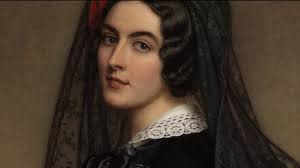
Lola stood quietly in the middle of the stage at the Bella Union Saloon in San Francisco and let the audience gaze up at her. She was a captivating beauty with dark, curly hair. Men from the various mining camps around traveled to town nightly to see the “fair-skinned woman with the pretty face.” She always began her act the same way:
“Good evening, gentlemen. I am Lola Montez. I was born in the year 1830, in Seville, the capital of Andalucía, the land of the serenades and balconies, of troubadours and romance – the fatherland of Miguel Cervantes, of Las Casas of the Roman Emperors Trajan and Theodosius.”
After the short introduction the music would start and the audience would cheer wildly. Lola would dance out on stage wearing flesh colored tights and a crinoline skirt. The excited crowd didn’t know that most of what she had just told them about herself was a lie. Lola had spent so many years creating her fictitious background that she had probably forgotten what the truth was anyway. And as long as the house was packed with men who paid to see her, she didn’t care.
Lola was actually born in 1818 in Ireland and her name was really Marie Dolores Eliza Rosanna Gilbert. By the time she had reached the Gold Country in 1851, she had already built a reputation for herself as a woman who possessed extravagant charm and thrived on adventure.
Like many other entertainers, Lola had come to California to enjoy the rewards of the Gold Rush. Stories of gold being tossed at the feet of performers lured many singing and dancing acts west. Lonesome and bored miners had an insatiable appetite for entertainment and they were willing to pay handsomely to see shows and variety acts. Lola Montez became one of the most popular performers of her time.
Lola was well known for a number she called the “Spider Dance.” She wore a risqué costume and fluttered around the stage pretending to be trapped inside a spider’s web. The music and dance became more and more frantic as giant tarantulas made of cork were dropped down on her from high above the stage. The curious miners were thrilled and shocked at the display. Lola’s dancing brought her high praise, but some found the scene a little too provocative for their taste.
To learn more about how Lola Montez’s career began and about the other talented performers of the Old West read
Entertaining Women: Actresses, Dancers, and Singers in the Old West.
This Day…
The Pioneer Manager
Entertaining Women:
Actresses, Dancers, and Singers in the Old West
Long before actors were vying for an Oscar nomination and world wide fame thespians were trying to carve out a modest living entertaining prospectors and settlers of the Old West. Today the curtain goes up on a woman entertainer who captured the hearts of the western pioneers.
Ladies and gentlemen, Sara Kirby Stark, the Pioneer Manager
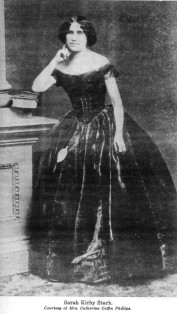
Sarah Kirby threw down the newspaper and paced across the room, only to turn and race back to the crumpled pages. She picked them up, smoothed them out, and once again read the diatribe against her penned by John Hambleton. Sarah was stricken with grief at the suicide of Hambleton’s wife. That the actor should blame her for his wife’s untimely death and publish his accusations in the San Francisco newspapers increased her distress. Her fingers whitened, and the edges of the page crumpled as she saw herself likened to a snake squeezing the life from its victim. Hambleton wrote of his dead wife’s devotion:
For six years of struggling hardship through poverty and sickness she was at my side night and day, with the same watchful attention as a mother to an infant, until, with the last two months a change had taken place, like a black cloud over shadowing the bright sun. She gradually lost all affection for me, riveting her attention on a female
friend who, like a fascinating serpent, attracted her prey until within her coils. In silence I observed this at first, and deemed it trifling, until I saw the plot thicken.
Sarah crushed the flimsy copy of the Evening Picayune again. She must counter this ugly story or lose her reputation in the city. Not for this had she struggled to attain a pinnacle of success as both an actress and a theater manager. As a manager of a company of actors—one of very few women managers—bad publicity could cost her everything.
A genuine pioneer of theater in California, Sarah Kirby had made her debut in Boston but arrived in the brawling new territory within a year of the first rush of Argonauts heading for the sparkling, gold-laced streams of the Sierra. Rowe’s Amphitheater in San Francisco saw her first performance as Pauline in The Lady of Lyons.
Two months later she appeared at the Tehama Theater, which she had opened and comanaged in Sacramento. By August 1850, she was a full-fledged manager, producing plays at a theater in Stockton, and in September she was back at the Tehama in Sacramento.
To learn more about how Sara Kirby Stark’s career began and about the other talented performers of the Old West read
Entertaining Women: Actresses, Dancers, and Singers in the Old West.
This Day…
1986: First women killed in the US space program (Judith Resnick, Christa McAuliffe) as Challenger explodes, killing all seven aboard
Diva of the Diggins
The time is now. Enter to win a copy of the book
Entertaining Women:
Actresses, Dancers, and Singers in the Old West
Long before actors were vying for an Oscar nomination and world wide fame thespians were trying to carve out a modest living entertaining prospectors and settlers of the Old West. Today the curtain goes up on a woman entertainer who captured the hearts of the western pioneers.
Ladies and gentlemen, Emma Nevada, Diva of the Diggins
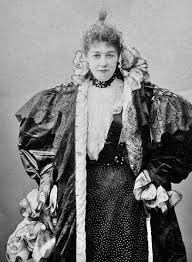
Doc Wixom lifted his three-year-old daughter and stood her carefully in the middle of the table. Wrapped in an American flag, golden brown ringlets framing her sweet face, Emma Wixom smiled at her audience. The church on the banks of Deer Creek was crowded with miners and merchants, teamsters and salon keepers. They were there to benefit a local charity, and the sight of a child symbolized the hopes of the future.
Unafraid of the eager faces crowded around the table, little Emma Wixom knew what was expected of her. She was happy to sing on this lovely morning. She did it all the time, unaccompanied, singing for the pure love of the sound.
That summer day in 1862, in the thriving California Gold Rush town named Nevada, she gave a performance to remember. Inside the Baptist church on the banks of Deer Creek, Emma took a deep breath and released a pure soprano voice that held the audience spellbound. By the time the last note sounded, there was not a dry eye in the house. Brawny, wet-cheeked miners showered her with nuggets of pure gold.
Emma Wixom, the daughter of a country doctor, began a long and illustrious career that day in the church. She would go on to sing opera in Europe and America. She would draw standing-room-only crowds to her performances, but her biggest fans remained the reckless, rugged gold miners who first took a little child into their hearts.
To learn more about Emma Wixom’s (later known as Emma Nevada) singing career began and about the other talented performers of the Old West read
Entertaining Women: Actresses, Dancers, and Singers in the Old West.
This Day…
The Jersey Lillie
Time to enter to win a copy of the book
Entertaining Women:
Actresses, Dancers, and Singers in the Old West
Long before actors were vying for an Oscar nomination and world wide fame thespians were trying to carve out a modest living entertaining prospectors and settlers of the Old West. Today the curtain goes up on a woman entertainer who captured the hearts of the western pioneers.
Ladies and gentlemen, Lillie Langtry, the Jersey Lillie
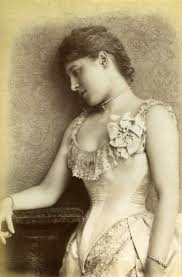
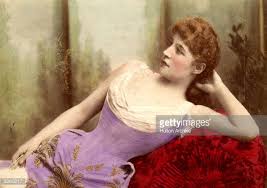
At 23 years-old Lillie Langtry’s striking looks were inspiring poets to write sonnets about her grace and pen and ink artists to sketch her elegant profile. She was known as a “Professional Beauty,” one of a handful of women in England with such arresting features they were invited to the finest soirées just so guests could admire them. Langtry was a tall, curvaceous lady with Titian red hair and portraits of her sold in shops for a penny.
Emile Charlotte LeBrenton was born to William Corbet and Emile Martin LeBreton in October of 1853 on the Isle of Jersey, a few miles off the coast of Saint-Malo, France. She was the only daughter in a family of six children. Her mother called her “Lillie,” which fit the beautiful child with lily-white skin.
Her education included studies in history, the classics and early theatre. By the time she turned 20 she had developed a love for theatre and a strong desire to leave her birthplace and see the world she had read so much about.
She married Edward Langtry on March 9, 1874, not long after watching his yacht sail into the Jersey harbor. He took her away from her home to England where they met and mingled with the country’s most renowned aristocrats. Their marriage would not survive the attention Lillie received from male admirers and friends who persuaded her to pursue a career on stage. The two separated after the birth of their daughter in April 1881.
Theatre owners looking for a chance to capitalize on the well-known siren’s popularity, invited her to join their acting troupe. Knowing that they were attracted only by her beauty, she refused all offers, deciding instead to take acting lessons. For months she trained with the critically acclaimed actress Henrietta Hodson Labouchere and on December 15, 1881, made her acting debut at the Theatre Royal in Westminster.
Lillie’s performance was stunning and audiences filled the house nightly. Labouchere became her manager and arranged for her pupil to appear at the most prestigious playhouses in England and Scotland. New York theatre owner and producer Henry Abbey saw Lillie in a show in Edinburgh and was instantly captivated by her talent. He wrote Henrietta with a generous proposal for Lillie, including an offer of 50 percent of the gross proceeds from her shows. Henrietta encourage her student to accept, but Lillie held out for 65 percent of the gross and payment of all her travel expenses.
To learn more about how Lillie Langtry’s singing career began and about the other talented performers of the Old West read
Entertaining Women: Actresses, Dancers, and Singers in the Old West.
This Day…
The Irish Prima Donna
Time to enter to win a copy of the book
Entertaining Women:
Actresses, Dancers, and Singers in the Old West
Long before actors were vying for an Oscar nomination and world wide fame thespians were trying to carve out a modest living entertaining prospectors and settlers of the Old West. Today the curtain goes up on a woman entertainer who captured the hearts of the western pioneers.
Ladies and gentlemen, Catherine Hayes, the Irish Prima Donna
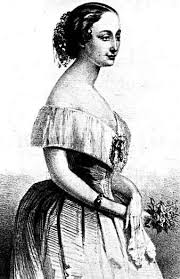
A demure ten-year-old girl sat in front of a clear blue river, half hidden under a canopy of willow trees in a lush garden, singing. Her silvery-toned voice resonated across the water and filled the afternoon sky with a melancholy sound. Couples canoeing on the river paddled toward the song, halted their boats, and waited in the shadows of the trees, listening. No one said a word. Not even a whisper gave away their position to the unknowing girl. Indeed she didn’t realize anyone was paying attention until she finished her tune and rapturous applause commenced. Thus was the romantic beginning of Kate Hayes’s singing career.
When Catherine (Kate) Hayes was born in July 1823 in Ireland, her mother, Mary, compared the child’s features to those of a cherub. Her talent for singing like an angel was soon revealed.
Kate’s father, Arthur, abandoned her and her sister when they were small children, leaving the family destitute; consequently, Kate and her sister were forced to go to work as soon as they were old enough. From the age of eight, Kate worked a variety of jobs, from caring for infants to scrubbing inn floors. At nineteen she found employment as an assistant to a charwoman. She sang as she cleaned the homes she worked in, and passersby who overheard her were astonished at her remarkable voice.
Bishop Edmond Knox of Limerick heard Kate singing as he was passing by one of the homes she was cleaning, and he proclaimed that she had the most beautiful voice he had ever heard. He was the first to recognize her potential and consequently took her on as his protégé. Bishop Knox consulted with friends and, along his wife Agnus, helped raise the necessary funds to send Kate to Dublin with letters of introduction to the accomplished vocalist and voice teacher Professor Antonio Sapio.
Professor Sapio agreed to train the young girl, as her voice possessed a clearness and mellowness he had rarely heard before. One month after her arrival in Dublin, Kate made her first formal public appearance at a concert hosted by her instructor. The discriminating audience was impressed by her talent, and the reviews in the newspaper the following day reflected the crowd’s pleasure. Intuitively, Sapio knew his protégé required more specialized training than he could provide and encouraged Catherine to continue her studies in France.
Bearing a letter of introduction from celebrated pianist George Osborne, Kate arrived in Paris in October 1844. Manuel Garcia, a renowned voice instructor who also taught other singers such as Jenny Lind, Maria Malibran, and Henriette Sontag, became her vocal teacher.
Garcia taught Kate everything he could, then sent her to Italy to study for a career in opera. She concentrated on language arts and drama. In Milan, she met many influential theater patrons who arranged for her to audition for Giuseppe Provini, manager of the Italian Opera in Marseilles, France. Provini was so taken by her talent that he scheduled her operatic debut on May 10, 1845, as Elvira in Bellini’s opera I Puritani. She was discovered by an American stage producer shortly after her debut in Italy. The producer quickly whisked her off to the United States.
To learn more about how Catherine Hayes’ singing career began and about the other talented performers of the Old West read
Entertaining Women: Actresses, Dancers, and Singers in the Old West.