1870 – Calamity Jane claims to have married Wild Bill Hickok on this date.

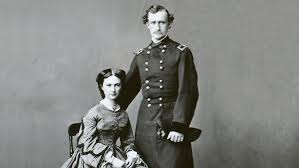
On June 27, 1876, Captain Frederick William Benteen spotted a cluster of white objects lying in a heap on a hill north of the Bighorn River in southern Montana. Benteen, a 42-year old career Army officer with a shock of white hair combed dramatically back over his long, bare forehead and harassed face, urged his horse slowly toward the knoll. A party of dutiful soldiers followed along behind him, their angry silence filled the air. As Captain Benteen inched his horse cautiously onto the site it became clear that the achromatic objects lying motionless in the tall grass were the remains of General George Custer* and his regiment. The flesh and bones of 210 members of the 7th Cavalry lay strewn over a mile of bloody ground. All of the bodies except for General Custer’s had been stripped naked and were mutilated.
Captain Benteen climbed down off his horse and made his way to General Custer’s body, stepping over dead soldiers pierced by arrows and lances in the process. George Custer’s ghostly frame was riddled with a number of injuries, not the least of which was a gunshot wound to the left flank and left temple. Benteen studied the bodies around him noticing that not only did the Indians in the fight leave George’s remains in tact, but left his socks on his feet. They had not scalped him either – his short, wavy hair was undisturbed.
“There he is, God damn him,” Benteen said coldly to members of his battalion now digging graves to bury the dead. “He’ll never fight anymore.” Benteen had known the popular boy General for more than ten years and he never liked him. He thought George was overly proud and impulsive. The Captain removed a piece of paper and the stub of a pencil from a pocket on his uniform, wrote George’s name on it, and nailed it to the wooden stake marking the spot where the General fell. “I went over the battlefield carefully with a view to determine how the fight was fought,” a distressed Benteen wrote in a report two days after the conflict. “I arrived at the conclusion I have right now – that it was a rout, a panic, till the last man was killed…. George himself was responsible for the Little Big Horn action, and it is an injustice to attribute the blame to anyone else.” Benteen had been in George’s command and ordered to reinforce his beleaguered troops at the Battle of Little Big Horn. For reasons that would be debated the rest of his life, Benteen did not come to George’s aide.
During the battle, Elizabeth Bacon Custer was only a few hundred miles away, in the Dakota Territory, waiting bravely for news of the expedition. The escalation of the Great Sioux War had brought the 7th Cavalry to the frontier, and where George went, Elizabeth followed.
One of the most charming and controversial soldiers the country ever produced, George Armstrong Custer and his equally delightful and charming bride, were devoted to one another and valued the time they spent together in the field and at their never-permanent homes at various Army post. Many times, Elizabeth lived in tents alongside members of the 7th Cavalry.
Over the twelve years the Custers were together, Elizabeth had lived history. She and George honeymooned in the war zones of the waning years of the Civil Way, and she witnessed the surrender of Robert E. Lee at Appomattox Courthouse and later was given the table at which the terms of surrender were signed. After the Civil War, when George’s regiment was sent to Texas to facilitate Reconstruction and then to the plains states as an “Indian Fighter” Elizabeth began her life on the frontier and experienced the most thrilling events of her life, an adventure that lasted until the memorable day when Custer and his troops made their immortal last stand against the Sioux Indians.

When pioneer and businessman Asa Mercer died on August 10, 1917, in Buffalo, Wyoming, few in the ranching community recalled the plan he devised to remedy the lack of single women in the Northwest in the 1860s.
It began with an ad placed in February 24, 1860, that testified to the serious shortage of a desired commodity in Washington Territory. “Attention Bachelors: Believing that our only chance for the realization of the benefits and early attainments of matrimonial alliances depends on the arrival in our midst of a number of the fair sex from the Atlantic States, and that, to bring about such and arrival a united effort and action are called for on our part, we respectfully request a full attendance of all eligible and sincerely desirous bachelors of this community assemble on Tuesday evening next February 28, in Delim and Shorey’s building, to devise ways and means to secure this much-needed and desirable emigration to our shores.”
Signed by nine leading citizens, the advertisement was picked up by other newspapers and reprinted across the country. They had hopes of attracting industrious, young women to the rich and rugged Northwest where a few thousand men were working on making fortunes in timber, fishing, farming, and other endeavors. There were a few favorable responses to the announcement but no solid plan was in place to import the desired commodity to the area.
By 1860, the pioneers in Washington Territory had established thriving communities along Puget Sound and were busy carving out farms and ranches along the coast and toward the foothills of the Cascades. The temperature climate, rich fisheries, and timber resourced proved the raw material upon which to build a comfortable life. The prosperous and clean-living young men populating the region in 1858 were “eager to put their necks in the matrimonial noose.”
In 1860, Asa Shinn Mercer hit upon a scheme to take the next step in the recruitment effort. He would import bachelorettes by traveling to the East Coast, where women were in abundance, and actively promote the unequaled advantages of Washington Territory. That idea and its sequel were part of the fascinating career of A. S. Mercer, who found his own bride among those he recruited for Washington Territory.
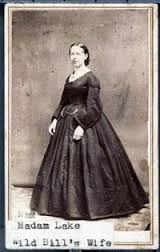
Wild Bill Hickok had many female admirers in his lifetime, but Agnes Lake Thatcher was the only woman who completely captured his heart. The man known as the “deadliest pistolero in the Old West” often declared to his friends that he preferred being a bachelor. It was a surprise to many when he married a widow several years older than himself. The circumstances that resulted in so great a change were romantically singular and worthy of record.
Mrs. Hickok was born Agnes Louise Messman on August 23, 1826, in Doehm, Alsace, France. Her mother died when she was four years old, and, shortly thereafter, her father took Agnes to America. The Messmans settled in Cincinnati, Ohio, when she was sixteen years old. As a child Agnes was an avid horseback rider. Her father helped mold her remarkable skill into a circus routine. In 1841, Agnes met a circus clown named William Lake Thatcher. He was a native New Yorker and used his connections to secure a job for Agnes with the circus he worked for, the Spaulding and Rogers Circus.
In addition to her impressive equestrian abilities, she also performed daring feats of skill on a tight wire. The August 23, 1907, edition of the New York Times reported that she “made a higher ascent on a wire than any performer of her day in 1858.” By 1859, she was billed the “queen of the high wire” and the most famous equestrienne the American circus had ever known.
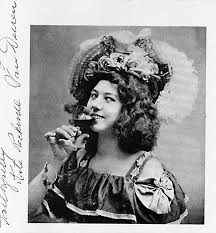
A frigid wind blew hard past the weather-beaten exterior of the Palace Garden Theatre in Dawson City, Alaska. It was the spring of 1900, and gleeful patrons were tucked warmly inside, waiting for the “Flame of the Yukon” to take the stage.
A fiery, red-headed beauty named Kate Rockwell glided out before the crowd, her violent eyes smiling. The men went wild with applause. The music began, and the entertainer swayed with the beat, placing a gloved hand to her breast and a fingertip to her lips and then, stretching her arm out, beckoning her admirers. The elaborate red-sequin dress she was wearing was form-fitting, and the long black cape that draped over her shoulders clung to her alabaster skin.
The piano player accelerated his playing, and Kate gyrated gracefully in and out of the shadow of the colored lights that flickered across the stage. After a moment, with a slight movement of her hand, she dropped the cape off her shoulders and it fell to the floor. The glittering diamonds and rhinestones around her neck sparkled and shined. Ever so seductively, she picked up a nearby cane adorned with more than 200 yards of red chiffon and began leaping, while twirling the fabric-covered walking stick. Around and around she fluttered, the chiffon trailing wildly about her like flames from a fire, the material finally settling over her outstretched body. The audience erupted in a thunderous ovation. She was showered with nuggets and pouches filled with gold dust. This dance would make her famous.
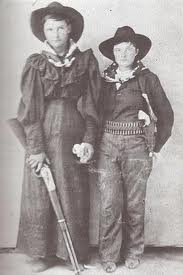
On the afternoon of August 18, 1895, United States Marshal Bill Tilghman and Deputy Marshal Steve Burke led their horses toward a small farm outside Pawnee, Oklahoma. The lawmen had tracked a pair of outlaws to the location and were proceeding cautiously when several gunshots were fired.
Marshall Tilghman caught sight of a Winchester rifle sticking out a broken window of a dilapidated cabin. He spurred his horse out of the line of fire just as the weapon went off. He steered his mount around the building and arrived at the backdoor the same time sixteen year old Jennie Stevens, alias Little Britches, burst out the house. She shot at him with a pistol while racing to a horse waiting nearby.
By the time Marshal Tilghman settled his ride and drew his weapon Jennie was on her horse. She turned the horse away from the cabin, kicked it hard in the ribs, and the animal took off. Tilghman leveled his firearm at the woman and shot. Jennie’s horse stumbled and fell, and she was tossed from the animal’s back, losing her gun in the process.
The marshal hopped off his own ride and hurried over to the stunned and annoyed runaway. Jennie picked herself up quickly and cursed her misfortune. She charged the lawman, dug her fingernails into his neck, and slapped him several times before he could subdue her. He was a battered man when he finally pinned her arms behind her back.
Back at the cabin, Deputy Marshal Steve Burke wrestled a gun away from thirteen year old Annie McDoulet, alias Cattle Annie, a rail-thin, young woman wearing a gingham dress and a black, wide-brimmed straw hat. The pistol she tried to shoot him with was lying in the dirt several feet in front of her.
Two years prior to their apprehension and arrest, Cattle Annie and Little Britches were riding with the Doolin gang, a notorious band of outlaws who robbed trains and banks. Enamored by the fame of the well-known criminals, the teenage girls had decided to leave home and follow the bandits. They helped the criminals steal cattle, horses, guns, and ammunition and warned them whenever law enforcement were on their trail.