
1806-Pike’s expedition makes a stockade on the upper Rio Grande in Spanish territory; he and his party are eventually taken prisoners by a Spanish force from Santa Fe, then led back to the American border.
Who Wrote the Song Happy Trails?
Like to win? Now’s your chance. Enter to win a copy of
The Cowboy and the Senorita: A Biography of Roy Rogers and Dale Evans and
Happy Trails: A Pictorial Celebration of the Life and Times of Roy Rogers and Dale Evans.
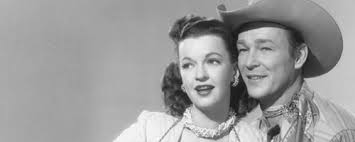
Elected to the Country Music Hall of Fame in 1980 as a member of the Sons of the Pioneers and elected again in 1988 as Roy Rogers.
Roy got his horse Trigger in 1938 and rode him in every one of his films and TV shows after that. He had appeared in one earlier movie, ridden by Olivia de Havilland in The Adventures of Robin Hood (1938). Trigger died in 1965 at age 33.
Roy’s theme song, “Happy Trails”, was written by Dale Evans.
Inducted (as a member of the Sons of the Pioneers) into the Hall of Great Western Performers of the National Cowboy and Western Heritage Museum in 1995.
Enter to win now and Happy Trails.
It Started With A Gold Mine
You can’t win if you don’t enter. Spend the holidays with the
King of the Cowboy and the Queen of the West.
Enter to win a copy of The Cowboy and the Senorita: A Biography of Roy Rogers and Dale Evans and Happy Trails: A Pictorial Celebration of the Life and Times of Roy Rogers and Dale Evans.
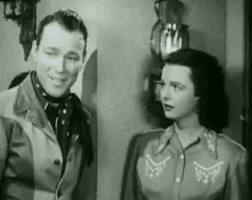
The Cowboy and the Senorita was Rogers’ first film with Evans, who was to appear in twenty films in a row with him and finally marry him in 1947. She was a versatile work horse of a singer-dancer whose maternal sexuality complemented Rogers’ boyish charm. She’s the senorita of the title, Ysobel Martinez, whose cousin, Lee, is left a gold mine that Hubbard tries to seize, Rogers and actor ‘Big Boy’ Williams (parading the simple smile that was his trademark) foil Hubbard. Made in 1944, the film is fun for Roy and Dale fans of all ages.
Enter to win now and Happy Trails.
This Day…
American Icons
Spend the holidays with the King of the Cowboy and the Queen of the West.
Enter to win a copy of The Cowboy and the Senorita: A Biography of Roy Rogers and Dale Evans and Happy Trails: A Pictorial Celebration of the Life and Times of
Roy Rogers and Dale Evans.
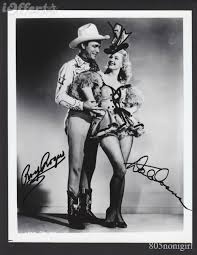
Dale Evans and Roy Rogers are such icons of the American West – quintessential cowgirl and cowboy – that sometimes its is difficult to remember that their personas were media creations and not the real thing. Neither of them grew up riding the range. Dale Evans, born Frances Smith, was married as a very young teen-ager, and then left to struggle as a single mother. Roy Rogers, originally Leonard Slye, grew up on a hard-scrabble farm.
Talent and the Hollywood machine transformed them into stars. They married after Rogers was left a widower with small children. Tragedy – and the triumph over it – didn’t stop there. Both adoptive and natural parents, they endured the sad loss of three of their children over the years.
Rogers and Evans managed to project an image of wholesomeness decade after decade over changing times.
Roy Rogers and Dale Evans made 81 western for Republic Studios
The Roy Rogers Show was among the top NBC television programs from 1951 to 1957
In 1947 alone Roy Rogers received more than 900,000 fan letters
In 1953 alone 408,000 pairs of Roy Rogers slippers, 900,000 lunch kits, and 1,203,000 jeans and jackets were sold.
Enter to win now and Happy Trails.
Roy Rogers & Dale Evans
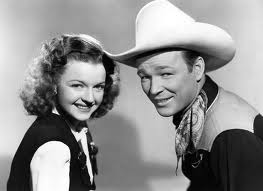
This month marks the 68th anniversary of when Roy Rogers and Dale Evans were married. To commemorate the union of the King of Cowboys and the Queen of the West in 1946, I’ll be giving away two signed copies of the books the Cowboy and the Senorita and Happy Trails. Both books were written by Howard Kazanjian and myself and feature personal photos and tales about the cowboy duo. From their first singing jobs to their successful film careers, these books chronicle their early struggles and rise to stardom. Throughout December I’ll present fun facts about Roy and Dale, share behind the scenes information from their popular films, and provide updates on the status of a new film being developed based on the Rogers’ life.
Enter to win now and Happy Trails.
The Robber’s Bride
On an upcoming episode of the Travel Channel’s program Mysteries at the Museum entitled The Robber’s Bride, I’ll explain why a mail-order bride left her fiancé at the altar. The original airdate of the episode is Friday, November 28 at 9/8 c.
In other news, congratulations to Janet Vavloukis of Chicago.
Janet won the drawing for a copy of
Cowboy True’s Christmas Adventure.
Ragamuffin Day
There’s still time… Enter to win a copy of the children’s book
Cowboy True’s Christmas Adventure.

Long before Halloween was the go-to holiday to be in costume, children in New York City would dress up on the final Thursday in November in what was known as Ragamuffin Day — which also happened to coincide with Thanksgiving.
As part of the Ragamuffin festivities, children, dressed in rags and masks (known as Thanksgiving Maskers), would go door-to-door and ask, “Anything for Thanksgiving?” Usually they would receive a treat of some sort: candy, fruit, or pennies.
The tradition stemmed from the late 1700s, when grown homeless men, during the holidays, would dress in women’s clothing and beg for food and money. In the late 1800s, the tradition evolved into annual event for children.
Ragamuffin Day ended in 1941, when President Roosevelt and Congress established Thanksgiving as a federal holiday. Many of the traditions associated with Ragamuffin Day found their way into Halloween.
To learn more about how Cowboy True celebrated the holidays read
Cowboy True’s Christmas Adventure.
All proceeds raised from the sale of the book go to benefit UC Davis Children’s Hospital.
This Day…
1889-Washington is admitted to the Union. During the past decade the territory has developed railway connections with the Great Lakes and the Mississippi Valley. The population has grown from almost 25,000 in 1870 t more than 350,000. Lumbering, shipbuilding, and commercial fishing are rapidly expanding.
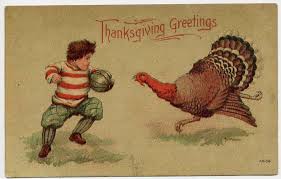
Turkey & Football
Enter to win a copy of the children’s book Cowboy True’s Christmas Adventure.
Love cranberry sauce or hate it, but that sweet desert (or relish — depending on how you consume it) has become quite the Thanksgiving commodity. Although cranberries were very present in America and easy to access, the Pilgrims likely weren’t devouring the commodity. Why, you ask? Considering that sugar — a key component of cranberry sauce — was a luxury item when the first Thanksgiving unfolded, making the jam was expensive. It’s unclear when the sauce was even created, research indicates it was 1663 — decades after the supposed first Thanksgiving — that people began commenting about a sweet sauce that was made from cranberries. But if you’re thinking about modern-day canned cranberry, that’s actually brought to you by Ocean Spray, a company that began selling the product in the early 1900s.
For many, turkey and football go hand in hand. As much as Thanksgiving is about acknowledging what one has been given, it is also about tuning in — or even playing — one of the nation’s most popular sports. According to The Pro Football Hall of Fame, Thanksgiving Day football was once a tradition among colleges and high schools, but that practice has since subsided and the NFL has picked up the torch. The modern-day tradition, it seems, dates back to 1934, when the Detroit Lions decided to play on Thanksgiving Day.
The team’s owner, George A. Richards, knew scheduling a game on the holiday was risky, but he decided to do it anyway in an effort to bolster the team’s standing in Detroit. The Lions played the Chicago Bears in a duel that inevitably attracted 26,000 people to the University of Detroit Stadium, selling out two weeks before the game.
Hence, the football and Thanksgiving tradition was born. The Pro Football Hall of Fame noted that Detroit has had a game every year since, aside from a brief hiatus from 1939 to 1944. Just the same, Dallas Cowboys, too, have played every year on Thanksgiving since 1966, only missing two years in 1975 and 1977.
As mentioned, though, football games on Thanksgiving were unfolding prior to the Lions’ 1934 holiday face off. According to the Library of Congress, “The American Intercollegiate Football Association held its first championship game on Thanksgiving Day, 1876.” And it didn’t end there. In the 1890s, Yale and Princeton attracted tens of thousands of fans for championship games and many high schools followed suit. Eventually, they stopped the practice and the NFL simply continued it.