1881-Bill Leonard and Harry Head were killed by Ike and Jim Haslett in Eureka, New Mexico. Leonard and Head were in the gang that tried to rob the Kinnear stage near Contention, Arizona on March 15, 1881.
Outlaw Talk in Dodge City
I returned from Dodge City and other towns in Kansas yesterday. I had been traveling around the state promoting two books, one of which was The Bedside Book of Bad Girls: Women Outlaws of the Midwest. Outlaw Alice Ivers was one of many bad girls I had a chance to talk to readers about. Alice was born in Sudbury, Devonshire England in 1851. She immigrated with her family to the U.S., settling in Virginia first, then moving to Fort Mead, Colorado where her father was a school teacher. She married a mining engineer, who introduced her to the fast world of the gamblers and their known haunts. Ivers greatly admired the car sharps and high-hatted gamblers that traveled the cow towns and soon she learned their card-playing wiles. While in her teens, Ivers went to Deadwood, South Dakota, where she became a dealer, specializing in poker and soon earning the sobriquet “Poker Alice.” After her husband died, she devoted the rest of her life to gambling; traveling through Arizona, Oklahoma, Kansas, South Dakota, Texas, and New Mexico, or wherever the stakes were high and the whisky smooth. She smoked thick, black cigars, and during the 1870s and 1880s, became a well-known and successful gambler in all the famous cow towns, from Deadwood to Tombstone, Arizona. In her heyday, she would spend $6,000 in the fancy New York run shopping stores buying the finest garments, but later, in old age, Ivers took to wearing army surplus clothing. Poker Alice would not tolerate a cheat and was never challenged by other gamblers. She was known to carry sever guns, one in her purse and one in a pocket of her dress. On occasion, she would practice her marksmanship by shooting knobs off the frames of pictures hanging in bars to warn gambler gunmen that she was capable of defending herself. Wild Bill Hickok reportedly asked Poker Alice to sit in with him and others during the game of poker in Saloon No. 10 in Deadwood on the day he was shot by Jack McCall; she declined, saying that she had already agreed to play with another group down the street in Mann’s Saloon. When hearing that Wild Bill had been shot in the back, Ivers rushed to Saloon No. 10 and saw Hickok sprawled dead on the floor and McCall fleeing out the back door. “Poor Wild Bill,” she said of Hickok, peering down at his corpse, “he was sitting where I would have been if I had play with Wild Bill on that fateful day because she “had a queer feeling that all would not be right that day.” Alice Ivers later married Frank Tubbs, a gambler who did not possess half her playing talents and one who took to drink early in their marriage. Poker Alice was forever getting her husband out of trouble. Tubbs was knifed one night by a disgruntled player, and Poker Alice stormed into the bar and shot the man in the stomach, wounding him from a distance of thirty feet. She and Tubbs moved on to Silver City, Nevada, where she broke the bank in the biggest saloon, winning an estimated $150,000. She and Tubbs then brought a huge Colorado ranch which Poker Alice later lost. Following her husband’s death, Poker Alice moved to Rapid City, South Dakota, where she ran a small poker club. She died there, a grand old lady of western lore, on February 27, 1930. 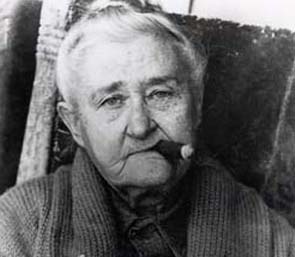
This Day…
1858-Commissioners from President Buchanan arrive at Camp Scott in Utah and proceed south to Provo. They bring a full pardon from the president ‘to all who will submit themselves to the just authority of the federal government.’ The pardon has been signed by the President two months earlier, and the commissioners admonished ‘to bring those misguided people to their senses.’ Only after the pardon is signed is the US Army allowed to march through Salt Lake City-still deserted-into an area soutwest of the city, where they will construct Camp Floyd.
The Hazards of Cowpunching
Stampede! This one word, more than the warning cry that Indians or outlaws were attacking, made any cowpuncher’s blood turn cold. There was no way of foretelling it; the sudden bark of a coyote, a rumble of a summer storm, lightning, the rearing of a horse, or the scream of a panther could all start a disastrous stampede. Sometimes there was no apparent reason; it seemed as though a half-wild but dormant instinct of flight had suddenly flared up in the brain of one of the steers. As many memoirs recall, it was a terrifying experience. There would be a sudden rumble like that of a far-off cannon; then the herd would bolt. Like an army of modern steam-rollers, the steers would move across the open prairie with the speed of an express train. No one could tell what direction they would take. Sometimes they plunged off cliffs, filling whole canyons with their broken bodies, or choked a river with their thrashing. The task of the cowpunchers was to divert that terrifying, fast-moving animal mass into a gigantic circle. To do that, cowboy and pony became as one. Sometimes the stampede went on for days. No one got any sleep. There was only time for a quick drink of scalding hot coffee and then back into the saddle. “I didn’t sleep for three days,” one puncher recalled. “The heard ran for miles…” 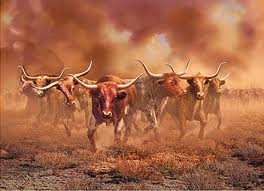
This Day…
The Hanging of Lewis Holder
Lewis Holder was an outlaw. After hearing the news from Judge Isaac Parker that he was going to die on the gallows, Lewis left forth a piteous scream then collapsed to the floor, paralyzed with fear. There was an immediate concern that Holder had died from fright, but the defendant was still very much alive. Holder, who had been convicted of murdering his partner George Bickford in the San Bois Mountains in Oklahoma on December 28, 1891, vowed that he would return to Fort Smith in spirit form and would haunt Judge Parker and the jury men if he were indeed hanged. No one paid much attention to the desperate warnings of a condemned man. Holder was executed as scheduled on Nov. 2, 1894. About one month later, jailer George Lawson was startled by a moaning sound coming from the direction of the jail yard gallows. Upon further examination, a thoroughly inebriated man was found lying prone on the wooden gallows. 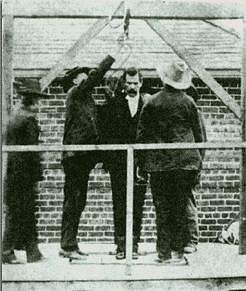
This Day…
To Hell and Back
The most decorated American war hero in World War II, Audie Murphy returned home with no place to go but down. What could top his spectacular battle feats? After lying about his age to join the army at 17, he had been wounded three times and credited with killing 240 Germans. Of 235 men in company, Murphy was one of two who survived. Not yet 21, he won twenty-seven medals, including three from the French and one from Belgium. After the war, Murphy was recruited to Hollywood by James Cagney, and in 1955 he starred in a movie version of his autobiography, To Hell and Back. He said it was “the first time, I suppose, a man has fought an honest war, then come back and played himself doing it.” Murphy joked about his lack of talent, but in twenty years his boyish face and freckles appeared in forty movies, mostly war films and Westerns in which he played eager fighters. It was a far cry from his youth as one of eleven children of a Texas cotton sharecropper-and from the battlefields of Europe-and the transition was not smooth. Murphy said the war left him with nightmares for years. He slept with a loaded automatic pistol under his pillow, and when he was asked how people survive a war, he said, “I don’t think they ever do.” One of Murphy’s friends, cartoonist Bill Maudlin, said “Murphy wanted the world to stay simple so he could concentrate on tidying up its moral fiber wherever he found himself.” Murphy became a quasi law-enforcement officer in the 1960s. He was made a special officer of a small California police department and rode around with police during drug busts. In 1970, he and a bartender friend beat up a dog trainer in a dispute over treatment of the friend’s dog. Murphy was acquitted of attempted murder. Though he had earned more than $2.5 million in his film career, Murphy was forced by too many bad business ventures to declare bankruptcy in 1968. Three years later, hounded by creditors and still trying to rebuild financial security for his wife and two teenage sons, he became interested in a company in Martinsville, Virginia, that manufactured prefabricated homes. He was on a small charter flight from Atlanta to see about making an investment when the plane crashed in a wooded mountain area during a light drizzle. The region, northwest of Roanoke, was so isolated that the wreckage, including the bodies of Murphy and five company officials, was not found for three days. The was hero was laid to rest in Arlington National Cemetery. 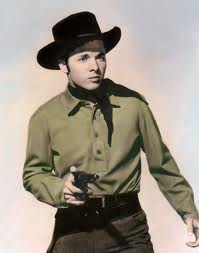
This Day…
1887-The Swan Land and Cattle Company of Wyoming, only four years old, declares bankruptcy following the devastating winter of 1886-87. The demise of the huge livestock corporation is symbolic of the Depression that will grip the cattle industry on the Great Plains during the next 10 year. Over this period the number of cattle in Wyoming alone will decline from 9 million head in 1886 to only 3 million by 1895.
Down Went the Duke
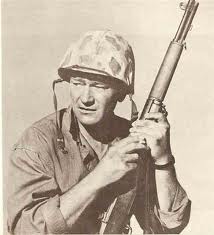
After acting as either a cowboy or a soldier in nearly one hundred films, John Wayne finally won a best actor Oscar in 1969 for True Grit. The quintessential macho man was himself exempt from service during World War II owing to a problem with his shoulder. Winning the Oscar, some say, added another ten years to his life. Although he was a longtime smoker, averaging four packs a day, Wayne nevertheless died of gastric cancer at age seventy-two in 1979. In 1955 John Wayne was among two hundred twenty cast and crew member who worked on the film The Conqueror. It was shot on a location in Utah, which was contaminated by radioactive fallout from atomic bomb tests. Much of the soil was transported back to Hollywood for studio scenes. By 1980 more than ninety of those who worked on the movie contracted cancer; forty-six died. Even though Wayne knew of the danger, often carrying a Geiger counter onto the set, he believed the risk insignificant. For more information about the great John Wayne read The Young Duke: The Early Life of John Wayne by Howard Kazanjian and Chris Enss.