
Pocahontas, a nickname meaning “little spoiled one,” was born Amonute, daughter of Chief Powhatan in 1595. She was an extrovert from a young age, inquisitive and naturally good-natured. At eleven years old she played a minor role in securing John Smith’s survival. Later she was the go-between for trade among the settlers and Indians bartering at Jamestown. The fictionalized version of her love affair with Smith may, in fact, bear some truth, but in a much more disturbing way for our modern sensibility. Today, a thirty-year-old having sex with a preteen is pedophilia and a crime. But, in that era, intercourse with non-Christian pagans of any age was not considered wrong. Pocahontas was known to have “long, private conversations” with Smith during her frequent visits to the Jamestown complex, yet the true dimensions of these encounters are a matter of conjecture. A few years later she was betrothed to the older Englishman John Rolfe, only after she agreed to be baptized in 1614. Rolfe took her to London, where she was received as a celebrity, billed as a real Indian princess by high society, and held an audience with King James. In 1617 she believed the smoky air of London was the cause of her coughs and bouts of weakness and wished to return to the forests she had known. Along with Rolfe she boarded a ship to return to Virginia, but the vessel only made it to the end of the Thames River before it turned back. Pocahontas died in London at age twenty-two of a disease called the king’s evil, a form of tuberculosis characterized by swelling of the lymph glands. 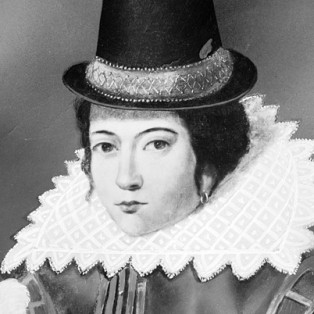
This Day…
1882-Nate Champion and Nick Ray were murdered by a hundred or so minions of the Wyoming Stockmens Association at the Kaycee Ranch in Johnson County, Wyoming. Ray was gunned down at daybreak outside the cabin and heroically pulled to safety by Champion. Ray soon expired and champion was put under siege inside the cabin. When the cabin was set afire Champion made a break for it and was shot 28 times. He left a detailed diary of events up to the fire.
This Day…
1867-General William T Sherman has devised a plan to drive all of the Plains Indians either north of the Platte or south of the Arkansas River, leaving a broad belt of territory for the transcontinental railroad and the Kansas Pacific Railroad. General Winfield Scott Hancock leads a large cavalry and infantry force across western Kansas. At Pawnee Fork, his troops capture and burn a Cheyenne village of 250 lodges. The Indians, fearing another massacre like the one at Sand Creek in 1864, flee before the advancing troops. In retaliation the Indians halt almost all travel across western Kansas. Surveying parties for the Kansas Pacific Railroad come under attack, and progress on that line is halted for over a month.
The Lone Ranger Rides
Clayton Moore played the masked cowboy riding high on his horse Silver in the TV favorite The Lone Ranger during the early fifties. With the help of the wise, quiet Indian Tonto, played by Jay Silverheels, the duo went about righting injustices in over one hundred episodes. Moore had the odd fate for an actor of wearing a mask onscreen so that even during the fame of the show, he was hardly recognized. Perhaps for this, there is no other actor who clung to his role do diligently, regularly donning the mask and costume to go out in public, some say even while in his car at a drive-through for fast-food. He was seen wearing his Lone Ranger costume shortly before his death of a heart attack in 1999 at age eighty-five. Silverheels took much less affinity to his role as Tonto and passed away quickly, though coughing laconically, at age sixty in 1980, of pneumonia. 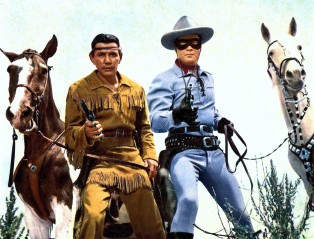
This Day…
1847-General Scott leaves Vera Cruz and is stopped at Cerro Gordo by Santa Anna’s men on 9 April. During the battle of 17 April. US Engineer officers Captains Robert E. Lee and George B. McClellan provide distinguished reconnaissance. By 15 May, Scott and his victorious army within 80 miles of Mexico City.
Following the Necktie Fashion
As railroad building brought desperadoes into Wyoming, citizens there found use for many ropes. Several bandits and killers were set swinging in and around Cheyenne and Laramie in 1868. Where the trees were not available, a telegraph pole served for scaffold. That was the case with the stringing up of Dutch Charley at Carbon and George Parrot (“Big Nose George”) at Rawlins. Idaho also attracted horse thieves, stagecoach robbers and killers who had to be eradicated. Vigilance committee at Payette and Boise did this with dispatch. The most notorious man strung up by the Boise group was David Updyke, leader of a desperado gang, who had been able to win an election for sheriff of Ada County. With Updyke and several of his men out of the way, the Idaho crime wave subsided. It’s amazing what happens as a result of a public hanging. Chapter three of The Plea will be on the website next week. Visit www.chrisenss.com.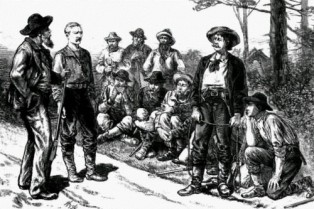
Sam Sixkiller Outstanding Oklahoma Book Award
|


This Day…
This Day…
There’s A Hangin’ Comin’
In Nevada, where highwaymen were active, Egan, Hamilton, Treasure City and other towns organized protective associations with written rules. Aurora formed one in 1864 after about thirty citizens had lost their lives by violence in three years. The vigilantes caught four of the outlaws, built a scaffold in front of the armory and placed four nooses. When the governor heard what was going on and wired an inquiry, the United States marshal replied, “Everything quiet in Aurora. Four men to be hanged in fifteen minutes.” Then, as a crowd watched, the four stretched rope. At Dayton, Carson, Virginia City, and elsewhere, vigilance committees, remained at worked for a decade or longer. In Colorado, outlaws often were sent to the next world in economy-sized packages. Near Sheridan a committee strung four desperadoes from a railroad bridge. On the Denver and Cheyenne road to the north, seven bandits were dropped from another trestle. Denver miners formed a people’s court in 1859 and hanged from a cottonwood a prospector who had killed another for his gold. The next year the same court strung up four killers. The most remembered was James Gordon, who had killed a man for refusing to drink with him at a bar. His hanging was witnessed by several thousand, whom the mounted Jefferson Rangers kept in order. Most of the Colorado mining camps organized people’s courts in the 1860’s. One historian noted that such courts “were about the only ones thoroughly respected and obeyed.” Their proceedings were open and orderly, he said. “They approached the dignity of a regularly constituted tribunal. The prisoner had counsel and could call witnesses if the latter were within reach. 





Close