
1902-Harry Stimler and William Marsh make a gold discovery on Columbia Mountain, Nevada about 30 miles south of an earlier discovery at Tonopah. This will lead to the famous Goldfield, Nevada, Mining District.
This Day…
Judge Bean
Of all the justices of the peace in the frontier west, the most publicized was Roy Bean, who held court in a rickety saloon in the arid chaparral country of southwestern Texas. Bean, of Kentucky birth, had been a trader in Mexico until settling at San Antonio. In the early 1800’s the Southern Pacific began building westward from the town, and Merchant Bean followed the construction camps to sell food, cigars, and liquor to the workers. Bean had little book learning, but his beard and his dignified appearance led some to bring their disputes to him for decision. Before long, with the nearest court nearly two hundred miles away, even the Texas Rangers began bringing prisoners to him for judgment. Late in 1882 the Rangers obtained his appointment as a justice of the peace. When the rail line was completed, Roy Bean settled at a dusty village named Langtry, near the Rio Grande and at the eastern edge of the mountainous Big Bend area. In 1884 his status as justice of the peace was continued by election. He obtained a blank book in which he wrote he “statoots,” along with his poker rules. With no jail at hand, Bean kept prisoners chained to a nearby mesquite tree and let them sleep in the open, with gunnysacks for pillows. Trials regularly opened and closed with drinks at his bar, and any long session probably would be interrupted with recesses for quenching thirst. Once an Irishman was brought before him on a charge of having killed a Chinese railroad worker and some of the defendant’s husky friends came along and made it plain to Bean that a wrong decision would lead to the boycotting or wrecking of his bar. Faced with this threat, the justice gravely thumbed through his law book and announced that he found no statute against the killing of a Chinaman. The drinks, he quickly added, would be on the Irishman. Bean lived comfortably from his sale of beer and from his fines, which he pocketed. Even a dead man was not immune from being fined. When the body of Pat O’Brien, killed by falling from a high bridge, was brought before Bean, the judge found that the dead man had a six-shooter and forty dollars. Quickly he confiscated the gun and fined the dead man forty dollars for carrying a concealed weapon.
This Day…
Hearing From God
Of all the women I’ve written about that have left their mark on politics or politicians, Joan of Arc is the most admirable. She made political and royal figures nervous and questioning their beliefs. The fifteenth century woman became a much talked about figure when she made public that she was hearing voices. To her, God had a message of insider military information, instructing her to drive the English out of France. She dressed for battle and showed up for war, and by her conviction (others called it madness) she rallied the troops and achieved a long sought victory of a key occupied city in just nine days. French King Charles VII, his own lineage rife with frequent bouts of insanity, dubbed her and her family nobility. A year later she was captured by the English, tried for heresy by the clergy of the Inquisition, and burned at the stake at age nineteen in 1431. Charles VII made no effort to free her. Five hundred years later she was canonized as a saint. Between 1450 and 1600, records indicate at least 30,000 were burned or executed as heretics or witches. The torture devises used during this period go beyond what the cruelest of masochistic minds could imagine, including water torture, racks, fingernail pullers, skull-and-limb crushing vices, burning feet machines, and metal chambers shaped like statues of the Virgin Mary lined with spikes in which the accused was enclosed to elicit a confession of heresy. The instruments were blessed prior to use; however in 2002, Pope John Paul II issued a general apology for this and for the “errors of his church for the last 2000 years.”
This Day…
The Naked Spy
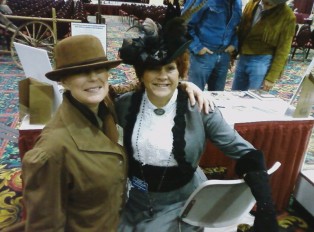
Making new friends at the SASS Convention in Vegas.
This Day…
Even If It Hurts

Her words cut deep, but she has the right to say them.
Tall in the Saddle
 Whether it is Ford pardoning Nixon or Bush never catching Bin Laden, there is a consistent theme in the American character. We want the hero to get the girl, and the bad guy to get what’s coming to them. We are willing to deal with adversity along the way, but we have to believe that the good guy wins out in the end. I do not believe it is possible here. That truth haunts me. It keeps me up nights. My sleep is so near waking at times it’s hardly worth a name. The only thing that’s going to help right now is some hard hitting dialogue from a few good westerns, the kind of westerns where the bad guy NEVER wins. First, from the 1937 film The Plainsman. Gary Cooper as Wild Bill Hickok to a gang of outlaws – “Take your hands off your guns-or there’ll be more dead men here than this town can afford to bury.” From the 1956 movie The Maverick Queen. Kit Banyon, the Maverick Queen (Barbara Stanwyck) to undercover Pinkerton cop Jeff Younger (Barry Sullivan), “The only way you leave the Wild Bunch is feet first.” From the 1955 western The Man from Laramie. “You’ve got no cause to shoot me!” “Shooting is too good for you.” Ranch foreman Vic Hansbro (Arthur Kennedy) and Will Lockhart, “The Man from Laramie” (James Stewart). And finally, from the 1955 flick The Kentuckian. “You coming peaceable?” “I ain’t comin’ at all.” Sheriff (bit player) and frontiersman Eli Wakefield (Burt Lancaster). I guess I feel a little better.