
Abraham Lincoln wrote this letter to his stepbrother, John D. Johnston, who had written Lincoln that he was “broke” and “hard-pressed” on the family farm in Coles County, Illinois, and needed a loan. Lincoln’s offer of a matching grant, as we call it today, was a recognition that “this habit of uselessly wasting time, is the whole difficulty,” and that getting into the habit of working was far more important to Johnston than getting a loan. “December 24, 1848. Dear Johnston, Your request for eighty dollars, I do not think is best to comply with now. At the various times when I have helped you a little, you have said to me, “We can get along very well now,” but in a very short time I find you in the same difficulty again. Now this can only happen by some defect in your conduct. What that defect is, I think I know. You are not lazy, and still you are an idler. I doubt whether since I saw you, you have done a good whole day’s work, in any one day. You do not very much dislike to work, and till you do not work much, merely because it does not seem to you that you could get much for it. The habit of useless wasting time, is the whole difficulty; it is vastly important to you, and still more so to your children, that you should break this habit. It is more important to them, because they have longer to live, and keep out of an idle habit before they are in it, easier than they can get out after they are in. You are now in need of some ready money; and what I propose is, that you shall go to work, “tooth and nail,” for somebody will give you money for it. Let father and your boys take charge of your things at home – prepare for a crop, and make the crop, and you go to work for the best money wages, or in discharge of any debt you owe, that you can get. And to secure you a fair reward for your labor, I now promise you that for every dollar you will, between this and the first of May, get for your own labor either in money or in your own indebtedness, I will give you one other dollar. By this, if you hire yourself at ten dollars a month, from me you will get ten more, making twenty dollars a month for your work. In this, I do not mean you shall go off to St. Louis, or the lead mines, or the gold mines, in California, but I mean for you to go at it for the best wages you can get close to home – in Cols County. Now if you will do this, you will soon be out of debt, and what is better, you will have a habit that will keep you from getting in debt again. But if I should now clear you out, next year you will be just as deep in as ever. You say you would almost give your place in Heaven for $70 or $80. Then you value your place in Heaven very cheaply, for I am sure you can with the offer I make you get the seventy or eighty dollars for four or five months’ work. You say if I furnish you the money you will deed me the land, and if you don’t pay the money back, you will deliver possession. Nonsense! If you can’t now live with the land, how will you then live without it? You have always been kind to me, and I do not now mean to be unkind to you. On the contrary, if you will but follow my advice, you will find it worth more than eighty dollars to you. Affectionately, Your Brother, A. Lincoln.”
This Day…
Loyalty to a Brother
Family loyalties involve certain obligations. They are duties we perform out of love. Many Old West characters practiced such loyalties – the Earps, the Mastersons, the Tilghmans, the Woodhall sisters, the James boys. This simple story illustrates allegiance between siblings during World War II. It’s seems appropriate that this story be shared on Veteran’s Day. One of two brothers fighting in the same company in France fell by a German bullet. The one who escaped asked permission of his officer to go and bring his brother in. “He is probably dead,” said the officer, “and there is no use in your risking your life to bring in his body.” But after further pleading the officer consented. Just as the soldier reached the lines with his brother on his shoulders, the wounded man died. “There, you see,” said the officer, “you risked your life for nothing.” “No,” replied Tom. “I did what he expected of me, and I have my reward. When I crept up to him and took him in my arms, he said, ‘Tom, I knew you would come-I just felt you would come.’” There you have the gist of it all; somebody expects something fine and noble and unselfish of us; someone expects us to be faithful.
This Day…
1934-Nebraska-The legislature adopts a unicameral nonpartisan form of government, ending 20 years of discussion, in an attempt to eliminate the delays and deadlocks of a two-house body. The new system is more economical in that fewer members are elected after redistricing, but it also does away with checks and balances, making the body more susceptible to outside influence. This experiment makes the state a focus of political scientists
Liberty or Death
A member of Virginia’s House of Burgesses and the first Virginia Committee of Correspondence, fierce opponent of the Stamp Act, and delegate to the Continental Congress in 1774-1775, Patrick Henry (1736-1799) was one of the colonies’ foremost patriots in the growing revolutionary cause. His oratory gave him lasting fame, and today he is remembered mainly for the fiery speech he gave to the Second Virginia Convention on March 23, 1775, at St. John’s Church in Richmond. The question before the Convention was whether to arm the Virginia militia to fight the British. Patrick Henry knew the moment had come for the colonies to gather their strength and commit themselves to action. “Mr. President, it is natural to man to indulge in the illusions of hope. We are apt to shut our eyes against a painful truth-and listen to the song of that siren, till she transforms us into beasts. Is this the part of wise men, engaged in a great and arduous struggle for liberty? Are we disposed to be of the number of those who, having eyes, see not, and having ears, hear not, the things which so nearly concern their temporal salvation? For my part, whatever anguish of spirit it might cost, I am willing to know the whole truth; to know the worst, and to provide for it… There is no longer any room for hope. If we wish to be free-if we mean to preserve inviolate those inestimable privileges for which we have been so long contending-if we mean not basely to abandon the noble struggle in which we have been so long engage, and which we have pledged ourselves never to abandon until the glorious object of our contest shall be obtained-we must fight! I repeat it, sir, we must fight! An appeal to arms, and to the God of Hosts, all that is left us! They tell us, sir, that we are weak-unable to cope with so formidable an adversary. But when shall we be stronger? Will it be the next week, or the next year? Will it be when we are totally disarmed, and when the British guard shall be stationed in every house? Shall we gather strength by irresolution and inaction? Shall we acquire the means of effectual resistance by lying supinely on our backs, and hugging the delusive phantom of Hope, until our enemies shall have bound us hand and foot? Sir, we are not weak, if we make a proper use of those means which the God of nature hath placed in our power. Three millions of people, armed in the holy cause of liberty, and in such a country as that which we possess, are invincible by any force which our enemy can sent against us. Besides, sir, we shall not fight our battles alone. There is a just God who presides over the destinies of nations; and who will raise up friends to fight our battles for us. The battle, sir, is not to the strong alone; it is to the vigilant, the active, the brave. Besides, sir, we have no election. If we were base enough to desire it, it is now too late to retire from the contest. There is no retreat, but in submission and slavery! Our chains are forged, their clanking may be heard on the plains of Boston! The war is inevitable-and let it come! I repeat it, sir, let it come! It is in vain, sir, to extenuate the matter. Gentlemen may cry, peace, peace-but there is no peace. The war is actually begun! The next gale that sweeps from the north will bring to our ears the clash of resounding arms! Our brethren are already in the field! Why stand we here idle? What is it that gentlemen wish? What would they have? Is life so dear, or peace so sweet, as to be purchased by the chains of slavery? Forbid it. Almighty God! I know not what course other may take; but for me, give me liberty, or give me death!”
Object: Matrimony
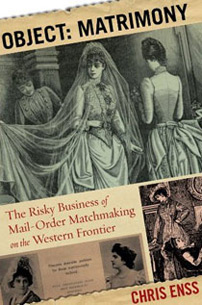
Desperate to strike it rich or eager for free land, men went into the frontier West alone and sacrificed many creature comforts. Only after they arrived at their destinations did some of them realize how much they missed female companionship.
One way for men living on the frontier to meet women was through subscriptions to heart-and-hand clubs. The men received newspapers with information about women with whom they could correspond—sometimes with photographs. Eventually a man might convince a woman to join him in the West, and in matrimony.
Complete with historic photographs and actual advertisements from both women seeking husbands and men seeking brides, Object Matrimony includes stories of courageous mail order brides and their exploits as well as stories of the marriage brokers, the mercenary matchmakers looking to profit off of the miners and settlers. Some of these stories end happily ever after; others reveal desperate situations that robbed the brides of their youth and sometimes their lives.
This Day…
Never Surrender, Never Retreat
The Alamo in San Antonio, Texas, has become an American symbol of unyielding courage and self-sacrifice. A force of Texans captured the mission fort in late 1835 after the outbreak of revolution against the dictatorship of Mexican General Antonio Lopes de Santa Anna. By early 1836, Lieutenant Colonel William Barret Travis and the fort’s garrison found themselves hemmed in by a Mexican army swelling to six thousand troops. On February 24, Travis dispatched couriers to nearby Texas towns, carrying frantic appeals for aid. Fewer than three dozen men picked their way through enemy lines to join the Alamo’s defenders. The siege continued until March 6, when Santa Anna’s forces overwhelmed the fort. The entire garrison was killed, some 180 men, including Colonel Travis, James Bowie, and Davy Crockett. Commandancy of the Alamo, Texas. February 24, 1836. To the People of Texas and All Americans in the World. Fellow Citizens and Compatriots: I am besieged by a thousand or more of the Mexicans under Santa Anna. I have sustained a continual bombardment and cannonade for twenty-four hours and have not lost a man. The enemy has demanded a surrender at discretion; otherwise the garrison are to be put to the sword if the fort is taken. I have answered the demand with a cannon shot, and our flag still waves proudly from the walls. I shall never surrender nor retreat. Then, I call on you in the name of Liberty, of patriotism, and of everything dear to the American character, to come to our aid with all dispatch. The enemy is receiving reinforcements daily and will no doubt increase to three or four thousand in four or five days. If this call is neglected, I am determined to sustain myself as long as possible and die like a soldier who never forgets what is due to his own honor and that of his country.
This Day…
American’s Creed & Big Foot
Unless you’ve been living in the woods somewhere in the Northwest, more concerned about finding Big Foot than affairs of the state, you know there’s an election tomorrow to decide who the next President of the United States will be. I wanted to spend this month writing about historical political events and the people who sought to make a difference in the process. In 1917, William Tyler Page of Maryland won a nationwide contest for “the best summary of American political faith.” The U.S. House of Representatives accepted the statement as the American’s Creed on April 3, 1918. It’s two paragraphs remind us that responsibilities are the source of rights. It deserves to be read and recited. Today very few people have even ever heard of it. “I believe in the United States of America as a Government of the people, by the people, and for the people; whose just powers are derived from the consent of the governed; a democracy in a republic; a sovereign Nation of many sovereign States; a perfect union, one and inseparable; established upon those principles of freedom, equality, justice, and humanity for which American patriots sacrificed their lives and fortunes. I therefore believe it is my duty to my country to love it, so support its Constitution; to obey its laws; to respect its flag, and to defend it against all enemies.” Don’t forget to vote. Oh, by the way, today’s news noted that Big Foot was last spotted in Idaho, in case you believe your time would be better spent searching for him. For what it’s worth, I’m not so certain that line of thought isn’t spot on.