
1884-Killin’ Jim Miller snuck up on his brother-in-law, John Coop, while he was asleep on his porch in Plum Creek, Texas and murdered him with a shot through the head. Miller was convicted and sentenced to life in prison, but got off on a technicality. Killin’ Jim went on to commit several more murders before he was finally hanged in 1909.
Husband Wanted
Big changes are coming to my website and news about the additional books I’ll be releasing soon will be announced over the next month. Until then I’ll be presenting some of my favorite mail-order bride ads included in the book Hearts West: Mail-Order Brides on the Frontier. For more information about the book go to www.chrisenss.com. “By a lady who can wash, cook, scour, sew, milk, spin, weave, hoe, (can’t plow), cut wood, make fires, feed the pigs, raise the chickens, rock the cradle, (gold-rocker, I thank you, Sir!), saw a plank, drive nails, etc. These are a few of the solid branches; now for the ornamental. “Long time ago” she went as far as syntax, read Murray’s Geography and through two rules in Pike’s Grammar. Could find 6 states on the Atlas. Could read, and you can see she can write. Can – no, could – paint roses, butterflies, ships, etc. Could once dance; can ride a horse, donkey or oxen, besides a great many things too numerous to be named here. Oh, I hear you ask, could she scold? No, she can’t you, you ______ _______ good-for-nothing________! Now for her terms. Her age is none of your business. She is neither handsome nor a fright, yet an old man need not apply, nor any who have not a little more education than she has, and a great deal more gold, for there must be $20,000 settled on her before she will bind herself to perform all the above. Address to Dorothy Scraggs, with real name. P.O. Marysville.”
This Day…
Ode to Sam Sixkiller
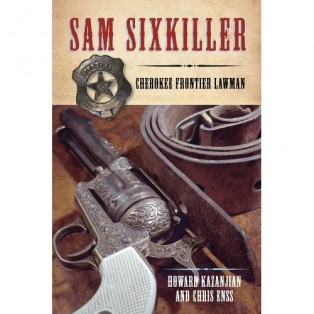 It was an honor to have worked on the book about Sam Sixkiller with Howard Kazanjian and to have met Sam Sixkiller’s family members in Oklahoma last month. The following review of the material appears in the September 2012 edition of True West Magazine. “Sam Sixkiller: Cherokee Frontier Lawman is a very important book, if only for the fact that it is one of the first, if not the first, biographies of an American Indian law enforcement officer of the Old West. The book is not about just any American Indian; it chronicles the life of one of the most famous and outstanding lawmen during the frontier era. Authors Howard Kazanjian and Chris Enss, through outstanding research, tell the engrossing story of Cherokee lawman Sam Sixkiller. During his career he was a deputy U.S. marshal under Judge Isaac C. Parker, a captain of the U.S. Indian Police and a railroad detective. This is an outstanding book on the Indian Territory and an American frontier hero. Art Burton, author of Black, Red and Deadly: Black and Indian Gunfighters of the Indian Territory, 1870-1907.”
This Day…
Violence
I’m taking a departure from writing about the Old West today. My thoughts have been centered around the horrific event that took place at a movie theatre in Colorado. I’ve read articles and heard talking heads blame violence on television and in motion pictures for the shooting and I wanted to respond. From cave drawings depicting the hunt to tribal war songs to a little tome called the Bible, the portrayal of violence has, in one way or another, been a part of human discourse ever since we stopped dragging our knuckles on the ground and started using them to give each other noogies. It seems like everyone is looking for someone to blame when people go bad, but motion pictures and television aren’t the biggest influences on kids. We are. There’s probably more real emotional violence and bad vibes at the average American family dinner table than in an entire season of C-S-I. At least that was my experience. I don’t know if I really buy that there’s a connection between violent movies and TV and violent behavior. I mean, I grew up watching a steady diet of Dark Shadows, Cannon, Johnny Quest and Bugs Bunny. I never once thought it was okay to load a gun and go hunting “wabbit” in public places. That being said, there are many shows that prey on our morbid curiosity: When Animals Kill, Brushes with Death, Shark Wranglers, and one of the worst of all, Housewives of New Jersey. Watching the local news isn’t any better. In reporting violent crime, the local news comports itself with all the dignity and responsibility of Moe, Larry, and Shemp locked in a haunted house. I think it’s all very simple. Forget government intervention, forget blaming all the bad that happens on movies and television and get back to basics. Stay home with your loved ones, turn the TV off, pray together, talk together, get to know one another. Tell the people in your life that have had a positive impact on you just how much their influence means. Hug them like there’s no tomorrow because as we know for many of the men and women who went to the movies this past weekend in Colorado there was no tomorrow.
Sam Sixkiller

“No one imagined that Muskogee was to lose a good citizen and the Territory one of the bravest of officers.”
The Indian Journal – December 29, 1886
In the hours leading up to Christmas Day 1886, Muskogee was crowded with trail hands, farmers, drifters and families. Mothers with their children in hand filtered in and out of the various stores that lined Main Street to shop. Upon exiting the businesses they would stop to admire the few displays in the windows. Most of the people visiting the mercantile, restaurants and hotels on December 23 and 24 were primarily interested in horse racing. They hurried back and forth from the two mile long stretch of track outside of town carrying food, alcohol and cash. Men laid money out recklessly on long-legged, sleepy-eyed geldings, some with United States Army brandings on their rump. Spectators stood on either side of the unmarked track anxiously waiting for the races to begin. Horses and riders lined up for the ‘dropped flag’ start. The shouts and cheers from the onlookers nearly drowned out the sound of the animals’ pounding hooves hurrying toward the finishing mark.
Dick Vann was among the enthusiastic group enjoying the festivities. Whenever the horse he bet on won he would celebrate with a round of thunderous applause and a long swig off a half-empty bottle of whiskey. Alf Cunningham had had his share of drinks during the event and he and Dick took turns slapping one another on the back each time their wager paid off and laughing uproariously at their good fortune.
By early afternoon on Christmas Eve both men were well on their way to getting drunk. They were belligerent with anyone jockeying for a better position to see the races than they had and were not immune from spitting in the face of people who celebrated a win when they had lost. Vann had finished off his bottle of whiskey and persuaded Cunningham to return to a place in town that would sell them more bootleg alcohol. Heavy grey clouds hung over the busy hamlet. A great V-shaped mass of ducks and Canadian geese flying south passed overhead of the two as they walked away from the race track. The whole sky was filled with the soft whir of wings. Cunningham removed a gun tucked inside his coat pocket, pointed it at the birds and pretended to shoot. Amused with himself, Cunningham laughed at his playful antics. Vann was too distracted by the sight of Tom Kennard, a Creek Lighthorseman to do more than grin.
Kennard stood in the doorway of the Commercial Hotel surveying the plethora of activity around him. Vann watched the officer carefully, then crossed to the other side of the street to avoid coming in contact with him. Unaware that anything was out of the ordinary at first, Cunningham followed after his brother-in-law. When he spotted Kennard he slowed down. Deciding against continuing on with Vann, he crossed the street to the lawman. Cunningham wore a contemptuous look as he approached Kennard. The bitterness he had for the law grew with magnificent intensity as he drew closer to the Lighthorseman. Kennard, a descendant of black slaves once owned by the Creek Indians, saw Cunningham walking towards him, but did not anticipate any trouble.
Without hesitating, Cunningham jerked his gun out and pointed it at the lawman’s face. He swore angrily at Kennard and threatened to kill him. Neither calm reasoning nor the promise of jail could persuade Cunningham to lower his weapon. A passerby, Mrs. Renfoe (wife of the town butcher), witnessed the exchange, grabbed the pistol and before Cunningham was able to wrench it free, Kennard drew his own gun. He brought the butt of the weapon down hard on the cursing assailant’s head and Cunningham collapsed at his feet. Kennard took the gun away from him and left him where he fell.
Cunningham came to a few hours later. In the near distance he could hear whistling, hand clapping and the sound of horses’ hooves galloping down the race track. The crowd that had congregated in town to celebrate the season had thinned considerably. No one around seemed the slightest bit concerned about whether Cunningham was face down in the dirt or not. People had cut a wide swatch around him to avoid any contact with the known trouble maker. After inspecting the lump on his skull, he got to his feet. He was rattled, but not enough to stay put. He dusted off his clothes then proceeded in the direction of the track.
As the stillness of a starry night crept up on Muskogee, Vann and Cunningham were seen together again wandering in and out of businesses in the process of closing. Cunningham relayed the tale of his encounter with Kennard to Vann and both men were infuriated with the officer and every other Lighthorsemen in the Nation. The memory of what happened to Jess Nicholson and Black Hoyt was still fresh in their minds. The men needed guns to do what they felt needed to be done. They tried to purchase a pistol from Turner & Byrnes’ Hardware, but were turned away by the owner of the store, C.F. Byrnes. Undeterred, they walked to the popular Mitchell House and went inside. Ray Farmer, the owner of the hotel, was too preoccupied with his job to notice the two enter and didn’t see Cunningham steal his shotgun. The two left the establishment determined to use the weapon they had acquired.
City Marshal Shelley Keyes was making his appointed rounds when Vann and Cunningham swaggered out of the Mitchell House in front of him. Cunningham raised the shotgun he was carrying to Keyes’s face. The lawman instinctively held up his hands. Vann eyed the pistol on Keyes’s hip and before the officer had a chance to object, he jerked it out of his holster. They left Keyes with his arms in the air and a bewildered look plastered across his face. He watched them disappear into the alleyways and dark corners of the buildings.
Drunk on the courage the guns gave them, Vann and Cunningham scanned the vicinity for Lighthorseman Kennard. One of Muskogee’s most well-known citizens, Armistead Cox noticed the two men walking down the street and caught a glimpse of the weapons they were toting as they passed by an eatery called King’s Restaurant. Cox wasn’t completely sure, but he thought he saw the butt of the shotgun tucked under Cunningham’s arm with the barrel pointed downward. The men continued on their way and there was no chance for a second look.
Captain Sixkiller was purchasing medicine at Dr. M.F. William’s drugstore when Vann and Cunningham arrived on the scene. The lawman wasn’t on duty, he had plans to take his family to a service at the Methodist church, but first he had to get rid of the headache he was suffering from. He had been sick for one reason or another since late November after returning home from a trip to Fort Smith. In early December, he and Fannie traveled to Vinita to visit family. The hope was that his health would be restored during that time, but they were forced to come home on December 15, 1886, because the captain wasn’t getting any better.
As Captain Sixkiller stepped out into the street he saw the shadowy image of the armed men. They were silhouetted against the light from the hotel and butcher shop across the street. The captain was unarmed and had no reason to believe Vann and Cunningham were carrying weapons. He wasn’t intimidated in the least. As he walked toward the pair one of them called out his name. Vann then shouted, “You’d never do that to me again.” Suddenly Cunningham fired the shotgun at the officer. Captain Sixkiller sprang forward before the full force of the shotgun shell made contact. He knocked the gun out of Cunningham’s hands and fell to the ground. A few pellets had riddled his clothing, but none had penetrated the skin. Before the lawman could defend himself, Vann drew his pistol and fired four times. Blood oozed from the lawman’s chest and head. All four bullets had met their target.
Captain Sixkiller staggered a bit then dropped to his hands and knees. Vann pulled the hammer back on the gun again and shot him one more time. The lawman groaned as the fatal wound fought against every internal organ to keep from working. The captain winched in pain as he exhaled. One of the murderers leaned over his body as he breathed his last breath; when it was over the shooters fled.
Rancher H.B. Spaulding and Armistead Cox were the first to arrive at the scene of the crime, followed by a gentleman named Nip Blackstone and the butcher, Jim Renfro. Cox checked to see if Captain Sixkiller was still alive. He knew by looking at his injured skull it wasn’t possible, but he had to be sure. It was a gruesome sight. The lawman had a hole in his face under his left cheekbone and it was covered with powder burns from being shot at close range. The clothing around his waist was saturated with blood; a pair of bullets was lodged into his abdomen.
City Marshal Keyes watched the men surround the deceased captain from across the street. He was overcome with guilt for letting the renegades get the best of him and take his gun. In an effort to conceal his identity from Vann and Cunningham and anyone else who might have witnessed the exchange, he turned his coat inside out and removed his hat. A reporter for the Cherokee Advocate who spotted Keyes noted “it seemed as though he might like to contract for a cast iron suit of clothes.”
Captain Sixkiller’s lifeless frame was transported to the undertaker’s office and his body was prepared for burial. His wife Fannie and his children learned of the shocking news from the men who handled the lawman’s remains. Fannie was inconsolable. Captain Sixkiller’s killing was a hard truth for the community to accept as well. The loss was immediately felt throughout the entire Indian Nation. Recognized as being the “head and heart of the Indian police,” the public demanded swift justice.
On Saturday morning December 26, writs were issued for the killers and given to four United States marshals, Frank Dalton, Tyson Greenbury, James Campbell and H.J. Hayes. The writs read “Dick Vann and Alf Cunningham feloniously, willfully and premeditatedly, and with malice and forethought, killed and murdered Samuel Sixkiller a Cherokee Indian.” For twenty-four hours the marshals searched vigorously for the murderers but could not locate them. An additional search took place on Monday, December 28, 1886. Captain Sixkiller’s brothers Martin and Luke joined the posse along with three other members of the Lighthorsemen. The men decided to look for the runaway killers in the thick bottoms of Gooseneck Bend, ten miles east of Muskogee. It was the area Vann had traveled to in 1884, when he was trying to escape justice for the attempted murder of John Hammer.
The December 29, 1886, edition of the Indian Journal newspaper reported that after Vann and Cunningham had killed the captain “they ran half leisurely down Main Street, turned the corner and passed the billiard hall as they headed out of town. Saturday night it was noted they attempted to lodge with an acquaintance named John Lowery who objected to them staying with him. Vann tried to change his mind by showing him the pistol he had and in the process the weapon discharged accidentally, the bullet going across the end of his thumb.”
While the police continued their search for killers, several letters of condolence were sent to Captain Sixkiller’s widow and his family. One of the letters Fannie received was from the chairman and secretary of the Missouri-Pacific Railway, Thomas Furlong and John J. Kinney. “Dear Madam: I was deeply pained to learn from this morning’s paper of the sad calamity that had befallen you in the untimely and cruel death of your late husband. My wife and family desire with me to tender you our sincere sympathy in your terrible affliction.” In addition to the letter, Furlong forwarded a resolution adopted by the railroad secret service. The resolution was adopted to express the rail line’s sentiment relative to Captain Sixkiller’s tragic death.
“Whereas, by the hands of murderous assassins our esteemed friend Captain Sam Sixkiller has been taken from our midst, and while submitting to the all-wise and inscrutable Providence, we desire to express our sentiments, respecting this to us an irreparable loss of a tried and true friend, and to the United States Government a brave, honest and competent officer. Therefore, we, the members of the Missouri-Pacific Railway Secret Service Department at St. Louis assembled, deeply deplore the cruel and untimely death of our esteemed friend, Captain Sam Sixkiller, who endeared himself to the members of this department by his uniform kindness and invaluable assistance rendered us in the discourage of our duties, and while our grief in itself is great at the loss of our esteemed friend, we realize that the loss of such an exemplary husband and father is immeasurable, and therefore we desire to convey to his family our heartfelt sympathy in this their greatest hour of affliction.”
More than two thousand mourners attended Captain Sixkiller’s funeral the Sunday after he was killed. The services were conducted at the Methodist Church and the eulogy delivered by Cherokee leaders from Tahlequah. The church could not contain the friends who gathered to pay their respects. According to the December 29, 1886, edition of the Indian Journal, “people from nearly every part of the eastern portion of the territory attended the last rites.”
Newspaper editors throughout the Nation praised Captain Sixkiller for his heroism and courage. An editor for the Indian Chieftain in Vinita wrote in an article that “a man with so little thought of danger should fall by violence seemed in no way strange.” The Indian Journal editor noted “the Captain has done probably more than any one person to free the railroad towns of this Territory of their dangerous and reckless elements, and to him the country owes a great degree the comparative security to life and property that it now enjoys.” In a report made to the Commissioner of Indian Affairs in Washington, Indian agent Robert L. Owen commended Captain Sixkiller noting that “he died a martyr to the cause of law and order and had the respect and confidence of all the decent people in the country particularly of men like Honorable Isaac C. Parker, U.S. Judge of this district….”
The procession that accompanied Captain Sixkiller’s remains to the cemetery was staggering and a testimony to how much people thought of him. The crowd on hand at the graveyard was one of the largest ever assembled in that section of the country.
The men responsible for the death of the revered Captain Sixkiller were two of the most wanted men in the Nation. A $1,500 reward was offered for their arrest. Friends of both Dick Vann and Alf Cunningham made it known that the men had every intention of turning themselves in to authorities and added that the pair were willing to stand trial, even though they believed Captain Sixkiller’s associates would distort the facts in their case and make sure they were prosecuted in the bitter end. Vann and Cunningham wanted to wait ten days before surrendering themselves to the law. The nearly two week span of time was to ensure tempers had cooled and that the public was ready to hear their side of the incident. Numerous officers were on the trail of Vann and Cunningham and were convinced the pair would be apprehended before the ten days had ended.
Vann and Cunningham were charged with the crime of murder by a Creek Indian court. When or if they were caught they were to be turned over to Creek authorities. According to the compact existing between the Creek and Cherokee Nation, the Creek Nation had jurisdiction over the case. If Vann and Cunningham were arrested in the Cherokee Nation they would have to be extradited to the Creek Nation to stand trial. Judge Parker wanted to help bring the fugitives to justice, but as all the parties involved in the murder were Cherokee, the federal court had no jurisdiction in the matter.
After carefully considering the specifics of the case, the Judge determined the only way the federal government could assist in arresting Alf Cunningham would be to go after him for theft. The gun he had taken from the owner of the Mitchell House qualified as stealing, a crime well within Judge Parker’s right to handle. He issued a writ giving his deputy marshals the authority to arrest Cunningham on a larceny charge. The murder charge took precedent over the crime of stealing. If the deputy marshals managed to apprehend Cunningham they would turn him over to the proper court.
While the hunt for the captain’s assassins was in progress, another man was named to the slain lawman’s post. William Fields, a U.S. marshal and the former city marshal of Tahlequah, was Captain Sixkiller’s successor. He was an accomplished officer who knew filling the vacancy left by his beloved predecessor would be a daunting task. Several months after the death of Captain Sixkiller newspapers were still praising his work. “There never was before and there never was afterwards an officer like Captain Sam Sixkiller,” the February 24, 1887, edition of the Muskogee Phoenix reported. “He was as handsome as an Apollo Belvedere; if there is a race born without fear, Sixkiller belonged to it. He had a figure like Mars divestible of immortality. It was worth a hundred miles travel to see Sixkiller seated in his saddle, straight as Tecumseh: perhaps no man ever had a more complete mastery over a horse than the gallant captain.”
Captain Sixkiller’s widow and children struggled with the loss of their loved one. His brothers had joined in the quest to track down his killers and his sisters, sons and daughters helped comfort their mother and care for the family home. A note on a picture of the captain hanging on the wall in the house reminded relatives how he was quickly taken from them: “Captain Sixkiller was gunned down in Muskogee by Alf Cunningham and Dick Vann.”
This Day…
1869-Vigilantes ordered a couple of ruffians, Sam Strawhim and Joe Weiss out of Hays City, Kansas. The two toughs later acosted a vigilante leader, A.B. Webster, in the post office and bullied him and threatened him and when Weiss finally pulled a gun on him Webster fired back. Weiss was killed and Strawhim fled town.
The Life and Hard Times of Belle Ryan
The New World gambling parlor in Marysville, California in 1851 was filled with prospectors and sojourners eager to lay their money down on a game of chance. Patrons could choose from a variety of amusements which included roulette, dice, faro and poker. The New World was a grand and ornate saloon. An elaborate bar lined an entire wall and brass mountings accentuated the gleaming countertops. Imposing mirrors clung to all sides of the enormous entryway and paintings of nude women relaxed in beauty prostrate, loomed over the patrons from the walls above. Madame Belle Ryan, a voluptuous creature with dark hair, hazel eyes and a fair complexion, sauntered down the stairs surveying the guests that had gathered. Men scrambled for a place at the tables, their gold dust and gold nuggets had been exchanged for the chips they tossed onto the green felt – bets for the lucky cards in their hands. Charles Cora, a handsome brute of a man with black hair and a thick, healthy trimmed mustache caught Belle’s eye. He was very nicely dressed. From the Bowler hat on top of his head to the polished, black boots on his feet, he exuded style and confidence. Charles was seated at a table in the corner of the room dealing a hand of poker to four men around him. The pile of chips in front of Charles was proof that he’d had a successful evening. He turned to look at Belle and gave her an approving nod. She smiled back at him then noticed a handful of Cavalry soldiers standing just inside the saloon. Charles spotted the men too and motioned slightly for Belle to go over to them. She winked and proceeded obligingly. The wide-eyed troops admired the beautiful Belle as she strode their way. “Why don’t you come on in and join the fun. Have a drink, sit in on a game or two?” she purred invitingly. “We aren’t much for gambling, ma’am,” one of the young soldiers shared. “We just got our pay and thought we’d stop in for one shot of whisky and then be on our way.” Belle slowly approached the uniform clad man and stopped uncomfortably close to his face. The soldier breathed in her perfume then glanced away, shyly. “But it’s so early,” she said smiling. “Have a drink, play a hand of faro and then we’ll dance,” she persuaded. “I guess we can stick around for a little while,” the enchanted young man offered. Belle escorted the troops to the bar and had the bartender serve them a glass of whisky. “That ones on the house,” she assured them. She then locked arms with a pair of the soldiers and ushered them to the faro table. They obediently sat down and Charles tipped his hat at the new players. “I’ll be back in a bit for my dance,” Belle whispered in their ears. As Belle walked away the bartender served another round of drinks to the soldiers and Charles started dealing the cards. By the time Belle returned to the table the troops had lost their entire wages. They took a turn with her on the dance floor then lumbered out of the establishment, dazed and disappointed. Occasionally, Belle Cora was the one that dealt the cards, but her main contribution to the gambling industry was luring players to the game and building their confidence. Belle and her partner, Charles Cora, made hundreds of thousands of dollars off unsuspecting marks who believe they were better than the professional gamblers luring them to the tables. Belle Ryan Cora was born in Baltimore in 1832 and her parents named her Clara Belle. Her father was the minister of a small parish and the home life she had with her doting mother and young sister, Anna was idyllic. At 17 she fell in love with a distinguished older gentlemen and became pregnant. After learning the news, the child’s father abandoned them. Desperate and ashamed, Belle fled to New Orleans to have her child. The baby died shortly after being born and Belle was despondent and alone. While wandering the streets of New Orleans contemplating her life, she met a kindly woman who took pity on her situation and offered to help.
Belle recognized the woman as a known madam in the city. She was fully aware of the kind of assistance being presented, but she felt her options were limited. After accompanying the woman to her parlor house, being fed and provided a new wardrobe, Belle accepted her offer of work. In a matter of only a few months she was earning more than any other woman in the city. When Charles Cora, a well-known New Orleans gambler spotted Belle he was instantly smitten. She was equally taken with him. The two began spending time together and in a few weeks were inseparable. Once the news of the California gold rush reached Charles, he decided to try his luck in a place rich with glittering finds. With Belle by his side the two boarded a steamship bound for San Francisco. Charles and Belle weren’t the only ones with a dubious past making the trip. The vessel contained more than 40 gamblers and ladies of the evening. Personalities clashed during the voyage. The scruples of such motley passengers were questionable or nonexistent. When they weren’t cheating one another at a game of poker of faro, they were conning law abiding travelers out of their possessions or blatantly stealing from others. Charles was one of two thieves who got caught trying to take writer Edward L. Williams’s purse filled with money. On December 11, 1849, Williams recorded the incident in his journal. “I was hanging in a hammock near the bow, alongside a row of bunks,” he wrote. “Not long after falling asleep I was awakened by a volley of curses and a loud “Get out of here!” There followed more “coarse and vile oaths” and the threat: “If you don’t get out, I will cut you down. You are keeping the air from me!” I didn’t move. One of them I recognized as Charles Cora, removed a large knife from his pocket. Just then, on the other side of his hammock I saw a pistol gleaming in the moonlight and the man holding it said, “You attempt to cut the boy down for his purse before me and I will blow a hole through you, you infernal blackleg Southerner. I know you, you used to run a gambling game at New Orleans and you robbed everybody. Get away from that boy!” The confrontation between Charles and the competing robber intensified as the voyage continued. Angry over the thwarted attempt to steal a bankroll to gamble with, Charles and his cohorts took to bullying the passengers. He caused so much trouble the ship’s captain had him and his partners in crime placed in irons. Belle and Charles arrived in San Francisco on December 28, 1849. The gambling team then boarded a stage for Sacramento. The river city was the location for some of the territories biggest poker games. The price to sit in on the game was $20 thousand. Belle put up the money and Charles played. He won a sizeable amount in one hand, but his luck quickly changed and he lost it all. Belle fronted him an additional $60 thousand to stay in the game, but he was unable to turn things around. He then solemnly vowed he would never again play with a woman’s money. The lovers left Sacramento and made the rounds at the various mining camps in the foothills. They set up games at make shift saloons and Belle lured perspective gamblers in for Charles to fleece. Once they had made up the losses they incurred in Sacramento they moved on to Marysville and opened a gambling den called The New World. There were no limits on the bets taken at the tables at the New World. One prospector recalled that “Charles Cora himself laid down a bet of $10 thousand in one hand of 5 card draw. He won his bet too.” Once the gaming house was established and earning a profit, Belle sought to expand the enterprise. In April 1851, she traveled to Sonora. The booming mining town had a population of 5 thousand people and was in desperate need of additional entertainment. Using the name Arabelle Ryan, the confidence woman and madam purchased a house of ill repute. She called the combination brothel and gambling den the Sonora Club. (A confidence woman is someone who gains a person’s trust in order to entice them into a game of chance.) The business was a profitable venture. Charles followed after his paramour and dealt cards for her. By the end of 1851, Belle and Charles had earned more than $126 thousand from their combined businesses in Sonora and Marysville. The gamblers used their substantial holdings to move their trade to San Francisco. Although Charles and Belle were not married she took on his last name when they relocated to the city by the bay. The pair operated out of a two story wooden building that had two entrances. Belle decorated the combination bordello and casino with the finest furnishings and accoutrements. When the Coras opened the doors to the business on November 17, 1852, patrons reported that “it rivaled the finest residences in the city.” Customers included politicians, entrepreneurs and other gambling professionals. They were treated to free champagne and hors d’oeuvres, the most beautiful women in the trade, and liberal tables with a new deck of cards or dice each night. A description of the Cora House included in a manuscript written in 1855 by historian Frank Soule, provides the best look inside Belle’s establishment. “In the fall of 1855, Belle and Charles hosted a party designed to attract high rollers to the den,” Soule noted. “The evening the couple selected for their soirée fell on the same night Mrs. William Richardson was having a get together. Mrs. Richardson and her husband, a U.S. Marshal, were unhappy with the lack of male attendants at their event. When they learned that their invited guests chose to go to Belle’s place, the marshal and his wife were furious.” The previous year antigambling laws had been past by California representatives and all such establishments were to have been shut down. Charles Cora could no longer practice his profession legally. The Richardson’s suspected the party at Belle’s place had actually been a private game in which Charles was the dealer. Mrs. Richardson and the marshal vowed to monitor the activities at the Cora House and catch the pair in the act of breaking the law. When Charles learned of the Richardsons’ plan he informed Belle. A bitter feud between the couples erupted. On November 5, 1855, the Coras and the Richardsons attended a play at the American Theatre. The two couples were placed in balcony seats in close proximity of the other. When the Richardsons learned that the Coras were at the same performance the marshal demanded the theatre management throw the “low moral fiber duo” out. When the manager refused, the Richardsons left. Over the next week, Charles and the marshal exchanged insults and derogatory remarks. Whenever their paths crossed tensions escalated into threats. Finally the two met on the streets to settle things once and for all. The gambler shot Marshal Richardson in the head with a derringer, killing him instantly. Charles was arrested and thrown in jail. Many of the towns people who admired the marshal were outraged and demanded that Cora be hanged immediately. Belle rushed to her common-law husband’s aid and hired two high-powered attorneys to represent him. The cost of their combined retainer was $45 thousand. While Belle fought to prove that Charles acted in self defense, a vigilante committee was being organized. Leaders of the group planned to overtake the jail and exact their own justice. Initial attempts to break into the facility and remove Charles were thwarted. He was arraigned on December 1, 1855, and the trial was set for early January. Belle was not content with merely purchasing good counsel, and she turned her attention to the witnesses who claimed to have seen Charles brutally gun down the unarmed marshal. Belle met with an eye witness to the shooting and offered her money to change her story. When that didn’t work she threatened to kill her. Neither approach convinced the witness to redact her accusation and she was allowed to go on her way unharmed. Charles trial began on January 3, 1856. Shortly after a jury was selected, Belle attempted to bribe a select few of them. Her efforts were fruitless. No one would agree to side with the unpopular couple. The court was made aware of Belle’s behavior, but decided against any legal action. The trial was lengthy and the prosecution played up the “devious” characteristics of Charles and Belle, referring to the pair as “shady gamblers with sinfulness in their lives.” The defense argued that their morals weren’t on trial and that whatever “sinfulness there was in Belle’s life, it was far outweighed by her fidelity to her man.” The jury deliberated for 41 hours after having received the case. They returned having failed to reach a verdict. While Charles awaited a second trial the public at large grew more and more incensed a the outcome. Believing that Charles would get away with murder, the vigilante committee stormed the jail and escorted him to a secret area to be hung. A blindfolded Belle was brought to the location of the execution. The tearful madams asked if one of the clergymen there would marry her and Charles. Minutes before Charles was put to death the two were legally wed. Heartbroken and inconsolable, Belle Cora retreated to her bedroom at the gambling den and remained tucked away in the house for more than a month. Belle emerged a changed woman. She sold the business and moved to a small house with only a few servants as company. She used her considerable financial holdings to support local charities and help children obtain a higher education. She died in San Francisco on February 17, 1862, having given away the bulk of her fortune. She was 30 years-old.