
1885-Led by Geronimo, Nana, and Mangas, more than 100 Apache Indians flee their reservation at San Carlos in Arizona territory and head for Mexico. A wave of panic siezed the area, as newspaper editorials and citizens call for dispatch of thousands of federal troops.
Ghosts of Bodie
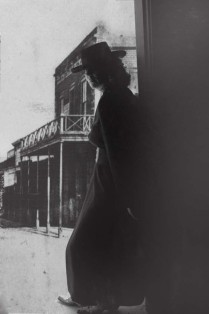
Standing in the shadows of a ghost town.
This Day…
Mr. Colt
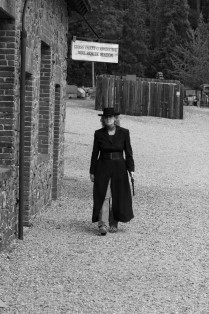 In every good western, whether it’s a book or a film, the bad guy more often than not get’s what’s coming to him in the end. That’s what makes westerns so attractive to me and hundreds of thousands of others. There’s something satisfying about a bully getting humiliated, a thief getting tossed in jail and a murderer being gunned down. I can’t help but think that’s part of what motivated inventor Samuel Colt to patent the revolving-camber pistol. Colt had a rough childhood. His mother died young from tuberculosis, he lost a sister to the same disease, and two of his other siblings committed suicide. At the age of eleven Colt was forced to work for a farmer who treated him cruelly. As soon as he was old enough he ran away. He went to work as a sailor and spent long hours staring at the ship’s wheel. He used this principle to invent a gun that could shoot multiple bullets without reloading. He excelled at both invention and marketing and today would be considered a compulsive workaholic. He struggled with a way to produce his guns cheaply but was forced to find a method of mass production after he received and order from the U.S. government in 1847 for 1,000 revolvers. By the time he died of exhaustion at age forty-seven, Samuel Colt had produced more than 400,000 Colt .45 revolvers. At his funeral in 1862 it was said of the Colt .45 he invented: “God created man, but Sam Colt [the Colt .45] made them all equal.” In 1873 the Colt SAA sold for $17.50. The complete kit with a holster and some ammunition could be covered by a $20 gold piece. The $20 Double Eagle of 1873 contained 0.9675 ounces of pure gold. Today an ounce of gold is about $1,090 and a new Colt SAA can be special ordered from Colt’s custom shop for about $1,500. It is fair to say that the invention of the Colt revolver changed the course of American history. It aided the westward expansion of America and the simplicity and effectiveness of the Colt revolver design is evidenced in the fact that they are still made and used today, both in the armed forces and in the private sector. Many have called the Colt repeating pistol the finest gun ever made. It was referred to as “law and order in six-finger doses.”
This Day…
1887-The Swan Land and Cattle Company of Wyoming, only four years old, declares bankruptcy following the devastating winter of 1886-1887. The demise of the huge livestock corporation is symbolic of the depression that will grip the cattle industry on the Great Plains during the next ten years. Over this period the number of cattle in Wyoming alone will decline from nine million head in 1886 to only three million by 1895.
Sacagawea
Ask any little girl what she wants to be when she grows up. Chances are she won’t say president or astronaut. Chances are she’ll say “Supermodel.” What does it say about our culture when Einstein’s original draft of the theory of relativity fetches less at auction than what a flat-line electroencephalograph Giacometti statue gets to stroll down a runway? And for goodness sake, isn’t it about time we passed an absolute edict forbidding these women from uttering the words “Modeling is hard work.” I think it would have been a thrill to have been Sacagawea. What a life she had. She was the young Shoshone Indian woman who served as Lewis and Clark’s translator on their 1803 expedition to explore the uncharted western regions of America. She made the entire journey to the Pacific, and the return trip, with a newborn baby on her back; many believe that without her aid, the journey, commissioned by President Thomas Jefferson, would have ended in failure. Some accounts say she died in 1812 at age twenty-five of putrid fever, while others believe she died in 1884 on an Indian Reservation in Wyoming. The child she carried in a papoose was Jean-Baptiste Charbonneau, nicknamed Pompy, meaning first-born, who eventually attended St. Louis Academy with tuition paid by Clark. Pompy later met Prince Wilhelm of Germany while on a natural history expedition and traveled back to Europe with him, where Pompy learned to speak four different languages. But by the time he was twenty-four Pompy was back in North America living as a mountain man. When the Gold Rush of ‘49 started, he got caught up in the fever and died from too much time wading through cold rivers panning for gold. His cause of death was bronchitis at age sixty-one, and his portrait is the only one of a child on any U.S. coin. What supermodel can boast a legacy like that?
This Day…
1878-McSween’s regulators shot up a cow camp and stole some horses killing one man and wounding two others.
1883-Marshall Henry Brown had to shoot a fractious Pawnee named Spotted Horse for causing a disturbance in Morris’ grocery store in Caldwell, Kansas. Spotted Horse lived two hours after being shot four times, once in the head.
The Family You Get & Jesse James
I live vicariously through the tales of the men and women of the Old West. From the research I’ve done many of the families that came over the plains cared deeply about one another and would sacrifice anything for the happiness of their loved ones. And then there’s the family I was born into. Whether or not these individuals married into the family or were brought about by the natural process of things, the majority of them have one thing in common and that’s to hurt. Making a family member bleed and watch them writhe in pain over their actions is a sport to them. I begin my Monday on the battle field of this family trying to deal with another crippling shot fired by a person whose idea of love is more akin to the actions of a character from a horror film who wants to wipe out everyone in their sight than someone who insists their behavior is motivated out of goodness or what’s best. If I couldn’t lose myself in the Old West today I’d want to hurl myself into a trash compactor. It’s seems only fitting that I’d be writing today about a man who knew how to stand up for his family but who had no regard for any other human life, Jesse James. James is perhaps the most beloved murderer in American history. He and his gang shot bank clerks in cold blood, killed passersby who looked the wrong way, and derailed trains and robbed the passengers as they lay injured. But none of that mattered. To many alive at the time James was a post-Civil War hero, satisfying the thirst of many defeated Confederates to get in a few last shots after the war. James, a handsome bearded man with blue eyes and a narrow face, was fashioned as a modern-day Robin Hood, though later historians were at a loss to find any evidence of charitableness. As a Confederate guerrilla and later as a bank robber, James came close to a violent death several times. But as long as he had his own guns, he always seemed to survive. During the war he was badly wounded in the leg and his horse was shot out from under him. Just after the war federal soldiers shot James in the lung and left him for dead. He lay on the ground for two days until a farmer aided him. When he was ambushed robbing the Northfield, Minnesota, bank in 1876, three of his gang were killed, three were shot and captured, and only Jesse and his brother, Frank escaped. His luck ended in 1882, after a local sheriff got 21-year-old Robert Ford, a less notorious outlaw, to join James’s gang to try to capture him. Ford and his brother easily joined up and were staying with James and his wife in St. Joseph, Missouri, that April, planning their next bank robbery. Early on the morning of April 3, James, who had just come inside from feeding the horses, took off his jacket and, because he trusted his friends, his gun belt. He had climbed up on a chair to pull some cobwebs from a picture when he heard the cock of a pistol. As he turned unarmed, Robert Ford shot James in the head with a .44-caliber pistol that James had given him as a present. James’s body was put in a $260 casket-paid for by the sheriff who had recruited Ford-and sent by train the few miles to his hometown of Kearney, in Clay County, Missouri. His open casket at the Kearney Hotel drew thousands, jamming the small town with their horses, and even passengers from the trains that made unscheduled stops on their way through. A collection to benefit James’s wife and two children gathered lass than $10, but that was only the beginning. Personal effects of the house were sold for about $250. The owner of the house, a St. Joseph city councilman who thought he had rented it to Thomas Howard (an alias of James’s) sold bloody floor splinters for 25 cents apiece. A year later James’s mother opened her home to visitors, also for a quarter. Of the more than twenty movies made about Jesse James, the first was financed by his descendants in 1920. Meanwhile, Robert Ford was pardoned by the governor, Ford toured Eastern cities reenacting the shooting, but the show was booed in the Midwest. Later, in a mining camp in Colorado, Ford was shot in the neck and killed by a man with a sawed-off shotgun seeking revenge for the death of Jesse James.
Calamity Jane
Doris Day is an incredible talent and she is brilliant in the musical Calamity Jane. Released in 1950, this film closely patterned on Annie Get Your Gun, though less stagebound and with a more wholesome star in Day. Calamity Jane follows the lengthy wooing of Howard Keel’s Wild Bill Hickok by tomboy Day. The plot offers Day and Keel ample opportunities to dress in the clothes of the opposite sex to comic and sometimes disturbing effect. David Butler’s animated direction is well suited to the material. Paul Francis Webster and Sammy Fain got an Oscar for ‘Secret Love’ as the best song of 1953. A year later, her recording of the song garnered Day her sixth million-selling record.
This Day…
1785-Congress passed the Land Ordinance of 1785, which provides that the northwestern territories be surveyed and divided into six-mile-square townships, each divided into 36 lots of 640 acres. This is a great improvements over earlier, more haphazard systems, which allowed for endless border disputes.