
1882 – Wyatt Earp and Doc Holliday gunned down Frank Stillwell at the train station in Tucson for his alleged part in the shoting of Virgil Earp. Stillwell and Ike Clanton were both there to make yet another attempt on the Earp family. Virgil was on the train escorting Morgan’s body to California for burial. Clanton scamptered off into the night when he saw Wyatt. It was the second time he fled from a fight with the Earps.
The Life of a Hero
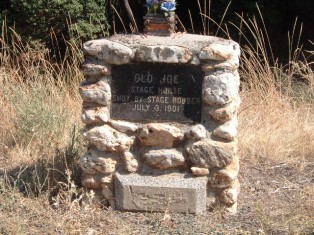
Old Joe might have had four legs but he was considered a hero to many travelers in the Gold Country.
I spend the bulk of my day writing about the Old West. Lately I’ve been focused on outlaws, but today I am turning my attention to the heroes. What makes a hero in my estimation is a concern for other people in need—a concern to defend a moral cause, knowing there is a personal risk, done without expectation of reward. Sitting Bull was such a hero. In an earlier time Sitting Bull might have been a great and prosperous Indian chief. But in the second half of the 19th century he was the ruler of a dying breed. His victory over General Custer at Little Big Horn in 1876 was but a glitch in the United States drive to corral the Sioux Indians onto reservations. A medicine man and never actually a chief, Sitting Bull led a dwindling number of Sioux away from federal troops for five more years, until finally, in 1881, he and fewer than 200 remaining followers surrendered. They were held in custody for almost two years before they were placed on Standing Rock Reservation in South Dakota, near where Sitting Bull was born. Sitting Bull, a tall, solid Indian with long, black, braided hair, was put on parade in several cities and in 1885 he toured with Buffalo Bill’s Wild West Show along the East Coast. But when he was on the reservation Sitting Bull stubbornly continued to stir up unrest. Even after federal authorities prohibited the ceremony, Sitting Bull encouraged Indians to perform the new Ghost Dance, which the Indians had come to believe would lead to a rebellion and would bring a savior to defeat the White Man. At dawn on December 15, 1890, about forty members of an Indian police force commissioned by federal authorities descending on Sitting Bull’s cabin to arrest him. They pulled the 59-year-old naked man from his bed and ordered him to get dressed and go with them. Sitting Bull gathered his things, but he took a long time to do it, which allowed time for a restless crowd of Indians to gather outside. By the time Sitting Bull was roughly pushed out of his cabin into the freezing weather, the crowd was angry. Sitting Bull stood waiting for his horse to be brought up. But then suddenly he yelled in the Sioux language-which the Indian officers, too, understood – “I am not going. Do with me what you like. I am not going. Come on! Come on! Take action! Let’s go!” Another leader of unrest on the reservation, Catch the Bear, pulled out a gun and fired at the top Indian officer. Lieutenant Bullhead was hit in the leg and as he fell he fired at Sitting Bull, shooting him in his left side. Another officer also shot the Indian leader, killing him instantly. Heroes often live such short lives.
This Day…
Spotting the Real Outlaws
Deception can be achieved one of two ways: Directly, by explicitly saying things which are not true, and indirectly, by leaving out critical information. For instance, you can be a person who lies to authorities about being sexually abused, or you can be a person who lies to the court that an individual has prior criminal convictions when you have evidence to the contrary. Both types of people are reprehensible curs. The one who lies and withholds evidence that would prove they are lying is worse, however – especially when that deceiver is a prosecuting attorney. Clinical physiatrists at Harvard University noted in a study done in the 2001, that people who regularly deceive by leaving out critical information cannot be cured. I thought about individuals like that a lot while writing the book about outlaws of the Old West due to be released this summer. It’s interesting to me that some of the most diabolical outlaws these have law degrees and claim to be protecting the rights of the people. I’ll take the bad guys and gals of the Old West over that kind of outlaw any day. As a rule, Old West outlaws could not be reformed. Frequently, however, they tired of being chased and became temporarily law abiding. Bill Longley, a gunfighter known as the deadliest in the Old West, tired of being hunted in Texas, went to Salt Lake City. Frank James left Missouri for California for the same reason. John Wesley Hardin left Texas for Florida from the same motive. All three soon returned to their old haunts and sooner or later renewed their old habits (except Frank). George Coe, a member of Billy the Kid’s gang, used to the free and wild New Mexico, when back on a Missouri farm with a wife felt like a “bird in a cage.” He moved to the West to become a reliable rancher. Henry Plummer’s (a lawman turned criminal), Boone Helm’s (a murderer and thief), and Ben Thompson’s (a Texas gunman and gambler) good wives and children could not turn them from their wayward careers. Henry Starr tried to quit robbing banks, but could not. Frank Jackson (bank robber with Sam Bass’s gang)stopped his career temporarily at Sam Bass’s death and was not heard of for a long time, until posting as a Mr. Downing in Arizona, he got drunk and was shot by a Ranger named Speed. Arkansas Tom, one of the very few remorseful killers, after several tires to reform, finally wailed, “I don’t know what’s the matter with me!” No doubt, some of the bad men were sincere in their attempts at reformation, but because of their past record, society was prejudiced against them. John Wesley Hardin actually tried to reform, but society would not accept him with his lurid background and prison record. At the very least quarrel he got into as lawyer and as a candidate for public office charges were made that he was back in his old boots again. Society would not let outlaw reform nor the good officer retire, because of their past records. People feared the former and wanted the latter for protection he afforded. They demanded, for instance, that intrepid Wyatt Earp continue as Marshal even after the work became distasteful to him. Everywhere he went he was met by a petition to represent the law. Restless Marshal Frank Canton could not settle down to normal, peaceful life. He was officer of the law wherever he went-be it Oklahoma, Montana, or Alaska. We sure could use someone like Frank Canton patrolling the halls of the U.S. Department of Justice in Kansas City, Missouri these days. And if he couldn’t spot the outlaws right off I could give him a couple of names to get him started.
This Day…
Dying With Your Boots Off
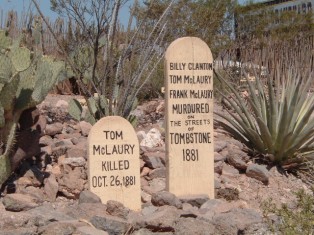
A Fitting End for Badguys and Badgirls
I’m often asked if there were any legendary Old West characters who died with their boots off. There certainly were and the following are just a few. Ed Tewksbury and Doc Holliday died of consumption. Robert Younger died while in prison, Cole Younger died of heart disease, and Frank James died on his farm in Missouri. Judge Roy Bead, “The Law West of the Pecos,” passed away peacefully in the arms of his friend, Billy Dodd. With him went much of the spirit of the Old West, the lawlessness he had unofficially helped to control. He died a natural death. And probably so did Burt Alvord, who took, together with Bob Downing and Billy Stiles, $10,000 from a Union Pacific train near Wilcox, Arizona, at the same time he was sheriff there. Downing was killed by Arizona Ranger Speed when he went on a drunken spree and beat up a disreputable woman. Billy Stiles escaped to the Philippines, joined the Army there, returned to Nevada, and was actually made a sheriff there. He was killed while making an arrest. Alvord buried his part of the loot, was captured, tried, sentenced. But he was double-crossed the Mexican desperado Augustine Chacon and had been instrumental in his capture by Captain Mossman, and so his term was cut short to seven years. He went out, upon his release, and dug up his treasure and rode away to the South, to Panama, where he died a few years later. There’s no telling what a bad man will say just before he leaps that unfathomable gulf into eternity. “Let me go. The world is bobbing around,” said Sam Bass just before he expired. Tom Horn, just before hanging, said, “Ed, that’s the sickest looking bunch of sheriffs I ever saw!” It is often said that they believed him innocent of murder of the youthful sheepherder, Willie Nichols for which he was hanged. Doc Holliday had bet frequently that a bullet would win out over tuberculosis in his death; but he lost the bet, saying just before he succumbed, “This is funny.” One thing the truly bad guys never did before they died was admit their wrongdoings. They had lied about what they had done for so long the lie was now truth to them. I know at least three murderers who currently operate on the same principle. If they’re ever brought to justice it will be a miracle. Whenever they meet their Maker however, I’m sure they’ll go without boots on.
This Day…
A Sickly Profession
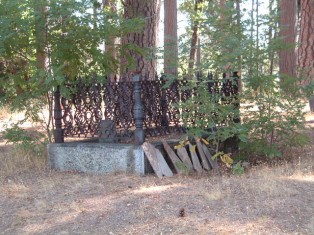
Tombstones, like the one to your left, dot the western landscape. Many settlers died traveling over the plains. Some of those brave souls had doctors to tend to them and they still died. That’s because the country doctors of old weren’t that great. In truth, many of the so-called physicians that traveled West with the wagon trains were actually no more than venturesome prescribers. Because their diagnosis was based on guesswork their therapy was totally unreliable. Sometimes it cured – often it killed. All things being relative, the compression with today may seem unfair, but even allowing for the state of the art during the 1860s through the 1890s general practice in the United States was backward, commercial and often fraudulent. The lack of education and proper licensing exposed the sick to hordes of ignoramuses masquerading as doctors. More a trade than a profession, medicine attracted not the sons of the elite-who preferred law or theology-but mediocrities who saw a chance to get rich quickly. And even this was not enough to satisfy one graduate, who declared, “Hell if I hadda knowed a feller had to git up every night I would never have started to learn doctoring.” In the latter half of the nineteenth century there were 460 “medical schools,” most of them private enterprises run by practitioners who were less concerned with standards than tuition. Students were required to take courses of two 4-to-6-month terms at about $60 a term, and often the second term was a verbatim repetition of the first. Frontier doctors got paid $.50 for house calls. Some were paid off in jam or poultry. At one time America was known as a “bastion of medical humbug,” a reputation that prompted Oliver Wendell Holmes to declare: “If the whole materia medica as now used could be sunk to the bottom of the sea, it would be all the better for mankind, and all the worse for the fishes.” Of course we’ve come a long way since then. An example of how fabulous some doctors are now of days is Doctor Thomas Borsky of Grass Valley, California. Through his kindness and generosity my brother Rick will now have eyeglasses. Rick has been struggling with his eyesight for years and contrary to what one might see in movies or television, there are few doctors in prison and those that are associated with the facility don’t care about the patients. Now, if I could at long last get Rick some teeth, he’d be a least able to eat solid food. If I had his dental records from twelve years ago I could have dentures made, but Rick’s ex-wife took his files from the office and destroyed them. No matter how good doctors become or how many medical advances are made there will still be no way to cure a demented soul like hers.
Gun Notching
The kind of bad man who reveled in his notches and gloated over his reputation was unusual in the Old West, although there were a few who did so. When Luke Short, a bad man bartender who shuttled back and forth from Kansas to Texas, was asked why he put notches on his gun, he replied, “When you come right down to it. I don’t know. It’s kind of a habit, I guess.” Henry Starr, the unparalleled Oklahoma bank robber, offered the most satisfactory and reasonable explanation why some gunmen cut notches in their weapons: “A skilled workman is proud of his tools. Watch a barber honing and fondling his favorite razor. It’s the best razor in seven states, if you believe him, and he’ll brag about how many thousand faces it has shaves, the wonderful steel in its blade and how it holds its edge. Or listen to a conductor or engineer bragging bout his watch that never varies a hundredth part of a second; or a carpenter talking about that saw he has had for nineteen years. We’ll the six-shooter is the working tool of the outlaw and the fellows who chase him, and a darned sight more important to him than a razor to the barber or the watch to the engineer, for his life hangs on it. A good six-shooter costs about forty dollars, and if you want to go in for ivory, stag horn, silver or gold mountings, you can go up a lot higher. A fellow gets into a hole and it downs the other fellow, he’s proud of it. He gives it a notch for remembrance. By the time there are six or eight notches on the stock he is a killer. He’s likely to be case-hardened by then and drop a man just to add another notch. Maybe he’s jealous of somebody that’s got fourteen notches on his shooting iron. It gets to be a kind of contest, like a fellow getting a lot of medals.” It was customary that the gun notches, literal, pretended or creditable, of the desperado were inherited by his killer who sought the reputation. That is, according to this custom, Pat Garrett, the New Mexico sheriff, would have been justified in cutting twenty-two notches in his gun – one for killing Billy the Kid and twenty-one for the men the Kid had killed – that is, if Pat Garrett had been the kind of braggadocious bad man sheriff some of them were. Wyatt Earp told his biographer Stuart Lake, “I never knew a man who amounted to anything to notch his guns with ‘credits’ as they were called for me he had killed. Outlaw, gunmen of the wild crew who killed for the sake of brag, followed this custom. I have worked with most of the noted peace officers – Hickok, Tilghman, Masterson, Bassett, and others of like caliber-have handled their weapons many times, but never knew one of them to carry a notched gun.” It does seem reasonable that the bad man, as a rule, would not care to have people estranged from and suspicious of themselves, especially their friends. They probably would be if they sported a notched gun. I think it’s a shame we can have some ‘notched’ system today. It’s hard to tell who the bad guys are many times. There are so many vicious women who want out of a relationship who falsely accuse men of the most outrageous actions. There are a great many women who date men who have children from previous relationships that want them to make false allegations against their ex-wife’s family because they are jealous of his past relationship. It’s vicious and unforgivable and these women are oh so proud of themselves. Now if there was a way for them to ‘notch’ their foreheads or something they could be avoided all together. Until then, we just have to watch our own six. Here’s a tip however; the bad guys now of days are generally someone our brothers have married.
This Day…
1878 – Frank Baker and Billy Morton were in the custody of a regulator posse led by Dick Brewer for their participation in the murder of John Tunstall. In an attempted escape at Steel Springs, New Mexico posseman William McCloskey was killed by Morton, but Morton and Baker were both quickly shot to pieces by the remaining members of the posse.