
1948 – Mildred Gillars (Axis Sally), an American broadcaster employed by the Third Reich in Nazi Germany to proliferate propaganda during World War II, pleads not guilty to eight chargs of treason in Washington, D.C.
While Outlaws Ride
Enter now to win a copy of
Tilghman: The Legendary Lawman and the Woman Who Inspired Him
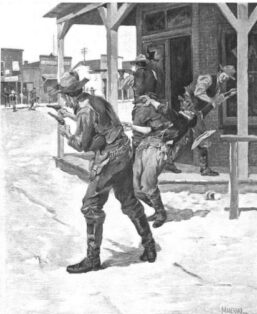
Bill Tilghman, Chris Madsen, and Heck Thomas lay on their stomachs behind a cluster of rocks, their rifles trained on a dugout three hundred yards away. The crude shelter, a rectangular hole carved into a ravine, was rumored to be the spot where the Doolin-Dalton Gang was hiding. The lawmen had sneaked into their position after midnight and were waiting until dawn to overtake the outlaws inside. The pale crescent moon above the trio shone like a silvery claw in the waning night sky. It was mid-March 1894, and it was cold.
The US deputy marshals were dressed for the frigid temperature, but the occasional icy winds left them wanting more than dusters and wool chaps to rely on for warmth. Knowing the outlaws would be in custody by daybreak kept them rooted to their setting despite the elements. Six months prior to Tilghman and the others learning the criminals’ location, a team of lawmen tried to apprehend the gang holed up in Ingalls. The outcome was disastrous for Evett Nix’s federal authorities. Three deputy marshals were killed and most of the outlaws escaped. Law enforcement’s defeat emboldened the desperados.
A month after the incident in Ingalls they attended an oyster supper in Cushing hosted by the women of the church. They were overheard planning bank and train robberies. They also threatened to come after the citizens of Ingalls who had sided with the deputy marshals who raided the area in September 1893. Frustrated with the lack of progress his officers were making to catch the gang, Nix persuaded Tilghman and Heck Thomas to leave their post in Perry and pursue a lead on the whereabouts of the Doolin-Dalton Gang. The pair would later reunite with Chris Madsen.
Madsen had sent his brother-in-law, Deputy Marshal Ed Morris, and two other officers to the Ingalls area to find out if those who championed the outlaws knew where they were hiding. Morris and his coworkers arrived in town on a chuck wagon disguised as cooks traveling to Texas to work on a cattle drive. During a visit to the local saloon, Morris learned that the gang was living in a dugout on the Dunn Ranch.
Rose Dunn’s paramour George Newcomb survived the police raid on Ingalls and was with the rest of the gang on her family’s property. Morris was informed that Rose had been seen taking provisions from the main ranch house to the dugout. Smoke emanating from the chimney of the dugout further confirmed their theory that Doolin, Dalton, and the other members of their group were indeed inside.
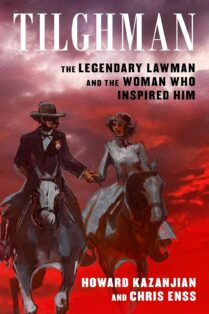
Tilghman
I'm looking forward to hearing from you! Please fill out this form and I will get in touch with you if you are the winner.
Join my email news list to enter the giveaway.
"*" indicates required fields
To learn how Marshal Tilghman apprehended Bill Doolin read
Tilghman: The Legendary Lawman and the Woman Who Inspired Him
This Day…
1875 – Billy the Kid is arrested for the 1st time and jailed after receiving clothing stolen from a Chinese laundry. Escapes two days later.
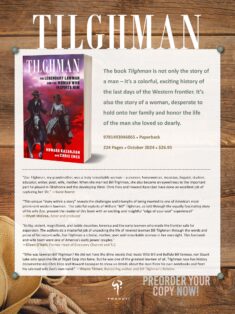
Tilghman Is One The Way
This Day…
1893 – Cherokee Strip, Oklahoma, opens white settlement homesteaders
Tilghman in Dodge City
Enter now to win a copy of
Tilghman: The Legendary Lawman and the Woman Who Inspired Him
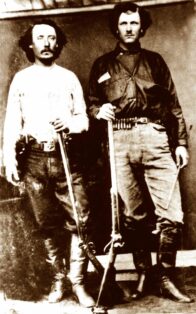
In mid-October 1885, two men ambled down the Jones and Plummer Trail, 120 miles from the Kansas border, toward the Cimarron River. Marshal Bill Tilghman was in the lead, his eyes fixed on the spot the riders would have to ford the swollen waterway. He had a tight grip on a bald-faced mare trailing behind him. Atop the animal was a horse thief named George Synder. He was a dark-complected man in his mid-thirties with a thin moustache and a gaunt intensity that wasn’t entirely healthy looking. Tilghman had journeyed to Mobeetie, Texas, to arrest Synder for stealing a horse that belonged to a politician from Great Bend named J. C. Briggs.
It wasn’t the first time Tilghman had made a long trip to apprehend a criminal. Unlike other lawmen who had to encroach on another jurisdiction to make an arrest, Tilghman insisted on acquiring the necessary writs from the officers overseeing the area he planned to invade. He expected the same courtesy to be shown him from law enforcement seeking to detain an offender in his domain.
In the first pages penned about his life and work, Zoe made note of such professional courtesies practiced by the marshal. “My husband’s career in law enforcement began in Dodge City when the country west of the Mississippi was finding its way,” she wrote. “Bill traveled to Okla homa in 1889 just before the first land rush in the nation. He served the rough Territory for thirty-five years as U. S. deputy marshal, sheriff, chief of police, and special aide to governors. His peers admired his ethics and outlaws feared his tenacity. In the end, when a new kind of frontier opened during the brawling oil boom of the 1920s, Bill gave his life as he had lived it—in the cause of decency and order.” Zoe could envision her husband escorting Synder to jail and contemplating his early years on the open range. His family had moved to Kansas after the military closed the fort where William Matthew Tilghman Sr. had been employed as a sutler at Fort Dodge, Iowa, selling provisions to the troops.
“He grew up on the plains, and a gun was rarely far from his hand,” Zoe noted about Tilghman’s upbringing. “At that time, in 1862, his father and oldest brother Richard enlisted in the Union Army and fought in the Civil War. Tilghman had to do the work on the farm near Atchison, Kansas, and furnish his mother Amanda and six others with food, which mostly consisted of rabbits and prairie chickens. When he wasn’t feeding the stock, milking, and gathering corn, he was practicing his shooting. In time, he was able to provide his mother, brothers, and sisters with geese and turkeys for their meals.”
Tilghman
I'm looking forward to hearing from you! Please fill out this form and I will get in touch with you if you are the winner.
Join my email news list to enter the giveaway.
"*" indicates required fields
To learn more about Marshal Tilghman and his wife Zoe read
Tilghman: The Legendary Lawman and the Women Who Inspired Him
Plain Genius- A Roy W. Dean Grant Finalist
Plain Genius: The Women Who Built America documentary is a finalist for the Roy W. Dean Grant
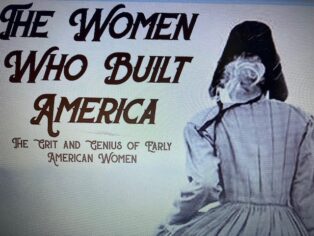

In 2026 America celebrates a monumental birthday – its 250th! ”America250” will be
an epic year of celebrating our past, present and hopes for the future. While traditional
historic reflections are focused on extraordinary male contributions to the founding
and building of America, this documentary series will reveals the outstanding, but
never heard of, women who not only helped shape our young country, but whose lives
reverberate 250 years later. The stories we will tell are of the lives of bold, pioneering
women who saw no limitations at a time when women had few options in life. Our
daughters today will see the women whose shoulders they are standing on.
The documentary series entitled Plain Genius: Women Who Helped Build America
will leverage the historical authorship of Chris Enss, best-selling author and skilled
storyteller. Her meticulously researched books provide a road map to primary materials
and archives necessary to present these women in rich and compelling detail. Each
episode will feature four women who had a profound impact on our nation’s early
development, AND the lasting legacy of their gifts to our culture. We will interweave
archival visual and audio materials with cutting-edge reenactments, interviews with
historians, legacy women, and appropriate celebrities.
This Day…
1948 – Margaret Chase Smith, American politician (R-Me) elected senator, 1st woman to serve in both houses of US Congress
The Widow Writes
Enter now to win a copy of Tilghman:
The Legendary Lawman and the Woman Who Inspired Him
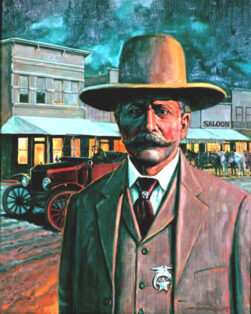
In addition to being a legendary marshal, Tilghman was a father of seven children and a faithful companion to his second wife Zoe for more than two decades. His violent death in November 1924 devastated Zoe and the three boys they had together. Tilghman had encountered numerous criminals over the course of his career and had come through the gun battles relatively unscathed.
When he took the job of bringing about stability in the untamed oil town of Cromwell, Zoe anticipated he’d take care of the work and return home to live out his days with her and their boys. She never imagined he would be gunned down in the line of duty. Now a widow at forty-three, Zoe was faced with how to continue without the man she cherished and admired. Not only would she be responsible to make sure nineteen-year-old Tench, seventeen-year-old Richard, and twelve-year-old Woodie were cared for on her own, but the debts the couple had accumulated fell solely to her to pay.
Tilghman was buried on November 5, 1924, and on November 10, 1924, creditors came calling. Zoe was the literary editor of the newspaper Harlow’s Weekly. Her salary alone would not cover the family’s needs and outstanding bills. She had been pondering the situation for weeks, in between reading Tilghman’s detailed memoirs of the various manhunts, posse rides, shootouts, and arrests in which he participated over the course of his life as a sheriff or marshal. She reviewed with considerable pride the newspaper clippings he had kept about the outlaws he apprehended.
Although he’d stayed on the job longer than any of his colleagues and squared off against more renegades than lawmen such as James Butler Hickok, Seth Bullock, or Virgil Earp, Tilghman’s name wasn’t as recognizable as most of the others in the field. Among the correspondence Zoe had received from men and women expressing their sorrow over Tilghman’s death were newspaper articles about Wyatt Earp’s work in motion pictures, his friendship with film star William S. Hart, and the biography in the works about the lawman and his gunfighter life. Zoe had never personally met Earp but knew of him from her husband.
She believed Tilghman’s experiences were at least as daring and exciting as anything Wyatt Earp had done, and spanned a far greater number of years. The idea to write a book about Tilghman’s adventures wearing a badge began forming in Zoe’s mind a month after his passing and was rekindled after reading of a possible volume on Earp. She was convinced readers would appreciate the tales of Marshal Tilghman’s efforts to tame the territory beyond the Mississippi.
According to Zoe, “My husband was one of the West’s greatest peace officers. He hunted down famous outlaws and killed when he had to. But Tilghman was more than an expert gunman who fought on the side of the law. He and other men who held dangerous jobs as sheriffs and marshals did the work of civilization along the whole frontier.”
Tilghman
I'm looking forward to hearing from you! Please fill out this form and I will get in touch with you if you are the winner.
Join my email news list to enter the giveaway.
"*" indicates required fields
To learn more about Zoe Tilghman and her husband read
Tilghman: The Legendary Lawman and the Woman Who Inspired Him
This Day…
1850 – Swedish soprano Jenny Lind, whose purity of voice and natural singing style earned her the nickname “the Swedish nightingale,” made her American debut at the Castle Garden Theatre in New York City on September 11, 1850. The appearance inaugurated a ninety-three-stop American tour which was arranged by showman and entertainment entrepreneur Phineas T. Barnum. The tour came on the heels of a fantastically successful string of appearances in England where the large packed-in crowds gave rise to the term, “Jenny Lind crush.”