
1948 – Allen Funt’s “Candid Camera” TV debut on ABC
Legendary Trendsetter – Amelia Bloomer
Enter now to win a copy of
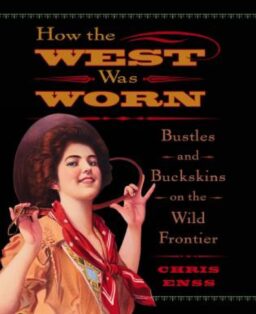
How the West Was Worn: Bustles and Buckskins on the Wild Frontier

Amelia Jenks Bloomer was a newspaper editor, public speaker, and proponent of women’s rights and other social reform. She did not design the then-daring outfit that carries her name – a short dress that reaches below the knees with frilled Turkish-style trousers gathered in ruffles at the ankles. She did promote the costume, wore it herself, and watched it become a symbol of the fledgling women’s movement
How the West Was Worn 2
I'm looking forward to hearing from you! Please fill out this form and I will get in touch with you if you are the winner.
Join my email news list to enter the giveaway.
"*" indicates required fields
To learn more about Old West fashion trendsetters like Amelia Bloomer read
How the West Was Worn: Bustles and Buckskins on the Wild Frontier
This Day…
1860 – Queen of Sandwich Islands (Hawaii) arrives in NYC
Legendary Trendsetter – James Butler Hickok
Enter now to win a copy of
How the West Was Worn: Bustles and Buckskins on the Wild Frontier
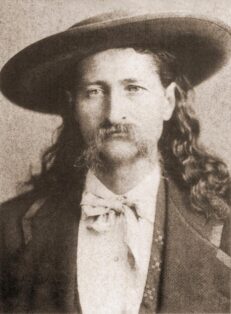
Wild Bill Hickok was an American frontier army scout, peace officer, stagecoach driver, and gambler. He was a big man and his 6-foot frame was accentuated by the long wool jackets he frequently wore. The red sash he generally sported around his waist stood out over the dark pants and vest of his everyday wardrobe.
The sash held two pistols, always pointed butt-forward beneath his coat. His giant brimmed hat was cocked on his head and his long wavy hair, parted in the middle, cascaded down his back. Many dime novel readers tried in vain to duplicate his style, but only one could do the look justice.
How the West Was Worn 2
I'm looking forward to hearing from you! Please fill out this form and I will get in touch with you if you are the winner.
Join my email news list to enter the giveaway.
"*" indicates required fields
To learn more about Old West fashion trendsetters like Wild Bill read
How the West Was Worn: Bustles and Buckskins on the Wild Frontier
This Day…
1926 – Harry Houdini stays in a coffin underwater for 1½ hours before escaping
Legendary Trendsetter – Elizabeth “Baby Doe” Tabor
Enter now to win a copy of
How the West Was Worn: Bustles and Buckskins on the Wild Frontier
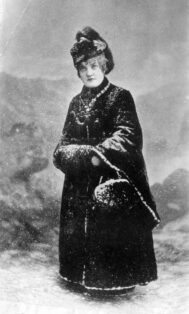
Colorado socialite Elizabeth Tabor had golden hair, blue eyes, porcelain skin, and a sense of style that rivaled that of any woman in Leadville. She arrived married to a struggling miner but dressed like she was the bell of the ball. She paraded down the main street of town wearing a sapphire-blue costume with dyed-to-match shoes. Her stunning style caught the attention not only of neighbors and storekeepers but also of millionaire Horace Tabor. Horace and Elizabeth scandalized the community by falling in love, divorcing their spouses, and marrying one another. Horace showered his new bride with jewels and the finest outfits from Boston and Paris. She wore one-of-a-kind outfits to opening nights at the opera house he had built for her.
All eyes were on the young Mrs. Tabor as Horace escorted his young bride into the theater. Her dresses were made of Damasse silk, complete with flowing train made of brocade satin. The material around the arms was fringed with amber beads. The look was topped off with an ermine opera cloak muff. Pictures of the Tabors appeared in the most-read newspapers, and soon, women from San Francisco to New York copied the outfit. The only part of the costume admirers were unable to reproduce to their satisfaction was Mrs. Tabor’s $90,000 diamond necklace.
How the West Was Worn 2
I'm looking forward to hearing from you! Please fill out this form and I will get in touch with you if you are the winner.
Join my email news list to enter the giveaway.
"*" indicates required fields
To learn more about Old West fashion trendsetters like Baby Doe Tabor read
How the West Was Worn: Bustles and Buckskins on the Wild Frontier
This Day…
1865 – Lewis Carroll publishes “Alice’s Adventures in Wonderland”
Fashion That Shaped the Old West
Enter now to win a copy of
How the West Was Worn: Bustles and Buckskins on the Wild Frontier
Men and women have always distinguished themselves through fashion. The outfits they chose to wear reflected their performance of different jobs, as well as their roles in society. Due to a lack of availability, however, the average western pioneer did not have the luxury of choosing from a wide assortment of clothing to wear. The one or two outfits he did possess were selected to fit the harsh living and working conditions of the frontier.
Soon after the discovery of gold ushered a flood of newcomers into the western United States, conventional fashion changed dramatically. Men traded dress pants and ties for Levi’s jeans and bandanas. Ladies stowed away their expensive, hooped costumes and donned cheap calico and work boots. Because of such changes, an individual’s role in society could no longer be determined by the garments he or she wore.
The pioneer look was mostly born out of necessity and, at first, was more functional than ornamental. A lady’s billowing skirt and long flowing train were not practical for buckboard travel or frontier living. It was difficult for women to fulfill trail duties while bound in stiff whalebone waist cinchers and stubborn crinolines. Men needed to wear clothing that could withstand the ruffed terrain and harsh frontier weather. Children, too, adopted less restrictive attire, allowing them the freedom to work and play alongside their immigrant parents.
Fashion-wise, westward expansion equalized the masses, and within that period of changing styles, a new look emerged – a look that would enable the rest of the world to recognize a westerner no sight.
To learn more about fashion in the Old West read
How the West Was Worn: Bustles and Buckskins on the Wild Frontier
This Day…
1912 – US government censors movies and photos of prizefights
Lozen – The Warrior Shaman
Enter now to win a copy of
Soldier, Sister, Spy, Scout Women Soldiers and Patriots on the Western Frontier
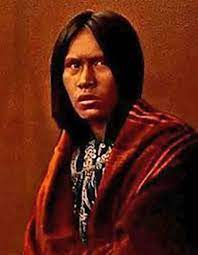
“Lozen is my right hand . . . strong as a man, braver than most, and cunning in strategy. Lozen is a shield to her people.” —Apache war chief Victorio, June 1880
The Apache leader known as Geronimo stood near an overhanging cliff in the Chiricahua Mountains of Arizona studying the terrain before him. His keen eye traveled across the rocks and valley below. It was unlikely the US cavalry would track the fugitive into the rocky stronghold, but Geronimo didn’t like to underestimate the army’s tenacity. A band of thirty-six loyal warriors surrounded the courageous renegade, ready to defend their lives and land should the military be in the immediate area and dare attack the party. Geronimo fixed his gaze on a distant plateau and lifted his voice to the sky. “We have suffered much from the unjust orders of US generals,” he said. “Such acts have caused much distress to my people. We will defend what is ours to the last man.”
A cold stillness hung in the air—a sense of impending calamity marking the beginning of the end of a race of people. Suddenly all eyes turned to an unassuming medicine woman stepping out of a cave in a massive pile of lava rocks. She walked over to an outcropping of stone and bowed her head. Geronimo watched with great interest as Lozen stretched her arms out and turned her palms to the heavens. She was petite and plain, her skin as supple as leather and her manner of dress in keeping with the other warriors. She scanned the horizon as the braves waited. They dared not make a move without Lozen’s wise council. It was her divine power that had kept Geronimo and his followers out of harm’s way for so long. Without her ability to detect the enemy’s nearing presence, the Apaches would have perished.
For close to a year, Geronimo’s desperate band of braves eluded US Army scouts. These few Natives were the last of the free Apache—stubborn holdouts who refused to surrender, be forced from their land, and be placed on a reservation. Many believed it was better to die like warriors than live off the scraps like dogs from the emigrants they referred to as “white eyes.” Lozen honored the beliefs of her people and used her gift to keep the “white eyes” at bay. Geronimo watched Lozen tightly close her eyes.
A gust of wind swept over her small frame, tossing about her straight, dark hair. “Can you tell me if the soldiers are near?” he asked quietly. “I can,” she replied. She stood in silence for a moment, her arms further extended, her hands slightly cupped. “The god Ussen has given me this power . . . it is good, as he is good,” she exclaimed.
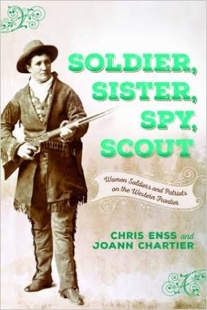
Soldier, Sister, Spy, Scout
I'm looking forward to hearing from you! Please fill out this form and I will get in touch with you if you are the winner.
Join my email news list to enter the giveaway.
"*" indicates required fields
Soldier, Sister, Spy, Scout
I'm looking forward to hearing from you! Please fill out this form and I will get in touch with you if you are the winner.
Join my email news list to enter the giveaway.
"*" indicates required fields
To learn more about Lozen read
Soldier, Sister, Spy, Scout Women Soldiers and Patriots on the Western Frontier