
1939 – “Gone With The Wind”, drama film directed by Victor Fleming and starring Clark Gable and Vivien Leigh, premieres in Atlanta (Best Picture 1940, inflation not adjusted highest-grossing film of all time)
Johnny Guitar Star
Enter now to win a copy of
Cowboys, Creatures and Classics: The Story of Republic Pictures
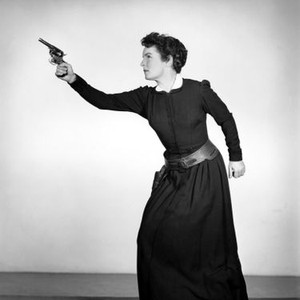
Academy Award winning actress Mercedes McCambridge portrayed Joan Crawford’s vindictive nemesis in Republic Pictures’ psychological Western Johnny Guitar. She was also Rock Hudson’s strong-willed older sister in Giant.
A versatile, radio-trained character actress with a strong resonant voice, McCambridge specialized in playing forceful, domineering characters on screen. Many film critics believed she outshined Crawford in Johnny Guitar. Crawford wanted Claire Trevor for the part of Emma in the film, but she wasn’t available. McCambridge had a way of commanding a scene and audience attention – less performance, more of a presence. Crawford immediately resented the kudos afforded McCambridge by the crew and consistently referred to her as ‘an actress who hadn’t worked in ten years – an excellent example of a rabble-rouser.’
When McCambridge delivered a stirring speech to the posse in the film, her performance received a round of applause from the crew. Crawford was watching the scene from a hilltop in the distance, grabbed McCambridge’s costumes out of her dressing room, and strewn them along a nearby road.
McCambridge was born in Joliet, Illinois, on St. Patrick’s Day in 1916 and grew up on a farm in Blackstone, Illinois, until attending Catholic high school in Chicago. While majoring in English and theatre in Mundelein College in Chicago in 1936, she caught the attention of NBC Radio’s Chicago program director and was signed to a five-year contract. From radio she made the leap to film.
In 1949 she won an Academy Award for Best Supporting Actress for the role of Sadie Burke in the film All the King’s Men. She nominated for the same award for work her work in the film Giant in 1956.
McCambridge success on screen didn’t translate to her personal life. She struggled desperately with alcoholism. She was married and divorced twice and in 1987, her son, John Lawrence Markle, 45, killed his wife and two daughters, then committed suicide.
McCambridge passed away on March 2, 2004. She was eighty-seven-years-old.
Cowboys, Creatures, and Classics 3
I'm looking forward to hearing from you! Please fill out this form and I will get in touch with you if you are the winner.
Join my email news list to enter the giveaway.
"*" indicates required fields
To learn more about McCambridge and the movie Johnny Guitar read
Cowboys, Creatures and Classics: The Story of Republic Pictures
This Day…
1928 George Gershwin‘s – “An American In Paris” symphonic poem premieres at Carnegie Hall, NYC, performed by the New York Philharmonic conducted by Walter Damrosch
The Tragic Life of Gail Russell
Enter now to win a copy of
Cowboys, Creatures and Classics: The Story of Republic Pictures
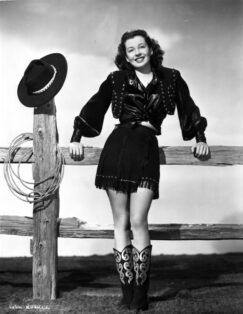
One of Republic Pictures most popular actresses was one of the motion picture industries most troubled. Her name was Gail Russell. Russell, a beautiful brunette with dark, blue eyes, was a gifted talent who dreamed of becoming a commercial artist. She was born Elizabeth L. Russell in Chicago on September 21, 1924. Throughout her childhood she was painfully shy and often hid under her parents’ piano whenever guests came to their home.
The young girl only felt completely comfortable when she was sketching various people and places in her sphere of influence. She began drawing at the age of five years old and was considered exceptional by most that saw her sketches and paintings.
When she was in her late teens, her mother, Gladys Russell, encouraged her to set aside her drawing pencils and venture into films. Russell was fourteen when her parents moved to Los Angeles so their daughter could pursue their dream of her becoming a star. She attended Santa Monica High School and as soon as she graduated, she auditioned for Paramount Pictures and signed a contract with the studio for $50 a week.
Russell’s shyness followed her as she began her career. Acting instructors were hired to help her overcome her timidity, but it never completely subsided.
In 1946 Russell starred in the first of four films she made for Republic Pictures. John Wayne coproduced The Angel and the Badman and specifically requested Gail Russell to play opposite him in the western written and directed by James Edward Grant. Wayne was moved by her quiet, unassuming personality. He treated her with the respect and kindness she’d not known from many other leading men or producers. The two became good friends while working on the film. Wayne was protective of Russell. He recognized vulnerability in the actress some could have taken advantage of. He was a father figure to Russell and she considered him to be a fiercely honest individual.
She was a success on screen, but her personal life was less so. Russell spent a month in a sanitarium learning to deal with the humiliation and hurt she experienced from a public divorce. Once she was released, she resorted to drinking. On November 26, 1953, Russell was arrested for drunk driving. At her hearing two months later, the troubled actress was placed on two years’ probation with the condition she refrain from intoxicants, stay away from places where liquor was sold, and obtain medical treatment. She was also ordered to pay a $150 fine.
On August 26, 1961, less than four years after her pledge about setting her life on a new course, Gail was found dead in her apartment. She had lost her battle with alcohol. Her body was discovered by neighbors that had stopped by to check on her. Russell was lying on the floor next to an empty bottle of Vodka. There were additional bottles of alcohol strewn about her home.
Gail Russell was thirty-six years old when she passed away.
Cowboys, Creatures, and Classics 3
I'm looking forward to hearing from you! Please fill out this form and I will get in touch with you if you are the winner.
Join my email news list to enter the giveaway.
"*" indicates required fields
To learn more about Western film actresses like Gail Russell read
Cowboys, Creatures and Classics: The Story of Republic Pictures
This Day…
1960 – Cy Coleman and Carolyn Leigh’s musical “Wildcat” with Lucille Ball premieres in New York City
Queen of Noir
Enter now to win a copy of
Cowboys, Creatures and Classics: The Story of Republic Pictures
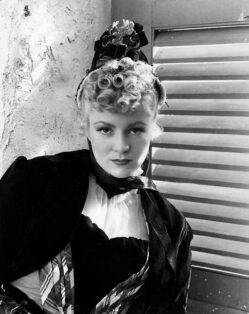
Claire Trevor made famous the role of Dallas the soiled dove in the film Stagecoach. With a voice once described as sounding like delicious trouble, she was one of the most sought-after supporting actresses during the 1930s and 40s.
She was born in New York City – movie buffs disagree whether it was 1909 or 1910 – to a Belfast, Ireland-born mother and a strict Paris born father who had a custom tailor shop on Fifth Avenue.
As a child, Trevor dreamed of being a ballerina. But along the way she became involved in church plays and fell in love with the stage. After studying art briefly at Columbia University, she attended the American Academy of Dramatic Arts in New York. She had to drop out after six months, though, because her father’s business failed during the Depression, and he told her that she would have to help out.
“That shocked the hell out of me,” she later recalled. “We weren’t rich, but I never thought of money as being a worry, so it scared me. I thought, ‘What do I know how to do? Acting is the only thing I know how to do, and to get a job in the middle of the Depression in New York was not easy.
After a successful run on Broadway at the age of twenty-one, Trevor made her film debut in the early Western, Life in the Raw, and between 1933 and 1938, starred in over twenty movies including Dante’s Inferno, Dead End and The Amazing Dr. Clitterhouse starring Humphrey Bogart. In 1939, she co-starred with an unknown Wayne in Ford’s classic, Stagecoach, and is one of few stars to have ever received top billing over The Duke.
Trevor appeared in other popular Westerns including Honky Tonk with The King of Hollywood, Clark Gable, and The Desperadoes starring Randolph Scott and Glenn Ford. She became known for her hard-boiled blondes in film noirs, winning her only Oscar for her performance in John Huston‘s Key Largo, but her unconventional Western roles popularized the bad girl of the Wild West making her a cornerstone of the genre.
The Oscar winning actress died on April 8, 2000, at the age of ninety.
Cowboys, Creatures, and Classics 3
I'm looking forward to hearing from you! Please fill out this form and I will get in touch with you if you are the winner.
Join my email news list to enter the giveaway.
"*" indicates required fields
To learn more about film legends like Claire Trevor read
Cowboys, Creatures and Classics: The Story of Republic Pictures
This Day…
Starlet Jane Russell
Enter now to win a copy of
Cowboys, Creatures and Classics: The Story of Republic Pictures
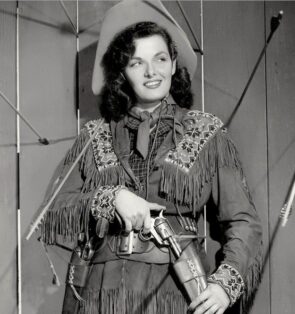
Jane Russell was a dark-haired siren whose sensational debut in the 1943 Western The Outlaw inspired producer Howard Hawks to challenge the power and strict morality of Hollywood’s production code. Her provocative performance in the film – and the studio publicity shots posing her in a low-cut blouse while reclining on a stack of hay bales – marked a turning point in moviedom sexuality. She became a bona fide star and favorite pinup girl of soldiers during World War II. Troops in Korea named two embattled hills in her honor.
Born Ernestine Jane Geraldine Russell on June 21, 1921, the stunning, talented actress would turn her sexy image to comic effect in films with Bob Hope, Marily Monroe and other major stars. Among her better films are The Paleface in which she plays the spirited Calamity Jane opposite Hope’s feckless dentist in a spoof of The Viriginian, and Gentlemen Prefer Blondes, a musical in which she is brunette gal pal Dorothy to Marilyn Monroe’s gold-digging Lorelei Lee. In the latter, the two stars perform a razzle-dazzle production number of the Jules-Styne-Leo Robin hit song “Diamonds Are A Girl’s Best Friend.”
Some of the other Westerns she starred were Son of Paleface, Montana Belle, and The Tall Man.
Russell was a Christian who made several appearances on the Trinity Broadcast Network discussing her faith in Jesus Christ. She passed away on February 28, 2011, at the age of eighty-nine.
Cowboys, Creatures, and Classics 3
I'm looking forward to hearing from you! Please fill out this form and I will get in touch with you if you are the winner.
Join my email news list to enter the giveaway.
"*" indicates required fields
To learn more about some of the amazing women in Westerns read
Cowboys, Creatures and Classics: The Story of Republic Pictures
This Day…
1941 – Imperial Japanese Navy with 353 planes attack the US fleet at Pearl Harbor Naval Base, Hawaii, killing 2,403 people
The Olympic Skater Turned Actress
Enter now to win a copy of
Cowboys, Creatures and Classics: The Story of Republic Pictures
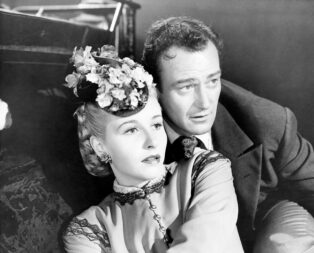
The most influential woman at Republic Pictures from the early 1940s to the studio’s demise in the early 1960s, was Vera Hruba. Born in Prague, Czechoslovakia, on July 12, 1919, the blonde beauty caught Republic Picture’s president Herbert Yates’ attention in 1939 when she toured the United States with an ice-skating show called Ice Vanities.
Vera was an exceptional ice skater, having placed 17th in the 1936 Olympics behind figure skater Sonja Henie. Yates was captivated with Vera’s talent and looks and believed she could be as successful as Ms. Henie who was one of the leading stars at 20th Century Fox. He cast Vera, and the entire company of the Ice Vanities, in a musical film entitled The Ice Capades. Critics called the picture “sheer enchantment on ice.” Vera was mentioned along with five other skaters as “spectacular”. Yates couldn’t have agreed more and in 1943 signed her to a long-term contract with the studio and added Ralston to her name. He added Ralston, a name borrowed from the cereal, because Hruba was difficult for moviegoers to pronounce.
The first movie Vera Hruba Ralston appeared as a star, minus the skates, was Republic Pictures’ 1941 horror film The Lady and the Monster. Her costars were Erich von Stroheim and Richard Arlen. Billed as “a picture from out of this world” the plot involves a millionaire whose brain is preserved after his death, and telepathically begins to take control of those around him. The film reviewer for the Havre Daily News referred to Ralston’s debut as a dramatic actress as “the find of the season.”
Most did not agree with the critics who found the foreign ingénue to be a promising star. Many complained that her performance was wooden and that her accent was too thick. Yates ignored every voice but his own and quickly reteamed von Stroheim and Arlen with his discovery in another feature entitled Storm Over Lisbon. In this spy thriller Ralston played an allied operative in Lisbon and Arlen an American newspaper man who she helps get out of Portugal with important information. Audiences found Ralston attractive, but struggled to understand what she was saying.
Yates hired acting instructors and speech coaches for Ralston. While her English and her acting soon improved she could not lose her strong Czech accent. Yates felt that ticket buyers would eventually see how compelling the stunning blonde’s talent truly was and learn to embrace her way of talking in much the same way they did Marlene Dietrich. In order to help Ralston, gain a broader acceptance he paired her with an actor that had mass appeal – John Wayne.
The western starring Wayne and Ralston was Dakota. Wayne and Ralston portray newlyweds who plan to use their nest egg to buy property at a location where a railroad town is rumored to be built. Before the pair has a chance to make a start for themselves, they are robbed of their money and Wayne sets out to find the crooks and retrieve what’s his.
Wayne was hesitant to work with Ralston. None of the pictures she had made for Republic had done well. Yates enticed Wayne into making Dakota with the promise of a percentage of the revenue from the next movie he was slated to do for the studio. The film was Wake of the Red Witch and Wayne made a substantial amount from the percentage Yates agreed to give him. It was enough to fund a production company of his own.
Widely released on Christmas Day in 1945, audiences were pleased with the fast-moving film. The movie critic at the Tallahassee Democrat called Dakota a “rip-snorting, fast-shooting, western drama packed with action.”
Returns were better than okay. Dakota was hugely profitable. In terms of box office sales, it would be the most profitable film Vera Hruba Ralston would ever make.
Vera passed away in February 2003 at the age of seventy-nine. To learn more about Vera read Cowboys, Creatures and Classics: The Story of Republic Pictures.