
1950 – Frank Loesser‘s musical “Guys & Dolls”, starring Robert Alda, Vivian Blaine, and Sam Levene, opens at 46th St Theater, NYC; runs for 1200 performances, winning 5 Tony Awards
Along Came Cowgirl Kitty Canutt
Enter now to win a copy of
Along Came a Cowgirl: Daring and Iconic Women of the Rodeo and Wild West Shows
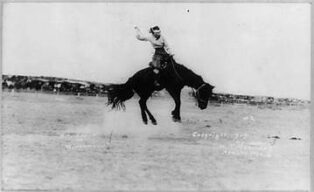
Bronc busting champion Kitty Wilkes won her first title at the Wild West Celebration Rodeo in Miles City, Montana, in 1916. The seventeen-year-old, New York native’s straightforwardness and untamed physical daring gave fans the impression she was born and bred into the rugged life of a Wyoming ranch. Few would have guessed she was new to the sport or that winning the top prize would inspire her to excel in other rodeos. From that exciting moment in Miles City she was determined to show the world that one need not be “born in the saddle” to be a crack rider.
Katherine Derre, whose stage name was Kitty Wilkes, was born on July 15, 1899. She had a natural talent for breaking horses and parlayed that skill into bronc riding in public showings. Not only did she have a way with wild horses, but she was also an exceptional trick and fancy rider. Owners of relay strings were eager to gain her services.
Between the rodeo in Montana in the summer of 1916 and the Pendleton Roundup in Pendleton, Oregon, in early fall of 1916, Kitty honed her bronc riding talent at ranches and rodeos throughout the West. She insisted on using the orneriest animals for training. Outlaw horses were blindfolded and saddled for her to ride. One encounter resulted in the horse bucking Kitty off and bruising her ribs. She wouldn’t allow the horse to beat her, however. She swung back into the saddle, refusing to leave it until the animal finally broke.
Kitty’s nickname was Diamond Girl because she had a diamond set in her front tooth. When needed, she would remove the diamond and pawn it for the entry fees to rodeo contests.
Her performance at the Pendleton Roundup in 1916 resulted in her being named the All-Around Champion Cowgirl. Among the many people she met during the roundup was Yakima Canutt. Canutt, who also competed at the rodeo, would go on to become one of Hollywood’s leading stuntmen. Kitty and Yakima fell in love and were married in Kalispell, Montana, in 1917.
Kitty was a fierce athlete who hated to lose. It was not uncommon for her to challenge women who outrode her, and she believed cheated, to a fistfight. In September 1918, she was disqualified from participating in a rodeo in Washington because she hit a rider in the mouth with a piece of wood.
Not content with being the top female bronc rider in the country, she aspired to be the top female relay racer as well. Rodeo fans loved to watch the petite woman fly past the grandstands on her horse, hurrying to meet the next mount waiting to be saddled and ridden to the next point. More than once Kitty would be finishing part of the race standing on the stirrups trying to get into the saddle. Her grit and resolve often paid off with a win.
The rodeo stars Kitty often competed against were Mabel Strickland, Bonnie McCarroll, and Prairie Rose Henderson.
Kitty Wilkes was eighty-eight years old when she died on June 3, 1988.
To learn more about fearless women like Kitty read
Along Came a Cowgirl: Daring and Iconic Women of the Rodeo and Wild West Shows
This Day…
1920 – Silent film “The Last of the Mohicans” released, adapted from James Fenimore Cooper‘s novel, starring Wallace Beery, Barbara Bedford
Along Came Cowgirl Berenice Dossey
Enter now to win a copy of
Along Came a Cowgirl: Daring and Iconic Women of the Rodeo and Wild West Shows
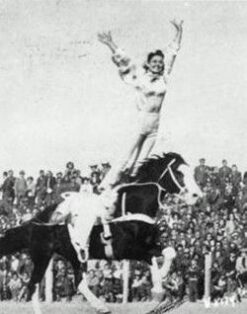
In early February 1941, more than twenty-five hundred people jammed into the stadium to watch the exciting events at the World’s Championship Rodeo in Phoenix, Arizona. They came to see wild cow riding, calf roping, steer roping, bronc riding, and trick rider Berenice Dossey. Not only was she a “spectacular performer” according to the Arizona Republic newspaper, but she was also known as one of the most beautiful women on the rodeo circuit. Among the myriad of tricks that she perfected on top of her horse Sundee were the hippodrome stand, double vault, and the Cossack drag, where she would hang under her ride’s belly at full gallop. It was her flawless execution of the Cossack drag that helped earn her the title of World Champion Trick rider in 1941 and 1945.
Berenice was born on April 26, 1913, in Ellensburg, Washington. Her parents Louis and Winnifred Smith Blair owned a ranch and its’ there she began riding horses at the age of three. By the time she was twelve she was standing up in the saddle when she rode and attempting a number of other stunts on the backs of the many thoroughbred horses belonging to her father and uncle. Like many skilled horsewomen in the 1930s, Berenice was a part of the Miller Brothers 101 Ranch Wild West shows. While she was with the famous show, she not only honed her trick riding skills, but became an accomplished horse racer and an expert of a type of choregraphed dressage riding called quadrille.
The trick rider’s peers considered her to be a “real trouper of the rodeo game.” On those occasions when she lost her balance and fell to the ground or was thrown off the back of her ride, she always continued with show, doing all the difficult stunts no matter what kind of pain she was experiencing.
Not only was Berenice an exceptional rider, but she was also a gifted seamstress. She made all the western apparel she wore in the various rodeos in which she participated.
Berenice worked as a professional trick rider for more than twenty years, performing in rodeos across the United States and Canada. She was married three times. Her second husband, Carl Dossey, was a World Champion bareback rider. The pair were living in Chandler, Arizona, when died tragically trying to stop of team of runaway horses at the Madison Square Garden Rodeo parade held on March 12, 1955.
The talented Berenice retired in 1956 after marrying Frank Bolen in Nogales, Arizona. The couple moved to California for a brief time before settling in Pocatello, Idaho. Berenice was active in several civic organizations and served as a 4-H leader and was on the board of directors for the Little Britches Miniature Rodeo. Her hobbies included dress pattern making and leather works. She made custom belts for her three adult children, grandchildren, and numerous friends.
Berenice Blair Taylor Dossey Bolen died of cancer on September 18, 1974, at the age of sixty-one. She was inducted into the Cowgirl Hall of Fame in 1991.
To learn more about fearless riders like Berenice read
Along Came a Cowgirl: Daring and Iconic Women of the Rodeo and Wild West Show
This Day…
1886 – Sherlock Holmes’s first story “A Study in Scarlet” is accepted by publisher Ward and Lock with payment of £25
Along Came Cowgirl Alice Greenough
Enter now to win a copy of
Along Came a Cowgirl: Daring and Iconic Women of the Rodeo and Wild West Show
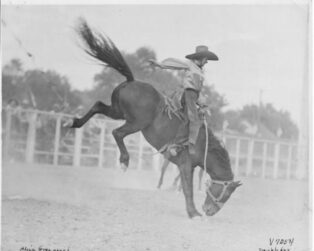
Spain. September 1932. Alice Greenough, a seasoned cowgirl, sits astride an angry steer. In the place of a saddle a surcingle, a sort of plastic girdle has been fashioned around the animal’s back and cinched to his stomach. He doesn’t like it. Alice’s attractive face is focused as she secures a good grip on the flat braided rope tied to the steer’s flank. When she was ready the bucking chute opened, and the angry beast stormed into the arena. The spectators were on their feet, cheering. Alice was quickly thrown from the steer’s back, but not off the animal entirely. He wouldn’t stop kicking and jumping long enough for the rider to drop safely to the ground. Matadors dressed in traditional garb raced to the scene and threw their capes over the steer’s head to slow him. Finally, the cowgirl leapt off.
Thirty-year-old Alice was one of only six people in history, and the only woman, to avoid injury riding a steer with a surcingle. Bullfighting fans erupted with applause at the achievement. Alice bowed and waved at the enthusiastic onlookers.
Alice was born daring. Her parents, Benjamin and Myrtle Greenough, were residents of Red Lodge, Montana. They welcomed their daughter to the world on March 17, 1902. Benjamin was a rancher, and his seven children helped him work the property. Alice learned to rope and ride at a young age. By the time she was fourteen she was delivering the U. S. mail on horseback to friends and neighbors along a thirty-seven-mile route around Billings. She was still in grammar school when she began riding saddle broncs at local rodeos, and a few years later, she and her sister Marge were hired by the Jack King Wild West Show to be trick riding performers.
Alice won the World’s Championship in women’s bronc riding in Boston in 1933, 35, and 36, and again in 1940 in New York. Her professional career spanned more than twenty-four years. She was one of the stars of the Madison Square Garden rodeo for eighteen straight seasons. She traveled throughout the United States, Mexico, and Canada competing for titles in relay racing, trick roping and riding. Alice toured England and Australia and in 1934 won the women’s bronc riding event in Melbourne. During her travels, she met with British royalty including King George V and the Duke of Windsor.
Not content with performing solely in Wild West Shows, Alice was eventually hired as a stunt woman for motion pictures and provided riding lessons to the King of the Cowboys and the Queen of the West, Roy Rogers and Dale Evans.
Alice was married twice, to Roy Cabill and then to Joe Orr. She and Joe created their own show, the Greenough-Orr Rodeo. Their rodeo featured the first woman’s barrel racing event. Not only did Alice help produce the various shows, but she also participated in the acts as well.
Alice Greenough-Orr was inducted into the Cowgirl Hall of Fame in 1985. She passed away at the age of ninety-three at her home in Tucson, Arizona, in 1995.
To learn more about fearless riders like Alice read
Along Came a Cowgirl: Daring and Iconic Women of the Rodeo and the Wild West Shows
This Day…
Along Came Cowgirl Mamie Francis
Enter now to win a copy of
Along Came a Cowgirl: Daring and Iconic Women of the Rodeo and Wild West Show
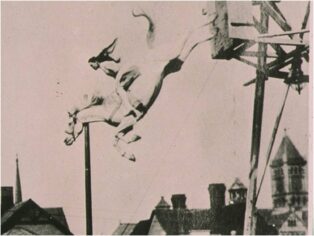
Cowgirl Mamie Francis sat atop her horse, Babe, waiting for the director of California Frank Hafley’s Wild West show to let her know when the program began. Mamie and Babe were perched on a wooden platform thirty feet in the air over Coney Island, New York, looking down at the audience in the grandstands. Directly below the platform was a forty-foot tank filled to overflowing with water. It was the summer of 1908.
Mamie gently urged Babe to the edge of the platform, both stood like a beautiful statue surveying the landscape before them. After receiving the signal, Mamie coaxed Babe forward. The horse pushed away from the boards and lunged outward into space. Moments later, rider and horse entered the water in the tank with a giant splash. When they came to the surface, the audience erupted in applause. Mamie patted Babe’s neck as the horse carried her up the ramp and out the tank.
Born in Nora, Illinois, on September 8, 1885, to Charles and Anna Ghent, and given the name Elba Mae, Mamie was an accomplished equestrienne by the time she turned sixteen. Her parents moved from Illinois to Wisconsin when she was a baby. Her mother worked for a farmer who owned several horses, and it was there she learned how to ride and use a gun to hunt. When Pawnee Bill’s Wild West show stopped in Kenosha, Wisconsin, for a two-night performance, Mamie was in the audience to take in the excitement. Before the show left town, she had signed on to be one of the entertainers.
As Mamie excelled at riding and shooting, that’s what Pawnee Bill had her do in the show. In time, she would be billed the greatest horseback and rifle shot in the world. Mamie met her first husband, trick rider Herbert Skepper, shortly after joining the show. The pair was married on July 7, 1901.
By 1905, Mamie had left the Pawnee Bill’s Wild West show and divorced Skepper. Charles Francis Hafley and his wife, trick shooter Lillian Smith, were familiar with Mamie’s talents and sought her out to join Hafley’s Wild West show. She happily agreed to be a part of the troupe. During her time with the experienced group, Mamie perfected her own sharpshooting routine, tried her hand at bronc riding, and even mastered a few rope tricks. In late 1907, she added horse diving to her repertoire. Known as the Diving Equestrienne, she and Babe made over six hundred jumps between 1907 and 1914.
When Mamie stopped horse diving, she turned her attention solely to sharpshooting, trick riding, and training horses to compete in dressage* events. Mamie married Charles Hafley in November 1909, a year after he and Lillian Smith divorced. The two managed the Wild West show for thirty-one years.
Mamie Francis Hafley died on February 15, 1950. She was sixty-four years old.
*The art of riding and training a horse in a manner that develops obedience, flexibility, and balance.
To learn more about fearless women like Mamie read
Along Came a Cowgirl: Daring and Iconic Women of the Rodeo and Wild West Shows
This Day…
1935 – “A Night at the Opera”, directed by Sam Wood, starring the Marx Brothers, is released
Along Came Cowgirl Marie Gibson
Enter now to win a copy of
Along Came a Cowgirl: Daring and Iconic Women of the Rodeo and Wild West Shows
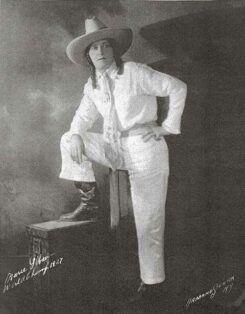
Twenty-three-year-old Marie Gibson straddled a cantankerous bronco waiting inside a chute at the Havre Stampede in Havre, Montana. It was July 1917, and this ride would be the cowgirl’s first as a professional. Long, black curls dangled from the wide sombrero atop her head, and she wore men’s riding breeches and a flamboyant silk shirt to match. When the onery bronc was set free, he bolted into the rodeo arena kicking and bucking. Marie held on, refusing to be thrown. She placed third in the women’s bucking contest but promised to return the following year to beat the riders that finished first and second – Fanny Sperry Steele and Fox Hastings.
Marie Antoinette Massoz Dumont Gibson was born in Holland, Manitoba, Canada on August 18, 1894. Her father operated a stable and trained horses at their family home in North Dakota. Marie learned to break horses at an early age and had a natural talent for trick riding. When she was sixteen, she married a businessman named Wilford Joseph Dumont and the couple moved to Canada. They had three children and when their marriage ended in 1916, Marie moved to Montana and found work on a ranch in Havre. It was there she honed her riding skills and learned to rope steers.
After her debut at the Havre Stampede, Marie went to Canada where she rode in more than a dozen rodeos. She was the sole supporter for her family and, in an effort to add to her winnings, she often announced that for a collection from the audience she would ride any horse brought into the arena. Marie was hired to perform with several Wild West shows and traveled all over the world demonstrating her trick riding skills.
Marie married professional bronc rider Tom Gibson in 1919. Five years after their wedding, Tom was involved in a car crash that left him crippled. Marie became the sole supporter for her family. She participated in several rodeos winning titles in steer riding and the money that went along with it. A series of minor accidents while taking part in bronc riding events left her with permanent injuries that required her to use a cane when she walked. But Marie did not let the disability come between her and taking part in various rodeos. She was named Women’s World Bronc Riding Champion at Cheyenne Frontier Days in 1925.
In 1931, after winning her third championship, she was badly hurt at a rodeo in Great Falls, Montana, when she was thrown from a horse called Scar Face. As she was coming out of the chute, her foot caught in the fence, tearing her boot almost off her foot. Marie lost her balance and was thrown violently. The horse then turned and struck her with both feet. The next day she rode with a bandaged head.
The plucky champion didn’t fear injury or death. When a reporter asked her about the many times she had been hurt riding she simply said, “It’s to be expected, but the sport is in one’s blood. It’s also a fine way to earn a living.”
Marie Gibson died on September 23, 1933, when her ride accidentally fell on her at a rodeo in Idaho Falls, Idaho. She was thirty-nine years old.
To learn more about fearless women like Marie read
Along Came a Cowgirl: Daring and Iconic Women of the Rodeo and Wild West Shows