An Open Secret & Busts at the Brothel


The discovery of gold in the southern Black Hills in 1874 set off one of the great gold rushes in America. In 1876, miners moved into the northern Black Hills. That’s where they came across a gulch full of dead trees and a creek full of gold and Deadwood was born. Practically overnight, the tiny gold camp boomed into a town that played by its own rules and attracted outlaws, gamblers, and gunslingers along with the gold seekers.

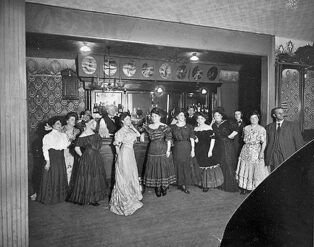
Deadwood was comprised mostly of single men. In the beginning the ratio of men to women was as high as 8 to 1. The lack of affordable housing, the hostile environment, the high cost of travel, and the expense of living in Deadwood prevented many men from bringing their wives, girlfriends, and families to the growing town. Hordes of prostitutes and madams came to Deadwood to capitalize on the lack of women. By the mid-1880s, there were more than a hundred brothels in the mining community.

One of the most notorious cat houses in Deadwood was owned and operated by Al Swearengen. Swearengen was an entertainment entrepreneur who opened a house of ill-repute shortly after he arrived in town in the spring of 1876. Initially known as The Gem, the brothel was host to several well-known soiled doves of the Old West from Eleanora Dumont to Kitty LeRoy.

Among the many madams who ran other cat houses in and around Deadwood were Poker Alice Tubbs, Mert O’Hara, and Gertrude Bell. The names of some of the most popular brothels in Deadwood Gulch were the Shy-Ann Room, Fern’s Place, The Cozy Room, the Beige Door, and the Shasta Room. After more than a hundred years of continual operation, the brothels in Deadwood were forced to close in 1980.

The brothels in Deadwood were raided numerous times during their 103-year existence. The Shasta Room located at 610 ½ Main Street was raided by authorities nine times between 1936 and 1964. Some of the madams were charged with the illegal sale of liquor and some with disturbing the peace. On January 11, 1939, a customer named Lodell Jay was taken into custody and charged with assault and battery after beating Madam Reid and creating a disturbance at the brothel.

To learn more about busts at the brothels read An Open Secret: The Story of Deadwood’s Most Notorious Bordellos. Visit www.chrisenss.com for more information. An Open Secret is available everywhere books are sold, on Amazon.com, Barnes&Noble.com, and at the Brothel Deadwood in Deadwood.
 

Queen of the West

Enter now to win a copy of

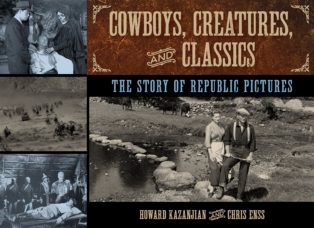
Cowboys, Creatures, and Classics: The Story of Republic Pictures


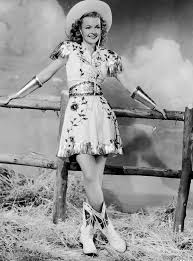
Dale Evans was one of Republic Pictures’ most popular western stars.  The unlikely celluloid cowgirl, western star starred in tandem with singing cowboy Roy Rogers in most of her thirty-eight films and two television series.  The undisputed Queen of the West was born Frances Octavia Smith on October 31, 1912, Uvalde, Texas.  In her words, her upbringing was “idyllic.”  As the only daughter of Walter and Betty Sue Smith, she was showered with attention and her musical talents were encouraged with piano and dance lessons.

While still in high school, she married Thomas Fox and had a son, Thomas Jr.  The marriage, however, was short-lived.  After securing a divorce, she attended a business school in Memphis and worked as a secretary before making her singing debut at a local radio station.  In 1931 she changed her name to Dale Evans.

By the mid-1930s, Dale was highly sought-after big-band singer performing with orchestras throughout the Midwest.  Her stage persona and singing voice earned her a screen test for the 1942 movie Holiday Inn.  She didn’t get the part, but she ended up singing with the nationally broadcast radio program the Chase and Sanborn Hour and soon after signed a contract with Republic Studios.  She hoped her work in motion pictures would lead to a run on Broadway doing musicals.

In August 1943, two weeks after signing a one-year contract with Republic Studios, Dale began rehearsals for the film Swing Your Partner.  Although her role in the picture was small, studio executives considered it a promising start.  Over the next year Dale filmed nine other movies for Republic, and in between she continued to record music.

Dale Evans dreamed of starring as the lead in the film version of Oklahoma, but Republic president Herbert Yates had other plans for the actress.  He wanted her to play opposite the studio’s star cowboy in the movie The Cowboy and the Senorita.

Dale’s only experience in westerns had been a small role as a saloon singer in a John Wayne picture, and she was not a skilled rider.  She committed herself to doing her very best, however, in the role of the “Senorita,” Ysobel Martinez.

The picture was released in 1944 and was a huge success.  Theatre managers and audiences alike encouraged studio executives at Republic to quickly re-team Dale and Roy in another western.

In between her film jobs, Dale toured military bases in the United States with the USO.  She sang to troops on bivouac, from Louisiana to Texas.  She was proud to think she was bringing a little sunshine into the hearts of the soldiers.

Dale also brought sunshine into the hearts of moviegoers, and ticket sales were evidence of that.  Republic had happened onto the perfect western team.  Dale was a sassy, sophisticated leading lady and the perfect foil for Roy, the patient, singing cowboy.

The Cowboy and the Senorita was a big hit for Republic.  The April 1944 edition of Movie Line Magazine heaped praise on the film and its’ stars.  “Intrigue and song fill the Old West when America’s favorite singing cowboy rides to the rescue of two unfortunate ladies about to be swindled out of their inheritance,” the magazine article read.


To learn more about Dale Evans read

Cowboys, Creatures, and Classics: The Story of Republic Pictures


Republic Pictures and Jean Nate

Enter now to win a copy of

Cowboys, Creatures, and Classics: The Story of Republic Pictures


Not too long ago, I was in Pasadena with Howard Kazanjian promoting the book we coauthored entitled Straight Lady: The Life and Times of Margaret Dumont, “The Fifth Marx Brother.” It was a lovely event. With the exception of one woman who was wearing a designer jumpsuit with rhinestones, twenty bracelets on each wrist, and way too much Jean Nate, everyone was kind and complimentary. The lady in the jumpsuit declined to purchase a copy of the book and wasn’t shy about letting us know why. “I read a few chapters of your work in Barnes and Noble,” she began. “Maggie Dumont and Groucho Marx had a long-standing affair and you never mentioned it your book. It’s disgraceful that you call yourselves nonfiction writers. It’s useless to pretend that you’ll ever be widely read.”

Before I was able to share with her that in fact, Dumont and Marx were never romantically involved, she turned and stormed out of the building. The smell of Jean Nate still hovered in the air hours after she’d gone. I thought of a dozen things I could have said in response to the rudeness. Things like, “If you’re going to say something that dumb, you could at least fake a stroke” or “There’s a bus leaving in a few minutes. Please be under it.” Instead, I said nothing. And then she posted her remarks on Amazon and I wished I had followed her out of the store and shouted, “So, that’s what a mummy looks like without the bandages!”

The truth is that authors with infinitely more talent than I ever hope to have had endured harsh words from readers. One reviewer called William Golding’s book Lord of the Flies, “…completely unpleasant.” A critic of Truman Capote’s book In Cold Blood noted, “One can say of this book-with sufficient truth to make it worth saying: ‘This isn’t writing. It’s research.’” Another noted of Thomas Berger’s book Little Big Man, “…a farce that is continually over-reaching itself. Or, as the Cheyenne might put it, Little Big Man Little Overblown.”

Noel Coward once said, “I love criticism just as long as it’s unqualified praise.” I think I agree. This month I’m giving away a copy of Cowboys, Creatures, Classics: The Story of Republic Pictures.

Bring on the unqualified praise!


The Adventures of Captain Marvel

Enter now to win a copy of

Cowboys, Creatures, and Classics: The Story of Republic Pictures


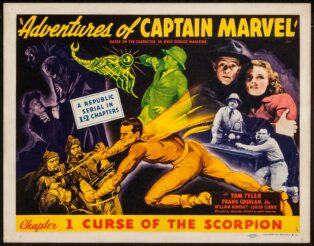
A popular character Republic Pictures was allowed to introduce in one of its chapter plays was Captain Marvel. Also known as Shazam, the superhero was created in 1939 by artist C. C. Beck and writer Bill Parker for Fawcett Comics. Captain Marvel was the most popular comic book superhero of the 1940s. He was also the first to be adapted into film. The film was entitled Adventures of Captain Marvel.

In an interdepartmental memo passed from various executives at Republic to Herbert Yates, the project was touted as having “massive potential to be a box office hit.” The twelve-part series premiered in March 1941. The plot of the chapter play was described in the following way:

To a remote section of Siam, jealously guarded by unconquered native tribes, comes the unwelcome Malcolm Scientific Expedition seeking knowledge of the ancient Scorpion Dynasty. Billy Batson, assistant to a radio expert, is the only one of the parties who does not enter a forbidden chamber. As a result, he is awarded the power to transform himself into a superman, Captain Marvel, upon uttering the word “Shazam.”

After a dozen spine-tingling chapters, Billy is bound and gagged so he cannot utter the word. He tricks the Scorpion into releasing the gag in order, as he pretends, to explain to him the secret of his invulnerability. Once released, he cries, “Shazam” and becomes Captain Marvel. He is able to free himself and his friends and expose the Scorpion once and for all.

Adventures of Captain Marvel was a huge success for Republic Pictures. Critics called the production “roaring good entertainment.” Many film aficionados consider the serial to be the best ever made.

The collaboration between Republic Pictures and Fawcett Comics continued after the release of the Captain Marvel serial. In 1942, the two entities brought the character Spy Smasher to the screen. Spy Smasher is a costumed vigilante and freelance agent who battles a Nazi villain known as the Mask. The Mask heads a gang of saboteurs determined to spread destruction across America. According to author and film historian Alan G. Barbour, the Mask was the first in a long line of stereotypes that pictured hard-faced Nazis as propagandist tyrants.

Spy Smasher was a twelve-part serial that was shot in thirty-eight days. Production began on December 22, 1941, just a few days after the Japanese bombing of Pearl Harbor. The Spy Smasher wore a cape, leaped from bridges onto fast-moving cars, outgunned Nazi devils, and escaped from all types of death traps, from burning tunnels to compartments slowly filling with water. Spy Smasher used a number of gadgets, among them being various laser beams and his fire-resistant cape, to foil the Nazis’ plans.


To learn more about Captain Marvel and the Spy Smasher read

Cowboys, Creatures, and Classics: The Story of Republic Pictures

The Doctor Was A Woman Research

During the many months I spent researching and writing about pioneer women physicians, I couldn’t help but notice a theme that ran through the majority of the stories I found. As far back as 1890 in the Gold Country, women patients were seeking doctors’ recommendations on how to stop the aging process. Women of a certain age were hoping to find a crème or a lotion to remove the dark circles under their eyes and reduce wrinkles on their face and neck.
The invention of the “bust improver” in 1887, with pads of assorted sizes that could be inserted into a slit in the fabric, solved any enhancement issues. The corset helped women who wanted a waist-measurement that did not exceed the number of years of her age was a problem solver as well. How to get rid of dark circles and wrinkles was still a mystery.
Some doctors suggested women slather their face with donkey milk or duck fat to eliminate crow’s feet and turkey’s neck. Women complained the prescription did nothing to eradicate the wrinkles. It did, however, attract cats. A trade off most ladies disliked immensely.
Advertisements for Pears Soap featuring the beautiful actress Lilly Langtry, promised women who used the product a “nice youthful complexion, young looking hands, a reduction in wrinkles, and happiness galore.” In the print ads, Lilly boasted about the wonderful results she had washing with Pears Soap daily and encouraged women with stubborn wrinkles to wash their face two and three times a day. Langtry was a successful, wealthy, twenty-eight-year-old and many women were annoyed that someone who obviously didn’t struggle with wrinkles at her age would be giving advice on how to halt the process or gain happiness.
I feel the same way every time I see a commercial about wrinkle cream starring a teenager. Or hear a twenty something model lecture me about avoiding meat and eating only lawn clippings and Greek yogurt. What makes advertisers think the opinion of these supermodels has more weight or importance simply because they happened to hit the pick six in the genetic lottery?
It seems our entire existence is spent yearning for what we don’t have, and we’re convinced that whatever it is we’re missing is the one thing keeping us from perfect bliss. Which the makeup manufacturers would have you believe resembles a Revlon commercial where everyone is in a thong bikini cavorting on the beach while applying rejuvenating cream on their nonexistent drying pores. I don’t think it’s possible to have baby dolphin smooth skin unless you’re a dolphin. And I personally look like a sumo wrestler in a thong.
And as for happiness… What makes people happy anyway? I’ve concluded that most people are only really happy not when something good happens to them, but when something bad doesn’t happen to them.
Happiness is not settling for less, but just not being miserable with what is. I have always lived by the creed that it’s not the approval or accolades or possessions that make you smile, but simply making the left turn even though you were the third car in the intersection.
Now, where’s that duck fat?