Along Came a Cowgirl and Florence LaDue

Enter now to win a copy of

Along Came a Cowgirl:

Daring and Iconic Women of the Rodeo and Wild West Shows


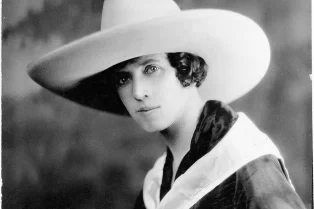
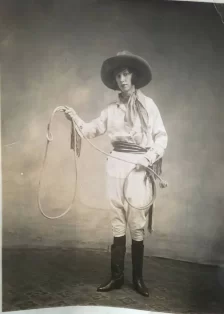
Twenty-nine-year-old Florence LaDue laid on her back in the middle of a rodeo arena in Alberta, Canada, twirling a lasso. It was July 1910 and the crowd in the stands watching her work were cheering and whistling. The trick the petite cowgirl was preparing to do was to throw a wide loop over a rider and his horse as they galloped by. Florence had already thrilled the spectators roping six running horses with a single twirl of her lariat. She’d also performed the difficult feat of tying a double hitch in slackened rope with two movements of her wrists and demonstrated her agility and endurance jumping through a loop from side to side. There wasn’t much doubt she could successfully pull off the next stunt from a prone position, but the audience watched with wrapped anticipation.

She spun the rope, tossed it high in the air and it landed around the cowboy and his Pinto. She then jumped to her feet and pulled the rope tight around the two. The fans erupted in applause. She waved at them and bowed appreciatively. For more than twenty years, Florence competed against some of the most accomplished cowgirls in the business for trick and fancy roping championship titles – with few exceptions she won the contests she entered. It’s for that reason she’s recognized as “the greatest woman trick and fancy rope of all time.”

The talented roper was born Grace Maud Bensel on June 27, 1883, in Chippewa County, Minnesota. Her mother died when she was a little girl, and she was raised by her father who was a farmer. When she was in her teens, she ran away from home and, at some point, signed on with the Cummins Wild West Show and Indian Congress and changed her name.

While perfecting her roping and riding act at a show in Chicago in 1905, she met a cowboy performer from Canada named George “Guy” Weadick. The two fell in love and were married on November 17, 1906. For the first five years of their marriage Florence and her husband were constantly on the move. They worked with John P. Kirk’s Elite Vaudeville Co. and appeared with Will Rogers in Will Rogers’ Wild West Show.  They performed at the Keith-Albee Theater, the Orpheum, and the Pantages, and appeared on Broadway in the show Wyoming Days. The couple also shared their talent with overseas audiences in Glasgow, London, and Paris.

By mid-1911, Florence was working with the Miller Brothers 101 Show and squaring off against their star performer America’s First Cowgirl, Lucille Mulhall.  In September 1912, Florence beat out Lucille at the Calgary Stampede Rodeo and was named woman’s champion in fancy and trick roping. She maintained that title until she retired in 1927.

Once Florence stopped competing, she dedicated herself to helping him run the Calgary Exhibition and Stampede Rodeo and the Stampede Guest Ranch, the first guest ranch in Canada.

Florence LaDue passed away on August 9, 1951, in Alberta, Canada. She was sixty-eight-years-old.
 

along came a cowgirl cover


Along Came a Cowgirl and Blanche McGaughey

Enter now to win a copy of

Along Came a Cowgirl:

Daring and Iconic Cowgirls of the Rodeos and Wild West Shows


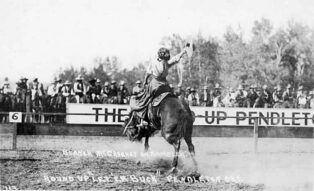
Bronc rider and bulldogger Blanche McGaughey sat in the chute atop a fierce quarter horse named Scar Leg.  “Wait a minute,” she told the cowboys sitting on either side of the gate.  She smiled at the men as she tucked an embroidered handkerchief into her belt.  “I don’t want to lose my power puff,” she told them.  “Does your nose need some nose paint?” one of the men remarked as he handed her the halter rope.  The mount was released into the arena before she could respond.  All eyes were on the cowgirl.  Scar Leg did his best, bucking and kicking furiously, but Blanche rode like an Amazon.

Blanche’s talent for riding and roping cattle was perfected at an early age while on her father’s Wyoming ranch.  “When I was only eight-years old, I thought nothing of riding an Indian pony that had never been saddled or bridled,” she told a newspaper reporter at the Allentown Leader in Pennsylvania in July 1914.  “The cowpunchers that worked the spread always let me in on the fun when there were cattle to be rounded up.  There’s no place I’d rather be than the back of a horse.”

Blanche’s love of riding led to a job with the 101 Wild West show.  In addition to bronc busting and trick roping, she also wrestled long-horned, Texas steers.  Her fellow performers credited her with nightly creating the “biggest thrill delivered to the audience.”  Blanche was devoid of nerves, strongly built, and never failed to get a “fall” out of the animal.  Rodeo goers were in awe of her ability. “The trick looks easy,” Blanche explained to the Allentown Leader reporter, “but I can assure you it is no child’s play to bring a steer to its knees and then make it turn over.  Sometimes the steer will yield after a little vigorous effort, but often it requires not only the utmost brute strength, but also an infinite amount of patience and diplomacy to bring the animal down.”

Blanche consistently won top honors at the Pendleton and Cheyenne rodeos and was recognized as the champion woman bronc buster of the northwest in 1912 and 1913.

The cowgirl suffered through a number of injuries on the road to the title.  She fractured her leg while relay racing at a show in Oregon and broke her wrist at a bulldogging contest in Wyoming.  During a daring performance at a rodeo in Winnipeg, Snake, the bronc Blanche was riding, threw himself to the ground and rolled over on her, crushing her foot.

Blanche had a reputation for being just as tough outside the rodeo arena as she was inside it.  She traveled with several well-known women riders including Prairie Rose Henderson, Ruth Roach, and Vera McGinnis.  In early 1913, Blanche got annoyed with Vera on one of their road trips and let her know how she felt about the cowgirl.  The verbal altercation escalated with Blanche referring to Vera as a “chippy.”  The pair settled their differences with a fist fight near the horse stalls at Madison Square Garden.

Blanche retired from the rodeo profession in 1917, shortly after being named as a co-respondent in a divorce suit filed in Uniontown, Pennsylvania.


To learn more about bulldoggers like Blanche McGaughey read

Along Came a Cowgirl:

Daring and Iconic Women of the Rodeo and Wild West Shows.


Along Came a Cowgirl and Bonnie Gray

Enter now to win a copy of the new book

Along Came a Cowgirl:

Daring and Iconic Cowgirls of the Rodeos and Wild West Shows


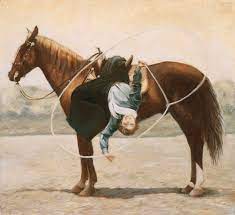
From the early 1920s to the mid-1930s, trick and fancy rider Bonnie Gray and her company were recognized as some of the best rodeo performers in the country.  The famous, all-around cowgirl solidified her place in the profession as an expert in the “under the belly crawl” stunt.  Riding quickly into the arena atop her horse, King Tut, Bonnie would drop down on the nearside of the horse, feed herself headfirst between the animal’s galloping legs, reach through, haul herself up the off side, and jump back into the saddle again.  Audiences from Manhattan to Cheyenne were dazzled by the skill and daring it took to execute the death-defying trick.

Bonnie Jean Gray was a natural athlete.  Born in Kettle Falls, Washington, in 1891, she learned to ride on her family’s ranch.  She was also a gifted musician.  An accomplished pianist, she attended the University of Idaho where she majored in music and participated in a variety of sports including track and tennis.

Among her many other abilities, Bonnie had a talent for medicine.  During World War I, she studied nursing at a military post in Montana.  She utilized her nursing expertise assisting her brother who was a doctor in Arizona.  She helped deliver many babies and tended to those struck down with influenza in 1917 and 1918.

Bonnie’s interest in trick riding was something she’d had since when she was a little girl.  She decided to pursue the sport in 1918 and, in 1922, made her professional debut.  She participated in some of the biggest rodeos across the country and in Canada.  In a short time, she had earned the title as the World’s Champion Woman Rider.

According to the February 23, 1923, edition of the Deming Headlight, Bonnie had charmed the fans by her overall look and attracted attention as the only woman to have ridden bulls used in the bullfights in Mexico.  “Is she pretty?” the article posed.  “Yes, in a softly, feminine way, with a row of dazzling white teeth that show no traces of dental adornment.  She’s fearless in the saddle as well as beautiful.”

In June 1930, Bonnie married trick rider Donald Harris in Los Angeles, California.  The bridal party was on horseback, and the ceremony was held in an elaborately decorated arena with more than a hundred mounted guests in attendance.

Bonnie and Donald’s marriage was a volatile one.  Donald was physically abusive, and, by August 1932, the couple was divorced.

After the divorce was finalized, Bonnie left the rodeo world to become a motion picture stuntwoman.  She doubled for popular western film stars Tom Mix, Tim McCoy, Hoot Gibson, and Ken Maynard.  One of the most elaborate and dangerous stunts she performed on camera involved her and the horse the studio had her ride.  The pair jumped a clump of brush and hurtled down a ten-foot cliff.  Bonnie was paid $10,000 for the stunt, but vowed she’d never agree to participate in anything else so hazardous again.

Bonnie Gray Harris died on April 28, 1988, at the age of ninety-seven.  She is buried at Forest Lawn Memorial Park in Hollywood Hills, California.


To learn more about riders like Bonnie Gray read

Along Came a Cowgirl:

Daring and Iconic Women of Rodeos and Wild West Shows.


Along Came a Cowgirl and Dorothy Morrell

Enter now to win a copy of

Along Came a Cowgirl:

Daring and Iconic Women of Rodeos and Wild West Shows


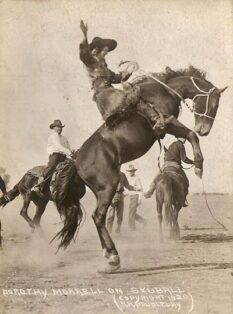
“I rode my first horse on a bet,” admitted World Champion cowgirl Dorothy Morrell in 1917. “That I am champion woman rider of the world today was due to an accident, or rather a dare.” At the age of twenty-four Dorothy attended a wild west exhibition in Fresno and was mesmerized by the women bronc riders. A cowboy spectator named Skeeter Bill Robbins, who was seated next to her at the event, bet she could ride one of the broncs. Skeeter had met Dorothy in Montana and witnessed her extraordinary riding skills. Even after she told him she’d never ridden a bucking horse in her life, Skeeter insisted she had what it took and dared her to try it. Dorothy reluctantly agreed.

The mustang’s name was Lillian Russell. “When I was fairly seated someone gave a whoop and the horse bowed its back and began to lunge,” she told a newspaper reporter years later. “With every impact there was a terrific jolt and I thought that every bone in my body would be thrown out of joint. Had it not been for Skeeter though, I think I surely would have been thrown. ‘Every time that cayuse hits the ground,’ he told me, ‘Raise your hat high and when he comes up hit him between the ears.’ The advice saved the day, for it kept me erect and well forward and going with the animal when he was in the air. That’s all there is to riding a bronc.”

Born Caroline Eichhorn in Russia in 1888, Dorothy immigrated to Canada with her family in 1889 and settled in Winnipeg. She came to the United States in 1912 and for several years lived near Helena, Montana. She learned to ride working as a mounted mail carrier for the Blackfeet Indians.

Shortly after accepting Skeeter’s bet and realizing she could indeed ride bucking broncos, Dorothy embarked on a career with the rodeo. She signed on with the 101 Ranch Show and there perfected the art of riding fractious horses. In 1914, she won the title of Women’s World Champion Bucking Horse Rider at Cheyenne Frontier Days rodeo and married Skeeter Robbins. Skeeter was also a bronc rider and the couple traveled together participating in rodeos from Dallas to London.

Dorothy and Skeeter spent time in Hollywood during the mid-1920s, where they worked as horseback riding extras and stunt doubles on several Western films. They also performed in vaudeville acts and in circuses. Skeeter was killed in a car accident in 1933. Dorothy was in the vehicle with him and was seriously injured. She returned to the rodeo circuit the following year winning awards in trick riding and roping and relay racing.

When Dorothy retired from professional riding, she returned to Canada where she enrolled in college and eventually became a nurse.

“I love being a cowgirl,” she told a reporter when she first started riding in rodeos. “That, perhaps, is because I love horses – horses, and babies. I often wish I could be a horse. Of course, I have been a baby once and therefore have no desire to be a baby again. But I would dearly love to be a horse!”

Dorothy Morrell died in Ontario in 1976 at the age of eighty-eight.


To learn more about the remarkable women whose names resounded in rodeo arenas across the nation in the early twentieth century read the new book

Along Came a Cowgirl:

Daring and Iconic Women of Rodeos and Wild West Shows by Chris Enss.


Along Came a Cowgirl and Hazel Hickey Moore

Enter now to win a copy of

Along Came a Cowgirl:

Daring and Iconic Women of the Rodeo and Wild West Shows


You could tell by the way Hazel Elizabeth Hickey Moore dressed when she was growing up, she was a cowgirl. You could also tell she was a cowgirl by the way she rode magnificent jumping horses in the Ringling Brothers and Barnum Bailey Circus. Hazel was also destined for a career as a Wild West Show cowgirl because of her parents. Her father was an equestrian circus performer, and her mother was a trapeze artist. Hazel was raised under the big top.

Born in Watertown, New York, on June 25, 1902, Hazel’s early years were spent raising and training a variety of animals from sheepdogs to stallions. When she wasn’t training animals, she practiced her horseback riding skills and became an expert in dressage and high jumping atop her horse Perfect Lady. When the Ringling Brothers Circus was performing in Kentucky, Hazel took some time away from her act to enter Perfect Lady in a jumping competition. The pair rode away with the top prize.

Hazel and Perfect Lady performed in several other western shows including the 101 Ranch, Cole Brothers, the Joe Green Wild West Show, and the Tim McCoy Wild West Show. In one of her most popular routines, Hazel would ride out into the center of the arena dressed in a long gown. After dazzling the audience with a series of dressage maneuvers, she would break into song and doves would fly about overhead. When Hazel signaled the birds, they would land on the horse and ride about the ring with her.

Not only did Hazel possess exceptional horseback riding talent, but she was a gifted fashion designer and seamstress. Throughout her career in the arena, Hazel designed, made her own costumes, and beaded accessories. In addition to making clothes for herself, she made outfits for several of the other men and women in the show. Hazel always had a small, travel-sized treadle sewing machine and riding tack with her.

The accomplished rider and seamstress met saddle bronc rider Percy Moore while performing in a show in the Midwest. The couple married on May 13, 1932 and continued to travel about the United States entertaining audiences.  The Moores had three daughters, the oldest of which was born while they were on the road performing. News of the blessed event and the location of the birth, a tent in Colonel Jim Eskew’s Wild West Show, was carried by newspapers across the country. Two of Hazel and Percy’s daughters went on to be rodeo performers, regaling spectators with their abilities as trick riders and ropers.

Hazel’s children and grandchildren proved to be just as interested in her legacy in fashion design as they were in her legacy in horseback riding. Her granddaughter, Linda Clark, and great granddaughter, Darcey Good, not only became remarkable barrel racers and a breakaway roper but went on to open a clothing boutique showcasing garments inspired by Hazel’s style. Hazel’s Fashion Wagon pays homage to the diminutive horseback riding superstar who entertained enthusiastic crowds from Syracuse to San Francisco.

Hazel Hickey Moore passed away on July 24, 1977, in Oklahoma City, Oklahoma, at the age of seventy-five.


To learn more about iconic rodeo stars like Hazel read Along Came a Cowgirl