
Big changes are coming to my website and news about the additional books I’ll be releasing soon will be announced over the next month. Until then I’ll be presenting some of my favorite mail-order bride ads included in the book Hearts West: Mail-Order Brides on the Frontier. For more information about the book go to www.chrisenss.com. “By a lady who can wash, cook, scour, sew, milk, spin, weave, hoe, (can’t plow), cut wood, make fires, feed the pigs, raise the chickens, rock the cradle, (gold-rocker, I thank you, Sir!), saw a plank, drive nails, etc. These are a few of the solid branches; now for the ornamental. “Long time ago” she went as far as syntax, read Murray’s Geography and through two rules in Pike’s Grammar. Could find 6 states on the Atlas. Could read, and you can see she can write. Can – no, could – paint roses, butterflies, ships, etc. Could once dance; can ride a horse, donkey or oxen, besides a great many things too numerous to be named here. Oh, I hear you ask, could she scold? No, she can’t you, you ______ _______ good-for-nothing________! Now for her terms. Her age is none of your business. She is neither handsome nor a fright, yet an old man need not apply, nor any who have not a little more education than she has, and a great deal more gold, for there must be $20,000 settled on her before she will bind herself to perform all the above. Address to Dorothy Scraggs, with real name. P.O. Marysville.”
Journal Notes
Ode to Sam Sixkiller
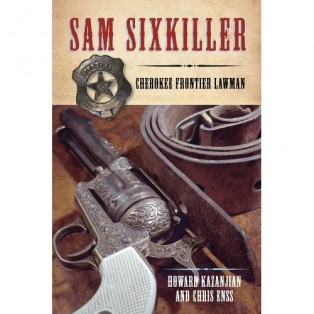 It was an honor to have worked on the book about Sam Sixkiller with Howard Kazanjian and to have met Sam Sixkiller’s family members in Oklahoma last month. The following review of the material appears in the September 2012 edition of True West Magazine. “Sam Sixkiller: Cherokee Frontier Lawman is a very important book, if only for the fact that it is one of the first, if not the first, biographies of an American Indian law enforcement officer of the Old West. The book is not about just any American Indian; it chronicles the life of one of the most famous and outstanding lawmen during the frontier era. Authors Howard Kazanjian and Chris Enss, through outstanding research, tell the engrossing story of Cherokee lawman Sam Sixkiller. During his career he was a deputy U.S. marshal under Judge Isaac C. Parker, a captain of the U.S. Indian Police and a railroad detective. This is an outstanding book on the Indian Territory and an American frontier hero. Art Burton, author of Black, Red and Deadly: Black and Indian Gunfighters of the Indian Territory, 1870-1907.”
Violence
I’m taking a departure from writing about the Old West today. My thoughts have been centered around the horrific event that took place at a movie theatre in Colorado. I’ve read articles and heard talking heads blame violence on television and in motion pictures for the shooting and I wanted to respond. From cave drawings depicting the hunt to tribal war songs to a little tome called the Bible, the portrayal of violence has, in one way or another, been a part of human discourse ever since we stopped dragging our knuckles on the ground and started using them to give each other noogies. It seems like everyone is looking for someone to blame when people go bad, but motion pictures and television aren’t the biggest influences on kids. We are. There’s probably more real emotional violence and bad vibes at the average American family dinner table than in an entire season of C-S-I. At least that was my experience. I don’t know if I really buy that there’s a connection between violent movies and TV and violent behavior. I mean, I grew up watching a steady diet of Dark Shadows, Cannon, Johnny Quest and Bugs Bunny. I never once thought it was okay to load a gun and go hunting “wabbit” in public places. That being said, there are many shows that prey on our morbid curiosity: When Animals Kill, Brushes with Death, Shark Wranglers, and one of the worst of all, Housewives of New Jersey. Watching the local news isn’t any better. In reporting violent crime, the local news comports itself with all the dignity and responsibility of Moe, Larry, and Shemp locked in a haunted house. I think it’s all very simple. Forget government intervention, forget blaming all the bad that happens on movies and television and get back to basics. Stay home with your loved ones, turn the TV off, pray together, talk together, get to know one another. Tell the people in your life that have had a positive impact on you just how much their influence means. Hug them like there’s no tomorrow because as we know for many of the men and women who went to the movies this past weekend in Colorado there was no tomorrow.
The Life and Hard Times of Belle Ryan
The New World gambling parlor in Marysville, California in 1851 was filled with prospectors and sojourners eager to lay their money down on a game of chance. Patrons could choose from a variety of amusements which included roulette, dice, faro and poker. The New World was a grand and ornate saloon. An elaborate bar lined an entire wall and brass mountings accentuated the gleaming countertops. Imposing mirrors clung to all sides of the enormous entryway and paintings of nude women relaxed in beauty prostrate, loomed over the patrons from the walls above. Madame Belle Ryan, a voluptuous creature with dark hair, hazel eyes and a fair complexion, sauntered down the stairs surveying the guests that had gathered. Men scrambled for a place at the tables, their gold dust and gold nuggets had been exchanged for the chips they tossed onto the green felt – bets for the lucky cards in their hands. Charles Cora, a handsome brute of a man with black hair and a thick, healthy trimmed mustache caught Belle’s eye. He was very nicely dressed. From the Bowler hat on top of his head to the polished, black boots on his feet, he exuded style and confidence. Charles was seated at a table in the corner of the room dealing a hand of poker to four men around him. The pile of chips in front of Charles was proof that he’d had a successful evening. He turned to look at Belle and gave her an approving nod. She smiled back at him then noticed a handful of Cavalry soldiers standing just inside the saloon. Charles spotted the men too and motioned slightly for Belle to go over to them. She winked and proceeded obligingly. The wide-eyed troops admired the beautiful Belle as she strode their way. “Why don’t you come on in and join the fun. Have a drink, sit in on a game or two?” she purred invitingly. “We aren’t much for gambling, ma’am,” one of the young soldiers shared. “We just got our pay and thought we’d stop in for one shot of whisky and then be on our way.” Belle slowly approached the uniform clad man and stopped uncomfortably close to his face. The soldier breathed in her perfume then glanced away, shyly. “But it’s so early,” she said smiling. “Have a drink, play a hand of faro and then we’ll dance,” she persuaded. “I guess we can stick around for a little while,” the enchanted young man offered. Belle escorted the troops to the bar and had the bartender serve them a glass of whisky. “That ones on the house,” she assured them. She then locked arms with a pair of the soldiers and ushered them to the faro table. They obediently sat down and Charles tipped his hat at the new players. “I’ll be back in a bit for my dance,” Belle whispered in their ears. As Belle walked away the bartender served another round of drinks to the soldiers and Charles started dealing the cards. By the time Belle returned to the table the troops had lost their entire wages. They took a turn with her on the dance floor then lumbered out of the establishment, dazed and disappointed. Occasionally, Belle Cora was the one that dealt the cards, but her main contribution to the gambling industry was luring players to the game and building their confidence. Belle and her partner, Charles Cora, made hundreds of thousands of dollars off unsuspecting marks who believe they were better than the professional gamblers luring them to the tables. Belle Ryan Cora was born in Baltimore in 1832 and her parents named her Clara Belle. Her father was the minister of a small parish and the home life she had with her doting mother and young sister, Anna was idyllic. At 17 she fell in love with a distinguished older gentlemen and became pregnant. After learning the news, the child’s father abandoned them. Desperate and ashamed, Belle fled to New Orleans to have her child. The baby died shortly after being born and Belle was despondent and alone. While wandering the streets of New Orleans contemplating her life, she met a kindly woman who took pity on her situation and offered to help.
Belle recognized the woman as a known madam in the city. She was fully aware of the kind of assistance being presented, but she felt her options were limited. After accompanying the woman to her parlor house, being fed and provided a new wardrobe, Belle accepted her offer of work. In a matter of only a few months she was earning more than any other woman in the city. When Charles Cora, a well-known New Orleans gambler spotted Belle he was instantly smitten. She was equally taken with him. The two began spending time together and in a few weeks were inseparable. Once the news of the California gold rush reached Charles, he decided to try his luck in a place rich with glittering finds. With Belle by his side the two boarded a steamship bound for San Francisco. Charles and Belle weren’t the only ones with a dubious past making the trip. The vessel contained more than 40 gamblers and ladies of the evening. Personalities clashed during the voyage. The scruples of such motley passengers were questionable or nonexistent. When they weren’t cheating one another at a game of poker of faro, they were conning law abiding travelers out of their possessions or blatantly stealing from others. Charles was one of two thieves who got caught trying to take writer Edward L. Williams’s purse filled with money. On December 11, 1849, Williams recorded the incident in his journal. “I was hanging in a hammock near the bow, alongside a row of bunks,” he wrote. “Not long after falling asleep I was awakened by a volley of curses and a loud “Get out of here!” There followed more “coarse and vile oaths” and the threat: “If you don’t get out, I will cut you down. You are keeping the air from me!” I didn’t move. One of them I recognized as Charles Cora, removed a large knife from his pocket. Just then, on the other side of his hammock I saw a pistol gleaming in the moonlight and the man holding it said, “You attempt to cut the boy down for his purse before me and I will blow a hole through you, you infernal blackleg Southerner. I know you, you used to run a gambling game at New Orleans and you robbed everybody. Get away from that boy!” The confrontation between Charles and the competing robber intensified as the voyage continued. Angry over the thwarted attempt to steal a bankroll to gamble with, Charles and his cohorts took to bullying the passengers. He caused so much trouble the ship’s captain had him and his partners in crime placed in irons. Belle and Charles arrived in San Francisco on December 28, 1849. The gambling team then boarded a stage for Sacramento. The river city was the location for some of the territories biggest poker games. The price to sit in on the game was $20 thousand. Belle put up the money and Charles played. He won a sizeable amount in one hand, but his luck quickly changed and he lost it all. Belle fronted him an additional $60 thousand to stay in the game, but he was unable to turn things around. He then solemnly vowed he would never again play with a woman’s money. The lovers left Sacramento and made the rounds at the various mining camps in the foothills. They set up games at make shift saloons and Belle lured perspective gamblers in for Charles to fleece. Once they had made up the losses they incurred in Sacramento they moved on to Marysville and opened a gambling den called The New World. There were no limits on the bets taken at the tables at the New World. One prospector recalled that “Charles Cora himself laid down a bet of $10 thousand in one hand of 5 card draw. He won his bet too.” Once the gaming house was established and earning a profit, Belle sought to expand the enterprise. In April 1851, she traveled to Sonora. The booming mining town had a population of 5 thousand people and was in desperate need of additional entertainment. Using the name Arabelle Ryan, the confidence woman and madam purchased a house of ill repute. She called the combination brothel and gambling den the Sonora Club. (A confidence woman is someone who gains a person’s trust in order to entice them into a game of chance.) The business was a profitable venture. Charles followed after his paramour and dealt cards for her. By the end of 1851, Belle and Charles had earned more than $126 thousand from their combined businesses in Sonora and Marysville. The gamblers used their substantial holdings to move their trade to San Francisco. Although Charles and Belle were not married she took on his last name when they relocated to the city by the bay. The pair operated out of a two story wooden building that had two entrances. Belle decorated the combination bordello and casino with the finest furnishings and accoutrements. When the Coras opened the doors to the business on November 17, 1852, patrons reported that “it rivaled the finest residences in the city.” Customers included politicians, entrepreneurs and other gambling professionals. They were treated to free champagne and hors d’oeuvres, the most beautiful women in the trade, and liberal tables with a new deck of cards or dice each night. A description of the Cora House included in a manuscript written in 1855 by historian Frank Soule, provides the best look inside Belle’s establishment. “In the fall of 1855, Belle and Charles hosted a party designed to attract high rollers to the den,” Soule noted. “The evening the couple selected for their soirée fell on the same night Mrs. William Richardson was having a get together. Mrs. Richardson and her husband, a U.S. Marshal, were unhappy with the lack of male attendants at their event. When they learned that their invited guests chose to go to Belle’s place, the marshal and his wife were furious.” The previous year antigambling laws had been past by California representatives and all such establishments were to have been shut down. Charles Cora could no longer practice his profession legally. The Richardson’s suspected the party at Belle’s place had actually been a private game in which Charles was the dealer. Mrs. Richardson and the marshal vowed to monitor the activities at the Cora House and catch the pair in the act of breaking the law. When Charles learned of the Richardsons’ plan he informed Belle. A bitter feud between the couples erupted. On November 5, 1855, the Coras and the Richardsons attended a play at the American Theatre. The two couples were placed in balcony seats in close proximity of the other. When the Richardsons learned that the Coras were at the same performance the marshal demanded the theatre management throw the “low moral fiber duo” out. When the manager refused, the Richardsons left. Over the next week, Charles and the marshal exchanged insults and derogatory remarks. Whenever their paths crossed tensions escalated into threats. Finally the two met on the streets to settle things once and for all. The gambler shot Marshal Richardson in the head with a derringer, killing him instantly. Charles was arrested and thrown in jail. Many of the towns people who admired the marshal were outraged and demanded that Cora be hanged immediately. Belle rushed to her common-law husband’s aid and hired two high-powered attorneys to represent him. The cost of their combined retainer was $45 thousand. While Belle fought to prove that Charles acted in self defense, a vigilante committee was being organized. Leaders of the group planned to overtake the jail and exact their own justice. Initial attempts to break into the facility and remove Charles were thwarted. He was arraigned on December 1, 1855, and the trial was set for early January. Belle was not content with merely purchasing good counsel, and she turned her attention to the witnesses who claimed to have seen Charles brutally gun down the unarmed marshal. Belle met with an eye witness to the shooting and offered her money to change her story. When that didn’t work she threatened to kill her. Neither approach convinced the witness to redact her accusation and she was allowed to go on her way unharmed. Charles trial began on January 3, 1856. Shortly after a jury was selected, Belle attempted to bribe a select few of them. Her efforts were fruitless. No one would agree to side with the unpopular couple. The court was made aware of Belle’s behavior, but decided against any legal action. The trial was lengthy and the prosecution played up the “devious” characteristics of Charles and Belle, referring to the pair as “shady gamblers with sinfulness in their lives.” The defense argued that their morals weren’t on trial and that whatever “sinfulness there was in Belle’s life, it was far outweighed by her fidelity to her man.” The jury deliberated for 41 hours after having received the case. They returned having failed to reach a verdict. While Charles awaited a second trial the public at large grew more and more incensed a the outcome. Believing that Charles would get away with murder, the vigilante committee stormed the jail and escorted him to a secret area to be hung. A blindfolded Belle was brought to the location of the execution. The tearful madams asked if one of the clergymen there would marry her and Charles. Minutes before Charles was put to death the two were legally wed. Heartbroken and inconsolable, Belle Cora retreated to her bedroom at the gambling den and remained tucked away in the house for more than a month. Belle emerged a changed woman. She sold the business and moved to a small house with only a few servants as company. She used her considerable financial holdings to support local charities and help children obtain a higher education. She died in San Francisco on February 17, 1862, having given away the bulk of her fortune. She was 30 years-old.
The Young Duke
Flamboyant, outspoken gossip columnist, Hedda Hopper approached the podium at the Hollywood American Legion and stared out over a sea of faces. The majority of the people watching her were influential leaders in the movie business who had assembled for a regular meeting of the Motion Picture Alliance for the Preservation of American Ideals in April of 1951. The organization’s president, John Wayne introduced Hopper to the crowd. She had asked for a chance to address the group on a matter of profound importance. Wayne graciously accommodated her. It wasn’t unusual for members to request a moment to speak on a topic they wanted the alliance to consider. Wayne was unaware that the issue Hopper wanted to discuss was the actor himself. As a round of polite applause rose up, Duke headed back to his seat on the dais. Hopper stopped him before he could get too far away and pulled him back towards the lectern. Wayne smiled obligingly. Wayne had been a member of the Motion Picture Alliance almost from the beginning of its inception in the late 1940s when directors Sam Wood, Walt Disney, and Leo McCarey had founded the group to protect the movie profession from the perceived threat of communism life. The Communist movement was founded in 1919. The economic idea behind the organization was collective ownership of property and group labor for the common advantage. Communism was a growing political force in the United States in the 30s and 40s. At the conclusion of W.W. II, the majority of the U.S. population decided to take a stand against the repressive movement. By the late 1940s a wide-ranging anti-communist network was in place to lead the nation on a crusade against domestic communism. In October 1947, a number of suspected Communists working in the Hollywood film industry were summoned to appear before the House Committee on Un-American Activities, which was investigating communist influence in Hollywood labor unions. The Motion Picture Alliance was a major force of the anti-communism network that sought to stop the impact of the party. Part of the group’s statement of principles included a commitment “to fight with every means at our organized command, any effort of any group or individual to divert the loyalty of the screen from the free America that gave it birth.” Many Hollywood actors, writer and producers were called before the HUAC. Gary Cooper, Robert Montgomery, George Murphy and Ronald Reagan testified, named names and encouraged Congress to intervene. Wayne was never asked to appear before the committee, but his idol Harry Carey was not as fortunate. Carey refused to be manipulated by the committee chair, Joseph McCarthy. McCarthy wanted those who testified to make untrue statements about fellow actors he hoped to imprison. Carey would not go along with him. His uncooperative attitude led to his own blacklisting. Many high-profile conservatives, such as Clark Gable, Gary Cooper and Ward Bond were members along with John Wayne. The majority of the members of the Motion Picture Alliance for the Preservation of American Ideals were in favor of “blacklisting” or barring members of the Communist Party from jobs in the motion-picture industry both on-screen and behind the scenes. Although Wayne believed in maintaining the American ideals in film, he was not in favor of blacklisting. He felt that denying a person the right to work based on their political orientation was wrong. He was also tolerant of industry professionals once associated with the Communist Party who apologized and asked for a second chance. Wayne’s understanding attitude did not sit well with many of the members of the alliance. The majority believed the best way to fight the Communist influence was to bar party members from jobs in front of behind the screen. The situation that angered Hedda Hopper and brought Duke a fair amount of criticism concerned actor Larry Parks. In 1951, Parks had been called before the House Un-American Activities Committee and extensively questioned about his involvement with the Communist Party. He admitted to being a member of the party and expressed his deep regret over the association. He then cooperated with the committee in their quest to find out who else was involved with the movement. Parks gave the committee several names of other participants. Although he was never officially blacklisted, Columbia Pictures terminated his contract and other studios refused to work with him as well. Leaders of the House Un-American Activities Committee asked Wayne, as president of the Motion Picture Alliance, to comment on Parks’s actions. Duke’s response was not the harsh reply they expected. He called Parks’s behavior courageous and added that he needed moral support. “He should be commended as a good American.” Few in the alliance agreed with Wayne. At the Motion Picture Alliance April meeting in 1951, Hedda Hopper gave Duke a thorough tongue lashing at one of the regular meetings of the alliance. She called him a “damn fool” for supporting Larry Parks. Wayne hotly defended his position and added, “when any member of the party breaks with them, we must welcome him back into American society. We should give him friendship and help him find employment again in our industry.” The reaction from the alliance members at the end of the Hopper Wayne exchange was mixed. Some were irritated with Hedda Hopper’s open criticism of Wayne while others commended her firm position. After much discussion the conservative and liberal sides of the alliance decided that all its members would withhold any comments on the HUAC hearings until the complete facts were known. According to director John Farrow, who worked with Wayne on the movie Hondo, Duke’s politics revolved around a simple issue, “he felt protective of his country and its way of life.” In spite of the fact that Duke had a soft heart for those who had made personal mistakes, he was less forgiving of filmmakers who produced material that denounced America’s heritage and foundation, which was perhaps what motivated him to participate in the Alliance. Among the directors and producers he strongly objected to were Academy Award winners Robert Rossen and Stanley Kramer. Wayne felt that Rossen’s film All the King’s Men and Kramer’s movie High Noon were patently “un-American.” All the King’s Men is the story of the rise of politician Willie Stark. Duke believed that the majority of the characters in Rossen’s motion picture lacked moral fiber. The character of Stark was a shady leader who seems only to benefit from his corrupt ways. Duke believed that character fully demonstrated to young viewers that doing right is pointless and evil has great rewards. Duke also felt that Kramer’s High Noon possessed the “single most disrespectful act in any film to date.” At the end of the movie Gary Cooper’s character removes his United States sheriff’s badge, tosses it into the street and steps on it as he walks away. “The message was clear and disturbing to me. It was like belittling the medal of honor,” Wayne told biographer Maurice Zolotow. In an effort to counteract the negative impact of the movies Duke referred to as “protest films,” he set out to make a series of patriotic films. The four motion pictures he choose to do based on their positive political content were Flying Leathernecks and Operation Pacific, released in 1951, Big Jim McLain, released in 1952, and Jet Pilot, released in 1957. All the films were box office successes. Big Jim McLain was a specifically anti-Communist film that generated a great deal of attention not only among film-goers, but with motion picture executives and government officials. In the movie Duke plays a F.B.I. investigator working for the House Committee on Un-American Activities. When it’s learned the Communists are threatening to infiltrate Hawaii, he and his partner are sent to the islands to get evidence against the Red cells that can be used for a documented public hearing. When the film was released it instantly sparked the interest of the Federal Bureau of Investigations and specifically J. Edgar Hoover. Hoover was concerned his agency would be perceived by audiences as one that would rob citizen’s of their Civil Rights in order to build a case against citizens. After reviewing both the completed motion picture and the written screenplay, the script, F.B.I. officials were satisfied the movie had nothing to do with them. They found it to be more the story of the HUAC investigative methods. Some film critics called Big Jim McLain an “embarrassment to the film industry,” and many more liberal-minded movie goers left the theatres fuming. Although the majority of reviews for the film were poor, it was no less a financial success. At the end of the 1952 it ranked among the top 30 highest grossing movies of the year. Young Duke Wayne’s traditional ideas first took root in Iowa. His parents, neighbors and friends families were conservative, and though he had at one time considered himself a liberal, he was a registered Republican and staunchly opposed to excessive taxation, big government and politicians. He was not shy about sharing his opinion on the subject with those closest to him, but was uncomfortable publicly speaking out against any of those areas. It was that uneasiness that convinced him to turn down the Motion Picture Alliance’s initial invitation to be the group’s president in 1949. Ward Bond persuaded Wayne to rethink his position, appealing to his patriotism. Bond believed fervently, as did many other members of the motion-picture industry, that the Communist threat was very real and had crept into the making of movies. “America needs someone like you,” Bond told Duke. “The Alliance needs someone of your stature too.” Wayne reconsidered the offer, believing that it would be a great way to stand up for his country. He reasoned that if he could make a difference with the Alliance he might be able to effect change on a grander scale, but Duke had no real political ambitions for himself. He was motivated solely to serve the country he loved and help those in need. One of his associates said that Wayne was about as “political as a Bengal tiger.” In 1952, Duke supported Senator Robert Taft of Ohio’s run for President of the United States. Taft was against President Franklin Roosevelt’s New Deal and the spending that went into funding the program and in favor of cutting taxes and putting a cap on government spending. Duke campaigned heavily for the Senator. Dwight D. Eisenhower would take the nomination and become President, but that wouldn’t end his relationship with the national political scene. According to fellow actor Ronald Reagan, “John Wayne represented the true American spirit.” The Republican Party capitalized on his influence in 1968 and called upon the star to open their convention in Miami, Florida. He was asked to deliver an inspirational reading rather than the run of the mill invocation. The speech he gave had the desired effect on the cheering crowd. He made it clear to voters that a “true commitment to American values made a difference to all United States citizens.” “This nation,” he proudly told delegates, “is more than laws and government. It’s an outlook, an attitude.” The applause at the conclusion of his speech lasted more than four minutes. John Wayne served three consecutive terms as president of the Motion Picture Alliance. He was succeeded as the head of MPA by Ward Bond. Ronald Reagan would eventually take over as president of the organization, echoing Duke’s sentiments about love for country and dedication to the American dream. The controversial investigation conducted by the HUAC resulted in the blacklisting of a large contingency of Hollywood writers, actors, directors and producers. Many never fully recovered from the social stigma attached to their names and reputation. The HUAC communist probe had a negative impact on the Motion Picture Alliance and many of its members. Industry professionals sympathetic to the plight of the individuals who bravely endured being blacklisted accused the MPA of not only being too compliant with the HUAC, but for being anti-labor, anti-Semitic, anti-women and anti-Negro. In 1975, 13 years after the House of Representatives changed the committee’s name from HUAC to the committee on Internal Society, the organization was completely abolished. The MPA disbanded at the same time. John Wayne arrived on the other side of the highly publicized “Red Scare” years virtually unscathed. Wayne’s liberal peers didn’t agree with his involvement with the MPA, but respected his conservative views and recognized him as a “fair minded individual who was not a reactionary, but a balanced, understanding man.” Most of Wayne’s fans saw him in the same light. In the midst of a troubled period in U.S. history, Wayne continued to seen by the public as a true American, a symbol of a time when men proved their worth not with words, but action.
The Demise of John Sutter
The life of Captain John Augustus Sutter, the German-Swiss pioneer, dramatically changed when gold was discovered on his property on January 24, 1848. Once the news of the find was made public the West was transformed into a land teaming with eager prospectors. Sutter immigrated from Switzerland hoping to make his fortune in America. He scarcely could have imagined the impact the glittering lumps of gold found near his sawmill in Coloma, California, would have had on his future and that of the emerging nation. Sutter was born in February 15, 1803 in Kandern Baden, Germany, a few miles from the Swiss border. He received his formal education in the village of Neuchatal. At 13 he became an apprentice to a firm of printers and booksellers. Although he was a diligent worker the trade did not suit him. He ventured into business, owning and operating a dry goods store. In addition to managing his store he also served as a Lieutenant in the Swedish Army Reserve Corps. Due in part to his expensive way of living, Sutter eventually ran into trouble with his debtors and lost the store. In May 1834, he fled the area and his creditors and headed for America. He left behind a wife and five children. Shortly after arriving in New York, Sutter was able to reestablish himself in the business world. His spending habits had not changed however and he fell into the same desperate financial situation as before. Again he ran and this time ended up in St. Louis, Missouri. There he worked as an inn keeper and merchant. Four years after his arrival into the states, and with a goal of building an agricultural empire, he joined the American Fur Company and headed west. After taking a brief detour to the Hawaiian Islands, Sutter made it to Monterey, California. He was driven to see his dream realized and met with the leader of the territory, Governor Alvarado, to discuss the possibility of establishing a business in the country. As soon as the initial permission was granted, Sutter secure two schooners filled with supplies and sent them down the Sacramento River. Two weeks later the vessels landed at the location where the American River meets the Sacramento. The Natives around the area where Sutter had disembarked did not like the foreign control of their land. They harassed him because of his association with the government in power. Sutter made treaties with the Indians and dealt fairly with them in all matters. They finally became friends and later worked for him. John Sutter successfully acquired a land grant by becoming an official Mexican citizen on August 29, 1840. The following year he began construction on a fort that would become the headquarters for all newcomers to California. Miwok and Nisenam Indians, Mexican and Hawaiian people were hired to work and guard the fort and the 48 acres of land surrounding the site. The fort housed a distillery, flour mill, bakery and a blacksmith and carpentry shop. The fields around the property contained several heads of cattle and numerous horses. There were also sheep, chickens and pigs. The fort grew to become a necessary stop for emigrants who came west. In 1847, Sutter contracted with the carpenter and pioneer James Marshall to build a sawmill on the South Fork of the American River, 50 miles east of Sutter’s Fort. The sawmill was near completion when Marshall discovered gold while walking along the clear banks of the water. At the time of the find that started the Gold Rush, Sutter’s asset were at their height. After several years of growth, the fort was self-contained. Instead of the gold find bringing him fortune, his land was suddenly overrun with squatters. They slaughtered his cattle at will and helped themselves to the rest of his livestock. His wheat fields were trampled, his lumber and grist mills were deserted and dismantled, and hides were left to rot in his tannery. His workers, even the Native Americans, abandoned him for the gold fields. Broken and desperate, Sutter fled with his newly arrived family to a farm near Yuba City, California. By 1865, having seen his fort reduced to one building and his farm burned to the ground, Sutter moved to Lititz, Pennsylvania. He lived out the remainder of his days near poverty. From 1865 to 1880, Sutter lobbied Congress for compensation for the loss of land for which he had paid thousands of dollars in taxes. Year after year he was told by political leaders that the matter would be addressed and settled, but it was never fully resolved. On June 20, 1880, John Sutter died of heart failure. He was 77 years-old. His funeral was attended by General Phil Sheridan and Mark Twain, and his eulogy was delivered by Western Expedition leader, General John Charles Fremont. Sutter was laid to rest in the Moravian Brotherhood’s Cemetery in Lititz, Pennsylvania.
Queen of Spades
 A massive wagon train, 190 people strong, inched its way into the booming metropolis of Deadwood, South Dakota. The dusty, white canvas tops of the slow moving vehicles could be seen for miles by anyone who might have glanced into the near distance. Most residents weren’t that interested in newcomers to the congested Gold Rush camp. Business owners along the main thoroughfare might have felt differently, but many viewed the presence of more settlers as competition for the gold in the Black Hills. The procession of Conestoga wagons would hardly of been noticed if not for the two figures escorting the caravan. The normally preoccupied citizens who caught a glimpse of the buckskin clad riders took time out of their usual routine of prospecting, purchasing supplies and visiting various saloons to watch the train lumber along. Richard Hughes, a reporter for the Black Hills Daily Times was the first to recognize the outriders as Wild Bill Hickok and Calamity Jane. “The two were dressed in buckskin with sufficient fringe to make a buckskin rope,” Hughes later wrote. “They were both wearing white Stetsons and clean boots. Jane was an Amazonian woman of the frontier, clad in complete male habiliments and riding astride. Yelling and whooping, she waved her fancy Stetson at all the men jammed into the crooked, narrow street.” Calamity Jane’s entrance into Deadwood Gulch in June of 1876 was an appropriate beginning for the eventful life she would lead during her time there. In addition to her nonconforming manner of dress, she was exceptionally skilled in areas traditionally reserved for men. She drove heavy freight wagons over rough Western terrain, cracking a bullwhip with expert precision. She could ride, rope, drink, curse, gamble with the best of the male population and if provoked would even fist fight with the opposite sex. If curious miners missed the commotion surrounding her first arrival into the area they need not have been disappointed, another public display would not be far behind. Calamity Jane began acting out against what the world thought a girl should be like when she was a youngster. Ornery cousins who pelted her with corncobs in hopes that their action would make her cry, were surprised when she stood up to them, hurling expletives their way. She was born in Princeton, Missouri on May 1, 1852. Her mother, Charlotte Canary named her Martha Jane. According to historian Duncan Aikman, Calamity came by her unconventional attitude honestly. Charlotte was an original thinker as well. She wore bold colored dresses many considered gaudy and flirted openly with men who could not resist her striking good looks. Her husband, Robert Canary tried desperately to reform his wife and keep the town from talking about her shameless behavior, but was unable to do so. Robert spent long hours farming in the fields around the family home. Charlotte busied herself doing anything other than making sure her children were close by. Calamity and her siblings were generally left to their own devices. Calamity spent the balk of her time with neighboring boys, riding horses, hunting and taking swims in the watering hole. Calamity was more comfortable around rowdy boys than properly behaved little girls. In her estimation boys seemed to have more fun and weren’t afraid of getting a little dirty. By the time Robert decided to move his wife and children west of the Mississippi, Calamity was a 12 years-old rebel. A tomboy who snuck drinks of whisky and the occasional chew of tobacco, and who preferred pants to dresses and riding to cooking. Calamity’s wild, unconventional ways fit right in with the untamed frontier. As the Canarys made their way west, Calamity roamed the countryside on horseback. When she wasn’t exploring the new land she was learning how to be a teamster. She practiced with the same 30 foot bullwhip the wagon train leader used to get the livestock to hurry along. The bullwhackers taught the young girl much more than how to snap a whip. Her education included how to smoke a cigar, play poker and swear. The later was a trait she would eventually elevate to an art form. In years to come she would be named the “champion swearer of the Black Hills of Dakota.” Calamity continued to feel more at ease with men than women as she grew older. In her autobiography she noted that men “were as rough and unpredictable as the wild country she had fallen in love with.” While other preteen girls dreamed of motherhood, social status or a career on stage, Jane wanted only to pursue her exploration of the high prairie. The rowdy life surrounding the mining community of Virginia City, New Mexico, where the Canarys settled, suited Calamity. She liked the sounds emanating from the saloons and the gunfights that played out up and down the streets. Her parents were so engrossed in themselves and their own problems, both marital and financial, that they paid little or no attention to where Calamity and her brothers and sister were spending their time. In fact, days would pass when neither Charlotte or Robert would be home at all. The Canary children were forced to fend for themselves. In 1865, Calamity’s father passed away and a year later her mother died. Robert’s death is believed to have been a suicide and Charlotte was stricken with pneumonia. At 15 years of age, Jane took over the care of her siblings. It wasn’t long before the task served to be too overwhelming and she abandoned the responsibility and headed to Salt Lake City, Utah. The bawdy community was crowded with soldiers from nearby military posts Fort Steele and Fort Bridger. Calamity made several of the men’s acquaintance, picking their brains about their experiences in the service, sharing a drink or two with them and joining in on a game of poker. She wasn’t the best card player, but occasionally she got lucky enough to win a hand. Her winnings kept her in food, alcohol and cigars. At 16, Calamity took a job as a bullwhacker for a wagon train of hunters. News of a woman working in such a capacity spread from town to town. People referred to her as that “Canary girl – the one that drinks a quart of whisky and curses like your grandfather and can drive a team like mad.” Over the next 8 years, Calamity would be employed by a variety of wagon freight lines through the west. In the process she became thoroughly acquainted with the terrain and its Native inhabitants. As time went on and her reputation as a tough woman teamster grew, she boldly began to challenge saloon owners policy about serving females. In Cheyenne, Wyoming she marched into a tavern on main street and ordered herself a drink. It was the first of many saloons where she would enjoy a libation. With only one exception, she was always served promptly. When a bartender in Denver, Colorado refused to provide her with a shot she pushed the barrel of her pistol into his face and demanded he rethink his position. Calamity wouldn’t be content with only being allowed to drink in saloons, she wanted to be able to gamble publicly as well. She particularly enjoyed a hand of 5 card stud. Seldom if ever did she spend any time at the faro tables. She believed that “chance always favored the house” in that game. It was while drinking and playing cards that Calamity found the best audience for her many tales. They served to further enhance her already inflated reputation with the westward pioneers. In early 1877, while gambling at a Rapid City saloon, an inebriated Jane told the men in the game with her about her time scouting for General George Custer. The cowhands turned their attention away from their cards and focused solely on Calamity. Custer had met his end in July the previous year at the Battle of Little Big Horn and interest in his 7th Cavalry troops and in the boy general himself was high. According to her autobiography, she told the story this way: “In the spring of 1876, we were ordered north with General Crook to join General Miles, Terry and Custer at Big Horn River. During this march I swam the Platte River at Fort Fetterman as I was the bearer of important dispatches. I had a 90 mile ride to make, being wet and cold, I contracted a severe illness and was sent back in General Crook’s ambulance to Fort Fetterman where I laid in the hospital for 14 days.” Historians doubt her story to be entirely true. In an article that appeared in the Sioux Falls Argus-Leader in 1906, writer George Hoshier, who knew Calamity, scoffed at her claim. “She did come into the hills with General Crook and wore men’s clothing at that time, but she was no more a scout than I was.” True or not, Calamity’s story achieved the desired two-fold effect. The more she talked the more drinks the men she was playing poker with bought her. The concentration on their cards was shaken to the point that they lost the majority of hands to the legendary character. Calamity Jane’s adventures as a stage driver, bull whacker and part-time nurse were captured in several dime novels. Released in the 1870s, the publications further blurred the line between truth and fabrication. It did, however make for good reading and it transformed the rugged woman, who had actually known a string of jobs from laundress to prostitution, into a celebrity. The notoriety prompted gamblers across the west to invite Jane to sit in on a hand and was worth countless rounds of drinks. Calamity acquired her handle in the early 1870s and there are almost as many explanations as to how she got the name as there are old timers. Among the most popular explanations come from historian Duncan Aikman who wrote that “Calamity was associated with her because she carried guns ostentatiously, suffered through several buggy accidents and was generally considered unlucky.” Other historians note that the name was given to her by an army lieutenant she nursed back to health after suffering through a bought with smallpox. He called her “an angel in calamity.” After getting to know James Butler Hickok in 1872, through her friend Buffalo Bill Cody, Jane had hoped her days of being in the center of one adversity after another had finally ended. Since she and the dashing lawmen gunfighter had first met she had been taken with him. Hickok was fascinated with Calamity’s bravado and amused by her wild antics. The pair were destined to become friends. She wanted there to be more, but Hickok was not interested in her in that way. When she rode into Deadwood with him in 1876, she had a fleeting hope that he might change his mind about her. Calamity Jane followed Wild Bill Hickok in and out of the gambling dens like a smitten fan. She sat beside him and played poker, smoked and chewed tobacco. He laughed in amusement at her remarks to the curious townspeople always at their heels. “Hello, you sons of mavericks,” she would call out. “When are you going to buy the drinks?” The crowd was always quick and eager to oblige. The delight Jane felt whenever she was in the vicinity of Hickok was short lived. Within three weeks of their arrival in Deadwood, a gunman shot and killed Bill while he was playing poker. Calamity was heartbroken. After changing out of her buckskins and putting on a dress, she purchased a bottle of whisky and went to the undertaker’s office where Hickok was lying in state. She proceeded to get drunk and she howled and cried over his body. Under the rough, coarse exterior the brave icon preferred to display, was a gentle, nurturing side that came out in times of extreme crisis. When an outbreak of smallpox threatened to decimate the Black Hills population in 1878, Calamity helped nurse the sick. She was one of the few women willing to venture into the quarantined area and care for the suffering. One of her friends bragged that she was “the last person to hold the head and administer consolation to the troubled gambler or erstwhile bad man who was about to depart into the new country.” Once the emergency had ended, Calamity returned to the saloons and her two favorite vices, drinking and poker. When Deadwood became respectable and civilized Jane moved on. It would be 15 years before she would return to the town to visit the grave of her dearly departed Wild Bill again. During the time of her absence from the town, she claimed to have appeared briefly with Buffalo Bill in his Wild West show, met and married a man in El Paso, Texas and had a child. Some historians doubt the validity of any of these claims. It is a fact that in 1896 her autobiography was printed and that she subsequently embarked on a brief lecture career, touring the East Coast and sharing stories about her time on the frontier. She didn’t enjoy the refinements of cities like New York and Chicago, however and longed to be back in the West. She eventually returned to the Black Hills taking up where she left off. She drank to excess and gambled away all of her earnings. By 1902, Jane was broke and seriously ill. Well meaning citizens helped pay her fare to Deadwood where she begged to be sent. Old friends there who remembered her kindness during the smallpox epidemic, took Calamity into their care. Her health would never fully be restored. She began having episodes of delirium and would stand in the middle of the street shouting about her time with Hickok and the daughter she believed she had. On August 1, 1903, Calamity Jane passed away. It was almost 27 years to the day Wild Bill Hickok had been shot. Although the cause of death is listed as inflammation of the bowels and pneumonia, those close to Calamity believed alcohol was the real culprit. Deadwood residents were given the chance to pay their last respects to the frontier woman at her funeral. Many paraded past her body lying in a casket at the undertaker’s parlor. A protective wire fence had to be placed over her head to stop souvenir hunters from cutting off pieces of her hair. Fifty-three year-old Calamity Jane’s last request was that she be buried next to the only man she ever loved, Bill Hickok. Calamity Jane is nationally and internationally known. Her memory has been kept alive in numerous books and movies about her life and times. She has even been memorialized in the game of poker she loved so much. The Queen of Spade is often referred to as a Calamity Jane.
Eleanor Berry & Louis Dreibelbis
“Please come out, Eleanor,” the frail voice of an elderly Ida Eigleberry pleaded from one side of a closed door leading into one of the rooms in her boarding house. She knocked lightly, but urgently on the frame, but there was no answer. Ida turned the knob and gently pushed the door open. Her senses were immediately assaulted with chloroform fumes. Choking back violent coughs she made her way to a still body on the other side of the suite. Twenty-two-year-old Eleanor Berry was laying face down on the mattress and a handkerchief was covering her head. The old woman quickly evaluated the desperate scene and panicked, racing out into the hallway. “Norman!” Ida called out to her husband. “Run and get the doctor. I’m afraid our Eleanor has gone and done something foolish.” According to the historical publication The Californians, if Eleanor Berry had gotten her wish she would have expired a month prior on July 27, 1873. She reasoned that if her life had ended on her wedding day she might have escaped the degradation and heartbreak that was to come. But alas, God had not struck her dead and now the deed was left to her. Eleanor’s life began in the spring of 1851 in Gilroy, California. Her parents died when she was an infant and so she was raised by the Eigleberrys, the family neighbors. She grew to be an attractive young lady, and chose to teach school as her profession. Still single at the age of twenty-two and fearing she always would be, Eleanor responded to an advertisement posted in a bay area literary journal. Louis Dreibelbis, the author of the advertisement, was searching for a wife and was thrilled to receive Eleanor’s letter about his ad. In the advertisement, Louis described himself as a wealthy, average looking man eager to settle down. Letters between the two went back and forth from Eleanor’s home in Gilroy to Louis’s in Grass Valley. The pair corresponded for three months. She was quite taken with his candor and praise of her desire to work with children. “Such a woman will make a fine mother,” he wrote. Louis found Eleanor’s letters to be “intelligent and sincere in tone.” It did not take long for the mutual attraction to evolve into affection. Louis’s letter of proposal was met with enthusiastic acceptance. The couple decided on a wedding date of July 27, 1873. After resigning her position as Gilroy’s school mistress, Eleanor packed her trunk and boarded an East-bound train to meet Louis for the first time and marry him. Eleanor fanned herself with a newspaper as she took her seat on the train. The temperature inside the Central Pacific passenger car was oppressive. Hotter than the ninety-five degrees outside the train. She was accompanied by several passengers who were making their way to the mining camps near Grass Valley in Nevada County. Once the train reached Colfax the bride-to-be and her belongings were transferred to a six-horse stage coach. Of the thirteen passengers on board, Eleanor was the only woman. The stage driver promised Eleanor and the other passengers a safe trip and tried to assure them that they would not be overtaken by *highwaymen. Given the cargo, the driver no doubt needed to reassure himself of that notion as well. Nestled between the trunks and suitcases was a safe containing $7,000 in gold that was to be deposited into a Grass Valley bank. The trip was relatively uneventful for the first leg of the journey. According to one newspaper account, the passengers passed the time on the eight hour journey swapping stories about the places they had lived or visited. Eleanor contributed to the conversation as well, trading brilliant remarks and witty banter with other passengers. The men admired her “vivacity and charm.” During lulls in the conversation, Eleanor daydreamed about her upcoming nuptials and life thereafter. She removed a few letters from her handbag that Louis had written her and reread them. She smiled to herself imagining she and her betrothed standing at the altar, looking into one another’s eyes, and seeing all the possibilities to come. The coach’s abrupt stop brought her back to the present, tossing her on the floor in the stagecoach. A gruff voice outside the buggy demanded the passengers step out with their hands in the air. She exchanged anxious glances with the wide-eyed travelers next to her as they reluctantly did as they were told. Four armed men wearing gunny-sack masks over their heads shouted at the passengers. The bandits eyed their victims carefully. For a moment no one made a move. Then the driver lowered his arms a bit and a highwaymen with a six-shooter pulled the hammer back on the gun. The driver’s arms shot back up. “We’ll take your treasure box,” the man with the six-shooter demanded. “It’s on the other stage,” the driver insisted. The bandit snickered. “Then we’ll keep you here until the other stage comes around,” he warned. The driver studied the dress of the bandits for a quick moment. Their feet were encased in gunny-sacks and tied in place at the ankle, a trick professionals used so no visible footprints would be left for a posse to follow. The driver realized these were ruthless desperados who would make good on their threats and finally relented. “It’s no use fooling any longer,” he said. “This is the only stage tonight.” The man with the six-shooter snickered again. “That’s what we thought.” A bandit carrying a shotgun aimed the barrel of the weapon at the driver’s head and motioned for him to move away from the stage. The two other thieves instructed the passengers to do the same. After lining the travelers up against a nearby fence, the gunmen climbed on top of the stage and headed for the strongbox attached to the coach. Several attempts were made to break into the safe with a pick, but to no avail. The thieves decided to blow the lock with gunpowder. Eleanor looked on in horror as one of the men hauled a small canister of gun powder from his saddlebag on the stage. The safe was in direct proximity to the passengers luggage. An explosion would destroy the trunks and all of their belongings. “Stop,” Eleanor yelled. The men halted their work to listen to the prospective bride. “Gentlemen, my trousseau is in my trunk. Won’t you take it down before you blow up the coach?” The thief with the six-shooter stood up and backed away from the safe. “With pleasure, miss,” he replied. Eleanor walked over to the stage as the robber chief jumped off and motioned for the gunmen near the safe to toss her trunk down. As he reached up to take hold of the trunk Eleanor noticed a long, jagged scar on the back of the man’s hand. She filed the image away in her mind and was pleased at the site of her possessions being returned to her. The highwaymen turned away and went about his business. KABOOOOOOMMMM!!! Seconds after the robbers lit the fuse on the canister of gun powder a fierce explosion ripped through the stage coach. The thieves wasted no time searching through the rubble to find the gold. After securing their ill-gotten-gain in their saddlebags, the leader hopped on the back of his horse. “Come on!” He yelled to his cohorts. Following suit the gunmen leapt onto their rides and all four hurried off into the trees, disappearing from sight. The shaken driver inspected the damage to the coach and determined that the frame of the stage and the running gear were still intact. The spooked horses were settled and readied to continue the journey to Grass Valley. The passengers found their places on the shattered coach and they were off. Upon their arrival into Nevada City, the crime was quickly reported to the authorities and police officers immediately set out to apprehend the culprits. The stage then proceeded on to its appointed destinations, first depositing Eleanor at the cottage of her betrothed. Louis Dreilbebis’s landlady greeted the exhausted bride and informed her that her fiancé had been called out of town, but that he would return shortly. The kind woman escorted Eleanor into the home and to a room where she could prepare for the wedding. The bride-to-be washed away the dust and dirt from her travels in a bath the landlady drew for her. After which she dressed in her most elegant attire, pinned up her hair and made up her face. “It’s time, dear,” the landlady said as she burst into the bedroom. Eleanor quickly stood up, smoothed down her dress and checked her look in the mirror. The next time she would see her reflection she would be Mrs. Louis Dreilbebis. Eleanor entered the parlor smiling nervously. There were two men sitting off to one side, one a minister and the other a witness. Opposite the pair, Louis stood dressed in his Sunday best. Eleanor found his eyes and the pair sized each other up for the first time. He looked considerably older than she expected, but there was a strength of character in his face that she always imagined her husband to have. Louis, on the other hand, was taken aback for a moment, almost as if he was surprised to see her. He covered his response with a slight smile before drinking in the petite, agreeable features of his fiancé. The minister took his place in front of a fireplace and the bride and groom made their way towards him. The minister happily opened the Bible he was holding and began the proceedings. As the couple recited their vows to one another Eleanor paused between pledges to think. Louis’s voice sounded strangely familiar. “We’ve been corresponding for months,” she thought to herself. “Perhaps what I recognize is the echo of the idea of him in my head.” The minister pronounced the two “man and wife” and Louis timidly leaned in to kiss his spouse. Their embrace was brief and awkward. The minister rescued them from the tense moment by escorting the newlyweds to a table to sign the marriage license. Eleanor took the ink pen in hand and placed her name in the appropriate area. Louis followed suit once she passed the pen to him. The light from the flames in the fireplace reflected off his hand revealing a long, jagged scar. Eleanor knew in an instant where she’d seen the mark before the color drained from her face and she screamed. She hurried out of the parlor and locked herself in her assigned quarters. Louis looked on, stunned, not knowing what to say or do. Of course he had recognized Eleanor as the young woman on the stage he had robbed earlier, but did not imagine that she had recognized him. He raced out the home, mounted his horse, and rode off into the night, saying nothing to the landlady, minister, or witness when he left. The landlady pressed her ear to the bedroom door and listened for a sound on the other side. Eleanor was crying. Too ashamed to face anyone and wishing she would simply expire, she remained holed up in the room until the next morning. The unfortunate bride stepped into the parlor the next day, her face wet with tears. The minister and landlady greeted her with apologies and words of comfort. Eleanor looked at them confused. “Mr. Dreilbebis and I never married,” she told her compassionate new friends. “I have no memory of a wedding, only a dream that in the night I was carried off by robbers.” The minister and the landlady exchanged a worried glance. The shock from the previous day’s events must have left her disoriented they thought. “I’ve changed my mind about taking, Mr. Dreilbebis as my husband,” she told the pair before her. “He’s not as well fixed as I expected to find him.” After packing her trunk and soliciting a ride to the stage stop from the minister, Eleanor was on her way back to her home in Gilroy. Nevada County Sheriff’s deputies caught up with Louis Dreilbebis more than two months after the wedding. He confessed to his crime, turned states evidence, testifying against his fellow bandits, and was subsequently released without charge. The detective who initially located Louis, bought him a one-way ticket to his hometown in Illinois and warned the robber against ever returning to California. Eleanor slipped into Gilroy under the cover of darkness. She was too embarrassed and ashamed to admit to her friends and neighbors she had married a thief. For anyone who dared ask what happened she maintained that her mail-order groom had not been what she expected. Eventually the truth of the ordeal became public knowledge and Eleanor was the topic of conversation. Humiliated beyond words, the young woman decided to commit suicide. The distraught mail-order bride’s life was saved by the fast action of her guardian and local doctors. It is not known what became of Eleanor after she was revived and brought back to good health. Historians speculate that her broken heart mended and that true love eventually made her forget her first trip to the altar.
Kitty LeRoy
A grim-faced bartender led a pair of sheriff’s deputies up the stairs of Deadwood’s Lone Star Saloon to the two lifeless bodies sprawled on the floor. One of the deceased individuals was a gambler named Kitty LeRoy and the other was her estranged husband, Sam Curley. The quiet expression on Kitty’s face gave no indication that her death had been a violent one. She was lying on her back with her eyes closed and if not for the bullet hole in her chest, would simply had looked as though she were sleeping. Sam’s dead form was a mass of blood and tissue. He was lying face first with pieces of his skull protruding from a self inflicted gunshot wound. In his right hand he still held the pistol that brought about the tragic scene. For those townspeople who knew the flamboyant 28 year-old LeRoy, her furious demise did not come as a surprise. She was voluptuous beauty who used her striking good looks to take advantage of infatuated men who believed her charm and talent surpassed any they’d ever known. Nothing is known of her early years; where and when she was born, who her parents and siblings were and what she was like as a child. The earliest historical account of the entertainer, card player and sometime soiled dove, lists her as a dancer in Dallas, Texas in 1875. She was a regular performer at Johnny Thompson’s Variety Theatre. She had dark, striking features, brown curly hair and a trim, shapely figure. She dressed in elaborate gypsy-style garments and always wore a pair of spectacular diamond earrings. Kitty’s nightly performances attracted many cowboys and trail hands. She received standing ovations after every jig and shouts from the audience for an encore. The one thing Kitty was better at than dancing was gambling. She was a savvy faro dealer and poker player. Men fought one another sometimes to death for a chance to sit opposite her and play a game or two. In early 1876, after becoming romantically involved with a persistent saloon keeper, Kitty decided to leave Texas and travel with her lover to San Francisco. Their stay in Northern California was brief. Kitty did not find the area to be as exciting as she had heard it had been during the Gold Rush. To earn the thousands she hoped as an entertainer and gambler she needed to be in a place where new gold was being pulled out of the streams and hills. California’s findings were old and nearly played out. Kitty boarded a stage alone and headed for a new gold boom town in the Black Hills of South Dakota. Deadwood Gulch, South Dakota was teaming with more than six thousand eager prospectors, most of whom spent their hard earnings at the faro tables in saloons. Kitty hired on at the notorious Gem Theatre and danced her way to the same popularity she had experienced in Dallas. Enamored miners competed for her attention, but none seemed to hold her interest. It wasn’t until she met Sam Curley that the thought of spending an extended period of time with another man seemed appealing. Thirty-five year-old Sam Curley was a cardsharp with a reputation as a peaceful man who felt more at home behind a poker table than anywhere else. Kitty and Sam had a lot in common and their mutual attraction blossomed into a proposal of marriage. On June 10, 1877, the pair exchanged vows at the Gem Theatre on the same stage where Kitty performed. Unbeknownst to the cheering onlookers and the groom, however, Kitty was already married. Her first husband lived in Bay City, Michigan with her son who was born in 1872. Bored with the trappings of a traditional home life, Kitty abandoned the pair to travel the west. When Sam learned that he was married to a bigamist he was upset and the pair quarreled. He was not only dissatisfied with his marital status, but he was fiercely unhappy with the law enforcement in the rough town. He didn’t like Sheriff Seth Bullock’s “strong arm tactics” and within six months after marrying Kitty he left Deadwood Gulch for Colorado. Perhaps she was distraught over the abrupt departure of her current husband, but Kitty’s congenial personality suddenly turned cold and unfriendly. She was distrusting of patrons and began carrying six-shooters in her skirt pockets and a Bowie knife in the folds of the deep curls of her hair. She moved from Deadwood Gulch to Central City where she ran a saloon. Because she was always heavily armed she was able to keep the wild residents who frequented her establishment under control. Restless and unable to get beyond Sam’s absence, Kitty returned to Deadwood and opened a combination brothel and gambling parlor. She called her place The Mint and enticed many miners to her faro table where she quickly relieved them of their gold dust. On one particularly profitable evening she raked in more than 8 thousand dollars. A braggadocios, German industrialist had challenged her to a game and lost. The debate continues among historians as to whether Kitty cheated her way to the expensive win. Most believe she was a less-than-honest dealer. Kitty’s profession and seductive manner of dress sparked rumors that she had had many lovers and had been married five times. Kitty never denied the rumors and even added to them by boasting that she had been courted by hundreds of eligible bachelors and “lost track of the numbers of times men had proposed” to her. Because she carried a variety of weapons on her at all times, rumors also abounded about she had shot or stabbed more than a dozens gamblers for cheating at cards. She never denied those tales either. By the fall of 1877, the torch Kitty carried for Sam was temporarily extinguished by a former lover. The two spent many nights at the Lone Star Saloon and eventually moved in together.
News of Kitty’s romantic involvement reached a miserable Sam who had established a faro game at a posh saloon in Cheyenne, Wyoming. Sam was furious about being replaced and immediately purchased a ticket back to Deadwood. Hoping to catch Kitty alone with her lover, he disguised his looks and changed his name. When Sam arrived in town on December 6, 1877, he couldn’t bring himself to face the pair in person. He sent a message to Kitty’s paramour to meet with him instead, but the man refused. In a fit of rage Sam told one of the Lone Star Saloon employees that he intended to kill his unfaithful wife and then himself. Frustrated and desperate, Sam sent a note to Kitty pleading with her to meet him at the Lone Star Saloon. She reluctantly agreed. Not long after Kitty ascended the stairs of the tavern, patrons heard her scream followed by the sound of two gunshots. A reporter for the Black Hills Daily Times visited the scene of the murder-suicide the morning after the event occurred. “The bodies were dressed and lying side by side in the room of death,” he later wrote in an article for the newspaper. “Suspended upon the wall, a pretty picture of Kitty, taken when the bloom and vigor of youth gazed down upon the tenements of clay, as if to enable the visitor to contrast a happy past with a most wretched present. The pool of blood rested upon the floor; blood stains were upon the door and walls…. The cause of the tragedy may be summed up in a few words; aye, in one “jealousy.” A simple funeral was held for the pair at the same location where they had met their end. Although they were placed in separate pine caskets they were buried in the same grave at the Ingleside Cemetery. According to the January 7, 1878 edition of the Black Hills Daily Times, Kitty had “drawn a holographic will in ink on the day prior to her death.” Her estate amounted to $650 dollars. A portion of the funds were used to pay for the service, burial and tombstone. It seems that Kitty LeRoy and Sam Curley’s spirits would not rest after they were lowered into their shared grave. A month after the pair had departed from his world their ghosts were reportedly haunting the Lone Star Saloon. Patrons claim the phantoms appeared to “recline in a loving embraces and finally melt away in the shadows of the night.” The editor of the Black Hills Daily Times pursued the story of the “disembodied spirits” and after investigating the disturbances, wrote an article on the subject that was printed on February 28, 1878. “The Lone Star building gained its first notoriety from the suicide, by poisoning, of a woman of ill repute last spring. The house was subsequently rented by Hattie Donnelly, and for a time all went smoothly, with the exception of such little sounds and disturbances as are incident to such places. About the first of December the house was rented by Kitty LeRoy, a woman said to be well connected and possessed of intelligence far beyond her class. Kitty was a woman well known to the reporter, and whatever might have been her life here, it is not necessary to display her virtues or her vices, as we deal simply with information gleaned from hearsay and observation. With the above facts before the reader we simply give the following, as it appeared to us, and leave the reader to draw their own conclusions as to the phenomena witnessed by ourselves and many others. It is an oft repeated tale, but one which in this case is lent more than ordinary interest by the tragic events surrounding the actors. To tell our tale briefly and simply, is to repeat a story old and well known – the reappearance, in spirit form, of departed humanity. In this case it is the shadow of a woman, comely, if not beautiful, and always following her footsteps, the tread and form of the man who was the cause of their double death. In the still watches of the night, the double phantoms are seen to tread the stairs where once they reclined in the flesh and linger o’er places where once they reclined in loving embrace, and finally to melt away in the shadows of the night as peacefully as their bodies’ souls seem to have done when the fatal bullets brought death and the grave to each. Whatever may have been the vices and virtues of the ill-starred and ill-mated couple, we trust their spirits may find a happier camping ground than the hills and gulches of the Black Hills, and that tho’ infelicity reigned with them here happiness may blossom in a fairer climate.” The bodies of Kitty LeRoy and Sam Curley were eventually moved to the mountain top cemetery of Mount Moriah in Deadwood and their burial spot left unidentified.
A Happy Ride
An excerpt from a newspaper in Northern California describes a controversial event that took place at a gentlemen’s club meeting in Nevada County. A group of prominent men, convinced that being single was better than being married, met on a regular basis to discuss the benefits of remaining unattached. The organization’s commitment to that belief was challenged when one member dared to follow through with plans to marry his mail-order bride. “One of the many devious ways in which the course of true love can be made to run was illustrated in Grass Valley recently – showing how by a chance buggy ride, a man saved $2000 and gained a wife. A certain young bachelor of Grass Valley paid his “distresses” to one of the beautiful young ladies so numerous in this grassy vale, and matters were rapidly progressing towards a matrimonial entanglement, when for some reason best known to himself the wooing swain “flew the track.” The deserted mail-order maiden was a girl of spirit, and she immediately commenced suit for breach of promise to marry. The trial commenced January 11, 1881, and the contest waxed hot for three days, resulting in a verdict for the fair plaintiff, with $2000 damages. Consternation was carried into the camp of the bachelors by their threatening results. A meeting of the Bachelor’s Club of Grass Valley was instantly called to discuss the situation and deliberate upon precautionary measures, to protect others of the fraternity from the fate that had overtaken their brother. Among other things, it was proposed that all members who were in dangerous habit of calling upon marriageable ladies should supply themselves with a receipt book, and have a release signed at the termination of each visit, stating that no matrimonial engagement had been entered into, and that all was square to date. In an earnest speech and with a voice trembling with emotion, the president besought the members to specially avoid osculation, as in law a kiss was regarded as seal to an implied contract making it binding upon the parties. The club adjourned without taking final action, and the members departed to their homes with a deep-rooted apprehension lurking in their bosoms, and resolved to spend their money on billiards and fast horses and let the girls severally alone. And now comes the romantic termination. About three months later a heavily loaded stage was on its way from Nevada City to Grass Valley, when it was met by a gentleman in a buggy, who offered to relieve the stage of one of the passengers, provided the person was willing to return to Nevada City while he was transacting a little business. The innocent driver gazed down into the stage and asked a lady if she desired to accept the gentlemen’s offer. She did desire and did accept, and alighted from the stage which immediately drove away. Then it was that the old-time lovers and recent litigants found that they were destined to take a ride. What was said during that ride we know not, but when they arrived in Nevada City, they went before Judge Reardon, the same who had presided at the trial, and were quickly made one. Indignant at this defection of a member whom they had considered their staunchest adherent, the Bachelor’s Club called another meeting and expelled him with imposing ceremonies.” The Daily Transcript – May 10, 1881