
In 1910 the Bison Movie Company moved from the East to the Santa Ynez Canyon, near Santa Monica, California, where it leased 18,000 acres. By chance, the Miller Brothers 101 Ranch Wild West happened to be touring in the area. With the help of entrepreneur and businessman, Thomas Ince, the two outfits struck a deal: the Oklahoma ranch’s huge holdings of Western accoutrements, including stagecoaches, tepees, herds of buffalo and cattle, and authentic cowboys and Native Americans, would settle down on the Bison acreage. The renamed company, Bison 101, began making large-scale Westerns, directed by Thomas Ince. A former actor himself, Ince had worked as a director in New York and Cuba. Rather than an artistic visionary behind the camera, Ince was more a producer. He organized his Westerns down to every minute item, coming up with detailed shooting scripts that would become the industry standard. Soon the sprawling 20,000 acre, California ranch was known as Inceville, and its films were receiving notices such as “the Bison Company’s Indians are always splendid fellows to behold and, what is more, they always look what they are supposed to be.” The company’s forte was drawing upon historical events and showing complex plots dealing with issues of ethnic diversity, such as the consequences of white settlers invading Native American lands. Ince raised the stature of the two-reel, half-hour Western with War on the Plains. The creation of Bison Movie Company enabled him to employ real Indians instead of made-up whites. At the time, the plots of his one-or-two-reel films were as ground breaking as his casting. They were the first to climax around battles between cowboys or cavalry and Indians. Ince’s well-crafted The Indian Massacre presented both sides of the story, depicting the settlers and cowboys as brave, but also showing the injustices inflicted upon Native Americans. “It’s closing scene – a silhouette of an Indian woman praying beneath the wood-frame burial pyre of her dead child – was as beautifully composed and photographed as anything in later John Ford films,” according to Western film historian William Everson. He is recognized among film historians as the “Father of Westerns.” By 1912, Ince was second only to director D.W. Griffith in importance as a director and producer. In contrast to Griffith, Ince’s films were all scripted and planned in detail with generally restrained acting and a leisurely romantic visual style.
Listed as his finest films are The Battle of Gettysburg and Custer’s Last Fight. Both films were extremely ambitious and featured the use of eight cameras to cover all the action. In 1918, Ince built the famous Culver City Studios. Many well known films have been shot over the course of the 89 years the studio has been in business. Among them were Gone With the Wind, King Kong, Lassie, and Casablanca. After spending a weekend on board William Randolph Hearst’s yacht in the summer of 1924, Thomas Ince died under mysterious circumstances. His death certificate lists thrombosis as the reason for his untimely demise, but many reports indicate he died from a gunshot wound to the abdomen.
Journal Notes
Nevada’s Copper Mining Queen
A strong, but dainty hand dipped a pen into an inkwell and scratched her name in a ledger at the Esmeralda County courthouse in 1881. Written in big, bold letters was the name “Fermina Sarras. Spanish Lady, Belleville.” Every miner in the area was required to register in the tax record and this feisty, forty-one year old prospector, often mistaken for being an Indian or Mexican, wanted to list her true heritage. The form completed, Ferminia proudly exited the building and marched off to her mining claims in the western Nevada hills. A hard rock miner who made and lost a fortune in numerous silver and copper diggings, she was considered by her peers to be a formidable force. Ferminia had a talent for locating valuable ore and was tough enough to defend her mine. The diminutive, slightly overweight woman carried a six-shooter in the folds of her dress to ward off anyone who considered jumping her claim. Ferminia was born in July 1840 in Nicaragua a descent of the noble Contreras family who governed the entire region in the 16th century. Several years before leaving Nicaragua, Ferminia married Pablo Flores and the couple had four children. In 1876, the ambitious thirty-six year old woman traveled to San Francisco in search of a better life and the immense opportunity for wealth in the nearby goldfields. Whether or not Pablo accompanied his family on the journey is unknown. Some historical records indicate that Pablo made his way to the mining district of Nevada without family. After arriving in San Francisco, Ferminia traveled through California and on into Nevada in 1880 with only her daughters by her side. The prospective miner initially settled in Virginia City, Nevada after she learned of the discovery of silver in the outlying hills. Looking out of place in a black taffeta dress and wearing a gold cross pendant, Ferminia invested the little funds she had in mining equipment and supplies. She decided to leave her two youngest girls at the Nevada Orphans Asylum before setting out to stake a claim with her two oldest children. Loaded down with picks, pans, axes, food, and clothing, the three hiked more than 100 miles from Virginia City to the mining camp of Belleville and then proceeded on to Candelaria. A census from 1875 show that Pablo was in the vicinity at the same, but there is no record that the two searched for silver together. Ferminia filed her first claim in April of 1883, but her husband’s name is not associated with the find. Some speculate that he had died by that time. The weather in the high desert where Ferminia looked for silver, copper, and gold was extreme. During the winter months, temperatures plunged below freezing and in the summer, the sun’s hot rays were relentless. The weather, though would not overwhelm the lady miner. She would trek for days at a time carrying a forty pound pack on her back. The possibility of a great fortune spurred her on. After scouring the countryside for more than two years, Ferminia finally located valuable silver ore on a site she named “The Central American.” When Ferminia wasn’t prospecting, she was spending the fruits of her labor in the mining camps that dotted the Candelaria Hills. She splurged on the finest food and champagne and kept company with a variety of miners, most of whom were considerably younger than her. She was also drawn to gunslingers, since they would be valuable in defending her claims. One such suitor lost his life defending her property from thieves. In early 1881, another of the men she became involved with left her with a new baby to care for. On January 25, 1881, she gave birth to her fifth child, a son named Joseph A. Marshall. She carried the newborn from one boom camp to another, never deviating from her mission to stake more claims. In 1885, Ferminia moved her family into a small house in the railroad town of Luning, Nevada near Tonopah. After locating a series of copper mines in the area she purchased a ranch in Sand Springs, a spot east of Fallon, and a toll road in Death Valley. The toll road proved to one of the most profitable ventures she ever entered into. During the years when her mines were not producing she lived off the funds earned from the road. In addition to supporting her family on the income she helped destitute miners passing through the area who needed a meal and a place to sleep. Determined that she would one day find a strike that would yield millions, Ferminia moved south to a location rumored to be rich with silver and copper called Silver Peak. She registered numerous claims in the area, none of which panned out to be worth much at all. It wasn’t until 1900 that she managed to make the significant money she dreamed she could from her various mines. Lucrative ore deposits found near Tonopah prompted investors to scramble to buy up claims. Ferminia’s holdings in the vicinity included abundant copper diggings and she sold off twenty-five claims at $8,000 a piece. As she always did whenever she got a little ahead financially, she celebrated her windfall in San Francisco, staying in fancy hotels, buying elegant clothing, and dining at the most expensive eateries. As a result of the copper discovery, the area around Tonopah grew at an alarming rate. By 1905, the region was in desperate need of a railroad depot to accommodate the miners and businessmen who were traveling back and forth between Tonopah and the nearby camp of Goldfield. Railroad executives decided against paying the landowners in the area the outrageous asking price for the property to build the depot. They chose instead to create a new town north of the Caldelaria Hills and build the depot there. Ferminia’s reputation as Nevada territories “Copper Queen” prompted railroad executives to name the spot Mina. Mina was a prosperous location and Ferminia benefited greatly from the influx of people to the town. She amassed a handsome sum selling off her land to the brokerage firms and entrepreneurs. Although she had relinquished many of her holdings in the district, she still possessed many profitable mines throughout the state. In 1907 residents from Tonopah to Reno estimated that she was worth more than a quarter of a million dollars. With the exception of $10,000, which was deposited in a Los Angeles bank, Ferminia kept the majority of her wealth hidden at her homestead. She believed banks were more likely to be robbed than she would be. Indeed, the only money that was ever taken from her were the funds in the bank. Doming Velasco, one of Ferminia’s lovers, managed to withdrawal the money and then left the country for South America. In her mid 70s, Ferminia decided to return to Luning and retire from prospecting. Her son, Joseph took over the everyday duties of the mining operations she still possessed and continued to include his mother in any discussions about their disposition. He recognized that Ferminia’s considerable knowledge of the business was the key to her success. In her final days she was surrounded by her children, sons and daughters-in-law, and numerous grandchildren, many of whom she had named claims after. Before passing away on February 1, 1915, Ferminia made out a will and several of her loved ones received a portion of her estate. The claims she owned in Giroux Canyon, Nevada are stilled being mined today and Ferminia’s descendants continue to benefit from her findings there. The Spanish Belle was buried at the Luning cemetery and a massive monument was placed over her grave. Vandals demolished the headstone, but nothing could erase Ferminia place in mining history. The day of her funeral the local newspaper, The Western Nevada Miner proclaimed her to have been “one of the last of those brave spirits who dared the desert’s fierce glare in Nevada’s primitive days and blazed the trails that other might follow.” Ferminia Sarras was 75 when she passed away.
Dying a Pauper
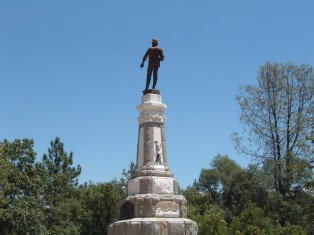
The site of John Marshal's burial.
“That James W. Marshall picked up the first piece of gold, is beyond doubt. Peter L. Weimer, who resides in this place, states positively that Mr. Marshall picked up the gold in his presence.”
The Coloma Argus Newspaper – 1855
Prospectors and settlers were amazed at the ease with which gold was recovered among the rocks and streams of the California foothills in early 1848. The first gold was discovered by James Wilson Marshall, a carpenter by trade and an employee of Captain John A. Sutter. Marshall was wandering along the bank of the American River where he was building a sawmill when he noticed a peculiar golden stone in the bedrock. It was a find that changed the course of western history.
By most accounts James Marshall was a surly man who kept to himself. He was born in Lambertsville, New Jersey in 1810 and from an early age worked with his father learning the trade of carpentry, carriage making and wheel righting. In 1828, he left home to start his own life. He settled in the Midwest farming on land in Kansas, Indiana and Illinois.
Farming proved to be an unsuccessful venture for him and in 1844 he headed west along the Oregon Trail to Puget Sound. Later he traveled down the Sacramento River arriving in California in 1845. He quickly found work at Sutter’s Fort and in a short time had acquired several acres of land and livestock.
Towards the end of August 1847, Captain Sutter and Marshall formed a co-partnership to build and operate a sawmill on a site 54 miles east of the fort. Mr. P.L. Weimer and his family were hired on to accompany Marshall to the location to cook and labor for the builders constructing the mill. The building began around Christmas and gold was discovered a little more than a month later. Marshall glanced down into the river water and something caught his eye. He leaned forward to get a better look and saw something shining in the gravel. “Gold!” Could it be gold?” He said to himself.
Marshall showed the rock to the workers around him. Many of them suspected the material to be iron pyrite, or fool’s gold. Marshall decided to return to Sutter’s Fort to verify the discovery. Before he left he swore the mill workers to secrecy. In exchange for their silence they would be given the chance to prospect on Sundays and after work.
As Marshall rode swiftly across the beautiful countryside towards the Fort he was troubled by a complication with the land where the gold was found. The property was purchased by Captain Sutter from Mexico and the local Indians, but since the sale of the land California had become a territory of the United States. Marshall was concerned the United States government would not honor Sutter’s prior claim once the gold strike was made public. When Marshall unveiled his findings to Sutter, Sutter was sure that the rock was gold and he too was concerned about the claim. Marshall’s hope was that the news of the discovery would be kept quiet long enough for Sutter to be granted full legal title with the new government. It was not to be however. Marshall and Sutter’s employees began to talk, sharing the news of the find with teamsters and trappers. Within 6 weeks of the discovery Sutter’s entire staff at the fort had deserted him and Marshall’s workers abandoned the mill.
Marshall informed the new prospectors in the area that he and Sutter owned a 12 mile tract of land along the river banks. He charged them 10 percent of their take for the privilege of working the gravel. His claim discouraged many miners, but when some of them made their way to San Francisco with full pockets the rush was on. A band of frustrated miners who felt they were being denied access to the gold defied Marshall. They overtook the half completed mill and killed several men who sided with Marshall.
After being pushed off the stake that he found, Marshall left the area in disgust. He traveled around Northern California searching for another strike, but was never fortunate enough to locate one. Marshall returned to the Coloma area in 1857 where he bought some land and started a vineyard. High taxes and increased competition eventually drove him out of business.
In 1872, the California State Legislature awarded Marshall with a 2 year pension. The funds were in recognition of his role in the Gold Rush. The $200 a year pension was renewed in 1874 and 1876, but lapsed in 1878.
James Marshall died a pauper on August 10, 1885, in Kelsey, California. He was 73 years-old. He was buried in Coloma near the site of the vineyard he once owned. The monument atop his grave features a granite stature of Marshall pointing towards the place he found the glittery substance that dazzled a nation.
The End of a Family
In 1848 San Francisco newspapers were read so thoroughly by excited citizens in the East that only scraps remained. Front pages were filled with encouraging words about a significant find at Sutter’s Mill on the American River in California. “The streams are paved with gold,” the report read, “the mountains swell in their golden girdle. It sparkles in the sand of the valleys, it glitters in the coronets of the steep cliffs.” The news brought ambitious miners from all over the world to the area to get rich. Michael Brennan, an Irishman from New York, arrived in the Gold Country in late 1850 determined to find the mother lode. The well-educated man convinced the management of the Mount Hope Mining Company in Grass Valley, California, that he had a gift for locating major gold veins. He was quickly hired and made the company’s superintendent. After moving his wife and children into a modest home near the mine, Brennan went to work. For two years Brennan and his team of diggers searched for gold, but the rich strike eluded him. He was racked with guilt over the money the mine owners had invested in his efforts and believed he had disgraced his family in the process. On February 21, 1858, in a fit of melancholy and dejection, Brennan decided to end the pain he was feeling. The suicide note he wrote sadly stated he “could not bear to leave his family behind living in poverty.” Using prussic acid, he poisoned his wife and children and them himself. A pistol was found lying next to Brennan’s body along with the vile of poison. Authorities determined that he had intended to shoot himself if the acid was not effective. The entire family was laid to rest side by side at the Elm Ridge Cemetery in Grass Valley, California. A single marker listing the names and ages of all five of the Brennans covers the grave. Michael was 38, his wife was 32, and their three children ranged in age from seven to two-years-old.
The Cry of a Nation
The barroom at the Hotel Carey in Wichita, Kansas, was extremely busy most nights. Cowhands and trail riders arrived by following the smell of whiskey and the sound of an inexperienced musician playing an out-of-tune piano inside the saloon. Beyond the swinging doors awaited a host of well-used female companions and an assortment of alcohol to help drown away the stresses of life on the rugged plains. Patrons were too busy drinking, playing cards, or flirting with soiled doves to notice the stout, six-foot-tall woman enter the saloon. She wore a long black alpaca dress and bonnet and carried a Bible. Almost as if she were offended by the obvious snub, the matronly newcomer loudly announced her presence. As it was December 23, 1900, she shouted, “Glory to God! Peace on earth and good will to men!” At the conclusion of her proclamation, she hurled a massive brick at the expensive mirror hanging behind the bar and shattered the center of it. As the stunned bartender and customers looked on, she pulled an iron rod from under her full skirt and began tearing the place apart. The sheriff was quickly sent for, and soon the violent woman was being escorted out of the business and marched to the local jail. As the door on her cell was slammed shut and locked, she yelled out to the men, “You put me in here a cub, but I will go out a roaring lion and make all hell howl.” Carrie Nation’s tirade echoed through the Wild West. For decades the lives of women from Kansas to California had been adversely affected by their husbands’, fathers’, and brothers’ abuse of alcohol. Carrie was one of the first to take such a public albeit forceful, stance against the problem. The Bible thumping, brick and bat-wielding Nation was a member of the Women’s Christian Temperance Union. The radical organization, founded in 1874, encouraged wives and mothers concerned about the effects of alcohol to join in the crusade against liquor and the sellers of the vile drink. Beginning in 1899, prior to Carrie’s outbursts, the group had primarily subscribed to peaceful protests. Carrie had been born Carrie Amelia Moore on November 25, 1846, in Garrard County, Kentucky. Her father was an itinerate minister who moved his wife and children from Kentucky to Texas, then on to Missouri and back again to Kentucky. Carried married in 1866. Her husband was a heavy drinker, and after their wedding she pleaded with him to stop. After six months of persistent nagging. Carrie’s husband still refused to give up the bottle. With a child on the way, she left him and returned home. He died of acute alcoholism one month before the baby boy was born. Not long after this death, Carrie remarried, but David Nation possessed the same love for alcohol. He was a lawyer and a minister who did not share in what he called “his wife’s archaic view” about liquor. Their differences of opinion not only interfered with their personal life but wrecked havoc on David’s professional life as well. The Nations moved to Texas, and Carrie immediately joined the Methodist church. Her outlandish beliefs and revelations prompted the members of the congregation to dismiss her. Carrie then formed her own religious group and held weekly meetings at the town cemetery. In 1889 Carrie insisted that David move her and their children to Medicine Lodge, Kansas. Kansas had a prohibition law, and Carrie believed the fact that liquor was outlawed would stop David from partaking of any libations. Determined Kansas residents found ways to drink and so did Reverend Nation. Drugstores and clubs sold whiskey in backrooms and alleys, calling the liquid medicine instead of alcohol. Carrie was outraged. Not only did she chastise members of her husband’s assembly in Sunday service, but she also scolded those whom she knew drank when she saw them on the street. Carrie believed the Lord had called her to take such drastic action against alcohol. According to her autobiography, The Use and Need of the Life of Carrie Nation, she felt it was her duty to defend the family home and fight for other women locked in marriages with excessive drinkers. At the age of fifty-three, she marched into a drugstore on the main street of Medicine Lodge and preached the evils of drink to all the customers. She was tossed out of the business, but a crowd of women who had gathered to inquire about the excitement applauded her efforts. Their response and the Women’s Christian Temperance Union members spurred her on. She continued to visit liquor stores until all the bars in town were effectively forced to close. Carrie Nation passed away on June 9, 1911, after collapsing during a speech at a park in Eureka Springs, Arkansas, at age sixty-five. The tombstone over her grave, erected by the Women’s Christian Temperance Union in 1924, reads Faithful To The Cause Of Prohibition, She Hath Done What She Could.
They Called Him Bat
Legendary lawman William Barclay Masterson had a reputation for being a tough talker, an excellent shot, and a dandy dresser. He wore tailor-made suits and a derby hat and carried a gold-headed cane. He was a handsome, well-liked character with black hair and blue eyes who was extremely fast on the draw. Born in Illinois on November 22, 1855, Bat (as he was more commonly known) was the second of five brothers. His parents were homesteaders who moved their family to a prairie farm in Wichita, Kansas in 1871. At the age of nineteen, Bat persuaded two of his brothers to abandon farm life for a job hunting buffalo. The Masterson boys stuck together for a while, but the trip split up when his siblings decided to return home and Bat decided to continue on with the difficult work. For more than a year, Bat roamed from Topeka to the Texas Panhandle. He changed employment often: He was a section hand for the Santa Fe Railroad, a ranch hand, and an Indian scout for the army. After his first gunfight in January 1876, in which Bat killed a man who fired on him and the woman he was with, he headed for Dodge City. There he invested in the Lone Star Dance Hall on the main street of town, and the establishment proved to be profitable. Not long after Bat’s arrival in the rough-and-tumble town, he helped a prisoner escape from jail. He’d had too much to drink and involved himself in an arrest that had nothing to do with him. The town marshal gave Bat a beating that turned him around so much so Masterson decided he would never go against the law again. In fact, the incident opened his eyes to the possibility of a future as an officer of the law. Bat followed his brothers-one a marshal, the other a deputy-into the field of law enforcement. Bat campaigned hard for the position of Ford County sheriff deputy and was subsequently awarded the job. He was an effective lawman who tried to talk perpetrators into surrendering rather than resorting to gunplay. Using his fists and finesse, he persuaded many wrongdoers to “leave town peacefully” or “be carried out with a bullet hole in their chest.” Bat had an impressive and famous array of friends that included Wyatt Earp and Doc Holliday. Outlaws who knew of their association refused to tangle with Masterson for fear the Earp brothers and Holliday would come after them. Before Bat’s siblings were killed in the line of duty, the men participated in numerous posses that successfully tracked down and apprehended outlaws in the area. As such, the plains around Ford County during Masterson’s time in officer were relatively peaceful. A controversial act drove Bat out of law enforcement in April 1881. Bat was in Tombstone, Arizona when he got the news that one of his brother’s lives was being threatened by a ruthless businessman. He quickly made his way back to Dodge City and arrived just in time to face the bad guys on the street. Once the smoke cleared from the gun battle, Bat alone was left standing. He resigned from his position as an officer and left Kansas to see the West. He traveled through New Mexico, Utah, and Texas, earning his keep at each location by gambling. His natural gift for storytelling led to a job writing newspaper articles in Creede, Colorado, where his work was noticed by a correspondent for the New York Sun who helped him secure a position as a sportswriter for the New York Morning Telegraph in 1901. Bat returned to law enforcement in 1905 when President Theodore Roosevelt appointed the fifty-year-old man as a special United State marshal to the Oklahoma Territory. He did not hold the post long due to the prior commitment he had with the Morning Telegraph. Just before noon on October 25, 1921, Bat headed up 8th Avenue from his New York apartment to the newspaper office and wrote his column for the next day. He died of a heart attack fifteen minutes after he finished writing the article. He was found slumped over his desk with his pen in one hand and his column in the other. He was laid to rest at the Woodlawn Cemetery in New York. The tombstone over his grave carries his name, date of birth, and the words Loved By Everyone.
Death of a Regulator
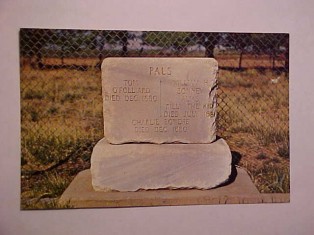
Billy the Kid's Tombstone
Making My Way Home
While sitting at the airport enduring the late flights and pajama wearing, no showering, multiple carry-on passengers, I decided to try and catch up on the daily journal section of my site. It’s been long but enjoyable two week adventure releasing of the book Sam Sixkiller: Cherokee Frontiers Lawman to the public. I began the journey in Colcord, Oklahoma where United State marshal Sam Sixkiller rode collecting bootleggers and murderers and I ended the trip in the hills around Edgewood, New Mexico where Billy the Kid spent time with his riders. In between I got to meet great western authors like Johnny Boggs and Sherry Monahan and hang out with actor Wes Studi. It will be good to get home and return to work, however. Getting updates on the Broadway production and the motion picture will be focus this week. But first, just to be home. As Charles Dickens once wrote, “Home is a name, a word, it is a strong one; stronger than magician ever spoke, or spirit ever answered, in the strongest conjuration.” That and I’m out of clean underwear.
Count It All Joy
Chuck Swindoll tells a story about a young man named Glen Chambers. Glen had a heart to serve God on the mission field. He got his training, went to Bible college, went to seminary, and he raised his support. He left everything behind and boarded a plane to fly as a missionary to South America. He had gone through the strain of financial problems and misunderstanding with family. He’d dealt with the pain of separation, and he was filled with hope and anticipation and excitement about serving Christ. As he was about to fly, he thought to himself, I really should have said more to my parents, so he tore off a corner of a magazine and wrote them a little note: “Mom and Dad, I’m so excited, going to serve Christ. Thanks for getting behind me in this. I love you, Glen.” Glen stuffed the note in an envelope and put it in the mail to his parents. Glen got on the plane, and in the middle of the night, a mountain in the jungles of Ecuador reached up, pulled that plane out of the sky, and Glen was killed in a plane crash. He never made it. All the training, all the fundraising-everything-and he never got there. After the funeral was over, his parents got the letter Glen wrote. They opened it. It turns out that on the back of the magazine corner he’d torn off to write that note was printed one word: “why.” Why? That’s the question that hits the hardest, isn’t it? It’s the question that hurts the most…lingers the longest…and it’s the question that every follower of Jesus Christ has asked. I’ve asked it so many times. Why, God? And it’s the question James helps us answer. James 1:2-4 Consider it pure joy, my brothers, whenever you face trials of many kinds because you know that the testing of your faith develops perseverance. Perseverance must finish its work so that you may be mature and complete, not lacking anything. In this world there will be pain and suffering. There’s just no getting around it. It a sure thing. Surer still is that God has overcome this world. God has a reason…a good reason. The nail that doesn’t remain under the hammer will never reach the goal. The diamond that doesn’t remain under the chisel will never become a precious jewel. The gold that doesn’t remain under the fire will never be refined.
Juanita Put to Death
The Fourth of July celebration held in Downieville, California, in 1851 was a festive event that included a parade, a picnic, and patriotic speeches from numerous politicians. Proud members of the Democratic County Convention spoke to the cheering crows of more than five thousand people, primarily gold miners, about freedom and the idea that all are considered equal. The celebration was accentuated with gambling at all the local saloons and the consumption of alcohol, available in large barrels lining the streets. When residents weren’t listening to orators wax nostalgic, many happy and drunk souls gathered at Jack Craycroft’s Saloon to watch a dark-eyed beauty named Juanita deal cards. Juanita was from Sonora, Mexico, and engaged to the saloon’s bartender, but that did not stop amorous miners from attempting to get close to her. Fred Cannon, a well-liked Scotsman who lived in town, frequently propositioned Juanita. On the Fourth of July in 1851, he took her usual rejection particularly hard and threatened to have his way with her regardless. When Juanita finished work that evening, she went straight home. The streets were still busy with rowdy patriots who weren’t willing to stop celebrating. Fred Cannon was among the men on the thoroughfare who were drinking and firing their guns in the air. After more than a few beers, Fred decided to take the celebration to Juanita’s house. Juanita was preparing for bed when Fred pounded on the front of her home and suddenly burst in, knocking the door off the hinges. She yelled at the drunken man to get out. Before leaving, Fred cursed at her and threw some of her things on the floor. The following morning Juanita confronted Fred about his behavior and demanded he fix her door. He refused, insisting that the door was flimsy and was in danger of falling off the frame prior to his involvement. Juanita was enraged by his response, and the two argued bitterly. When Fred cursed at her this time, she pulled a knife on him and stabbed him in the chest. Fred’s friends surrounded the woman, calling her a harlot and a murderer. They demanded that she be hanged outright. Many of the townspeople insisted on trying her first, however. After a quick and biased hearing, Juanita was found guilty and sentenced to be hanged. The fearless woman held her head up as she was led to the spot where she would be put to death. She refused a blindfold, and when asked if she had any final words about the crime for which she was accused, she simply nodded her head. She boldly stated that she was not sorry and that she would “do it again if so provoked.” Juanita was the first woman to be hanged in the state of California. She was buried in the same grave as Fred Cannon. The pair was moved from the site six months later when gold was discovered where they laid. Their remains were relocated to the Downieville Cemetery. Time and the elements have erased the name of the infamous Juanita from the marker that stands over her grave.