The Most Exciting Cliffhanger Serial Ever Made

Enter now to win a copy of

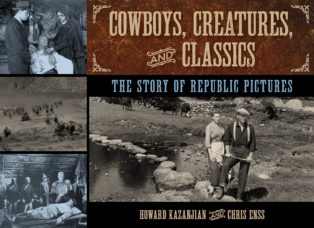
Cowboys, Creatures, and Classics: The Story of Republic Pictures


Panther Girl of the Kongo starring Phyllis Coats was the most expensive serial Republic Pictures produced in the 1950s. A great deal of footage used to make this film had been originally shot in 1941 for the movie Jungle Girl. Frances Gifford, the star in Jungle Girl, was the first female lead in a Republic serial, and Phyllis Coats was the last female lead in a Republic serial. In fact, Phyllis Coats wore the same outfit in Panther Girl that Frances Gifford wore in Jungle Girl.

The plot of Jungle Girl was simple.

Dr. John Meredith, ashamed of the crime spree of his evil twin brother, Bradley, travels with his daughter, Nyoka, to Africa. There his skills as a doctor displace Shamba, the resident witch doctor of the Masamba. Years later, Slick Latimer and Bradley Meredith arrive looking for a local diamond mine and team up with the disgruntled Shamba. Bradley kills his brother John and takes his place. They also bring along Jack Stanton and Curly Rogers, who promptly joins Nyoka in trying to stop the villains.

Jungle Girl was the first sound serial to have a female lead.

The director of Jungle Girl was studio favorite William Witney. From 1935 to 1956, Witney practiced the philosophy Herbert Yates, head of Republic Pictures, taught which was “make ‘em fast and make ‘em cheap.” Witney was a specialist in outdoor action and stunt direction. He directed or co-directed more Republic serials than any other company hire. He is considered the greatest action director in B movies.

Among Witney’s fans are directors Steven Spielberg and Quentin Tarantino. Tarantino gave Witney high praise for his rough and believable action scenes and visual style. Witney’s Republic serials served as the inspiration for Spielberg’s Indiana Jones movies.


To learn more about William Witney and Jungle Girl read

Cowboys, Creatures, and Classic: The Story of Republic Pictures

BEWARE! A MONSTER IS LOOSE!

Enter now to win a copy of

Cowboys, Creatures, and Classics: The Story of Republic Pictures


Republic Pictures made a number of ridiculous horror films. The Catman of Paris was the studio’s version of the successful motion picture Werewolves in London

In April 1946, thrill seekers were looking forward to the release of The Catman of Paris. The gruesome mystery melodrama involved a man suffering from a loss of memory who was accused of being a feline filler operating in Paris.

The tagline read: “Walks like  man. Attacks like a cat. Who is the Catman of Paris.” The plot involved author Charles Regnier returning to 1896 Paris after exotic travels, having written a best seller that the Ministry of Justice would like to ban. That very night, an official is killed on the dark streets…clawed to death! The prefect of police suspects a type of cat, but Inspector Severen thinks there is nothing supernatural about the crime and thinks Regnier is responsible for the murder. Regnier denies he had anything to do with the crime but begins to doubt himself when he has a hallucinatory blackout during a second killing.

Vienna-born stage actor Carl Esmond played the troubled author Regnier. Lenore Aubert, the female lead in the movie, was also from Vienna. The press packet Republic Pictures circulated to theaters and media across the country contained plenty of information about the film as well as background information about the picture’s stars. Aubert’s story of how she made it from Vienna to Hollywood could have been a movie on its own.


To learn more about cliffhanger horror films made by Republic Pictures read

Cowboys, Creatures, and Classics: The Story of Republic Pictures.


The Widowed Ones Wins WILLA Award

On behalf of Women Writing the West, congratulations on your book The Widowed Ones: Beyond the Battle of the Little Bighorn being selected as a 2023 WINNER in the WILLA Literary Awards Scholarly Nonfiction category. We are pleased to honor you and your work with this prestigious award.


I’m humbled and honored.

The Deadly Beat of the Drums of Fu Manchu

Enter now to win a copy of

Cowboys, Creatures, and Classic: The Story of Republic Pictures


Drums of Fu Manchu premiered in the spring of 1940.  The creepy chapter play featured a race of bald-headed, fanged slaves known as “Dacoits” who had been lobotomized into doing the bidding of the immortal and insidious Doctor Fu Manchu. Fu Manchu hopes to conquer Asia and subsequently the world but needs specific artifacts from the tomb of Genghis Khan to achieve his goal.

In Los Angeles, California, he convenes a meeting of the S-Far, an international conspiracy group that helps him draw up his plans. When archeologist Dr. James Parker is killed so Fu Manchu can obtain rare scrolls in his possession, his son Allan joins forces with Sir Denis Nayland Smith of the British Foreign Office to avenge his father’s death.

The sixteen frightful-looking “Dacoits” who contributed many of the thrills to Drums of Fu Manchu were a product of the makeup artists Bob Mark’s wizardry. The normal-looking people became grotesque monsters in Mark’s hands.

Rubber caps entirely covered  their hair, giving them the impression of baldness. These caps, which could be worn only once, were specially manufactured at the cost of five dollars each. They were fitted tightly over the “Dacoit’s” heads, and heavy, theatrical grease paint was applied over them. The scars, which represented the incisions where Dr. Fu Manchu had removed the frontal lobes of their brain, were made of a special rubber composition and were held in place by rubber cement. The makeup of Fu Manchu himself, an elaboration of the “Dacoit’s” makeup, took exactly 2.5 hours each day to apply.

The fifteen-part Fu Manchu series was directed by William Witney. He considered Fu Manchu to be his finest work.


To learn more about the Drums of Fu Manchu read

Cowboys, Creatures, and Classics: The Story of Republic Pictures.

Visit www.chrisenss.com to enter to win a copy of the book. 

Republic Pictures’ Greatest Thrill Show on Earth!

Enter now to win a copy of

Cowboys, Creatures, and Classics: The Story of Republic Pictures


Daredevils of the Red Circle was a twelve-part serial that included a cape-wearing villain. The suspenseful, spin-tingling, mystery film told the tale of diabolical mastermind Harry Crowel, a.k.a. Prisoner 39013. Crowel escapes from prison and, aided by a seemingly endless supply of henchmen, sets out to destroy all holdings of industrialist Horace Granville, the man who put in him prison. One target is an amusement park, home of three Daredevils of the Red Circle who perform death-defying stunts.

When head Daredevil Gene’s kid brother is killed in Crowel’s attack, the three heroes swear to capture Prisoner 39013. Unbeknownst to them, he is holding the real Granville captive and, with a near perfect disguise, has taken his place. A mysterious cloaked figure known as the Red Circle aids the daredevil in their crusade.

Shot in five weeks on a budget of $1,500 an episode, Daredevils of the Red Circle, directed by William Witney, who was one of Republic Picture’ best directors, consistently appears on lists of all-time greatest serials. Audiences referred to the serial as the “greatest thrill show on earth!”


To learn more about Daredevils of the Red Circle and other exciting cliffhanger serials read

Cowboys, Creatures, and Classics: The Story of Republic Pictures


The Purple Monster Strikes

Enter now to win a copy of

Cowboys, Creatures, and Classics: The Story of Republic Pictures


Moviegoers throughout the 1930s and 1940s enjoyed film adventures, from heroes on exotic animals to those in spacecrafts. Such was the case with The Purple Monster Strikes, the original Republic Martian invader serial.

The Purple Monster was actually not a monster at all, nor was he purple. The villainous character was in reality a Caucasian, Martian space soldier. He was part of the advance guard preparing a vast invasion of earth, dressed in a blue, tight-fitting outfit, trimmed with scaly gold metallic material, and wearing a matching gilded hood. Among the Purple Monster’s alien abilities was the power to become a transparent phantom and enter the body of another, controlling his actions, thereby donning the ultimate disguise.

The Purple Monster Strikes was the first post-war serial of 1945. Republic was prohibited from using the term “rocket ship” when referring to the spacecraft the Purple Monster used in the film. Universal Studio had a copyright on the word which was used quite extensively in their serial Flash Gordon.


To learn more about the Purple Monster and other fascinating serials produced by Republic Pictures read

Cowboys, Creatures, and Classics: The Story of Republic Pictures.


Tune in tomorrow for another exciting tale about the

ghouls, freaks of nature, and the walking dead made famous by Republic Pictures.


A Republic Pictures’ Tale – The Sacred City of the Golden Bat

Enter now to win a copy of

Cowboys, Creatures, and Classics: The Story of Republic Pictures


Bat Men of Africa (a.k.a. Darkest Africa), directed by Joseph Kane, was the first fifteen-episode serial produced by Republic Pictures. World famous big game hunter and lion tamer Clyde Beatty starred in the chapter play portraying an adventurer on safari in East Africa. While in the Dark Continent, he meets and befriends a loincloth-wearing boy and his pet ape.

The boy reveals that he has escaped from the lost city of Joba, King Solomon’s sacred city of the Golden Bat, but that his sister, Valerie, remains there. Clyde agrees to help his new friend rescue Valerie and treks through the dangerous Valley of Lost Souls to get to her. Meanwhile, a pair of unscrupulous treasure hunters notices a green diamond the young boy is wearing, and they decide to follow the trip to plunder the city of Joba.

Among the cliffhangers in the picture are volcanic eruptions, a patrol of Bat-men type creatures attacking the trio from the air, a landslide, and a fall down a mineshaft. At a cost of $119,343, Bat Men of Africa was the most expensive Republic serial of 1936.


To learn more about the cliffhanger serials of

Republic Pictures read

Cowboys, Creatures and Classics: The Story of Republic Pictures.

Tune in tomorrow for another exciting look at Cowboys, Creatures and Classics!

The Fiendish Crimson Ghost

Enter now to win a copy of

Cowboys, Creatures, and Classics: The Story of Republic Pictures


A dark figure weaves through a forest of imposing, leafless trees toward a weathered cabin in a clearing. An eerie mist blankets the ground, and a lone wolf howls in the distance. Inside the cabin, two men dressed in business suits and fedoras discuss plans to steal a counter atomic bomb device called the Cyclotrode. Their conversation is interrupted when the door of the structure is flung open and a madman wearing a skull mask and crimson robe enters. This is the Crimson Ghost, and the men deliberating over the robbery work for him.

The Crimson Ghost is determined to get his hands on the Cyclotrode. The Cyclotrode cannot only stop nuclear missiles, but it can also cripple transportation and communications. The Crimson Ghost wants the invention for his own nefarious plans, including selling the device to foreign powers.

Two people know of the Crimson Ghost’s dangerous ambitions, and they are criminologist Duncan Richards and Diana Farnsworth, secretary for the professor who created the Cyclotrode. The duo is determined to stop the villain and his henchmen from taking the contraption and destroying lives.

The duo match wits and fists with the miscreant and his aides in an attempt to keep the Cyclotrode from being used for mass destruction. Duncan and Diana were threatened with death by explosion, poison gas, deadly slave collars, and death rays.

The Crimson Ghost was one of Republic Pictures most popular cliffhanger serials. To learn more about the exciting cliffhanger films from the once thriving movie studio read Cowboys, Creatures, and Classics: The Story of Republic Pictures.


Cowboys, Creatures, and Classics Book Cover


Tune in everyday to enter to read about another fascinating and silly cliffhanger serial and

enter to win a copy of Cowboys, Creatures, and Classics.


The Virginian – Favorite Western Featuring a School Teacher

Enter now to win a copy of

Frontier Teachers: Stories of Heroic Women in the Old West


A New England schoolmarm living in Wyoming in 1879, falls in love with a cowboy who’s not only an expert roper and rider, but handy with a gun.  The teacher is opposed to violence, and her relationship with the cowboy is put to the test when he insists on squaring off with a card sharp who’s accused him of being a cattle thief and a liar.  This is not a storyline in a Harlequin paperback series, but of a novel hailed by newspapers from the San Francisco Chronicle to the Kansas City Star as one of the “best romances of the West in American literature.”  The novel is the Virginian:  A Horseman on the Plains by Owen Wister.

Published in 1902 by Macmillan Company of New York, the hero of the story is a Virginian who drifted out on the old Santa Fe trail when he was sixteen, and who, at twenty-seven, when the story opens, is a master of the cowboy arts.  Wister’s Virginian has a grand sense of humor.  The Yankee schoolteacher is a fine woman, but I wish she’d been a little more jovial; then maybe her cowboy wouldn’t have had to endure so many forlorn days.  Wister captures their fragile romance with lines like “she would watch him with eyes that were fuller of love than of understanding” and “Ah, me.  If marriage were as simple as love!”

Now I admit I’ve never been a fan of romance novels.  The stories of beautiful people and how their love blossoms in unusual circumstances seem implausible to me.  When is anyone ever taking a casual ride on the prairie dressed in a taffeta gown complete with a black velvet and lace bonnet and silk gloves?  And then, on that ride meet a shirtless, Chris Hemsworth type searching for a wandering calf?  I went on a horseback ride with a guy once, we were both dressed in jeans and a T-shirt.  It was kind of fun until he ran out of quarters. But I digress.

Many of the most celebrated books in the western genre are romances.  From Dorothy Johnson’s short story, The Man Who Shot Liberty Valance and Louis L’Amour’s Conagher to Lauran Paine’s The Open Range Men and Max Evan’s The Hi-Lo Country, romance is a driving force in those westerns.  Not only does the romantic element make the stories compelling, but, as it turns out, it’s also a key selling point.

A Publishers Weekly 2020 study showed that 72.6 million Americans read at least one romance a year.  Thirty-two percent of those readers were men.  Close to half of the romance books that sold were set on the American frontier.  According to a 2021 study by Psychology Today, the common ingredient that explains the appeal of the western romance is the “dashingly handsome, rogue cowboy captivated by the female lead who ultimately reforms his ways.”  The study also shows readers enjoy a romance story because it “simply gives them hope that they too could have that romantic love of which they dream.”

Whatever the reason, romance is big business, particularly in book publishing.  Online magazine MarketWatch notes it’s a billion-dollar industry and western romances claim a respectable percentage of those earnings.

In addition to Owen Wister, contemporary western romance writers have authors James Fenimore Cooper, Bret Harte, and Zane Grey to thank for pioneering the genre.  Since their work debuted in mercantile stores and bookshops across the country in the 1870s to the early 1900s, the field has undergone changes and evolved with the times.  Western romance novels are no longer strictly written from the male perspective.  The focus has shifted from the hero’s goals and wants to the heroine’s journey, motivations, and aspirations.

The fancy but picturesque character study in The Virginian is just one of the reasons it ranks as one of the best western romance novels.  That, and Wister’s talent for writing crisp dialogue which makes it hard to resist rooting for his lead characters to live happily ever after.  “I don’t think I like you,” the schoolmarm says to the Virginian.  “That’s all square enough,” he replies.  “You’re going to love me before we get through.”

That’s the goal for all western romance authors, that we love what they’ve written before we get through with their stories.


To learn more about teachers such as the one featured in Wister’s book, read

Frontier Teachers: Stories of Heroic Women in the Old West.

The Student Teacher

Enter now to win a copy of

Frontier Teachers: Stories of Heroic Women of the Old West


Throughout history teachers have been at the forefront of all civilizations, educating and inspiring the next generation and keeping societies moving forward. Frontier Teachers captures that pioneering, resilient, and enduring spirit of teachers that lives on today.

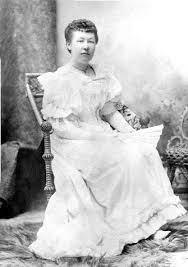
Tears streamed down twelve-year-old Bethenia Owens’s face as she watched her teacher pack his belongings into a faded, leather saddlebag and slip his coat on over his shoulder. She was heartbroken that the gracious man who introduced her to the alphabet and arithmetic would be leaving to teach school at a far-off location. Bethenia’s brothers and sister gathered around him, hugging his legs and hanging onto his hands. Mr. Beaufort had boarded with the Owens family during the three-month summer school term in 1852, and everyone had grown quite attached to him, especially Bethenia.

Mr. Beaufort smiled sweetly at Bethenia as she wiped her face dry with the back of her dirty hand. Streaks of grim lined her thin features and continued on into her hairline. Her long, brown locks protruded haphazardly out of the pigtails behind each ear. The dainty ribbons that once held her hair in place were untied and dangling down the back of her soiled, well-worn gingham dress.

Bethenia would remember this day for the rest of her life and her first teacher Mr. Beaufort. It was his kindness and dedication to education that inspired her to want to be a teacher.


To learn more about Bethenia Owens Adair, the schools teachers like her established, and about the other brave educators in an untamed new country read 

Frontier Teachers: Stories of Heroic Women of the Old West.