Enter to win a copy of the new book
An Open Secret: The Story of Deadwood’s Most Notorious Bordellos along with a new Kindle.


In a time when notorious Depression-era criminals were terrorizing the country, the Barker-Karpis Gang stole more money than mobsters John Dillinger, Vern Miller, and Bonnie and Clyde combined. Five of the most wanted thieves, murderers, and kidnappers by the Federal Bureau of Investigation (FBI) in the 1930s were from the same family. Authorities believed the woman behind the band of violent hoodlums that ravaged the Midwest was their mother, Kate “Ma” Barker.
Alvin Karpis, Harvey Bailey, and Bernard “Big Phil” Courtney walked quickly out of the Citizens National Bank in Wahpeton, North Dakota, on September 30, 1932. Each was wearing long overcoats, and if not for the Thompson machine guns or .45 caliber revolvers they carried in their hands, they could have passed as bank examiners to the casual observer. An alarm screamed behind them, and Fred Barker and Lawrence Devol charged out the double doors of the bank, each having a female hostage in front of him. Fred pulled a Tommy gun from under his coat and opened fire on law enforcement agents collecting on the sidewalk across the street from the bank. The police didn’t dare exchange bullets with the bank robbers for fear of hitting one of the captives.
The bandits kept a careful eye on the reinforcement of officers that quickly arrived. Alvin shot at the incoming officers, forcing them to take cover behind parked cars and streetlights. The hostages screamed and tried unsuccessfully to break free. Thomas Holden, driver for the Barker-Karpis Gang, revved the engine on the 1932 Hudson, passenger sedan and drove it evenly and quickly out of the nearby alley.
The gangsters loaded into the vehicle as it paused momentarily. They shot more rounds at the officers to keep them pinned to the ground. The police cowered under the gang’s gunfire. Both Fred and Lawrence pulled the hostages onto the running boards of the car. The women were panicked but complied. The vehicle roared away from the bank as the women cried out for help.
In a few short moments, law enforcement was chasing after the gangsters in their police vehicles. The police were careful when they returned fire because the women were still being used as human shields. The pursuit was slowed when one of the bank robbers broke open the rear window and threw two five– gallon milk jars full of roofing nails onto the road. The police swerved their vehicles to miss the objects. Some didn’t make it. They hit the nails, and their tires blew. A flurry of fast gunfire from the fugitives dissuaded the officials from traveling too close to the getaway car.
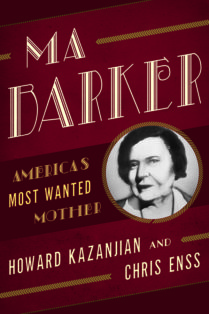
16 Jan 1935, Florida, USA — Original caption: 1/16/35-Oklawaha, Florida: Ma Barker and her son, gangster Fred Barker, in morgue of Iklawaha, Florida, after they were shot. Photograph. — Image by © Corbis
“I’ll never have a close relationship with anyone other than my boys. After all, they know what my heart sounds like on the inside.” With that being said, Arizona Barker, Ma Barker to the world, set out to raise four sons to be criminals. It’s believed by many that the Ma Barker image was originated by J. Edgar Hoover’s FBI in an effort to justify the killing of an old lady. She has been portrayed as the mastermind of the Barker-Karpis gang, while surviving gang members absolutely denied the allegations. However, evidence indicates that she was much more involved in criminal activity than some think, whether she was the “mastermind” or not is debatable.
To say the least, she was a willing accomplice, if nothing else. Arizona Donnie Clark was born near Springfield, Missouri, the exact year is not known, though most agree that she was born on October 8, 1873. In 1892, she married George Barker and in time gave birth to four of the meanest examples of humanity ever to exist! The boys were named Herman, Lloyd, Arthur and Fred. After the birth of Fred, George Barker left the family, though it may have been at the insistence of his wife. At some point, she began using the name Kate Barker. On several occasions Kate faced the authorities on behalf of her sons, trying to keep them from serving jail time. She was usually successful. It all came to an end for Ma in early 1925.
Posing as J.E. Blackburn and wife, Ma and her son Freddie rented a house on the northern banks of Lake Weir, near the town of Ocklawaha, Florida. The neighbors thought they were an odd couple with him being so young and her being so much older. They didn’t associate with the neighbors and frequently large cars were seen entering and leaving the place. Unknown to the Barkers, the FBI had the map they had taken from Doc’s apartment and had been checking their mail through the postal service to positively identify them.
Disguised as county road workers, the FBI kept surveillance on the house. Upon seeing the Blackburns, the FBI positively identified the Barkers. The FBI was under the impression that several members of the gang were in the house. Just before daybreak on January 16, 1935, the FBI arrived outside the two-story house. There were agents from Jacksonville, reinforced by agents who had been flown in from Chicago and Cincinnati. A call for their surrender was met with no response. After a few moments, Agent Earl Connelly of Cincinnati yelled, “Unless you come on out, we’re going to start shooting!” Ma replied, “Go ahead.” What followed was the longest gun battle the FBI was ever involved in; it lasted four hours and there are reports that a minimum of 1500 rounds of ammunition were poured into the house. The FBI requested that the bodies of Ma and Freddie be held in a morgue for an extended time, thinking that other gang members would show up to pay their respects – and be captured. Eight months later, they were removed from the morgue, transported to Welch, Oklahoma and buried alongside Herman, in the Williams Timberhill Cemetery.
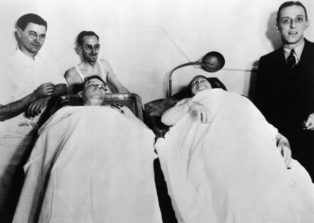
She began with a hymn book in her hand; she died clutching a gun. That was “Ma” Barker, mother of four outlaw sons whom J. Edgar Hoover, chief of the Federal Bureau of Investigation, Department of Justice described as the real “public enemy No. 1.”
Kate Barker – “Ma” as she was known to her criminal associates was the “brains” of the Barker-Karpis gang – kidnappers, bank robbers, and murderers. And she died as most criminals wanted by the federal government do. Ma Barker began her public career in Kansas City, Missouri. In either an attitude or assumed or real piety she was the leader of a small band of religious zealots who used to hold meetings in the street near city hall. Whenever one of her followers was arrested for picking pockets, vagrancy, or street walking or casual misdemeanor, she would go before the police judge, shed tears and claim that she alone was left in the world to befriend the poor defendant. In most cases the defendant went back to more and bigger crimes and “Ma” Barker’s friendliness and a slight ability as a defense witness soon became a racket.
“Ma” and her boys were responsible for kidnapping two of the country’s wealthiest men and holding them ransom. The Barker-Karpis gang murdered police officers and federal agents and any outlaw who double-crossed them. Ma Barker’s life ended at a home she was renting in Florida on January 16, 1935.
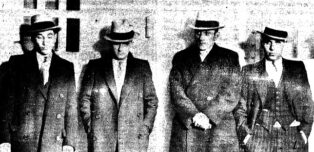
When the suggestion to kidnap Edward Bremer was presented to Ma, she ordered her crew to meet and discuss the proposal. In the summer of 1933, the Barker-Karpis Gang had kidnapped William Hamm, Jr., the president of Hamm’s Brewing Company. The caper was successful, yielding the gang $100,000 in cash for the return of the millionaire. News of the kidnapping was reported throughout the country. “Money or death was the ultimatum laid down by the culprits that absconded with Hamm’s Brewing Company executive,” the June 17, 1933, edition of the Albert Lea Evening Tribune read.
William had been captive near the same location in Bensenville, Illinois, where Edward Bremer was secured away. The police had withdrawn from the case at the request of the family. They were frightened of what might happen to William if law enforcement interfered. The ransom note from the abductors warned the Hamms that William would be shot and killed if the police were allowed any involvement. A note sent to William’s father instructed him to deliver the ransom money in “$5, $10, and $20 bills.” Payment of the ransom for the release of William, the kidnappers directed, was to be made using one of the company’s beer trucks. Not only did the Barker-Karpis Gang get the full amount they were asking in ransom, but when the authorities did begin investigating the kidnapping, a rival gang was arrested for the crime.
“J. Edgar Hoover himself announced from Washington that his men had put together a solid case against the Touhy gang,” Alvin Karpis wrote in his memoirs. “The scientific evidence left no doubt at all,” Hoover said, “that the Touhys were behind the kidnapping of William Hamm.”
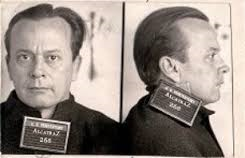
The ease with which the Barker-Karpis Gang was able to get away with taking William and collecting the ransom was an argument for kidnapping Edward Bremer. In late December 1933, Ma’s boys convened at William Weaver’s apartment in St. Paul to talk through the details of the abduction. Who would trail Edward to learn about his habits, routine, friends, and work associates, who would write the ransom notes, who would deliver those notes to what contact, and when the job would be done were all determined. With the exception of Arthur, whom Ma suggested might have been a little too rough with the victim, everyone performed his duties as planned.
In a time when notorious Depression-era criminals were terrorizing the country, the Barker-Karpis Gang stole more money than mobsters John Dillinger, Vern Miller, and Bonnie and Clyde combined. Five of the most wanted thieves, murderers, and kidnappers by the Federal Bureau of Investigation (FBI) in the 1930s were from the same family. Authorities believed the woman behind the band of violent hoodlums that ravaged the Midwest was their mother, Kate “Ma” Barker.
Ma Barker removed a tattered handkerchief from the navy–blue pocketbook cradled in her lap and dabbed away a fake tear. The guards on duty at the Oklahoma prison were disinterested in her supposed grief. Their job was to make sure the inmates at the facility moved efficiently from the visitor’s area back to their cells. Ma watched a pale-faced, stupefied guard escort her son Arthur out of the room. It was mid-February 1920, and mother and son had concluded a short visit. A thick, long glass separated the convicts from the civilized world. Here, communication was done using plain, black phones minus a dial wheel, wired from one side of the glass to the other. Arthur and Ma each had their own receiver to talk through, as did several other families and friends visiting their loved ones through the glass partition.
The iron-barred doors clanged shut as the last prisoner was ushered out of the room. Ma sat stock-still until she heard the guard lock the door behind the inmates. As she turned to get up from her assigned seat, a heavyset guard approached her, and with flinty eyes, looked her up and down. She looked more frumpy than menacing. The coat she wore was big and bulky, frayed in spots, and a few buttons were missing. The tan, bell-shaped hat on her head had seen better days, and her hair underneath it was pinned back in a haphazard fashion. “My boys would be all right if the law would leave them alone,” she told the guard. He had no response and simply led her to the exit of the room, and she shuffled along as little old ladies do.
Two short siren blasts issued from the main building of the jail as Ma exited the complex. She glanced back at the other visitors following her and at the stone walls topped with snaky concertina wire overhead. Once every guest had left the jail, the heavy steel doors were closed behind them.
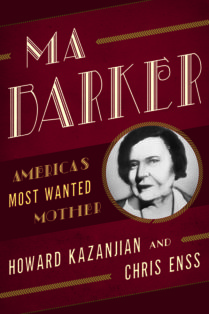
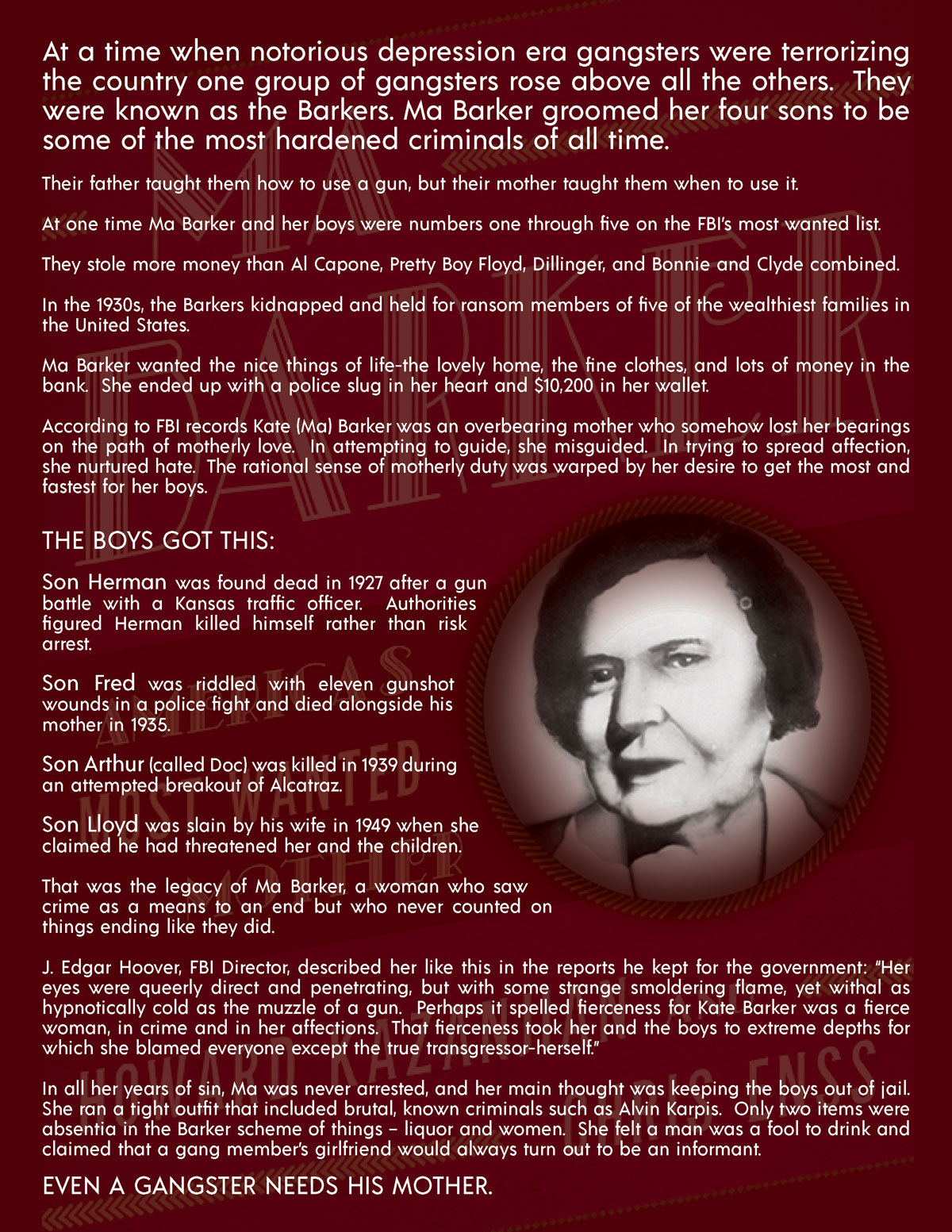
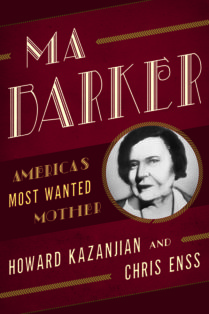
Ma Barker: America’s Most Wanted Mother tells of the notorious mother of several criminals who oversaw the Barker gang during the Depression years. Kate Barker’s thirst for the finer things in life was challenged by the economic pressures of her times, and her image has been virtually set in stone from FBI records depicting her as a controlling mother figure. Was she really as terrible as history claims? Two entertainment industry writers survey the real facts of not only Ma Barker’s life and participation in family and crime, but the milieu of her era, and the reality of her situation. History and biography readers will find this a lively and different exploration.
Midwest Book Review
Was Arizona Donnie Clark, AKA Kate “Ma” Barker the mastermind behind the Barker gang terrorizing the Midwest during the early years of the great Depression? Or was she a terrible mother who urged her sons to criminal behavior for her own financial gain? Or does the truth lie somewhere in between. This lively retelling of the legend of Ma Barker and her boys is full of action, intrigue, and the answers to mysteries that have lingered for more than 70 years.
I spent three years researching and writing about Ma and her boys and before the book was submitted a fact checker was paid $35 an hour to make sure all was correct. Still, there were those who said Ma Barker couldn’t have been a crook. Seems like many of the books I write are controversial. I’m writing about George “Machine Gun” Kelly and his wife Kathryn now and I’m sure the title will be just as debated.
Here’s what some on Goodreads had to say about Ma Barker: America’s Most Wanted Mother:
“This one puts a new spin on the phrase, “the apple doesn’t fall far from the tree”. This was an interesting book about the criminals Ma Barker, her sons and their other partners in crime. Remorseless, self-entitled, manipulative, cold hearted are words that I’d use to describe Ma “Kate” Barker. She was the master mind and influence of the crimes her sons committed. This was indeed…a good read!”
“Ma looked out for her boys. She often chastised them, not for doing wrong, but for getting caught. Some who knew something of the criminal activity of the Barker boys believed that Ma was a bystander who just wanted what was best for her sons. The truth, according to authors Howard Kanzanjian and Chris Enss, was that Ma Barker was at the center of the gang’s non-stop illegal rampages. Richly detailed, a page turner, a wild ride, a good read.”
“I loved the history of an early mob family. The first chapter grabbed me instantly, highlighting robbery, kidnapping and murder. Ma Barker and her four sons were as notorious as Capone, Bonnie & Clyde, and Dillinger. The gangsters of the 30’s ran right along with the crooked police and lawyers. I liked that at the end of the book the authors listed the aliases and crimes of the Barker family.”