Enter the Holiday Giveaway now for a chance to win a copy of
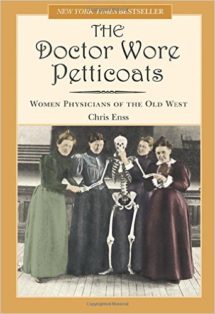
The Doctor Wore Petticoats: Women Physicians of the Old West
Nellie Mattie MacKnight
The Beloved California Physician
“Taken as a whole they will probably never amount to much unless the experience of the past belies that of the future. While this is so, yet no person of extended views or liberal ideas can desire to see the doors of science closed against them.”
Doctor R. Beverly Cole, prominent male physician in a speech delivered to members of the California Medical Society -1875Eighteen year-old Nellie Mattie MacKnight stepped confidently into the spacious dissecting room at San Francisco’s Toland Hall Medical School. Thirty-five male students stationed around cadavers spread out on rough board tables, turned to watch the bold young women enter. The smell of decomposing corpses mixed with tobacco smoke wafting out of the pipes some of the students were puffing on assaulted Helen’s senses. Her knees weakened a bit as she strode over to her appointed area, carrying a stack of books and a soft, rawhide case filled with operating tools.
To her fellow students Nellie was a delicate female with no business studying medicine. Determined to prove them wrong she stood up straight, opened her copy of Gray’s Anatomy and removed the medical instruments from the case.
It was the spring of 1891. She nodded politely at the future doctors glowering at her. A tall, dapper, be speckled professor stood at the front of the classroom watching Nellie’s every move. The sour look on his face showed his distain for a woman’s invasion into this masculine territory. “Do you expect to graduate in medicine or are you just playing around,” he snarled? The blood rushed to Nellie’s face and she clinched her fists at her side. She had expected this kind of hostile reception when she dared to enroll, but was taken aback just the same. “I hope to graduate,” she replied firmly. Disgusted and seeing that Nellie could not be intimidated, the professor turned around and began writing on a massive chalk board behind him. The students quickly switched their attention from Nellie to their studies. Nellie grinned and whispered to herself, “I will graduate…and that’s a promise.”
Nellie got her resolute spirit from her mother. Olive Peck MacKnight raised her daughter virtually alone, enduring many trials while providing for her only child.
Nellie was born to Olive and Smith MacKnight on December 15, 1873 in Petrolia, Pennsylvania. She was one of three children for the MacKnights. Their son and first daughter died shortly after they were born.
Olive was very protective of her surviving child and Smith, a land surveyor by trade, constantly showered his “only little girl” with attention. According to her autobiography Nellie’s early years were happy ones. She was surrounded by the love and affection of her parents and numerous extended family members.
In 1878, Smith MacKnight contracted a contagious case of gold fever that drove him to leave his wife and child and head West. Before he left he sent Olive and Nellie to live with his mother and father in New York. He promised to send for the pair once he had found gold. Olive was distraught about having to move from their home and the prospect of being without her husband. It was a heartbreaking experience from which Olive never fully recovered.
By the time Smith’s first letter from California arrived, five year-old Nellie and her mother had settled into life on the MacKnight farm. The absence of Smith made Olive quiet, withdrawn and despondent. Outside of her daughter she seemed content to be left alone. Nellie on the other hand was outgoing and cheerful. She was particularly close to her grandmother whose character was much like her own. Grandmother MacKnight taught Nellie how to cook and quilt and how to prepare homemade remedies for certain illnesses.
Her grandfather and uncle taught her how to ride a horse and care for animals.
As Olive slipped further into depression, Nellie became more attached to her grandparents. A letter from Smith announcing that he had purchased a mine with “great potential” momentarily lifted Olive’s spirits and gave her hope that they might be together soon. Several days later news that Olive and Nellie would have to wait for the mine to pay off before Smith sent for them left devastated all over. The dispirited woman nightly cried herself to sleep.
The stability Nellie had come to know at her grandparent’s home ended abruptly one evening in October of 1880. Her grandmother contracted typhoid fever and died after a month of suffering with the illness. Helen watched pallbearers carry her grandmother’s wooden coffin into the cemetery. She wept bitterly wishing there had been something she could have done to save her. The subsequent death of her favorite Uncle, suffering from the same ailment, served as a catalyst for her interest in healing.
Fearing for the physical well being of her daughter, Olive moved Nellie to her father’s home in Madrid, Pennsylvania. Any hopes the two had that their circumstances would improve at their new location were dashed when Olive became sick and collapsed. The high temperature from the typhoid fever mad Olive delirious. She didn’t recognize her surroundings, her family or her child and cried out constantly for her husband.
Olive recovered after several weeks, but the fever and the sadness of being separated from Smith, had taken its toll. Her dark hair had turned gray and the dark hollows under her eyes were a permanent fixture.
Smith’s mine in Bodie, California had still not yielded any gold and he was unable to send any money home to support his family. In order to keep herself and Nellie fed and clothed, Olive took a job at the Warner Brothers’ Corset Factory. Nellie attended school and excelled in all her subjects, showing an early aptitude in medicine. She poured over books on health and the human body.
When Nellie wasn’t studying she spent time trying to lift her mother’s melancholy spirit. Letters from Smith made Olive all the more anxious to see her husband again and even more broken hearted about having to wait for that day to come.
She began using laudanum, a tincture of opium used as a drug, to ease the pains she had in her hands and neck. The pains in her joints was a lingering effect of the typhoid fever. Olive developed a dependence on the drug and one night overdosed. She left behind a note for her daughter that read, “Be a brave girl. Do not cry for Mamma.” Smith was informed of his wife’s death, and although he was sad about the loss, he opted to continued working his claim.
The day after Olive was laid to rest, ten year old Nellie was sent back to New York to live with her father’s brother and his wife. Nellie’s uncle was kind and agreeable, but her aunt was not. She was resentful of Nellie being in the home and treated her badly. Nellie endured her aunt’s verbal and physical abuse for two years until her mother’s sister invited Nellie to live with her at her farm four miles away.
Nellie adapted nicely to the congenial atmosphere and learned a great deal from her aunt about primitive medicine. After a short time with her aunt, Nellie finally received word from her father. Smith was now living in Inyo County, California and working as an assayer and surveyor. Nine years of searching for gold had turned up nothing. Smith decided to return to his original line of work and he wanted his daughter by his side.
Fourteen year-old Nellie met her father on the train in Winnemucca, Nevada. Smith agreed to meet with her there and escort her the rest of the way to his home. Although his face was covered with a beard and his eyes looked older, Nellie knew her father when she saw him. Smith, however, did not instantly recognize his child. He wept tears of joy as she approached him. “You’re so grown up!” he told her. Little time was spent before the pair were made to take their seats to continue their journey. Father and daughter had a long way to travel before they reached Smith’s cabin in Inyo County. As the train sped along the tracks, Nellie was in awe of the purple blossoming alfalfa that grew along the route and of the grandeur of the Sierra Mountains.
Nellie continued to be impressed with the sights and people she encountered during their two day trip to the homestead in Bishop. Smith promised his daughter a happy life among the beauty and splendor of the California foothills. Nellie recorded in her journal how exciting, gay, and carefree she found her new home to be.
“The streets of the town were like a country road, lined with tall poplars and spreading cottonwoods – quick growing trees marked boundary lines and gave shelter to man and beast. Their leaves were pieces of gold in the sunshine.”
Nellie MacKnight – 1887