Midwest Book Review of The Lady and the Mountain Man


Synopsis: Isabella Bird was a proper Victorian lady, a minster’s daughter, a writer who traveled the globe. She was expected to marry a man of means and position instead she was drawn to a gruff mountain man, a desperado named Jim Nugent.

The unlikely pair met in Estes Park, Colorado in 1873. Jim was enchanted by Isabella and she was infatuated with him. In a published version of Isabella’s letter to her sister, she said of Jim that “he was a man any woman might love but no sane woman would marry.” On a climb to the top of Longs Peak their friendship blossomed into more than expected.

This book reveals the true story of Bird’s relationship with Nugent as they traveled through the dramatic wilderness of the Rocky Mountains.

Critique: The Lady and the Mountain Man: Isabella Bird, Rocky Mountain Jim, and their Unlikely Friendship is the extensively researched, true-life account of how two people with tremendously different backgrounds and temperaments shared a mutual love of a wild land. Isabella Bird was a well-to-do woman, an author, and a traveler with dreams, expected to marry a man of means and position. Yet she became infatuated with the gruff desperado Jim Nugent (“Rocky Mountain Jim”) in Estes Park, Colorado in 1873. Their unlikely friendship bloomed over the course of a climb to the top of Longs Peak. Extensive notes, a bibliography, and an index round out his in-depth examination of a journey and a relationship that would transform both Isabella and Jim of them for the rest of their lives – although Isabella was ultimately destined to have a much longer life than Jim. A thoroughly captivating slice of history, The Lady and the Mountain Man is highly recommended especially for public library Western History collections.


Regard for Romance

Enter now to win a copy of

The Lady and the Mountain Man: 

Isabella Bird, Rocky Mountain Jim, and their Unlikely Friendship


“Thank you, Chris Enss, for this marvelous introduction to Isabella Bird, an English lady who refused to let unremitting pain keep her from exploring the American West. Isabella was a prolific writer whose reports on all she saw and experienced brought admirers from across the world to bask in the wonders of Colorado and the Rocky Mountains. Americans today will gain greater appreciation for our country, seeing it through this woman’s eyes even as she fell in love with a crusty, drink-riddled mountain man. Enss, a prolific and engaging writer in her own right, beautifully brings this woman to life.”

Two-time Western Writers of America Spur Award Winner, Carol Crigger


The Lady and the Mountain Man Book Cover

The Lure of the Fabled Rocky Mountains

Author Chris Enss details Isabella Bird and her journey to Estes Park and her “unlikely friendship” with Rocky Mountain Jim in this American West classic, The Lady and The Mountain Man.


The lure of the fabled Rocky Mountains was an irresistible force for Isabella Bird.

Like many British citizens in the late 19th century, Bird had read stories and heard tales about the majestic American range across the ocean. The air of Colorado’s high altitude offered healing properties for travelers, and its stunning peaks were magnificent sights apt for anyone’s bucket list.

For Bird, who set out from Britain on a steam ship in 1872, the prospect of a visit to the Rocky Mountains was hardly promising or simple. Bird, who had suffered serious health issues since childhood, embarked on the transcontinental journey with a wire cage around her neck, a Victorian medical solution to her weak spine and injured neck.

What’s more, Bird undertook the journey alone, a decision that defied the societal norms and expectations of the time.

“This is in the 1870s, and Bird is a single, Victorian woman in poor health traveling to America,” said author Chris Enss, whose latest book, “The Lady and the Mountain Man,” details Bird’s journey to Colorado in 1873.

Enss’s latest book detailing the history of the American West focuses on Bird’s journey to Estes Park and her “unlikely friendship” with “Rocky Mountain Jim” Nugent, a one-eyed outlaw who guides her to the top of Longs Peak. The book explores Bird’s legacy as an explorer, the colorful characters who resided in Estes Park in the late 19th century and the sometimes-fatal regional struggles for land, power, and influence.

At its heart, however, the book follows a theme that runs throughout Enss’s impressive oeuvre of dozens of books about the American West. The author has long focused on exploring the lives of the women who braved a new frontier in a time of unabashed sexism and structural misogyny. Isabella Bird, who’d gain a reputation as an unparalleled explorer, author, photographer, author, and anthropologist, is a fitting focus for Enss, who’s long worked to spotlight the stories of the women of the West who’ve been overlooked by history.

Throughout her life, Bird’s travels spanned the globe, from Japan to Australia to the Sandwich Islands (Hawaii) to India, Turkey, and Singapore. Her writings set the standard for international travel and cultural understanding in the 19th century; she was the first woman to be inducted into the Royal National Geographic Society.

For all of her impressive odysseys, Bird’s travels to Colorado served as a watershed in several ways, Enss said.

“The consistency throughout the book is the story of this strong woman who decided that she was going to do something regardless of what the rest of the world said she could or couldn’t do,” Enss said. “Not only were there stereotypes about what women could do in the American west, but she was also an aristocratic woman from Britain,” she added, noting that Bird defied expectations from multiple cultures.

Enss, who drew material from letters, newspaper articles and other primary sources, added that while Bird serves as the central figure of the book, “The Lady and the Mountain Man” offers readers multiple narrative tracks and simultaneous threads. As the book’s title indicates, the story explores the unique relationship between Bird and Jim Nugent, a grizzled outlaw out of a Western storybook who also boasted a penchant for poetry, literature, and history. As Bird herself noted, he was a “man any woman might love but no sane woman would marry.”

Bird, who called Nugent her “dear desperado,” forged a relationship with Nugent as they ascended Longs Peak together, a harrowing journey that would’ve been challenging for even the most experienced mountaineer.

“It was incredibly difficult. They did not have any of the fineries that people have now. She speaks a lot about the difficulty in crossing the lava bed, with all the jagged rocks. Her footing wasn’t so good,” Enss said, citing reports initially spelled out in Bird’s letters to her sister at home, accounts that ultimately figured into her book “A Lady’s Life in the Rocky Mountains.” “It was cold. There were lots of wild animals that seemed to be stalking them.”

As the pair braved those risks in the day, and bonded around the campfire at night, their relationship took on a different dimension, Enss notes. The journey offered an opportunity for both to reveal their character – they swapped verses of poetry, discussions about the Bible and meditations about Shakespeare. According to one of her letters, Nugent “told stories of his early youth, and of a great sorrow which had led him to embark on a lawless and desperate life.”

That combination of peril and intimacy left an indelible mark, Enss said.

“It results with the pair falling in love,” she said. “He drank in excess, he was crude. But at one point he had studied to be a priest. He was a poet, and he could quote Shakespeare. Going up to Longs Peak in the evenings, he regaled her with his verses.”

This unlikely bond builds against a backdrop of frontier conflicts and violence. Lord Dunraven, an aristocrat who owned land in the Estes Park area, was intent on claiming large swaths of the area for hunting preserves and other purposes, wanted to get rid of Nugent and drive him from his land. That conflict would ultimately claim Nugent’s life, after Bird left Colorado for further international journeys.

“The book really is in three parts. You have the part with Isabella and Jim; there’s the Lord Dunraven portion of the story and his combative relationship; but you also have Isabella Bird, who as she’s getting healthier, tours the Rocky Mountains by herself,” Enss said, adding that journey ultimately served as a transformative experience – after her time in Colorado, Bird no longer wore the wire cage to support her neck and back. “That was unheard of in 1873 for a woman to do.”

A through-line that undergirds all elements of the book is the setting. Enss has long explored different sites and locales in the American West, but this tome offered the author the opportunity to spotlight Colorado and the Estes Park region as its own character.

“Colorado is a character in and of itself. That’s really important in this book,” she said, adding that the setting and the main character combined to make this piece unforgettable in her 50-plus book bibliography. “Of all the people who I’ve written about (more than 50 books), I’ll miss her the most. She was just an inspired human being.”


Enter now to win a copy of The Lady and the Mountain Man


Traveling With Mountain Jim

Enter now to win a copy of

The Lady and the Mountain Man: 

Isabella Bird, Rocky Mountain Jim, and their Unlikely Friendship


The Greeley stage arrived by mid-morning and came to a stop at the stables not far from the inn.  A male passenger dressed in tailored clothing from his head to his boots stepped out of the vehicle.  He was wearing light colored, woolen breeches, a white shirt, silk bandana, a heavy, double-breasted, lined flannel coat, and a black woolen-lined driving cap with ear flaps.  Isabella recognized him as the Englishman William Haigh.  She’d had occasion to meet him once in Estes Park while he was visiting with Griff Evans.  Carrying a few of her belongings, she walked to the stage.  Jim followed alongside her, clutching her bags in each hand.

Ever the polite dandy, Haigh bowed briefly at the waist when he saw Isabella.  The two exchanged cordialities, and then she introduced him to Mountain Jim.  After expressing how honored he was to make his acquaintance, he told Jim his reputation had proceeded him and how much he would enjoy going on a hunting trip with him.  Jim was courteous and thanked the Englishman for his thoughtfulness.  Haigh extended his hand to shake Jim’s.  It was a scene Isabella recalled vividly.  “…[H]e put out a small hand cased in a perfectly fitting lemon colored kid glove,” she wrote in her memoirs.  “As the mountain man stood there in his grotesque rags and odds and ends of apparel, his gentlemanliness of deportment brought into relief the innate vulgarity of a rich parvenu.”

Once the stage driver secured Isabella’s bags on the vehicle, it was time to go.  Haigh helped Isabella into the coach while regaling her with news of England, his trip to the Rockies, and the influential people he’d come to know during his time in the American West.  The driver cracked the whip, and the team of horses lit out.  Isabella looked back to wave goodbye to the desperado she had come to know and dared to love.  Jim had mounted his ride and was trudging through the mud and snow in the opposite direction.  The dazzling sunlight broke through the thick tree line and danced on the renegade mountain man’s golden yellow hair.  Slowly, his image faded into the snowy terrain.


To learn more about Isabella Bird and her time with Rocky Mountain Jim Nugent read

The Lady and the Mountain Man


Praise for the Lady and the Mountain Man

Enter now to win a copy of

The Lady and the Mountain Man: 

Isabella Bird, Rocky Mountain Jim, and their Unlikely Friendship


“A touching, well-researched story of the love shared between a prolific author and Victorian lady in the Rocky Mountains and the renegade trapper who helped her realize her dream of climbing Longs Peak.”

New York Times Bestselling Author of Give My Heart to the Hawks, Win Blevins


“Thank you, Chris Enss, for this marvelous introduction to Isabella Bird, an English lady who refused to let unremitting pain keep her from exploring the American West. Isabella was a prolific writer whose reports on all she saw and experienced brought admirers from across the world to bask in the wonders of Colorado and the Rocky Mountains. Americans today will gain greater appreciation for our country, seeing it through this woman’s eyes even as she fell in love with a crusty, drink-riddled mountain man. Enss, a prolific and engaging writer in her own right, beautifully brings this woman to life.”

Two-time Western Writers of America Spur Award Winner, Carol Crigger


“A delightful account of the peregrinations of Isabella Bird, footloose nineteenth-century English travel and inspirational writer. She documented journeys in Britain and the Pacific, finally ending in Colorado, where she befriended legendary Rocky Mountain Jim Nugent. Her wanderlust later took her to Asia and north Africa. If you don’t know Isabella Bird’s story, you’re in for a treat. A good read by Chris Enss, a perennial winner.”

Spur Award Finalist and Will Rogers Medallion Winner, Harlan Hague


Denver Post Review of The Lady and the Mountain Man

Sandra Dallas’s Review of The Lady and the Mountain Man for the Denver Post.


The Lady and the Mountain Man Book Cover


“Isabella Bird is one of Colorado’s favorite historical figures. The fearless Englishwoman rode all over Colorado’s mountains in 1873, in bad weather and by herself. “The Lady and the Mountain Man” is a definitive treatment of Bird’s life.

Bird was an invalid, and doctors recommended sea voyages to improve her health. She was intrigued with the American West, and once healed, she came here by herself to explore the mountains. She settled in Estes Park where she met infamous mountain man Jim Nugent. Mauled by a grizzly, Mountain Jim was scarred and missing an eye, but Bird found him handsome. He had a reputation for violence, particularly when he was drunk, and Bird was warned against him.

The two fell in love, but a future together was not to be.

In this detailed account of the star-crossed lovers, the author — who is known for her books on Western women — plumbs both Colorado and British resources. In Enss’ hands, Bird is not a female oddity, but a woman of strength, courage and loyalty.”


Praise for The Widowed Ones

Enter now to win a copy of

The Widowed Ones:  Beyond the Battle of the Little Bighorn


America has a mythic story that is inhabited by giants, men like General George Armstrong Custer, Captain Thomas Ward Custer, and Lieutenant James Calhoun. They live large on the silver screen, in literature, and in the American imagination.  We can all see them on Last Stand Hill, out of ammunition, their sabers drawn, knowing the end is coming.  But there is another story—a story that has largely been ignored for over a century and a half.  It’s the powerful and heartrending tale of what happened to the wives they left behind after the Battle of the Little Big Horn. Hounded by the media and tormented by souvenir hunters, they were not allowed to move beyond the sorrow.

Once or twice in a lifetime comes a meticulously researched book that so radically changes your understanding of a historical event it is as though the scales fall from your eyes and you actually see what happened for the first time.  The Widowed OnesBeyond the Battle of the Little Bighorn is that book.

Listen to the women’s side of the story.  We promise you will never be the same.

Michael Gear and Kathleen O’Neal Gear  

New York Times bestselling authors of Dissolution and The Ice Orphan  


The Widows Are On the Way

Enter now to win a copy of

The Widowed Ones:  Beyond the Battle of the Little Bighorn


It was almost two in the morning. Elizabeth couldn’t sleep. It was the heat that kept her awake, the sweltering, intense heat that had overtaken Fort Lincoln earlier that day and now made even sleeping an uncomfortable prospect. Even if the conditions for slumber were more congenial, sleep would have eluded Elizabeth. The rumor that had swept through the army post around lunchtime disturbed her greatly and until this rumor was confirmed she doubted that she’d ever be able to get a moment’s rest.

Elizabeth walked her anxious frame over to the window and gazed out at the night sky. It had been more than two weeks since she had said goodbye to her husband. She left him and his troops a few miles outside of Fort Lincoln. His orders were to intercept the Sioux and Cheyenne Indians in the territory, force them back to the reservation, and bring about stability in the hills of Montana.

Just before riding out, she turned around for one last glance at General George Custer’s column departing in the opposite direction. It was a splendid picture. The flags and pennons were flying, the men were waving and even the horses seemed to be arching themselves to show how fine and fit they were. George rode to the top of the promontory and turned around, stood up in his stirrups and waved his hat. Then they all started forward again, and, in a few seconds, they had disappeared, horses, flags, men, and ammunition – all on their way to the Little Bighorn River. That was the last Elizabeth saw of her husband alive.

Over and over again she played out the events of the hot day that made her restless. Elizabeth and several other wives had been sitting inside her quarters singing hymns. They desperately hoped the lyrics would give comfort to their longing hearts. All at once they noticed a group of soldiers congregating and talking excitedly. One of the Indian scouts, Horn Toad, ran to them and announced, “Custer killed. Whole command killed.” The woman stared back at Horn Toad in stunned silence. Catherine Benteen asked the Indian how he knew that Custer was killed? He replied: “Speckled Cock, Indian Scout, just come. Rode pony many miles. Pony tired. Indian tired. Say Custer shoot himself at end. Say all dead.”


To learn more about the widows of the Last Stand read The Widowed Ones. 

Coming in June.

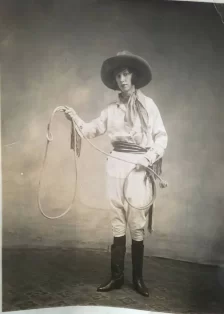
Silent Western Film Star Bessie Barriscale


Between 1914 and 1926, roper, rider, and actress Bessie Barriscale dazzled silent film fans in a series of fast paced Westerns. Movie audiences were fascinated with the versatile and beautiful star’s ability to outsmart and outshoot the outlaws in pictures such as The Bells of Austi and The Gambler’s Pal.

Named Elizabeth Mary Barriscale at birth in New York City, she came to San Francisco with her family as a child and made her stage debut at the age of eight at the Baldwin Theatre. For three years beginning in 1905, she toured the United States and England in the play Mrs. Wiggs of the Cabbage Patch, playing the role of Lovey Mary. During the tour, the attractive blonde actress married Howard C. Hickman, actor, director, and author.

Late in 1907, she starred in The Bird of Paradise at the Alcatraz Theatre where she remained a favorite in later plays. In 1912, she and her husband went to Los Angeles where she made her silent film debut as Juanita in Rose of the Rancho. The Western picture was based on a play by David Belasco and Richard Walton Tully and was directed by Cecil B. DeMille. Bessie’s character was the feisty love interest of a government agent sent to help California landowners battle with an unscrupulous banker threatening to take over the territory. The film cost $16,988 to make and grossed $87,028 in 1914.

One of Bessie’s most popular films was Two-Gun Betty. The immensely talented cowgirl actress was able to show her incredible range in the tongue-in-cheek comedy Western. The premise was an inspired and unique one in 1918. Hoping to win a bet, Betty Craig (Barriscale) disguises herself as a man and lands a job as a ranch hand on the spread owned by her best friend’s brother, Jack Kennedy. It doesn’t take long for Kennedy and the other cowboys to see through Betty’s masquerade, but they don’t let on that they know that “he” is a “she”, and Betty becomes convinced that she has pulled off her deception. Betty and Jack inevitably fall in love and plan to get married, but first Jack must rescue Betty from a gang of desperadoes who don’t want to play along with her little game. Two-Gun Betty was directed by her Howard Hickman, produced by Robert Brunton, and distributed by Pathe Exchange.

Bessie and her husband left Hollywood in 1919 and crisscrossed the country for eight years on the Keith-Orpheum vaudeville circuit. The pair performed comedy skits with Bessie adding in rope tricks when appropriate. Following the Hickmans’ retirement in 1927, the couple lived in Los Angeles before moving to Marin County in 1945. Howard died in 1949. Bessie died in 1965 at the age of eighty-one.