Miss Kitty Canutt


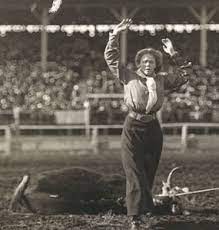
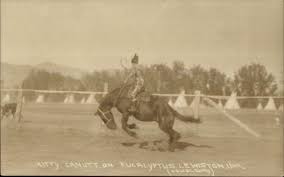
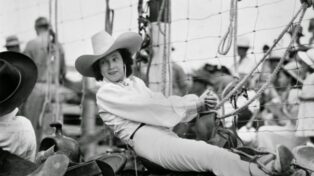
Bronc busting champion Kitty Wilkes won her first title at the Wild West Celebration Rodeo in Miles City, Montana, in 1916.  The seventeen-year-old, New York native’s straightforwardness and untamed physical daring gave fans the impression she was born and bred into the rugged life of a Wyoming ranch.  Few would have guessed she was new to the sport or that winning the top prize would inspire her to excel in other rodeos.  From that exciting moment in Miles City she was determined to show the world that one need not be “born in the saddle” to be a crack rider.

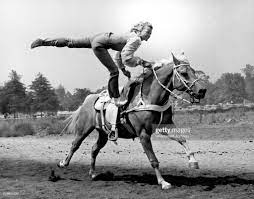
Katherine Derre, whose stage name was Kitty Wilkes, was born on July 15, 1899.  She had a natural talent for breaking horses and parlayed that skill into bronc riding in public showings.  Not only did she have a way with wild horses, but she was also an exceptional trick and fancy rider.  Owners of relay strings were eager to gain her services.

Between the rodeo in Montana in the summer of 1916 and the Pendleton Roundup in Pendleton, Oregon, in early fall of 1916, Kitty honed her bronc riding talent at ranches and rodeos throughout the West.  She insisted on using the orneriest animals for training.  Outlaw horses were blindfolded and saddled for her to ride.  One encounter resulted in the horse bucking Kitty off and bruising her ribs.  She wouldn’t allow the horse to beat her, however.  She swung back into the saddle, refusing to leave it until the animal finally broke.

Kitty’s nickname was Diamond Girl because she had a diamond set in her front tooth.  When needed, she would remove the diamond and pawn it for the entry fees to rodeo contests.

Her performance at the Pendleton Roundup in 1916 resulted in her being named the All-Around Champion Cowgirl.  Among the many people she met during the roundup was Yakima Canutt.  Canutt, who also competed at the rodeo, would go on to become one of Hollywood’s leading stuntmen.  Kitty and Yakima fell in love and were married in Kalispell, Montana, in 1917.

Kitty was a fierce athlete who hated to lose.  It was not uncommon for her to challenge women who outrode her, and she believed cheated, to a fistfight.  In September 1918, she was disqualified from participating in a rodeo in Washington because she hit a rider in the mouth with a piece of wood.

Not content with being the top female bronc rider in the country, she aspired to be the top female relay racer as well.  Rodeo fans loved to watch the petite woman fly past the grandstands on her horse, hurrying to meet the next mount waiting to be saddled and ridden to the next point.  More than once Kitty would be finishing part of the race standing on the stirrups trying to get into the saddle.  Her grit and resolve often paid off with a win.

The rodeo stars Kitty often competed against were Mabel Strickland, Bonnie McCarroll, and Prairie Rose Henderson.

Kitty Wilkes was eighty-eight years old when she died on June 3, 1988.


Lillian Russell Sings

Not long ago, the Library of Congress found a recording of a song by American actress and singer Lillian Russell.  I was asked by the LOC to write a piece on the song that became the talented entertainer’s signature tune.

Visit https://www.youtube.com/watch?v=22B8T-PEK28 to hear Lillian sing

Come Down Ma Evening Star.


“Come Down Ma Evenin’ Star”–Lillian Russell (1912)

Added to the National Registry: Essay by Chris Enss

When actors and Broadway producers Joe Weber and Lew Fields debuted their burlesque show “Twirly Whirly” in the fall of 1902, New York critics unanimously panned the production. An article in the September 12, 1902, edition of the “St. Louis Post” noted that “in the opinion of the theatrical reviewers at large, the piece itself showed how little real wit it takes to amuse the public.” The only bright spot in the program was a ragtime song sung by the celebrated actress and singer Lillian Russell. According to the December 19, 1902, edition of the “Kansas City Daily Gazette,” “L. Russell’s stunning beauty and glorious delivery of a brilliant piece entitled ‘Come Down Ma Evenin’ Star’ was the one and only highlight in ‘Twirly Whirly.’”

Written by composer and conductor John Stromberg, the sentimental ballad would become stage queen Lillian Russell’s signature tune. Stromberg was a well-respected songwriter who had created several popular works for Weber and Fields’ productions. Born in Canada in 1853, Stromberg often collaborated on his songs with lyricist Edgar Smith. Although Stromberg penned “Come Down Ma Evenin’ Star” specifically for Lillian, he resisted handing the song over to her because he didn’t believe it was good enough.

He had promised to write Lillian the “prettiest song she ever sang” and was consumed with doubt over the finished product. In early July 1902, John Stromberg was found dead at his home in Freeport, New York. The official cause of death was ruled as paralysis of the heart, following a long attack of rheumatism. Friends and colleagues knew the exceptional agony Stromberg suffered as a result of his rheumatism and were saddened to learn the real reason he had died was because he’d taken a fatal dose of insecticide to stop the pain once and for all. When Stromberg’s body was discovered, the sheet music for “Come Down Ma Evenin’ Star” was found in the pocket of the suit he was wearing.

Lillian Russell was the theater’s leading musical comedy prima donna in the 1890s. She had played in many of the Gilbert and Sullivan operettas and had received tremendous acclaim both abroad and in America. Her beauty and voice had drawn innumerable admirers who showered her with jewels. Although she thought Stromberg was an exceptional talent, she worried her fans would not be pleased with her singing a ballad.

The song “Come Down Ma Evenin’ Star” would be a significant change in her style. When the curtain rose on “Twirly Whirly” and Lillian took her place center stage, the audience erupted with applause before she even uttered a note. When the excitement died down, she sang “Come Down Ma Evenin’ Star” with the feeling of an opera aria, displaying deep and personal emotion to the public before her. At the conclusion of the song, the audience cheered and clapped approvingly. Lillian’s anxieties were at last relieved. A review of her performance in the mid-September edition of the “Daily Mirror” reported that “Miss Russell made a decided hit with ‘Come Down Ma Evenin’ Star.’”

Lillian would sing Stromberg’s final song often in her future years. She noted in her memoirs that each time she sang the song she would see John in his last, painful hours finishing the manuscript just for her. “I always thought of Honey Stromberg whenever I sang that song,” she wrote. “And, strange to say, no one ever sang it in public but me.” In a final tribute to Stromberg, Weber and Fields, led by Lillian, staged a benefit for Stromberg’s widow. It netted more than $6,000. In 1912, Lillian recorded her rendition of “Come Down Ma Evenin’ Star.” It was the only recording she ever made.


Cowgirl Actress Victoria Forde


When news that cowgirl and silent film actress, Victoria Forde, had left her husband Western star, Tom Mix, in August 1928, fans were crushed.  The husband-and-wife team had entertained audiences in several films together between 1914 and 1922. Both were skilled riders who performed their own stunts in the cowboy and outlaw movies made for the Selig Polyscope Company. They were well-loved by movie-goers across the country and their marriage was as admired as their talent. Everyone imagined their homelife mirrored their idyllic onscreen relationship.

Victoria Forde was born on April 21, 1896, in Manhattan, New York. Her mother was a popular Broadway actress who nurtured her daughter’s love for horseback riding and entertaining.  She helped get Victoria work in films when she was fourteen. The teenager made several pictures with Biograph Company, one of the first major American motion-picture studios in the early days of filmmaking. In 1912, Victoria signed a contract with Nestor Studios and in a five-year period made more than a hundred short films with the company. When her time with Nestor Studios ended, she joined Selig Studios. She was thrilled to be signed to appear in Western films because she could ride her horse while appearing opposite Tom Mix.

Victoria and Tom were married in 1918 and made more than thirty short Western together. In 1922, the couple welcomed their daughter Thomasina to the world. Shortly after her birth, Victoria retired from acting to stay home with the child. By August 1928, the Mix’s marriage was all but over. Tom made the announcement during an interview with a reporter for the North American Newspaper Alliance. According to the cowboy star, Victoria had moved to Paris with their daughter and was seeking a divorce.

“It seems Victoria Forde wasn’t such a great actress when she and Tom Mix married,” an article about the pair in the Los Angeles Times read. “Nor was Tom the ace of Westerns then, as he is now, with several millions to his credit. He was making a fair living when he met Victoria and she was an ambitious girl who had lofty ideas for her future. One of those was to be able to have her face operated on by a good plastic surgeon. A horseback accident had marred her features. And one of the first things her husband had done for her was a facial operation in which the marks of the horse’s hoof were eradicated.”

The article indicated that Tom’s drinking was one of the reasons for the marriage ending. He had a problem with alcohol that Victoria couldn’t handle. The couple divorced in 1931.

Victoria never returned to the screen. She died on July 24, 1964, at the age of sixty-eight.


War Widow’s Guide to Survival


There weren’t many women in the late 1800s who had the opportunity to accompany their husbands on adventures that were so exciting they seemed fictitious. Such was the case for the women married to the officers in General George Armstrong Custer’s Seventh Cavalry. There were seven officers’ wives. They were all good friends who traveled from post to post with one another along with their spouses. Of the seven widows, Elizabeth Custer was the most well-known. As the wife of the commanding officer, Libbie felt it was her duty to be present when the officer’s wives at Fort Lincoln were told their husbands had been killed at the Battle of the Little Bighorn.

The women were overwhelmed with letters of condolence. Most people were sincere in their expressions of sorrow over the widows’ loss. Others were ghoulish souvenir hunters requesting articles of their husbands’ clothing and personal weapons as keepsakes. The press was preoccupied with how the wives of the deceased officers were handling their grief. During the first year after the tragic event, reporters sought them out to learn how they were coping, what plans they had for the future, and what, if anything, they knew about the battle itself. The widows were able to soldier through the scrutiny because they had one another. They confided in each other, cried without apologizing, and discussed their desperate financial situations.

The friendship the bereaved widows had with one another proved to be a critical source of support. The transition from being officers’ wives living at various forts on the wild frontier to being single women with homes of their own was a difficult adjustment. Without one another to depend upon, the time might have been more of a struggle. The Widowed Ones: Beyond the Battle of the Little Bighorn tells the stories of these women and the unique bond they shared through never-before-seen materials from the Elizabeth Custer Library and Museum at Garryowen, Montana, including letters to and from politicians and military leaders to the widows, fellow soldiers and critics of George Custer to the widows, and letters between the widows themselves about when the women first met, the men they married, and their attempts to persevere after the tragedy.

Preorder The Widowed Ones:  Beyond the Battle of the Little Bighorn now. Email proof of purchase to gvcenss@aol.com to be entered into the Kindle Giveaway on June 1, 2022.

Reel Cowgirl Ruth Roland


Reel cowgirl Ruth Roland portrayed Pearl Marvin in a dozen silent films in The Perils of Pauline series between 1915 and 1917. Fans were on the edge of their seats watching the spunky actress ride her way in and out of trouble while solving crimes.  They waited in suspended animation for the film operator to change reels so they could learn the fate of the lead character. In the stuffy darkness of the theater the piano player tried, unsuccessfully, to quiet the audience’s nerves with a tasteful rendition of “Hearts and Flowers” to a gum-chewing accompaniment. Yet the suspense was a terrific ordeal, and the projector flickered out just as Ruth, all lost save honor, lay roped to a filthy pallet, with a leering bad guy rubbing his hands in the doorway. All wondered if the heroine would make it out alive!  Audiences loved Ruth.

Ruth Roland, who took Pearl White’s place in the hearts of the hair-breadth escape fans when Pearl deserted Hollywood for Europe just before World War I, remained for a heart-throbbing period the star of the serial “flickers.”  Whether in chaps or elegant gown, Ruth was always just slipping by the flick of an eyelid from the most appalling situation in her pictures; and with an astute comprehension of interest “build-up” her director always left her, at the conclusion of each performance, tied to a railroad track with the express thundering around the bed, or shackled in a sinister basement while the water crept upward from knees to waist, or leaping on horseback from the edge of a cliff to escape “a fate worse then death.”

Born in San Francisco on August 26, 1892, the daughter of John R. Roland, a newspaperman who had worked on the New York Sun and San Francisco Chronicle, Ruth began her stage career at the age of three, when she went on tour with Edward Holden’s “Cinderella” company.  Ruth’s screen career began in 1910. “I reached Los Angeles on April Fool’s Day,” she once related, “and stepped out at once and got a job. I fixed up a stage sketch with my horse and we were booked to perform in Los Angeles and dozens of nearby towns.”  Shortly thereafter, she was signed with the Kalem Film Company earning $115 a week. Her first picture was The Last Shot, one of the earliest westerns made. In ten years, she made a hefty sum making movies and she invested her earnings in real estate.

In the late 20’s Ruth retired from the screen to devote her entire time to her extensive real estate holdings, consisting principally of business lots in the Wilshire-Fairfax district in Los Angeles. At one time she reputedly had property worth three and a half million dollars.

Ruth did her own stunts in all her pictures until she was thrown from a horse. The accident caused injury to her spine which gave her much pain in later years. She was diagnosed with cancer in early 1937. The illness took her life on September 22 of the same year.

Ruth Roland was thirty-nine years old when she died.


Last Chance

Last chance to enter to win a copy of

Happy Trails: 

A Pictorial Celebration of the Life and Times of Roy Rogers and Dale Evans


The first three people to enter to win today will win a copy of the book!


Cowgirl Dale Evans

Enter now to win

Happy Trails:

A Pictorial Celebration of the

Life and Times of Roy Rogers and Dale Evans


A few quotes by Dale Evans


Time and experience have taught me a priceless lesson: Any child you take for your own becomes your own if you give of yourself to that child. I have born two children and had seven others by adoption, and they are all my children, equally beloved and precious.


Christmas, my child, is love in action.  Every time we love, every time we give, it’s Christmas.


Cowgirl is a spirit, a special brand of courage. The cowgirl faces life head on, lives by her own lights, and makes no excuses. Cowgirls take stands. They speak up. They defend the things they hold dear. A cowgirl might be a rancher, or a barrel racer, or a bull rider, or an actress. But she’s just as likely to be a checker at the local Winn Dixie, a full-time mother, a banker, an attorney, or an astronaut.


Every day we live is a priceless gift of God, loaded with possibilities to learn something new, to gain fresh insights.


If we never had any storms, we couldn’t appreciate the sunshine.


To learn more about Dale Evans read

Happy Trails


Under Western Stars

Enter now to win a copy of

Happy Trails: 

A Pictorial Celebration of the Life and Times of Roy Roger and Dale Evans


Under Western Stars

An Essay for the National Film Registry

By

Howard Kazanjian and Chris Enss


King of the Cowboys Roy Rogers made his starring motion picture debut in Republic Studio’s engaging western musical Under Western Stars.  Released in 1938, the charming, affable Rogers portrayed the most colorful Congressman ever to walk up the steps of the nation’s capital.  Rogers’ character, a fearless, two-gun cowboy and ranger from the western town of Sageville, is elected to office to try to win legislation favorable to dust bowl residents.

Rogers represents a group of ranchers whose land has dried up when a water company controlling the only dam decides to keep the coveted liquid from the hard working cattlemen.  Spurred on by his secretary and publicity manager, Frog Millhouse, played by Smiley Burnette, Rogers campaigns for office.  The portly Burnette provides much of the film’s comic relief and goes to extremes to get his friend elected.  His tactics include pasting stickers on the backs of unsuspecting citizens he engages in conversation and helping to organize a square dance to highlight Rogers’ skill and dedication to solving the constituent’s crisis.  Using his knowledge of land and livestock and his talent for singing and yodeling, Rogers wins a seat in Congress.

The sweep of this picture, which moves rapidly from physical action on the western plains to diplomatic action in Washington and back again, is distinctively thrilling.  The surging climax in the dust-stricken cattle country makes for one of the most refreshing films of its kind.  The politicians Rogers appeals to about the drought are not convinced the situation is as serious as they are led to believe and decide to inspect the scene for themselves.  The investigation committee is eventually trapped in a real dust storm.  The shots of the storm and the devastation left in its wake are spectacular.

Roy Rogers came to Hollywood from Duck Run, Ohio.  He made a name for himself as a member of the successful singing group the Sons of the Pioneers.  Reigning box office cowboy Gene Autry’s difficulties with Herbert Yates, head of Republic Studios, paved the way for Rogers to ride into the leading role in Under Western Stars.  Yates felt he alone was responsible for creating Autry’s success in films and wanted a portion of the revenue he made from the image he helped create.  Yates demanded a percentage of any commercial, product endorsement, merchandising, and personal appearance Autry made.  Autry did not believe Yates was entitled to the money he earned outside of the movies made for Republic Studios.  He refused to include Yates in the profits and threatened to leave the studio if Yates did not reconsider.  Autry was also demanding a raise in pay.

Yates decided it was time to begin grooming another talent to take Autry’s place should the need arise.  Rogers was a contract player with the studio making $75 a week.  Billed as Leonard Slye he appeared in a handful of films with Gene Autry singing along with the Sons of the Pioneers.  Rogers even had a part as a bad guy in one of Autry’s films.  When Autry caught up with Rogers in the picture, instead of taking him to jail he demanded the wily character yodel his way out of his troubles.

Yates had been looking for a musical actor to go boot-to-boot with Autry and Rogers was to be the heir apparent.  His sweet, pure voice and wholesome image made him a natural for the hero in Under the Western Stars.  Whether regaling the audience with a song about fighting the law entitled Send Our Mail to the County Jail or delivering a stump speech via a tune called Listen to Rhythm of the Range, Rogers makes the most of his leading role.

The Maple City Four, the well-known quartet who made the number Git Along Little Dogies popular, added their talents with Rogers harmonizing on the film’s most important song entitled Dust.  Written by Johnny Marvin, a recording artist from Oklahoma, Dust was nominated for an Academy Award for Best Original Song.  It was the first song from a B-western to be Oscar nominated.

According to the February 24, 1938, edition of the Hollywood Reporter, Dust was purchased by Republic Studios from the composers, Gene Autry and Johnny Marvin, for use in Under Western Stars.  A subsequent news item in Hollywood Reporter on April 13, 1938, just prior to the film’s release, noted that Autry was suing the studio for $25,000 for unauthorized use and dramatization of the lyrics with Dust.  According to contemporary sources, the suit over Dust was settled out of court and Johnny Marvin is listed as sole writer of the song.

Audiences made Under Western Stars a box office success and critics called its star “the new Playboy of the Western World.”

Director Joseph Kane, Republic’s top director of westerns delivered a film with a slight new slanting to make it different from all other B-westerns before it.   In addition to the political intrigue in Under Western Stars there is a fair amount of gunfights, fast horses, and unforgettable stunts.  What makes Kane’s film unique is that the fight is not over horse thieves, but the rights of man.  Critics at the Brooklyn Daily Eagle newspaper sited Kane’s “sensitive directing eye with giving the horse opera a social consciousness.”

Actors Carol Hughes, Guy Usher, Tex Cooper, Kenneth Harlan, Curley Dresden, Bill Wolfe, Jack Ingram, Jack Kirk, Fred Burns, and Tom Chatterton round out the exciting cast of players and no happy ending would be possible at all if not for Roy’s magnificent Palomino horse Trigger.  Brothers and veteran western writers Dorrell and Stuart McGowan penned the screenplay for Under Western Stars along with actress and screenwriter Betty Burbridge.

The film was shot in the Alabama Hills of Lone Pine, California.  The scenic location has been used for the backdrop in hundreds of motion pictures and television programs.  The high desert surroundings are integral to the story line of Under Western Stars and could be billed as a supporting role in the film.

Roy Rogers’ first starring vehicle solidified his place as a rising star in B westerns.  Film writer and critic Louella Parsons likened Rogers to “Gary Cooper in personal appeal.”  According to her report with the International News Service on November 29, 1938, she called Rogers an “upstanding young American who made the picture Under Western Stars a delight.”


Happy Trails Cover


To learn more about Roy Rogers and Dale Evans and Under Western Stars read Happy Trails.


Memories of Teachers Pack a Punch


This spring I met with a handful of California State Board of Education members to discuss Packing the West and learn the criteria to be followed when writing the Gold Rush curriculum for the program.  Some of the meetings were held in elementary school classrooms after students had left for the day.  Being in that setting brought back a flood of memories, primarily of one of the teachers who helped spark my desire to write.

Dr. Augustus Bock was my high school English teacher.  He loved the flirtatious tango of consonants and vowels, the steady dependability of nouns and the capricious whimsy of verbs, the strutting pageantry of the adjective and the flitting evanescence of the adverb, all kept safe and orderly by those reliable little policemen, punctuation marks.  He wanted to write the great American novel and when that didn’t happen, he turned to teaching.  Most of the time his passion for the vocation was infectious, but there were weeks when it was clear he believed he’d settled.  It was then that the tweed jacket with suede patches at the elbows he always wore appeared as if he’d slept in it, and he started to smell like cherry pipe tobacco and defeat.  I guess he didn’t understand how much his students valued him even if he never penned his version of East of Eden.

The same couldn’t be said for my British literature teacher, Evelyn DeLagrange, an Amazonian-looking woman with long red hair and an unnatural obsession with Geoffrey Chaucer.   Our troubles began after she read a book report I’d written about The Canterbury Tales in which I noted that “Chaucer was an expert at making nothing happen slowly.”  In a meeting Ms. DeLagrange had with my parents at the end of the semester, she suggested they take the college money they’d been saving for me and buy themselves a fishing boat because the only college she thought I’d be able to attend would have the word “beauty” or “clown” in front of it.

But I showed her.  After two years studying journalism at Cochise College, in Sierra Vista, Arizona, I went on to attend the University of Arizona, where I majored in drama.  When you tell someone you majored in drama, the first thing they do is mentally subtract twenty grand off what they think you make for a living.  The second thing they do is ask you to bring them a menu and tell them about the soup for the day.

Some teachers make a person want to become a writer, scientist, historian, etc., because they love the subjects they teach, and that ignites a desire in their students.  Other teachers drive students to their life’s pursuit just to prove that they were meant to do more than wear a multicolored wig, a rubber nose, and a massive bow tie.  And that brings me back to Packing the West.  With the Packing the West program, we hope to not only stir in students a love for the American West but to encourage them to strive for more, in the same way that the men and women on the frontier did.  We’re just getting started, but the historical figures we’ve included in the first set of learning materials for youngsters are impressive.  With Nat Love, Louisa Clappe, William Bent, Mary Graves, Buffalo Bill Cody, and Jim Bridger as teachers, anything is possible.  And that should be the mantra for every teacher.

*Note to Buena High School Friends – Evelyn DeLagrange is not the real name of the teacher in the story. The name has been changed to protect Chaucer.